For forty days and forty nights, Mount Sinai groaned beneath the supernatural weight of the uncreated glory of Yahweh. Billows of dense smoke, crackling sapphire lightning, and the resonant vibration of divine speech enveloped the towering granite crags where Moses lingered in holy communion. Above, God was delivering the sacred architecture of the Tabernacle—the divine blueprint by which the Creator of heaven and earth would take up residence in the midst of redeemed humanity. Below, across the sprawling desert floor of the Wilderness of Sinai, nearly two million freed Hebrew slaves were succumbing to an insidious, creeping spiritual rot: the lethal poison of impatience.
To a people whose collective memory had been forged under four centuries of Egyptian chattel slavery, invisible realities felt vaporous and uncertain. They were accustomed to tangible deities—towering stone colossi of Amun-Ra, gilded images of Osiris, and the sacred Apis bull paraded through the sun-drenched streets of Memphis. For nearly six weeks, their solitary human mediator, Moses, had been swallowed by the dark tempest on the mountain. To their anxious, faithless minds, he had perished in the devouring fire. Gathering in a menacing, unruly mob around Aaron, they delivered a treasonous ultimatum: "Come, make us gods who shall go before us; as for this Moses, the man who brought us up out of the land of Egypt, we do not know what has become of him" (Exodus 32:1).
Aaron's Cowardice and the Casting of the Bovine Idol
Faced with the terrifying roar of the restless multitude, Aaron experienced a total collapse of spiritual backbone. Instead of rebuking their mutinous demands with the thunderous commandments heard only weeks prior, Aaron opted for political appeasement. Calculating perhaps that greed might stay their idolatry, he commanded them to tear out the golden earrings from their wives, sons, and daughters—ornaments plundered from the Egyptians on the night of the Exodus. Yet the demonic thirst for a visible idol obliterated human miserliness; the people stripped their ears without hesitation and laid the glittering piles of gold at Aaron's feet.
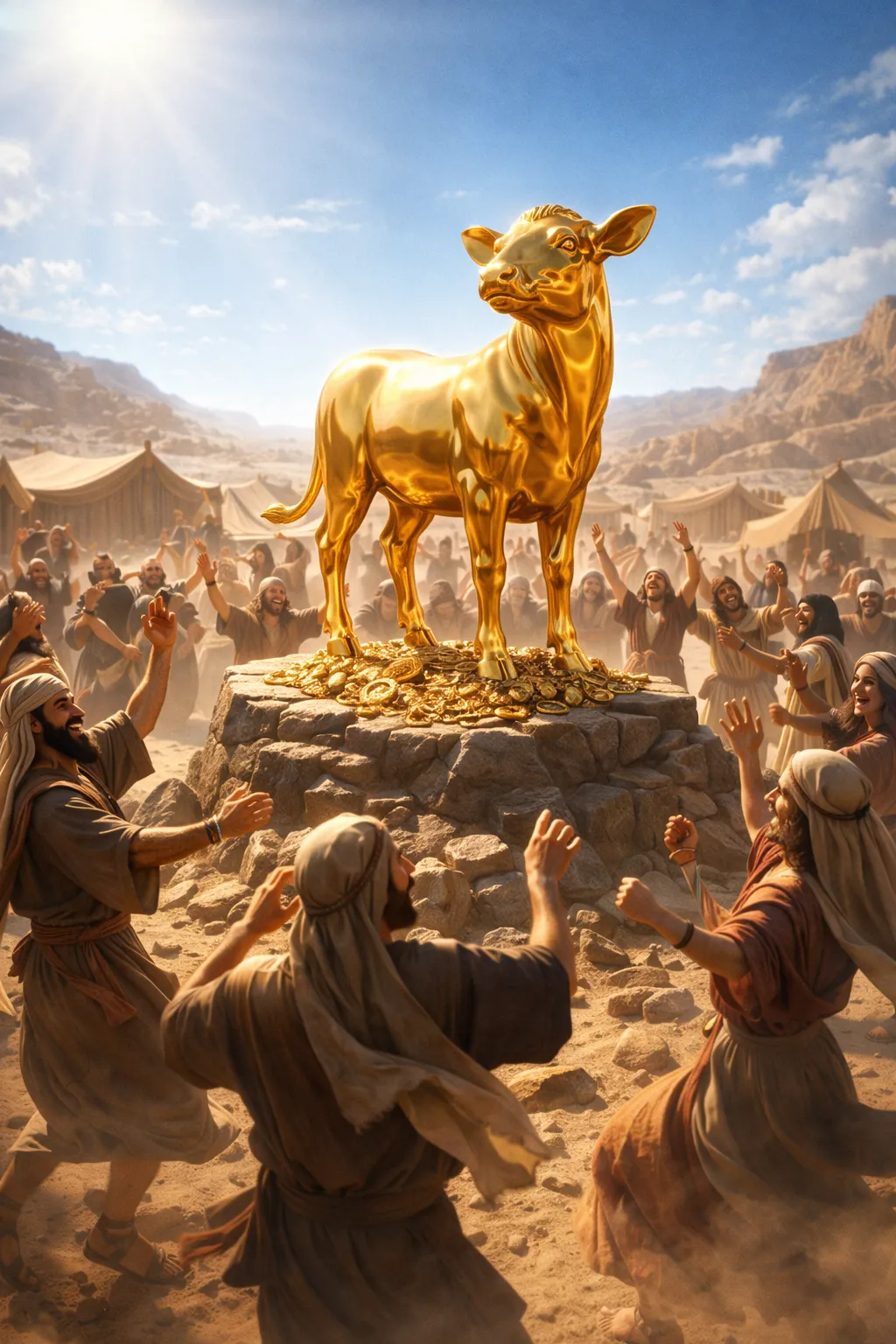
Taking an iron graving tool (cheret), Aaron cast the melted bullion into an engraved mold, producing a gleaming molten calf (Egel Masekah). When the golden beast emerged from the embers, a triumphant shout echoed across the encampment: "This is your god, O Israel, that brought you up out of the land of Egypt!" In a pathetic attempt to appease both the mob and his wounded conscience, Aaron built an altar before the gleaming animal and proclaimed: "Tomorrow shall be a feast to Yahweh!" It was the ultimate blasphemous synthesis—dressing carnal, pagan idolatry in the venerable vocabulary of the covenant Lord.
At dawn, the camp erupted into an unrestrained pagan festival. Burnt offerings and peace offerings were sacrificed upon the illicit altar. The people sat down to eat and drink gorged upon sacrificial meat, and then rose up to play (tsachaq). What ensued was not innocent dancing, but an uninhibited, sexually charged pagan orgy—the identical carnal madness that characterized the fertility rites of the Egyptian cow-goddess Hathor. Stripped of their garments and dancing wildly around their molten creation, the holy nation became a laughingstock before their watching desert enemies.
The Heavenly Courtroom and Moses' Desperate Intercession
High upon the mountain, the omniscient eye of God gazed upon the sickening spectacle. Suddenly, the divine voice shattered the sacred stillness with alarming words of total dissociation: "Go, get down! For YOUR people whom YOU brought out of the land of Egypt have corrupted themselves. They have turned aside quickly out of the way which I commanded them. They have made themselves a molded calf, and worshiped it and sacrificed to it... Now therefore, let Me alone, that My wrath may burn hot against them and I may consume them. And I will make of YOU a great nation" (Exodus 32:7-10).
This was the ultimate test of Moses' calling. Yahweh was offering him the dream of every tribal patriarch: to wipe the slate clean of a treacherous rabble and birth a new chosen people entirely from Moses' own loins. A lesser man, nursing resentment against a complaining, rebellious flock, would have gladly consented. But Moses demonstrated the authentic heartbeat of a shepherd. Falling upon his face, he implored the presence of Yahweh his God (chalah).
Moses' intercession remains one of the most sublime legal appeals in human history. First, he anchored his argument in God's sovereign ownership and power: "Lord, why does Your wrath burn hot against YOUR people whom YOU have brought out of the land of Egypt with great power and with a mighty hand?" Second, he appealed to the divine reputation among the heathen nations: "Why should the Egyptians speak, and say, 'He brought them out to harm them, to kill them in the mountains, and to consume them from the face of the earth'?" Third, he laid hold of the unbreakable, unilateral covenant sworn to the fathers: "Remember Abraham, Isaac, and Israel, Your servants, to whom You swore by Your own self, and said to them, 'I will multiply your descendants as the stars of heaven'!" Moses dared not appeal to Israel's merit, for they had none; he clung entirely to the immutable character and sworn promises of God. And Yahweh relented of the total destruction He had spoken.
The Shattered Tablets and the Levite Sword
Turning back down the mountain slopes, Moses carried in his hands the two tablets of the Testimony—slabs of sapphire-like granite inscribed front and back by the very finger of God (Etzba Elohim). As he and Joshua descended the rocky defiles, Joshua's warrior ear caught the distant cacophony: "There is a noise of war in the camp!" But Moses discerned the deeper horror: "It is not the noise of the shout of victory, nor the noise of the cry of defeat, but the sound of singing I hear."
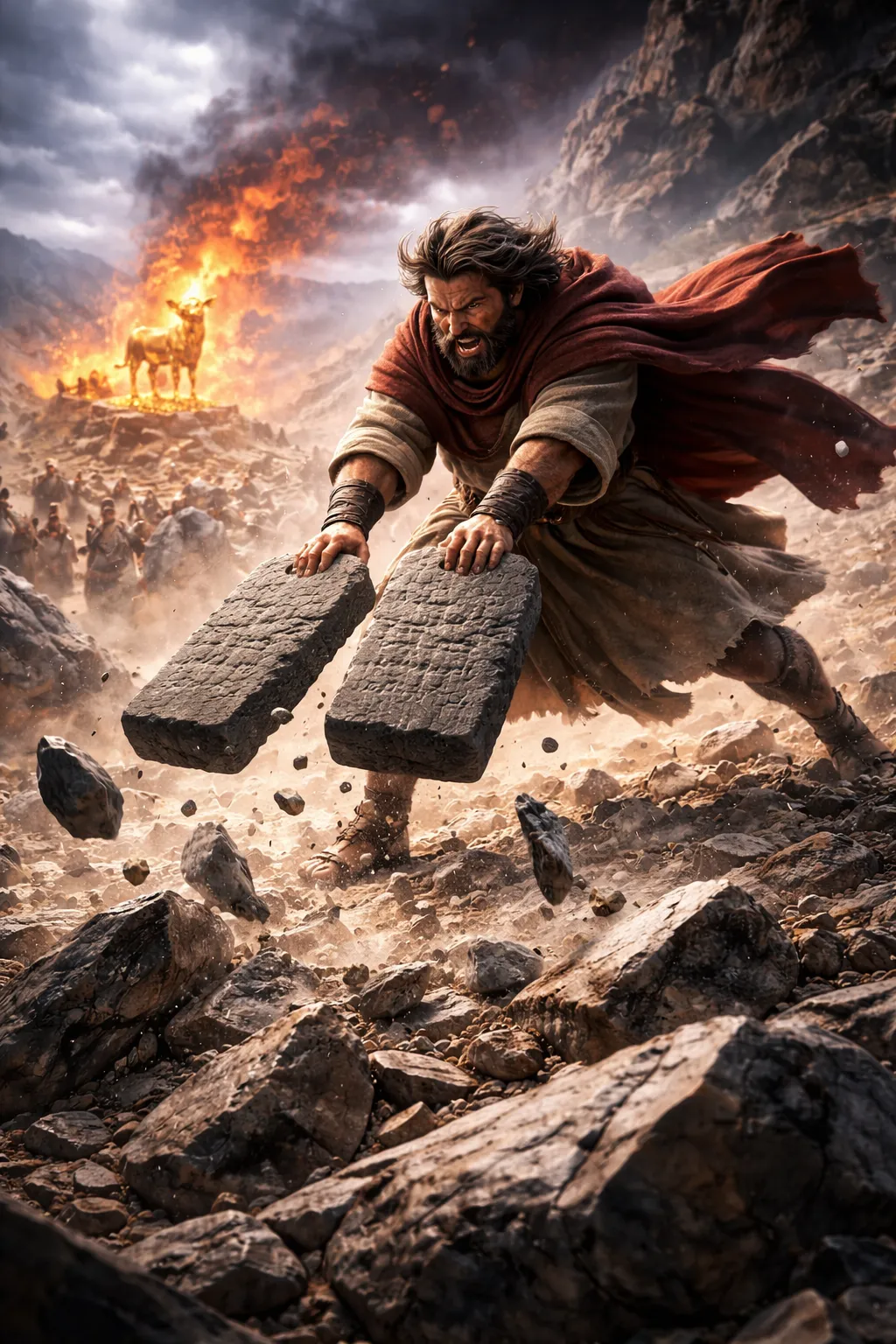
When Moses rounded the foot of the mountain and witnessed the gleaming gold bovine idol and the shameful, naked revelry of the multitude, holy indignation ignited in his soul. In a dramatic legal act of covenant annulment, he raised the divine tablets above his head and hurled them down upon the rocks at the foot of the mountain, shattering them into thousands of fragments (shabar). The visual sermon was terrifyingly clear: the covenant had been smashed by their treason before the ink had even dried.
Striding into the midst of the terrified dancers, Moses seized the golden calf, threw it into the roaring furnace, ground the charred metal into microscopic dust, scattered the glittering residue across the rushing brook of Sinai, and forced the trembling Israelites to drink their own domesticated god. Confronting Aaron with piercing wrath—"What did this people do to you that you have brought so great a sin upon them?"—Aaron offered the pathetic, childish defense that has echoed through the corridors of human blame-shifting: "They gave me their gold, I cast it into the fire, and out came this calf!"
Seeing that the people were unrestrained and running wild to their shame, Moses stood at the entrance of the camp and cried out with thunderous authority: "Whoever is on the Lord's side—come to me!" Out of the twelve tribes, only the sons of Levi rallied as one man to his side. Moses commanded them: "Put every man his sword on his side, go in and out from entrance to entrance throughout the camp, and let every man kill his brother, every man his companion, and every man his neighbor." That terrible day, approximately three thousand rebel ringleaders fell beneath the cold steel of the Levites' swords, sanctifying the tribe of Levi for perpetual priesthood through their uncompromising allegiance to God's holiness.
Blot Me Out: The Height of Mediatorial Love
The morning following the slaughter, the camp lay shrouded in mournful silence. Moses addressed the trembling survivors: "You have committed a great sin. So now I will go up to Yahweh; perhaps I can make atonement for your sin." Climbing the bloody slopes back into the presence of God, Moses uttered one of the most astonishing prayers in the annals of Scripture:
"Oh, these people have committed a great sin, and have made for themselves a god of gold! Yet now, if You will forgive their sin—but if not, I pray, blot me out of Your book which You have written" (Exodus 32:31-32).
Moses was offering his own eternal soul, his place in the registry of the living (machah), to serve as a vicarious sin-bearing ransom if God would spare His wayward people. God responded with sovereign justice: "Whoever has sinned against Me, I will blot him out of My book." Yet in mercy, God commanded Moses to lead the people toward the Promised Land under angelic guidance, sending a disciplinary plague among those who had bowed to the calf.
The tragedy of the Golden Calf stands as an everlasting lighthouse across redemptive history. It exposes the fathomless deceitfulness of the human heart, which can hear the audible voice of God thundering from the fire and, within forty days, bow before a cast piece of metal. Yet shining through the darkness of Sinai is the glorious silhouette of Moses—the faithful mediator whose self-sacrificing intercession held back the wrath of heaven, pointing forward to the day when a greater Mediator, Jesus Christ, would not merely offer to be blotted out, but would willingly pour out His life unto death to cleanse our idolatrous hearts forever.
Biblical Keywords & Theological Roots
A molten young bull or cast metallic idol, fashioned through pouring molten gold into an engraved casting matrix, epitomizing the reduction of the transcendent Creator into a domesticated beast.
To laugh, mock, indulge in wild carnal amusement, or engage in licentious pagan revelry; describing the unrestrained moral decay and debauchery surrounding the golden calf altar.
To appease, entreat, or stroke the face of another; an intense idiom for agonizing prayer wherein the intercessor urgently seeks to pacify divine wrath on behalf of a condemned people.
To break in pieces, smash, shatter, or legally invalidate; signifying the catastrophic annulment and rupture of the covenant between Yahweh and rebel Israel.
To wipe out, blot away, erase, or obliterate from a legal registry; used of Moses offering his own eternal destiny to be erased from God's book if Israel could not be forgiven.
Ancient Near Eastern & Archaeological Context
Excavations throughout Egypt and the Sinai peninsula reveal that the bovine cult—specifically the worship of Apis the bull of Memphis (representing virility, strength, and agricultural prosperity) and Hathor the cow-goddess of joy and fertility—deeply impregnated the religious psyche of Semitic laborers during centuries of Egyptian enslavement. When Moses failed to descend after nearly six weeks, the Hebrews did not desire to abandon Yahweh altogether; rather, they sought a syncretistic, visible physical vessel (*theriomorphic representation*) to domesticate and anchor the invisible, terrifying God of Sinai. Ancient Near Eastern Suzerainty treaties stipulated that if a vassal state visibly defied the emperor's primary statutes before treaty ratification was concluded, the covenant was legally null and void—a reality graphically symbolized when Moses smashed the twin sapphire-stone tablets at the mountain's foot.
Practical Discipleship & Spiritual Application
- The Danger of Spiritual Impatience: When God remains silent or answers seem delayed, do not construct artificial solutions or emotional golden calves to fill the void. Trust His invisible sovereign timing over visible shortcuts.
- Guarding Against Syncretism and Carnal Worship: Israel did not deny Yahweh's existence; they attempted to worship Him using Egyptian pagan methodologies. Modern believers must never sanitize carnal cultural trends and label them as holy worship.
- Cultivating the Heart of an Intercessor: Moses refused God's offer of personal dynasty in order to plead for fallen brethren. True spiritual maturity manifests when we sacrifice our self-interest to pray for those who have stumbled in sin.
- Radical Repentance and Total Eradication of Idols: Moses did not merely rebuke the people; he ground the idol into powder, poured it on water, and forced them to drink it. Total spiritual victory requires the ruthless eradication of secret idols.
⚡ Fast Facts
- Moses was atop Mount Sinai for 40 days and nights receiving the stone tablets and tabernacle blueprints when the rebellion occurred.
- Aaron utilized an engraver's tool (*cheret*) after collecting golden earrings ripped from the ears of Israelite wives, sons, and daughters.
- Approximately 3,000 men perished by the sword of the faithful Levites when Moses called for those on the Lord's side to take up arms.
- Moses ground the golden calf into fine dust, scattered it across the brook descending from Sinai, and compelled the people to drink it.
❓ Frequently Asked Questions (FAQs)
Aaron suffered from a catastrophic failure of leadership driven by intimidation and the fear of man (Proverbs 29:25). Facing an unruly, anxious multitude that had gathered menacingly against him, Aaron sought an appeasement strategy, likely calculating that asking for their prized golden earrings would cause them to hesitate. When they surrendered them without hesitation, his moral cowardice compelled him to follow through, attempting to salvage his conscience by declaring, 'Tomorrow is a feast to Yahweh' (Exodus 32:5).
Moses' action was not merely an outburst of uncontrolled emotional rage; it was a profound, legally binding covenant act (*symbolic legal rupture*). In Ancient Near Eastern jurisprudence, a written Suzerainty treaty was publicly smashed to pieces when one party committed blatant treason, legally certifying that the covenant was shattered and void. Because Israel had already broken the first two commandments against other gods and molten images before even receiving the physical stones, Moses demonstrated that Israel stood completely disenfranchised from the covenant.
Moses serves as an astonishing Old Testament type of Christ as the Ultimate Intercessor. When God's holy wrath threatened to wipe out the nation, Moses stood in the breach (Psalm 106:23), appealing solely to God's covenant promises to Abraham and His holy reputation before the nations. Furthermore, Moses offered himself as a vicarious substitute, crying out: 'Now, if You will forgive their sin—but if not, blot me out of Your book which You have written' (Exodus 32:32). This foreshadows Jesus Christ, who took our curse upon Himself and shed His blood to establish an unbreakable New Covenant.