The Desolate Road from Mount Zion
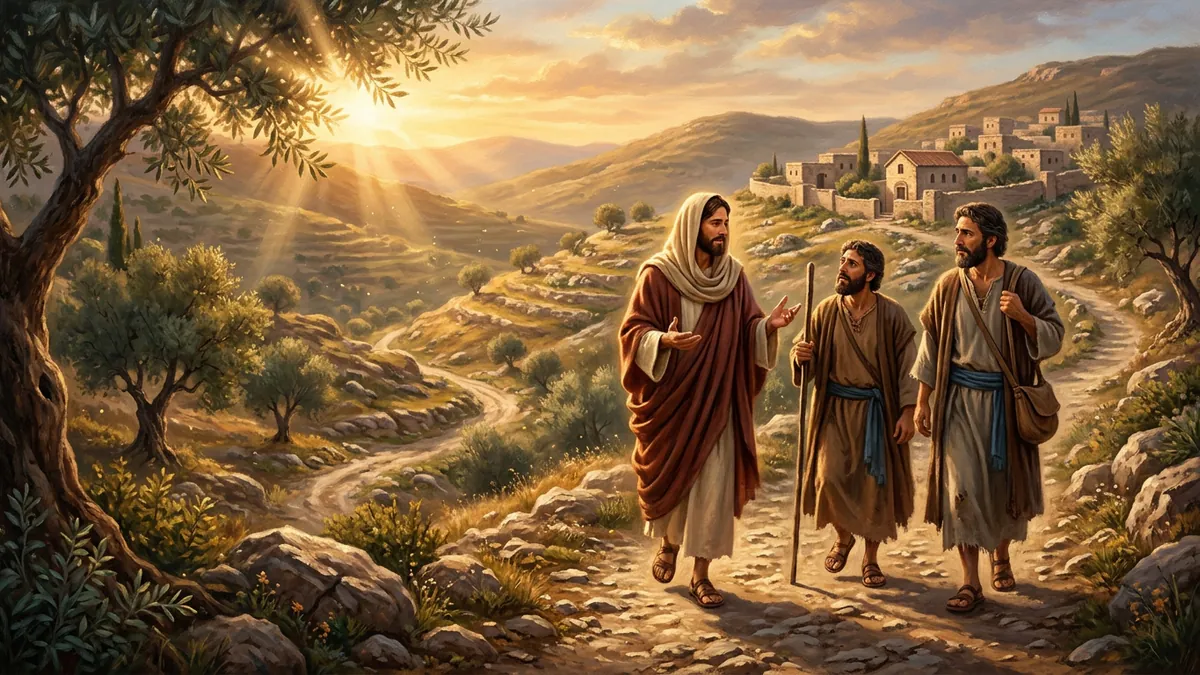
The afternoon shadows lengthened across the white limestone terracing of the Judean hill country on that first day of the week. Two disciples, their faces etched with the deep creases of grief and bewilderment, passed through the western gates of Jerusalem. Behind them lay the holy city, buzzing like an angry hive following the brutal crucifixion of Jesus of Nazareth on Golgotha three days prior. Ahead lay the winding, stony descent leading seven miles down toward the secluded village of Emmaus.
One of the travelers was Cleopas, a devoted follower of the Nazarene; the other walked beside him in silent, heavy-hearted contemplation. They had poured their youth, their devotion, and their messianic hopes into the prophet of Galilee. They had witnessed His peerless authority over demons, seen blind eyes burst with vision at His touch, and hung upon His words as He proclaimed the arrival of the Kingdom of God. In their hearts burned the unshakeable conviction that this Jesus was the long-awaited Redeemer who would shatter the iron yoke of Roman tyranny and restore the throne of David.
Instead, they had watched in horror as the religious aristocracy delivered Him up to Roman scourges, mocking thorns, and heavy iron spikes. The tomb in the rock garden had been sealed with Caesar’s wax and guarded by imperial sentries. That morning, shocking reports had erupted within their hiding places: certain women of their company claimed the stone had been rolled away, the body was gone, and celestial messengers had proclaimed Him alive. Peter and John had sprinted to the sepulcher, finding the linen graveclothes empty yet failing to see Christ. Trapped between wild rumor and crushing reality, Cleopas and his companion could bear the suffocating tension of Jerusalem no longer. With broken spirits, they began the seventy-stadia trek home.
Luke 24:14–15: 'And they talked together of all these things which had happened. So it was, while they conversed and reasoned, that Jesus Himself drew near and went with them.'
The Unrecognized Traveling Companion
As they trudged along the Roman roadway, their debate grew intense. How could the Promised Messiah die a cursed death on a Roman tree? Why had God allowed righteousness to be swallowed by judicial murder? Absorbed in their debate, neither traveler noticed the stranger who stepped onto the road from a converging path. Clothed in the standard woolen traveling cloak of a wayfarer, He matched His pace to theirs.
It was Jesus of Nazareth, clothed in the radiant power of His resurrected humanity. Yet Luke records a startling sovereign mystery: 'their eyes were restrained, so that they did not know Him.' The divine veil fell across their spiritual perceptions. God intentionally withheld physical sight so that their faith might not depend upon transient sensory sight, but upon the eternal, indestructible foundation of the prophetic Scriptures.
Walking beside them, the stranger broke the heavy silence with a gentle inquiry: 'What kind of conversation is this that you have with one another as you walk and are sad?'
The question struck like a hammer blow. The two disciples stopped dead in their tracks upon the rocky path, their faces dark with sorrow. Cleopas turned to the stranger with incredulous astonishment: 'Are You the only stranger in Jerusalem, and have You not known the things which happened there in these days?' The entire city had shuddered in darkness; the sixty-foot temple veil had torn in two; earthquakes had rattled the hills. How could any traveler in Judea be ignorant of the tragedy of Golgotha?
Quietly, Jesus asked: 'What things?'
The Lament of Shattered Hopes
The floodgates of Cleopas’ grief burst wide. For months, they had restrained their tears; now, in the presence of this listening stranger, they poured out their agony: 'The things concerning Jesus of Nazareth, who was a Prophet mighty in deed and word before God and all the people, and how the chief priests and our rulers delivered Him to be condemned to death, and crucified Him.'
Then Cleopas uttered the most heartbreaking sentence in the New Testament: 'But we were hoping that it was He who was going to redeem Israel.'
The verb was plunged into the past tense—'we were hoping.' Their hope had been buried in the garden tomb. They continued, recounting the confusing morning reports: 'Yes, and besides all this, today is the third day since these things happened. Yes, and certain women of our company who arrived at the tomb early astonished us. When they did not find His body, they came saying that they had also seen a vision of angels who said He was alive. And certain of those who were with us went to the tomb and found it just as the women had said; but Him they did not see.'
Their testimony was a masterpiece of tragic honesty. They possessed all the factual data: the empty tomb, the angelic announcements, the third-day timeline, the folded graveclothes. Yet because they evaluated spiritual realities through the lens of human defeat, their hearts remained paralyzed in unbelief.
The Master's Exegetical Masterclass
The stranger did not offer hollow platitudes. Instead, He leveled a holy indictment that pierced their melancholy like lightning: 'O foolish ones, and slow of heart to believe in all that the prophets have spoken! Ought not the Messiah to have suffered these things and to enter into His glory?'
With those words, Jesus inaugurated history's greatest Bible exposition. Beginning with Moses—the foundational Pentateuch—and moving systematically through all the Prophets, Christ unrolled the grand tapestry of redemptive history, demonstrating that the cross was not a tragic accident, but the eternal divine plan ordained before the foundation of the world.
He led them back to the dawn of creation: to the Garden of Eden, where Genesis 3:15 promised that the Seed of the woman would have His heel bruised so that He might shatter the serpent's skull. He walked them up Mount Moriah, showing how Isaac had carried the wood for his own sacrifice until God provided the substitute ram caught in the thicket. He explained the blood of the spotless Passover Lamb that shielded Hebrew households from the angel of death in Exodus 12. He unveiled the bronze serpent hoisted upon the pole in the wilderness of Numbers, granting life to dying sinners who looked in faith.
Moving into the Prophets and Psalms, Christ opened the ancient scrolls of their memory: the terrifying crucifixion portrait of Psalm 22, where hands and feet were pierced and garments divided by lot; the triumphal assurance of Psalm 16 that the Holy One would not see corruption in Sheol; and the soaring fifth Gospel of Isaiah 53, where the Servant of the Lord was wounded for our transgressions, bruised for our iniquities, led as a lamb to the slaughter, and poured out His soul unto death to make intercession for the transgressors.
As the stranger spoke, the chill of the evening air vanished beneath a holy warmth. The two disciples listened spellbound. Truths they had memorized in the synagogue from childhood, which had seemed like disconnected riddles, snapped into crystalline alignment. The execution of their Master was not defeat—it was cosmic atonement. His suffering was the indispensable royal portal to His eternal glory.
The Table at Emmaus: The Host Revealed
The sun dipped beneath the western hills, painting the sky in deep hues of violet and burnished gold as the three travelers reached the modest village of Emmaus. Cleopas and his companion halted before their doorway. The stranger, however, made as though He would journey further along the road into the descending night.
The disciples could not bear the thought of His departure. Their souls were captivated by His words. Luke uses the potent Greek word parebiasanto—they constrained Him, pleading with earnest hospitality: 'Abide with us, for it is toward evening, and the day is far spent.'
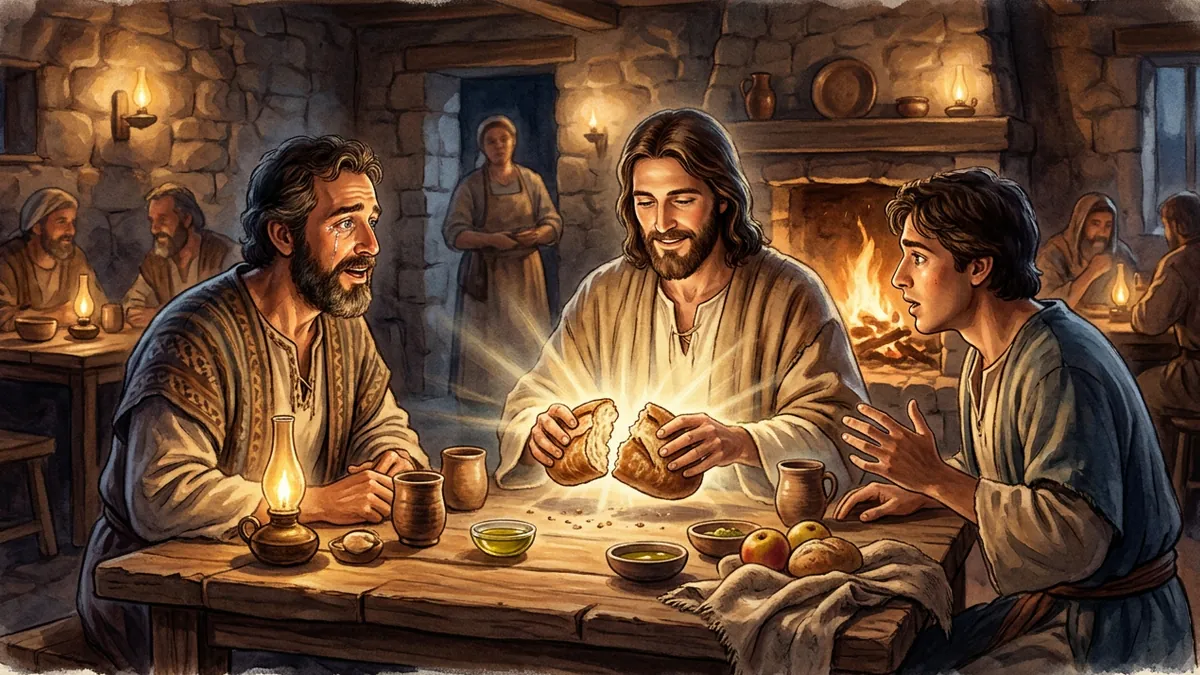
Yielding to their invitation of faith, Jesus stepped across the limestone threshold into their humble stone dwelling. An oil lamp was ignited, casting warm amber shadows across the rough-hewn table. A simple meal was arranged: a wooden bowl of olive oil, dried figs, and a coarse round loaf of barley bread.
As they reclined to eat, a remarkable inversion occurred. The invited traveler naturally assumed the role of the Master of the house. Jesus reached forth His hands, took the round loaf of bread, lifted His eyes toward heaven, and spoke the ancient Hebrew blessing: 'Baruch atah Adonai Eloheinu, Melech ha-olam...' Then, His hands broke the bread in two and handed the pieces to the disciples.
In that solitary act, the divine veil was torn away. As His hands extended, the disciples beheld the jagged red nail wounds upon His wrists. The posture, the voice, the Eucharistic breaking of the bread unlocked their spiritual sight. Luke records: 'Then their eyes were opened and they knew Him.'
It was no ghost. It was no vision. It was the Lord Jesus Christ, physically alive, bodily victorious over death! But before they could throw themselves at His pierced feet, He vanished supernaturally from their sight. The room was silent save for the crackling of the oil lamp and the ragged sound of their weeping breath.
Burning Hearts and the Midnight Sprint
Cleopas looked across the table at his companion, tears streaming down his face into his beard. Neither spoke of the supernatural disappearance; their thoughts raced back to the dusty roadway. Cleopas exclaimed: 'Did not our heart burn within us while He talked with us on the road, and while He opened the Scriptures to us?'
The Greek phrase kardia kaiomenē conveys a heart ablaze with celestial fire. Their despair was incinerated. The fatigue of the seven-mile walk evaporated in an instant. Though night had fallen and the rocky mountain trails were prowled by wolves and thieves, they could not remain in Emmaus for another hour.
Abandoning their untouched dinner, the two men sprang to their feet, gripped their walking staffs, and bolted into the darkness. Up the steep 2,000-foot ascent toward Jerusalem they ran, their lungs burning, their feet flying across the flinty stones, propelled by the ecstatic joy of resurrection reality.
Arriving at the locked upper chamber in Jerusalem, they pounded upon the fortified door. Admitted into the candlelit room, they found the Eleven apostles and the believers gathered, who greeted them with thunderous shouts: 'The Lord is risen indeed, and has appeared to Simon!'
Then Cleopas and his companion recounted the glorious journey: how their sorrow had been swallowed by the living Word on the road, and how their King had unveiled His majestic glory to them in the breaking of the bread. The dark night of human despair was forever shattered; the dawn of the New Creation had begun.
Ancient Near Eastern & Archaeological Context
In first-century Roman Judea, the road from Jerusalem to Emmaus traversed the rugged western declivity of the Judean hill country, dropping steeply from Jerusalem's 2,500-foot ridge through terraced olive groves and limestone ravines. Walking seventy stadia (about seven miles) required roughly three hours of foot travel, often undertaken during afternoon hours to avoid scorching noon heat. Following the traumatic execution of Jesus outside Jerusalem's walls during the Passover festival, the Roman military garrison maintained high alert against potential messianic insurrection, while the Sanhedrin patrolled rumors of stolen bodies. Disciples who had banked their nationalistic hopes on Jesus as an earthly political redeemer found themselves utterly disillusioned, scattered, and susceptible to despair. Sharing travel along communal Roman roads was customary, allowing travelers to walk together for mutual safety against bandits, making Christ's unannounced companionship historically and culturally natural.
Practical Discipleship & Spiritual Application
- The Emmaus narrative speaks directly to every believer who has ever walked through a season of shattered expectations, unanswered prayers, or spiritual disillusionment. Often, when God does not act according to our predetermined timelines or human formulas, we conclude that He is absent—unaware that the risen Savior is walking right beside us in the dust of our heartbreak. True spiritual recovery begins not in emotional escapism, but in returning to the immovable foundation of the Scriptures, allowing Christ to reorient our suffering within His eternal redemptive purpose. When we cultivate a holy hunger and constrain Him—crying 'Abide with us!'—He reveals Himself in intimate fellowship, transforming cold disappointment into burning hearts and turning weary wanderers into passionate, unshakeable messengers of the Gospel.
Support Independent Biblical Research
Did this study bless you? Help support our independent bilingual research and interactive visual Bible tools.
⚡ Fast Facts
- The Distance of Sixty Stadia: Luke 24:13 specifies the distance between Jerusalem and Emmaus as 60 stadia (stadious hexēkonta), equating to approximately 7 Roman miles or 11.5 kilometers—a rugged two-to-three-hour foot journey across rocky limestone terrain descending over 2,000 feet in altitude
- Cleopas and Hegesippus' Church Tradition: While Cleopas is explicitly named in Luke 24:18, second-century church historian Hegesippus recorded that Cleopas was the brother of Joseph of Nazareth, making him the legal uncle of Jesus, which explains his intimate familiarity with the Messianic expectations of Christ's inner family
- The Unnamed Second Traveler: Early patristic commentators like Origen proposed that the unnamed traveling companion was Simeon, son of Cleopas, while others suggested Luke himself or Cleopas' wife, Mary of Clopas, who had stood faithfully at the foot of the Cross in John 19:25
- The Christocentric Hermeneutic (Luke 24:27): In one afternoon walk, Jesus delivered history's greatest Bible study; the Greek verb 'diermēneusen' indicates He systematically expounded every covenant, sacrificial lamb, tabernacle furnishings, and prophetic psalm from Genesis to Malachi as pointing exclusively to His atonement and resurrection
❓ Frequently Asked Questions (FAQs)
Why were the disciples' eyes supernaturally prevented from recognizing Jesus on the road?
Luke 24:16 states that 'their eyes were restrained (ekratounto) so that they did not know Him.' This divine withholding of physical sight served a profound pedagogical and theological purpose. God deliberately prevented outward physical recognition so that their faith would not rest merely upon visible sensory proof, but upon the infallible, living authority of the Old Testament Scriptures. Jesus wanted them to comprehend from the Law and the Prophets that the Messiah had to suffer and enter His glory before they beheld His glorified body. True biblical faith operates by hearing the Word of God rather than sight (Romans 10:17; 2 Corinthians 5:7). Only after their hearts caught fire from the Scriptures were their eyes unlocked in the sacramental breaking of the bread.
What Old Testament passages did Jesus expound to prove the Messiah had to suffer and rise?
Beginning with Moses and moving through all the Prophets (Luke 24:27), Jesus illuminated the scarlet thread of redemption woven through Israel's scriptures: the seed of the woman bruising the serpent's head while being bruised in the heel (Genesis 3:15); Abraham's sacrifice and substitution of the ram on Mount Moriah (Genesis 22); the blood of the unblemished Passover Lamb delivering Israel from death (Exodus 12); the lifted bronze serpent healing poisoned sinners (Numbers 21); the exact agonies of the pierced hands and feet in Psalm 22; the holy soul not left in Sheol in Psalm 16:10; the stone rejected by the builders becoming the chief cornerstone in Psalm 118:22; the vicarious scourging and triumphant soul-making offering of the Suffering Servant in Isaiah 53; and the prophet Jonah emerging alive after three days in the belly of the sea (Jonah 1:17).
Why did Jesus vanish the exact moment the disciples recognized Him at Emmaus?
The sudden disappearance of Jesus (aphantos egeneto) marked a vital transition in the nature of His post-resurrection ministry and presence with the Church. Throughout His earthly ministry, Christ had been physically localized with His followers. But in His resurrected and glorified state, His disciples needed to learn that He is perpetually present with them through His Word, His Spirit, and the communion of the table, even when unseen by physical eyes. The moment their spiritual eyes were opened to recognize His true identity as the conqueror of death, physical localization was no longer necessary. Having encountered the living Word through the Scriptures and the breaking of bread, their paralysis of despair vanished, propelling them into bold, courageous apostolic witnesses.