The Fortress of Fear Behind Barred Doors
Night fell heavily upon Jerusalem on that momentous first day of the week. Inside a secluded upper room nestled in the dense residential quarters of the Upper City, ten grown men sat trapped in suffocating silence. The heavy timber doors were not merely closed; they were doubly bolted, reinforced with iron crossbars sunk deep into the limestone doorposts. The atmosphere inside smelled of stale sweat, cold olive oil, and raw fear.
The execution of Jesus of Nazareth on Golgotha three days prior had left them spiritually orphaned and politically branded. Roman sentries patrolled the cobblestones below, and the temple guards of High Priest Caiaphas were actively hunting for the Nazarene's inner circle. To be identified as an apostle of the crucified King meant immediate arrest, interrogation under the whip, and probable execution as an insurrectionist.
Yet terrifying joy battled with paralyzing terror in that locked room. Early that morning, Mary Magdalene had burst in, weeping aloud: 'I have seen the Lord!' Peter and John had sprinted to the tomb, finding the stone rolled away and the linen grave bandages collapsed like an empty chrysalis. Later in the afternoon, Peter had experienced a private, trembling encounter with the living Christ. And just moments before, Cleopas and his companion had pounded on the door, breathlessly recounting how the risen Jesus had walked with them seven miles to Emmaus and vanished after breaking the bread. The ten disciples debated in chaotic agitation. Could it be true? Was death truly overthrown? Or were they losing their minds under the weight of trauma?
John 20:19: 'Then, the same day at evening, being the first day of the week, when the doors were shut where the disciples were assembled, for fear of the Jews, Jesus came and stood in the midst, and said to them, "Peace be with you."'
The Sovereign Entry and the Breath of Life
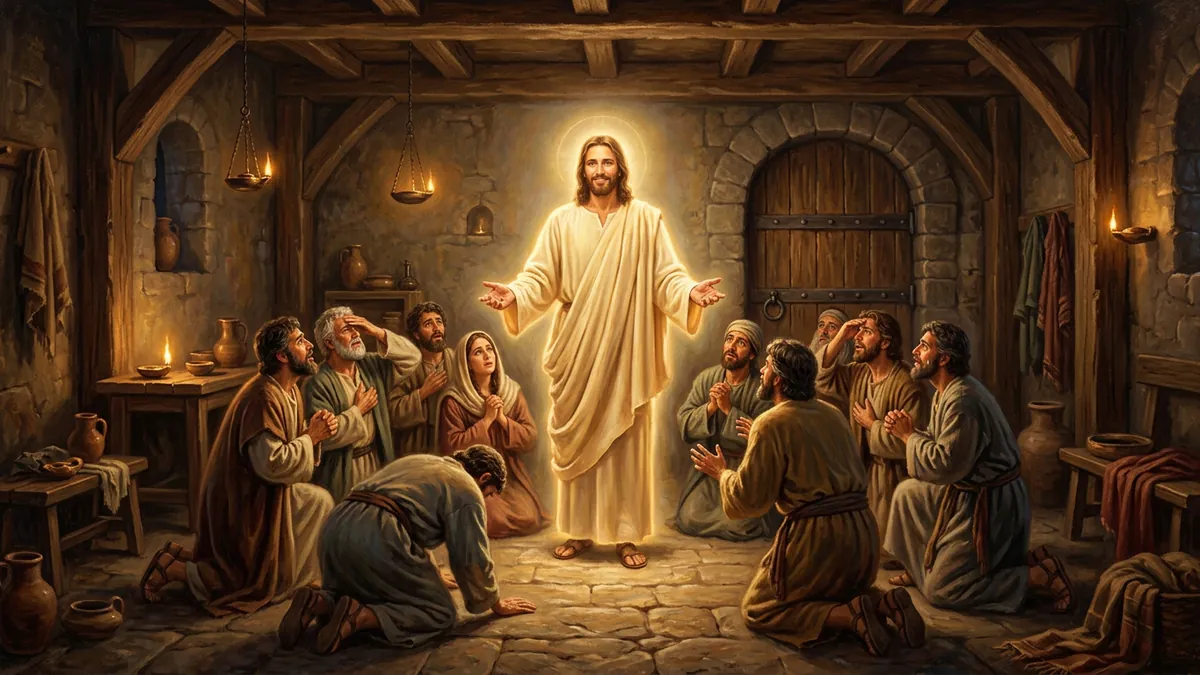
Without the turning of an iron key, without the sliding of a bolt, and without the creak of a hinge, the molecular atmosphere of the room suddenly shifted. A soft celestial radiance illuminated the shadows. There, standing bodily in the exact center of the stone chamber, was Jesus Christ.
Terror seized the disciples. Luke records that they supposed they were gazing upon a disembodied phantasm or spirit. But Christ shattered the dread with the ancient covenant greeting of Yahweh: 'Shalom aleichem'—'Peace be with you.'
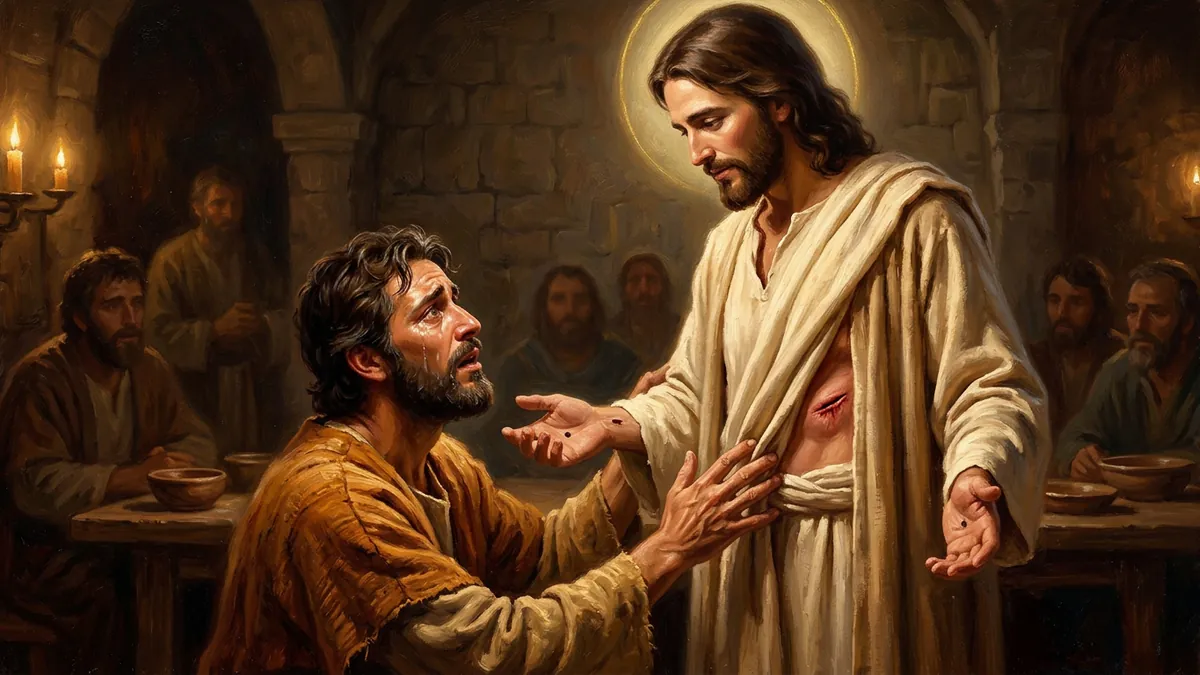
Seeing their trembling bewilderment, the Savior offered unmistakable empirical proof: 'Why are you troubled? And why do doubts arise in your hearts? Behold My hands and My feet, that it is I Myself. Handle Me and see, for a spirit does not have flesh and bones as you see I have.' He drew aside His linen garments, displaying the dark, jagged puncture wounds in His wrists and the gaping crimson spear laceration beneath His ribs. Overwhelmed by joy and disbelieving for sheer wonder, they wept. To permanently destroy any lingering notion of an illusion, Jesus asked for food; taking a piece of broiled fish and part of a honeycomb, He ate it before their astonished eyes.
Then, the risen King inaugurated the dawn of the New Creation. Looking upon the ten men who had deserted Him in Gethsemane, He spoke absolution: 'As the Father has sent Me, I also send you.' Leaning forward, Christ breathed upon them. It was the identical creative act of Genesis 2:7, when Yahweh bent over the dust of the earth and breathed the breath of life into Adam’s nostrils. Jesus declared: 'Receive the Holy Spirit.' The resurrected Lord was breathing resurrection life into the foundational pillars of His Church.
The Absent Skeptic and the Eight-Day Torment
Yet one place at the table had been tragically vacant. Thomas, called Didymus ('the Twin'), had not been present during that holy visitation. Thomas was neither a coward nor an apostate. Weeks earlier, when Jesus resolved to journey into Judea to raise Lazarus despite death threats from the Sanhedrin, it was Thomas who had courageously rallied his brethren: 'Let us also go, that we may die with Him' (John 11:16). Thomas possessed a loyal, melancholic, fiercely realistic heart. He loved deeply, and because he loved deeply, the horror of Golgotha had crushed him to powder.
When Thomas finally reconnected with his brethren, they surrounded him with ecstatic, weeping shouts: 'We have seen the Lord! He stood in our midst! We saw His hands! We saw His side!'
Thomas listened with stone-faced rigidity. To him, this sounded like the tragic hallucinations of heartbroken men desperate to escape reality. He had seen the Roman spear thrust into Jesus' side; he had watched the blood and water pour out; he knew that dead men do not return from rock-hewn tombs. Cross-examining their joy, Thomas drew an uncompromising line in the sand:
'Unless I see in His hands the print of the nails, and put my finger into the print of the nails, and put my hand into His side, I will not believe.'
For seven agonizing days, Thomas lived in the pitch-black dungeon of his own ultimatum. While his ten companions radiated the vibrant hope of resurrection joy, Thomas walked in isolation and cognitive dissonance. He did not leave the fellowship, yet he could not sing their songs. His mind demanded empirical, tactile verification that seemed impossible to grant.
The Second Visitation: Omniscience and Grace
Eight days later—the following Sunday—the disciples were gathered once again inside the upper room. This time, Thomas was sitting among them. The doors were bolted fast just as before, the iron latches securely in place against the night.
Suddenly, the air filled with heavenly warmth. Without a sound, Jesus appeared in their midst, stepping out of the unseen realm into the visible room. Standing in divine majesty, He raised His scarred hands: 'Peace be with you.'
A holy hush descended upon the chamber. The disciples held their breath. Jesus did not address Peter, John, or James. Bypassing the ten, Christ turned His eyes directly upon Thomas. Those eyes held no biting sarcasm, no cold condemnation, and no bitter rejection. They radiated infinite, tender, pursuing love.
Before Thomas could speak a word, Jesus repeated verbatim the secret, skeptical challenge Thomas had uttered eight days prior in another room: 'Reach your finger here, and look at My hands; and reach your hand here, and put it into My side. Do not be unbelieving, but believing.'
The shock shattered Thomas to his core. Jesus had not been physically present when Thomas laid down his stubborn ultimatum—yet Christ had heard every whispered word! The risen Lord had read the deepest, darkest corridors of his tormented heart. The Savior had not merely conquered physical death; He was the omniscient, omnipresent God who searches the reins and hearts of men.
The Apex Confession: 'My Lord and My God!'
Standing before the exposed spear wound, looking into the wounded hands of the King of Glory, all of Thomas’ intellectual defenses disintegrated like dry autumn leaves. He did not reach forth his finger. He did not thrust his hand into the bleeding scar. The visual reality, married to Christ’s divine omniscience, was infinitely more than enough.
Apostle Thomas collapsed to his knees upon the stone floor. Tears of shame, wonder, and adoration cascaded down his cheeks. Clasping his trembling hands before his chest, he cried out the highest theological confession in the entire New Testament:
'Ho Kyrios mou kai ho Theos mou!' — 'My Lord and my God!'
It was not a pious exclamation of shock; it was a formal theological adoration. Thomas was addressing Jesus of Nazareth as Yahweh, the sovereign Lord of the universe and the true God of Israel. The Gospel of John, which began with the profound prologue declaring that 'the Word was God' (John 1:1), reached its majestic narrative crescendo through the lips of the healed skeptic.
The Eternal Beatitude for Unseen Faith
Jesus looked tenderly down upon the prostrate apostle. He did not rebuke Thomas for confessing His deity; rather, He accepted the adoration as His rightful due. But with gentle pastoral wisdom, Christ used this moment to speak across space and time to every believer who would ever live:
'Thomas, because you have seen Me, you have believed. Blessed are those who have not seen and yet have believed.'
With those immortal words, Jesus pronounced a special divine blessing upon you and me. The Apostles had the unique historical privilege of seeing, touching, and eating with the resurrected Christ to authenticate their eyewitness testimony. But throughout the subsequent millennia, millions upon millions of believers across every tribe, tongue, and nation would embrace the risen Christ purely through the proclamation of the Gospel and the inner testimony of the Holy Spirit. We love Him whom we have not seen; in Him, though now we do not see Him, yet believing, we rejoice with joy inexpressible and full of glory (1 Peter 1:8).
Tradition records that Thomas was transformed from a paralyzed doubter into one of the most daring missionaries in history, carrying the torch of the Gospel through Persia and across the Indian Ocean to the shores of Kerala and Tamil Nadu, where he ultimately sealed his confession of 'My Lord and my God' with his martyr's blood. His doubt was swallowed up in victory; his confession echoes through eternity.
Ancient Near Eastern & Archaeological Context
Following the public crucifixion of Jesus during Passover, the Jerusalem Sanhedrin under High Priest Caiaphas launched active surveillance to suppress any emerging Messianic resurgence or rumors of resurrection. The disciples of Jesus were branded as associates of an executed political rebel (crucified on charges of sedition under the titulus 'King of the Jews'). Fearing imminent arrest, interrogation, or execution, the inner core sought refuge in an upper room (hyperōon)—likely the spacious guest room of a wealthy supporter such as Mary, mother of John Mark. First-century urban Jerusalem homes featured heavy cedar or cypress doors reinforced with transverse iron bolts (kleithra) fitted into limestone sockets. Locking these heavy doors was a desperate security protocol against nocturnal temple police raids. In Jewish culture, an eight-day interval (from Sunday to the following Sunday) constituted an inclusive weekly cycle; Thomas endured seven agonizing days of isolated skepticism and cognitive dissonance while his ten colleagues rejoiced in resurrection certainty.
Practical Discipleship & Spiritual Application
- The account of Thomas provides profound pastoral comfort to anyone who has ever wrestled with honest doubts, intellectual questions, or seasons of spiritual dryness. Notice that Jesus did not excommunicate, humiliate, or cast away Thomas because of his struggle; instead, the Good Shepherd waited patiently for eight days and returned specifically to meet the honest seeker at the exact point of his weakness. Christ understands our human frailty and does not demand blind, irrational credulity; He invites honest inquiry into the immovable truth of His Word. When doubts assail your heart, do not isolate yourself from the fellowship of believers as Thomas initially did. Bring your questions directly into the presence of the risen Lord. His scars declare that He bore our brokenness, and His living voice transforms the deepest skeptics into the boldest worshippers who cry: 'My Lord and my God!'
Support Independent Biblical Research
Did this study bless you? Help support our independent bilingual research and interactive visual Bible tools.
⚡ Fast Facts
- The Double Lock Behind Closed Doors: John 20:19 emphasizes that the doors were bolted ('tōn thyrōn kekleismenōn') out of paralyzing fear of the temple authorities; Christ's sudden entry demonstrated that His resurrected, glorified body was not bound by three-dimensional spatial physics, yet remained fully tangible flesh and bone
- The Johannine Pentecost (John 20:22): Christ breathed on the disciples and commanded, 'Receive the Holy Spirit.' The Greek verb 'enephysēsen' appears only here in the New Testament, mirroring Genesis 2:7 where Yahweh breathed the breath of life into Adam's nostrils, inaugurating the spiritual new creation
- The Meaning of Didymus: Thomas is designated 'Didymos' in John 20:24, which is the Greek translation of the Aramaic name 'Te'oma', meaning 'the Twin'; church tradition in Edessa associated him with deep, inquiring philosophical reflection
- The Apex Christological Confession: Thomas' cry 'Ho Kyrios mou kai ho Theos mou' ('My Lord and my God!') in John 20:28 represents the theological zenith of John's Gospel, directly fulfilling the prologue of John 1:1 ('the Word was God') through the lips of a healed skeptic
❓ Frequently Asked Questions (FAQs)
Did Thomas actually physically insert his fingers into Jesus' wounds, or did seeing suffice?
The text of John 20:27–28 records that Jesus explicitly commanded Thomas to reach forth his finger and thrust his hand into His side. However, the narrative does not state that Thomas actually proceeded with the physical touch. The sheer visual reality of the glorified Savior, coupled with Christ's supernatural omniscience—repeating verbatim the exact private skeptical words Thomas had uttered eight days earlier in his absence—instantly pulverized the disciple's doubt. Hearing his private skepticism echoed from the mouth of the risen Lord with infinite tenderness, Thomas fell prostrate in worship, moving directly from demanding empirical tactile proof to the highest Christological confession in Scripture: 'My Lord and my God!'
Why did Jesus retain the physical scars of the crucifixion in His glorified resurrection body?
While Christ's resurrected body was glorified, immortal, and imperishable, His wounds were deliberately retained for profound redemptive and theological reasons: First, the wounds served as undeniable historical proof of identity, establishing that the risen Lord was the identical Jesus who was scourged, pierced, and crucified on Calvary. Second, the scars are the eternal trophies of His victory over sin, Satan, and death, demonstrating that the debt of human guilt is fully paid. Third, as Revelation 5:6 reveals, Christ stands in heaven as the 'Lamb as though it had been slain,' bearing those holy marks as the eternal High Priest who ever lives to intercede for His people. Those scars are the only man-made things in heaven, serving as the everlasting guarantee of our redemption.
What is the meaning and application of Jesus' blessing: 'Blessed are those who have not seen and yet have believed'?
In John 20:29, Jesus looked beyond the locked Upper Room across centuries to encompass every future generation of believers, including the contemporary Church. While the original Apostles were granted unique apostolic eyewitness encounter to serve as foundational witnesses, the vast majority of the Church throughout history must believe through the apostolic testimony preserved in Scripture without visible sight (1 Peter 1:8). Christ declares that believing on the authority of God's Word through the inward witness of the Holy Spirit carries an exalted, special beatitude. Faith that trusts the promises of God without demanding physical, sensory verification demonstrates profound spiritual maturity and honors the truthfulness of God.