The deep velvet shadows of Saturday night were slowly giving way to the cold, pearl-gray mist of Sunday morning. It was the first day of the week—the sixteenth of Nisan. High above the eastern horizon over the mountains of Moab, the first faint rose-colored fingers of dawn began to bleed across the sky. Along the quiet, winding dirt path leading through the olive groves outside Jerusalem's northern wall, a small company of grieving women walked in hushed, sorrowful silence. Mary Magdalene, Mary the mother of James, Salome, and Joanna carried heavy clay jars filled with aromatic spices and expensive perfumes, hoping to complete the hurried, provisional burial rites that had been interrupted by the arrival of the Sabbath.
As their sandals crunched against the dew-moistened limestone gravel, their hearts were weighed down by a paralyzing practical dilemma. Mark records their anxious whispers: 'Who will roll away the stone from the door of the tomb for us?' They knew that the entrance to Joseph's sepulcher was blocked by an immense, disc-shaped limestone boulder weighing over a ton, set deep into an inclined stone trench. Even with their combined physical strength, moving such a colossal barrier was impossible. Furthermore, rumors had reached them that Pontius Pilate had dispatched a squad of armed Roman legionaries to guard the site and affixed the imperial seal across the stone.
The Cosmic Earthquake and the Dazzling Messenger
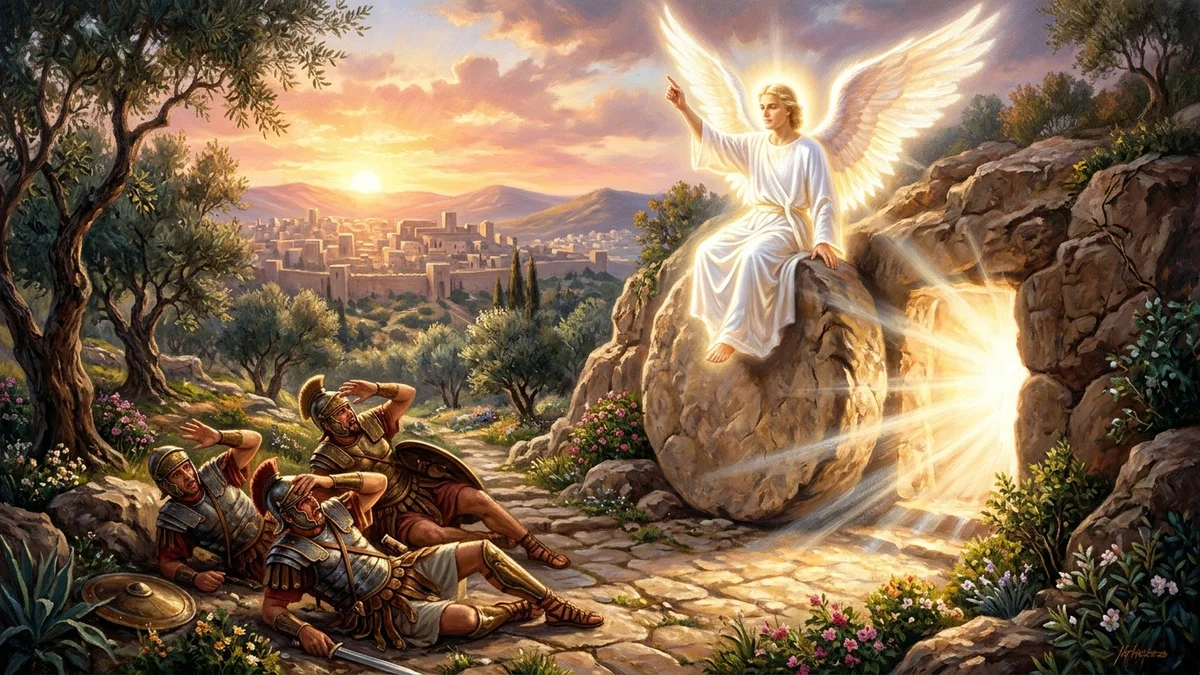
Before their trembling feet could reach the garden gate, the earth beneath them violently convulsed. Matthew records the terrifying, supernatural event: 'And behold, there was a great earthquake; for an angel of the Lord descended from heaven, and came and rolled back the stone from the door, and sat on it.' The bedrock of Mount Moriah trembled. Out from the celestial realm plunged a mighty archangel of God. His appearance was like blazing lightning, radiating uncreated heavenly brilliance, and his garments were dazzling white like virgin snow.
Approaching the tomb, the angel touched the massive multi-ton stone; effortlessly, as though it were a child's toy pebble, the angel rolled the boulder back along its stone groove, completely unsealing the dark mouth of the cavern. Then, in an act of breathtaking, holy defiance against the puny powers of earthly empires, the angel sat atop the rolled stone! The battle-hardened Roman sentries—veterans of brutal imperial campaigns—froze in sheer, absolute terror. Their bronze swords slipped from paralyzed fingers. Their knees shook violently, and overcome by the blinding celestial glory, they collapsed face-first onto the stone path, paralyzed and unconscious like dead men.
'He Is Not Here; For He Is Risen!'
When the tremor subsided and the terrified Roman guards fled into the city, the women entered the tranquil garden enclosure. Looking up through the thinning morning mist, they stopped dead in their tracks: the impossible had occurred. The massive circular stone had already been rolled away! Stepping hesitantly through the low stone portal into the damp, shadowy limestone tomb, they were greeted not by the putrid stench of a decaying corpse, but by the sweet fragrance of myrrh and aloes mingled with heavenly light.
Suddenly, two men in dazzling, luminous apparel stood beside them. Terrified, the women bowed their faces to the earth. But the celestial messengers spoke words that would forever alter the course of human history: 'Do not be afraid, for I know that you seek Jesus who was crucified. Why do you seek the living among the dead? He is not here; for He is risen (ēgerthē), as He said! Come, see the place where the Lord lay. And go quickly and tell His disciples—and Peter—that He is risen from the dead, and indeed He is going before you into Galilee; there you will see Him, as He said to you.'
Notice the exquisite, tender pastoral grace of heaven: the angel explicitly added the words, 'and Peter.' The broken fisherman who had wept bitterly in the dirt of Jerusalem, convinced that his three cowardly denials had forever disqualified him from apostleship, was singled out by name for divine restoration. Overcome with trembling, astonishment, and ecstatic joy, the women ran from the sepulcher to bring the staggering news to the eleven apostles.
The Sprint of Peter and John
Bursting through the heavy wooden door of the Upper Room where the disciples sat huddled in grief and terror behind locked doors, the women poured out their breathless report. But Luke notes with searing realism that their words seemed to the apostles like idle tales, nonsense (lēros), and they did not believe them. In the patriarchal culture of antiquity, women's testimony was viewed with deep skepticism. Yet something in Mary Magdalene's burning conviction ignited Simon Peter. Leaping to his feet, Peter bolted out the door, with young John sprinting at his heels.
The two apostles ran side by side through the waking streets of Jerusalem, out through the northern gate, and into the hillside garden. Being younger and faster, John outran Peter and reached the tomb first. Stooping down and peering into the dark opening, John saw the linen wrappings lying on the limestone bench, yet reverence restrained him from stepping inside. Heavy-footed and panting for breath, Simon Peter arrived moments later. Characteristically impulsive, Peter did not hesitate; he plunged straight through the low doorway into the tomb.
What Peter beheld inside silenced every breath. The physical evidence before his eyes dismantled every possibility of grave robbery. In the ancient world, grave robbers seeking valuable burial spices and linens either stole the entire wrapped body or hacked through the bandages, leaving a chaotic mess of torn rags. But here, the linen cloths (othonia)—hundreds of yards of linen embedded with one hundred pounds of dried gummy spices—were lying completely intact, undisturbed and collapsed inward, like an empty chrysalis from which a butterfly has emerged! Even more astonishingly, the face cloth (soudarion) that had been bound around Jesus' head was not lying with the linen wrappings; it was neatly rolled up or folded in a separate place by itself on the stone ledge.
Entering the tomb behind Peter, John looked upon the collapsed shroud and the folded napkin. In that incandescent moment, the truth of the Gospel exploded in the young apostle's heart: 'He saw and believed.' No human thief would have taken the time to strip a corpse, nor could any thief have extricated a body from hardened resin without unwinding the cloth. The Lord had simply passed bodily through the linen wrappings, leaving the empty graveclothes as a silent, physical trophy of His victory over death. Stunned and bewildered, the two apostles walked back toward their lodging, wondering what had transpired.
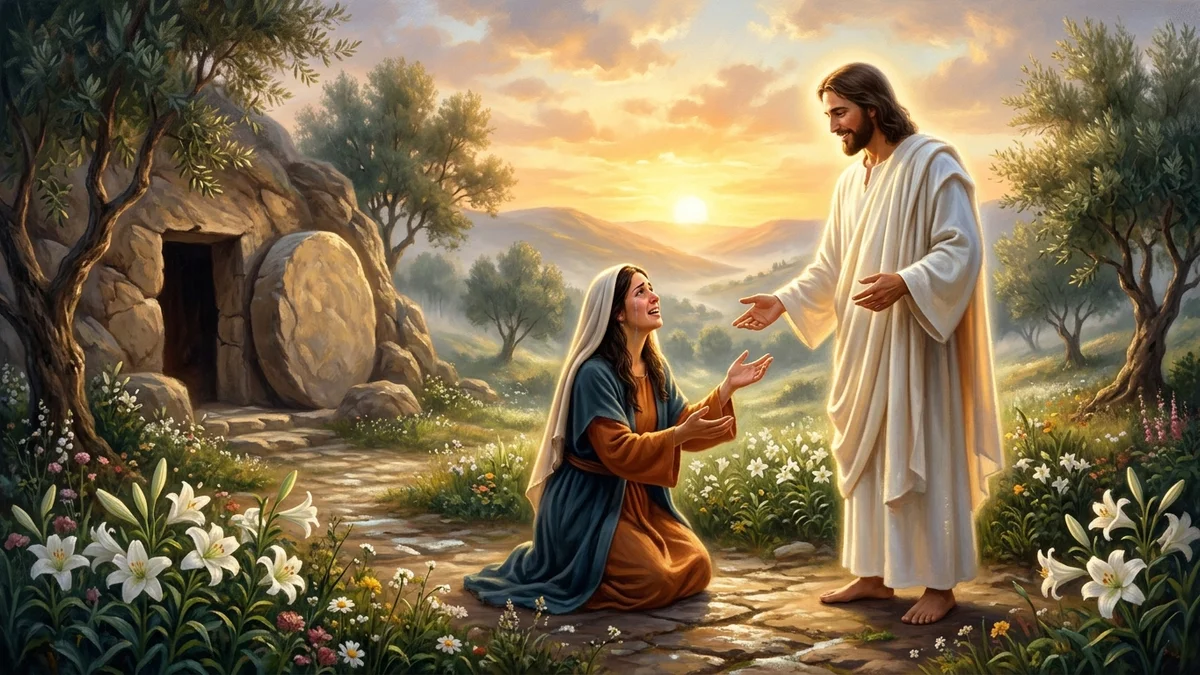
'Mary!' — The Risen Shepherd and the Weeping Sheep
Mary Magdalene had followed the two apostles back to the garden, but after they departed, she remained behind. Standing outside the low entrance of the empty cave in the cool morning mist, her heart shattered into a million pieces. She could not comprehend resurrection; she only knew that her beloved Master was gone. Collapsing onto the stone pathway, she wept inconsolably (klaiousa), her body heaving with raw, agonizing sobs. Weeping, she stooped down to look into the tomb once more.
Through her streaming tears, she saw two angels in radiant white garments, sitting one at the head and the other at the feet where the body of Jesus had lain—mirroring the two golden cherubim overshadowing the Mercy Seat of the ancient Ark of the Covenant! The angels asked gently: 'Woman, why are you weeping?' Mary poured out her broken heart: 'Because they have taken away my Lord, and I do not know where they have laid Him.' Turning around to step back into the garden, she saw a man standing near an olive tree in the golden morning sunlight, but through her tears and the morning mist, she did not recognize that it was Jesus.
Jesus looked upon her with infinite love and asked: 'Woman, why are you weeping? Whom are you seeking?' Supposing Him to be the chief gardener of the estate, Mary pleaded through her sobs: 'Sir, if you have carried Him away, tell me where you have laid Him, and I will take Him away.' Notice her fierce, selfless love: an impoverished, exhausted woman offering to carry the heavy corpse of a crucified man by herself, if only she could cradle His body and give Him a proper resting place.
Then, the King of the Universe, who had shattered the iron gates of death and disarmed the principalities of hell, spoke a single word in His tender, familiar Aramaic tongue: 'Miryam!'—'Mary!' In that one word, the universe was reborn. It was the voice of the Good Shepherd who calls His own sheep by name. The scales fell from her eyes. The heavy veil of sorrow dissolved into blinding celestial ecstasy. Spinning around on the stone path and falling prostrate at His feet, she reached out her trembling hands and cried in her native tongue: 'RABBOUNI!' which means, 'My Great Master!'
Jesus said to her with gentle authority: 'Do not cling to Me, for I have not yet ascended to My Father; but go to My brethren and say to them, 'I am ascending to My Father and your Father, and to My God and your God.'' Notice the staggering theological transition: never before had Christ called His disciples 'My brethren.' By His death and resurrection, believers were brought into the intimate, eternal family of God; His Father had become their Father! Radiating heavenly joy, Mary Magdalene ran through the city gates, bursting into the gathering of the disciples with the immortal victory shout: 'I have seen the Lord!' Death was dead; Christ was risen; and the dawn of the new creation had broken over the world forever.
Ancient Near Eastern & Archaeological Context
In first-century Jewish funerary customs, burial took place on the day of death before sunset. The deceased was washed, anointed with scented oils, and wrapped in linen shrouds (sindōn and othonia) with aromatic resins (myrrh and aloes). Because the Sabbath immediately followed the Friday crucifixion, the women were forced to leave the burial incomplete, resolving to return at the earliest permitted moment following the Sabbath rest. Jewish tombs of the wealthy in Jerusalem were cut into limestone hillsides, typically featuring a low outer vestibule and an inner chamber with benches (arcosolia) where bodies were laid. The tomb entrance was sealed by a massive, disc-shaped stone weighing one to two tons, rolling down an inclined rock-cut track to wedge tightly against the opening. To move such a stone required the combined strength of multiple strong men. Furthermore, following the Sanhedrin's appeal to Pilate, a Roman guard unit (custodia) of four to sixteen legionaries was stationed at the tomb, and a cord was stretched across the stone and sealed with wet clay stamped with the Roman imperial signet. Breaking a Roman seal incurred automatic execution by crucifixion. Yet on the morning of the third day—Sunday, the sixteenth of Nisan, the biblical Day of Firstfruits—heaven's authority dissolved imperial Rome's seal into irrelevance.
Practical Discipleship & Spiritual Application
- The Ultimate Conquest Over Death and Despair: The Empty Tomb stands as history's irrefutable declaration that Jesus Christ holds the keys of death and Hades; because He lives bodily in unshakeable triumph, the grave is forever stripped of its finality.
- The Living Savior Beyond Dead Sepulchers: The angelic proclamation—'Why seek the living among the dead?'—challenges us to stop searching for dynamic spiritual life inside dry religious legalism, bygone grief, or worldly philosophies; Christ is alive and actively reigns today.
- Personal Comfort in Intimate Calling: In the tranquil morning garden, the risen Lord did not reveal Himself first to emperors or councils, but stopped to comfort a weeping Mary Magdalene by speaking her name; the Good Shepherd intimately knows every heartbroken disciple.
- An Unquenchable Mandate to Proclaim Hope: From the trembling women at sunrise to believers across millennia, the empty tomb sends us out with urgency to proclaim that Christ is risen; our present suffering is not the end of the story, for resurrection life awaits all who belong to Him.
Support Independent Biblical Research
Did this study bless you? Help support our independent bilingual research and interactive visual Bible tools.
⚡ Fast Facts
- Women as Primary Legal Witnesses: Under first-century Jewish rabbinic halakha and Roman jurisprudence, the testimony of women was legally inadmissible in court; that all four canonical Gospels record women as the primary eyewitnesses to the Empty Tomb is definitive historical evidence of the authenticity of the narrative, as no first-century fabricator would invent such a detail
- The Mystery of the Folded Soudarion: In John 20:7, Peter observed that the face napkin (*soudarion*) was not carelessly cast aside with the linen strips, but was rolled up or neatly folded in a place by itself; in ancient Middle Eastern dining etiquette, a folded napkin left on the table was a deliberate message from the master to his servants: 'I am not finished; I am coming back'
- The Stone Was Rolled Away for Us, Not for Jesus: Christ's glorified, resurrected physical body was no longer bound by spatial-temporal physics—He passed through closed doors in John 20:19; the angel rolled away the multi-ton limestone disc not to let Jesus out, but to let the disciples and the world look in and see that the tomb was empty
- The Biblical Feast of Firstfruits: Jesus rose on Sunday morning, the 16th of Nisan—the exact day when the High Priest waved the first sheaf of the barley harvest before the Lord in the Temple (Leviticus 23:9–14), fulfilling Paul's theological declaration: 'Now Christ is risen from the dead, and has become the firstfruits of those who have fallen asleep' (1 Cor 15:20)
❓ Frequently Asked Questions (FAQs)
How do we refute the claim that the disciples stole the body of Jesus as the Sanhedrin alleged?
The 'stolen body' hypothesis (Matthew 28:11–15) collapses under historical and psychological scrutiny. First, the tomb was secured by a Roman military guard (custodia) of elite sentries under penalty of execution for sleeping on duty, and sealed with the imperial Roman seal. Second, the disciples were terrified cowards hiding behind locked doors in fear of arrest; it is absurd to imagine them overpowering armed Roman legionaries. Third, the graveclothes were left in undisturbed, collapsed order—grave robbers would never take the time to unwrap a decaying corpse and neatly fold the face cloth. Most conclusively, men will die for what they believe to be true, but no human being willingly endures torture, flogging, stoning, and crucifixion for something they know to be a deliberate fraud. Eleven of the twelve apostles died brutal martyrs' deaths testifying to the physical reality of the Risen Christ.
Why did Mary Magdalene initially mistake the resurrected Jesus for the gardener?
Mary's initial failure to recognize Jesus was due to a combination of physical and spiritual factors. Physically, it was early dawn, the garden was shrouded in thick mist, and her eyes were blinded by torrential tears of grief. Furthermore, Jesus' resurrected body was glorified—clothed in transcendent immortality, free from the bleeding wounds and disfigurement of Friday's scourging. Spiritually, she was entirely fixated on finding a corpse ('they have taken away my Lord, and I do not know where they have laid Him'); she was not looking for a living King. It was only when Jesus spoke her personal Aramaic name—'Miryam'—with the intimate, shepherd's voice she had known so well, that her spiritual eyes were opened to recognize her Lord.
What is the cosmic theological significance of the bodily resurrection of Jesus Christ?
The resurrection is the non-negotiable bedrock of the Christian faith; as Paul writes in 1 Corinthians 15:14, 'If Christ is not risen, then our preaching is empty and your faith is also empty.' The resurrection validates Christ's claims to deity (Romans 1:4), confirms that the Father accepted His atoning sacrifice on Calvary as complete payment for sin (Romans 4:25), and breaks the ultimate curse of Genesis 3 by conquering biological physical death. Furthermore, Christ's bodily resurrection is the guarantee of our future bodily resurrection: He is the 'firstfruits' of a new creation, assuring every believer that death is not the end, and that one day all who belong to Him will be raised into imperishable, eternal glory.