The Forty Days of Living Proof
For forty glorious days following His resurrection from the dead, Jesus of Nazareth transformed the earth into a classroom of the Kingdom of God. He was not a phantom or a poetic memory; He was physically, bodily alive. As Luke records in the prologue to Acts, 'He presented Himself alive after His suffering by many infallible proofs, being seen by them during forty days and speaking of the things pertaining to the kingdom of God.'
He had met weeping Mary Magdalene in the mist of the garden cemetery. He had walked seven miles with Cleopas along the winding road to Emmaus, setting their hearts on fire through the Scriptures. He had materialized inside the locked upper room, breathing resurrection life upon the terrified ten and displaying His pierced hands and side. Eight days later, He had returned to meet Thomas Didymus, transforming the broken skeptic into an unshakeable confessor of His deity. On the dawn-lit shores of the Sea of Galilee, He had roasted fish over a charcoal fire, restored fallen Simon Peter with threefold grace, and commanded him to feed His sheep. Over five hundred disciples at once had gazed upon His glorified form on a Galilean hillside (1 Corinthians 15:6).
Every lingering shadow of despair had been incinerated in the furnace of resurrection certainty. The disciples now understood the grand scarlet tapestry: the Messiah had to suffer to satisfy divine justice, and He had to rise to conquer death and open the gates of paradise. Yet their training was not yet complete. The King of kings was about to issue the imperial manifesto that would alter the trajectory of human history forever.
Matthew 28:18–20: 'And Jesus came and spoke to them, saying, "All authority has been given to Me in heaven and on earth. Go therefore and make disciples of all the nations, baptizing them in the name of the Father and of the Son and of the Holy Spirit, teaching them to observe all things that I have commanded you; and lo, I am with you always, even to the end of the age."'
The Summit in Galilee: The Imperial Decree
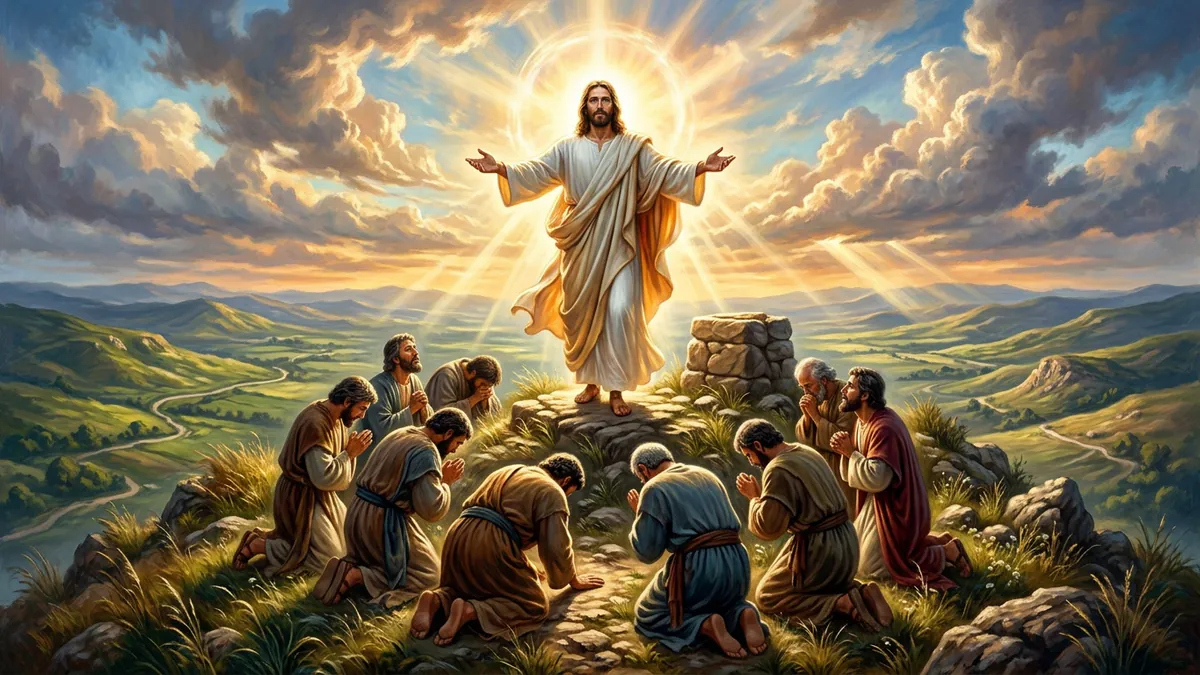
Obeying Christ's summons, the eleven apostles climbed the grassy slopes of an appointed mountain in Galilee. As Jesus approached them, radiant with celestial majesty, an overwhelming wave of reverence struck the apostolic band. They fell prostrate upon the mountain turf, worshiping Him as Lord. Matthew honestly records that 'some doubted'—not with cynical rejection, but with that stunned, holy hesitation of mortals confronted with the terrifying splendor of the divine.
Stepping forward, Jesus shattered every earthly limitation with a thunderous cosmic claim: 'All authority has been given to Me in heaven and on earth.'
Caesar Augustus in Rome claimed authority over the Mediterranean basin; the Sanhedrin in Jerusalem exercised jurisdiction over the temple courts. But Christ laid claim to absolute, unrestricted dominion over every galaxy, every angel, every demon, every nation, every government, and every human heart. His authority was universal, absolute, and irrevocable, purchased by His sinless blood upon Calvary.
Upon the bedrock of that sovereign authority, Christ issued the Great Commission:
'Go therefore and make disciples of all the nations (mathēteusate panta ta ethnē), baptizing them in the name of the Father and of the Son and of the Holy Spirit, teaching them to observe all things that I have commanded you.'
The mission was staggering in its scope. Eleven penniless, unlettered Jewish provincials from Galilee—armed with neither armies, political patrons, nor financial treasuries—were commanded to conquer the global Roman Empire and every continent beyond! They were not sent merely to secure intellectual assent or religious converts; they were commissioned to make disciples—to mold surrendered men and women who would obey every command of Christ. They were to baptize converts into the single, shared divine Name (onoma) of the Triune God: Father, Son, and Holy Spirit.
Lest their hearts faint before this impossible global conquest, the King sealed His mandate with an unbreakable covenant promise: 'And lo, I am with you always, even to the end of the age. Amen.'
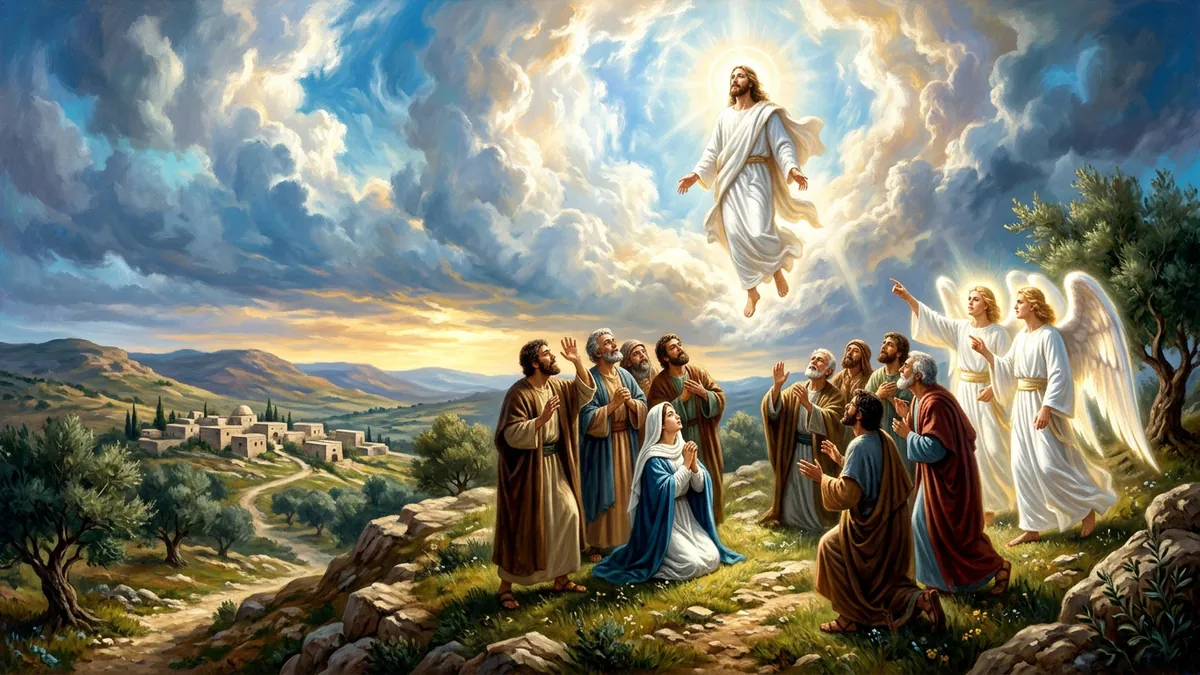
The Final Ascent from Mount Olivet
Ten days before the feast of Pentecost, Jesus gathered the disciples back to the holy city of Jerusalem. Leading them out through the eastern gates, down through the shadowed bed of the Kidron Valley, He guided them up the winding trails of the Mount of Olives toward the quiet village of Bethany.
As they walked among the ancient gnarled olive trees, the disciples' minds still wrestled with nationalistic Jewish expectations. They asked Him: 'Lord, will You at this time restore the kingdom to Israel?' They were still dreaming of an immediate geopolitical revolution that would overthrow Roman legions and establish Jerusalem as the political capital of the world.
Jesus gently corrected their earthly myopic vision: 'It is not for you to know times or seasons which the Father has put in His own authority.' Then, He redirected their gaze to the true spiritual battlefield of the ages:
'But you shall receive power (dunamis) when the Holy Spirit has come upon you; and you shall be witnesses to Me in Jerusalem, and in all Judea and Samaria, and to the end of the earth.'
They were not called to political conspiracy, but to spiritual conquest. They were not to march in human strength, but to wait in Jerusalem until the supernatural fire of the Holy Spirit clothed them from on high. Their witness was to ripple outward like concentric shockwaves: starting in hostile Jerusalem where Christ was crucified, expanding into Judea and despised Samaria, and surging across mountain ranges and oceans to the uttermost ends of the earth.
The Celestial Departure in the Shekinah Cloud
Reaching the crest of Mount Olivet, with the magnificent gilded towers of the Temple gleaming across the valley in the morning sun, Jesus halted. He looked upon the Eleven who had shared His earthly trials, His tears, and His triumphs.
Lifting His holy, scarred hands toward heaven, Christ assumed His eternal posture as the great Melchizedek High Priest, pouring out an audible blessing upon them. Luke records with breathtaking simplicity: 'Now it came to pass, while He blessed them, that He was parted from them and carried up into heaven.'
As they watched in stunned silence, His feet gently lifted from the limestone soil. Bodily, tangibly, effortlessly, Jesus rose upward into the blue vault of the morning sky. Higher and higher He ascended, His hands still outstretched in blessing over the watching disciples. Suddenly, a luminous, radiant cloud—the nephelē, the uncreated Shekinah glory cloud that had led Israel through the Red Sea and overshadowed Mount Sinai—descended from the celestial heights, enveloping the Son of God and receiving Him out of their physical sight.
The Lord Jesus Christ had ascended to the right hand of the Father, taking His rightful seat upon the throne of the universe as King of kings and Lord of lords, crowned with glory and honor!
The Promise of the Two Angels
The eleven apostles stood frozen on the mountain ridge, their necks craned upward, their eyes straining into the brilliant azure sky where their Master had vanished. They were paralyzed by the sheer awe of what they had witnessed.
Suddenly, the silence was broken by two voices. Standing right beside them were two celestial messengers dressed in dazzling, snow-white apparel. The angels addressed the transfixed disciples with gentle, urgent conviction:
'Men of Galilee, why do you stand gazing up into heaven? This same Jesus, who was taken up from you into heaven, will so come in like manner as you saw Him go into heaven.'
The angelic oracle pierced their trance like a silver trumpet. The departure of Christ was not an eternal farewell; it was the prelude to His glorious return! The manner of His return was explicitly prophesied: It would be this same Jesus—not an abstract spirit, not a different Messiah, but the identical crucified, resurrected Son of Man with the nail scars in His hands. He would return bodily, visibly, and upon the clouds of heaven, setting His feet once again upon this very Mount of Olives (Zechariah 14:4) to execute righteous judgment and reign forever.
The Return with Great Joy
The paralyzing sorrow that had gripped them at Golgotha was completely gone. In its place erupted an uncontainable, ecstatic joy. Prostrating once more upon the grassy summit of Olivet, they worshiped their ascended King.
Then, turning away from the sky, they descended the Mount of Olives and walked the Sabbath day's journey (roughly three-quarters of a mile) back across the Kidron Valley into Jerusalem. They climbed the stairs into the upper room, uniting in passionate, unceasing prayer alongside Mary the mother of Jesus and the wider company of 120 believers. Luke closes his Gospel with the triumphant verdict: 'and were continually in the temple praising and blessing God. Amen.'
The King had ascended to His throne; the battle plan was drawn; the promise was sealed. The Church of the Living God was waiting for the fire to fall.
Ancient Near Eastern & Archaeological Context
The period between Passover and Pentecost spanned fifty days according to the biblical calendar of Leviticus 23. During the first forty days, Jesus appeared periodically to His disciples in Judea and Galilee (1 Corinthians 15:6 records an appearance to over five hundred brethren at once). The Mount of Olives (Har HaZeitim), situated directly east of Jerusalem across the Kidron Valley, rises roughly 2,700 feet above sea level, providing an expansive panoramic vista of the Temple Mount and the Judean wilderness stretching toward the Dead Sea. The village of Bethany (Beit Anyah) lay on its eastern slope roughly two miles from Jerusalem. Historically, Mount Olivet held profound messianic significance: Ezekiel 11:23 described the glory of Yahweh departing the Temple and resting upon the mountain east of the city, and Zechariah 14:4 prophesied the ultimate eschatological theophany upon the very same mount. Under Roman imperial law, religious leaders who claimed cosmic authority over all earthly kingdoms were committing treason against Caesar, highlighting the audacious, revolutionary counter-imperial claim of the Great Commission.
Practical Discipleship & Spiritual Application
- The Ascension and Great Commission stand as the supreme marching orders and comfort of the Church. Christ did not ascend into heaven to abandon us, but to reign as our glorified King, to intercede as our great High Priest, and to pour out His Spirit to empower our witness. He holds absolute, supreme authority over every political empire, every spiritual principality, every disease, and every circumstance of life. When you feel inadequate, intimidated, or weak in sharing the Gospel, remember that the King did not send you in your own strength: 'Lo, I am with you always, even to the end of the age.' Live with your eyes anchored on the skies, faithful in the work of making disciples, energized by the blessed hope that this same Jesus is returning in glory to consummate His kingdom.
Support Independent Biblical Research
Did this study bless you? Help support our independent bilingual research and interactive visual Bible tools.
⚡ Fast Facts
- The Forty-Day Infallible Period: Acts 1:3 notes that Jesus remained on earth for forty days, presenting Himself alive through 'many infallible proofs' (pollois tekmēriois); in biblical numerology, forty signifies a completed season of preparation and transition (matching Moses on Sinai, Israel in the wilderness, and Elijah at Horeb)
- The Singular Name in the Trinitarian Formula: In Matthew 28:19, Jesus commands baptism into the 'Name' (singular noun, eis to onoma), not 'names' (plural), of the Father, the Son, and the Holy Spirit, providing the foundational New Testament proof for the triune nature of the one true God
- The Geographic Trajectory of Acts 1:8: Christ outlined the strategic blueprint for the entire book of Acts: Jerusalem (Chapters 1–7), Judea and Samaria (Chapters 8–12), and the ends of the earth (Chapters 13–28 to Rome), transforming a localized sect into a global organism
- The Shekinah Cloud of Glory: The cloud (nephelē) that received Jesus at the Ascension was not a condensed vapor cloud, but the celestial Shekinah glory cloud of Yahweh's presence that filled the Tabernacle (Exodus 40:34) and Mount Transfiguration (Matthew 17:5)
❓ Frequently Asked Questions (FAQs)
What is the true biblical distinction between 'making disciples' and merely 'making converts'?
In the Great Commission (Matthew 28:19–20), the primary imperative verb in Greek is 'mathēteusate' ('make disciples'). The participles 'going' (poreuthentes), 'baptizing' (baptizontes), and 'teaching' (didaskontes) describe how this central mandate is executed. A convert merely makes an initial intellectual or emotional profession of faith; a disciple, however, is a lifelong learner, follower, and apprentice of Jesus Christ. Discipleship requires comprehensive theological and moral obedience: 'teaching them to observe all things that I have commanded you.' It involves total worldview transformation, dying to self, taking up the cross daily, and reproducing Christ's character and mission in others.
Why did Jesus command the disciples to wait in Jerusalem instead of immediately launching their global mission?
In Acts 1:4–8, Jesus strictly forbade the disciples from launching their mission until they received the 'Promise of the Father'—the baptism with the Holy Spirit. Despite having spent three years in Christ's physical presence, witnessing His resurrection, and possessing sound doctrine, they lacked supernatural divine power (dunamis). Attempting to confront the demonic fortresses of paganism, the hostility of the Roman Empire, and the darkness of the human heart in human flesh would have resulted in catastrophic failure. The Church is a supernatural spiritual body, and it requires the supernatural indwelling presence and authority of the Holy Spirit to convict sinners, perform signs, endure martyrdom, and preserve the truth.
What is the theological connection between the Ascension of Jesus and His Second Coming?
The Ascension (Acts 1:9–11) and the Second Coming (Parousia) are inseparable bookends of Christ's exalted reign. The two angelic messengers proclaimed that 'this same Jesus... will so come in like manner as you saw Him go.' The manner of His return matches His departure: It will be personal, bodily, visible to human eyes, and accompanied by the clouds of heaven (Zechariah 14:4; Revelation 1:7). Zechariah 14:4 specifically prophesies that in the day of His return, His feet will stand upon the Mount of Olives east of Jerusalem. The Ascension inaugurated Christ's current heavenly session as King and High Priest at the right hand of the Father; His return will consummate His visible reign over all creation.