The Frustrated Night on the Sea of Tiberias
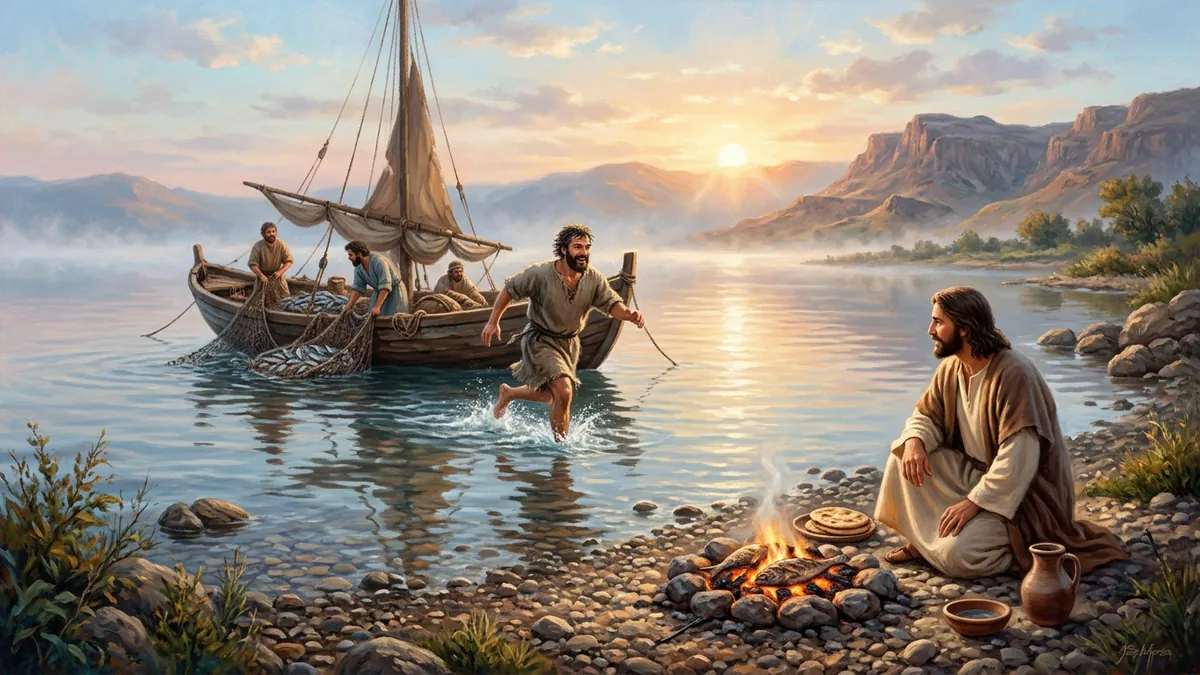
The dark, glassy waters of the Sea of Galilee lapped gently against the curved cedar hull of a Galilean fishing boat. Overhead, a blanket of brilliant desert stars wheeled across the northern sky. Inside the vessel, seven men sat in silence, their muscles aching from hours of relentless physical exertion. Heavy linen nets, soaked with cold lake water and smelling of algae, were hauled over the wooden gunwales once again. Once again, they were entirely empty.
Simon Peter stood in the stern, wiping cold sweat and spray from his brow. Beside him were Thomas Didymus, Nathanael of Cana, James and John the sons of Zebedee, and two other disciples. Following the breathtaking appearances of the risen Christ in Jerusalem, the apostles had obeyed the Master’s command to travel north into Galilee to await His marching orders. But waiting was agonizing for men forged in physical labor. Days had stretched into nights with no fresh word. In restless frustration, Peter had suddenly declared to the company: 'I am going fishing.' The others had responded immediately: 'We are going with you also.'
Yet all night long, the fish had evaded them. Master fishermen who knew every deep trench, every underwater reef, and every nocturnal feeding pattern of the lake had caught nothing. The silence was suffocating. Every empty net felt like an echo of Peter's own spiritual failure: empty, fruitless, powerless without the physical presence of the Master.
John 21:3–4: 'They went out and immediately got into the boat, and that night they caught nothing. But when the morning had now come, Jesus stood on the shore; yet the disciples did not know that it was Jesus.'
The Voice in the Dawn Mist
The first pale lilac and amber light of dawn began to spill over the jagged basalt cliffs of the Golan Heights to the east. A gentle thermal mist hovered over the glassy surface of the lake. As the weary disciples turned their vessel toward shore, roughly one hundred yards out, they perceived the solitary silhouette of a man standing on the stony beach.
Across the calm water, a clear voice drifted to them: 'Children, have you any food?'
The Greek term paidia carried the affectionate tone of a father addressing his tired children. Shouting back across the mist, their gruff, embarrassed reply consisted of a single monosyllable: 'No.'
Then the stranger shouted back an impossible command: 'Cast the net on the right side of the boat, and you will find some.'
To veteran Galilean fishermen who had spent eight fruitless hours dragging both sides of the hull, the advice seemed absurd. What difference could twenty feet across the keel make in broad daylight, when fish retreated into the cold depths? Yet an intangible divine authority resonated in the voice. Weary arms hoisted the heavy net and flung it over the starboard side. The lead weights hissed into the water.
Before the cords had fully unspooled, the surface of the lake erupted in boiling foam! Silver fins, thrashing tails, and massive scaled bodies surged into the hemp mesh. The wooden boat heeled sharply under the sudden, colossal weight. Seven grown men seized the ropes, planting their feet against the ribbing of the boat, but their combined strength could not drag the net aboard.
'It Is the Lord!' and Peter's Plunge
In that electrifying instant, memory detonated within the heart of John, the disciple whom Jesus loved. Three years earlier, in these exact waters, after another night of fruitless failure, the Teacher had commanded them to launch out into the deep, producing a catch that began to sink two boats (Luke 5). The miracle was unmistakable. It was the signature of the Creator.
Grasping Peter's forearm with trembling fingers, John gasped: 'It is the Lord!'
Those four words struck Simon Peter like lightning. He did not look at the fish; he did not count the silver bounty. All his heart cared for was the Master standing on the beach. Peter was stripped for labor, wearing only his linen loincloth. Grabbing his heavy outer fisher's tunic, he bound it tightly around his waist with a leather cord out of reverence, hurled himself over the gunwale, and plunged into the waist-deep water.
Splashing through the surf, chest-deep in the cold morning lake, Peter swam and waded toward the shore with frantic strokes, leaving the other six disciples to navigate the wallowing craft, dragging the bulging net through the water.
Breakfast with the King on Charcoal Coals
Scrambling up onto the smooth basalt pebbles of the shoreline, dripping wet and breathing heavily, Peter stopped dead in his tracks. A sensory shock struck his nostrils. The scent of burning olive-wood charcoal wafted through the morning air.
There upon the stones was an anthrakia—a bed of glowing red charcoal coals. Upon the embers sizzled freshly cleaned fish, and beside it lay a round, warm loaf of flatbread. Jesus had not needed their catch to prepare a banquet; He had already provided breakfast out of sovereign abundance. Sitting beside the fire, cloaked in morning light, was the risen Lord of heaven and earth.
Jesus looked up with warm, smiling eyes: 'Bring some of the fish which you have just caught.' Peter sprinted down to the surf, seized the main tow-rope singlehandedly, and hauled the massive net up onto the dry gravel. Counting the harvest one by one, they tallied 153 large fish. John records with wonder: 'and although there were so many, the net was not broken.'
Then Jesus uttered the sovereign invitation of grace: 'Come and eat breakfast.'
None of the disciples dared question Him, asking 'Who are You?', for the holy reality of His identity settled upon their spirits like a weight of glory. Jesus took the warm bread and distributed it to their hands, followed by the savory roasted fish. They sat together on the pebbles in reverent, weeping joy, watching the pierced hands of their Master serve them breakfast at dawn.
The Threefold Interrogation of Love
When the meal ended, the silence grew profoundly personal. The charcoal embers continued to glow softly between them. Peter stared down at the glowing coals, and an agonizing memory flooded his soul. The last time Peter had stood beside a charcoal fire (anthrakia in John 18:18), it had been in the freezing courtyard of High Priest Caiaphas, where he had three times cursed, swearing: 'I do not know the Man!'
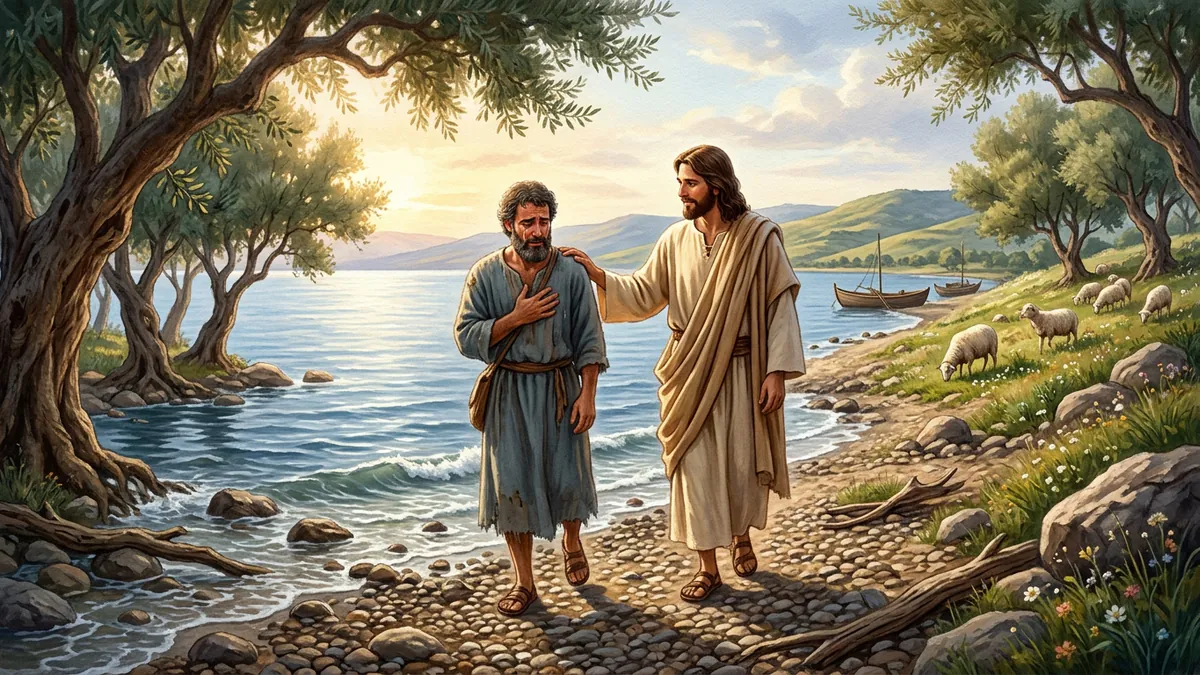
Jesus rose and signaled for Peter to walk with Him along the water's edge. Side by side they walked along the wet sand, the morning breeze rustling Christ's linen robe. Then, the Master pierced Peter's soul with the first question:
'Simon, son of Jonah, do you love Me more than these?'
Christ used Peter's old natural name—'Simon, son of Jonah'—reminding him of his earthly frailty before he was named the Rock. 'More than these' referenced Peter's arrogant boast in the Upper Room: 'Even if all are made to stumble because of You, I will never be made to stumble' (Matthew 26:33). Jesus used the high Greek verb agapas me—demanding divine, unreserved, self-sacrificial love.
Peter could no longer boast. His self-righteous swagger was dead. With moistened eyes and bowed head, he replied: 'Yes, Lord; You know that I love You.' But Peter used a different verb: philō se—'Lord, I have deep, affectionate brotherly love for You. I dare not claim more.'
Jesus did not crush him. He responded with holy trust: 'Feed My lambs' (Boske ta arnia mou).
A second time, Jesus stopped and looked into Peter's troubled eyes: 'Simon, son of Jonah, do you love Me?' Again, Christ asked for agape love. Peter’s voice trembled as he answered again with contrite humility: 'Yes, Lord; You know that I love You (philō se).'
Jesus replied: 'Tend My sheep' (Poimaine ta probata mou).
Then came the third inquiry: 'Simon, son of Jonah, do you love Me?'
This time, Jesus did not use agape. In boundless pastoral tenderness, Christ descended to Peter's level, using Peter's own word: 'Phileis me?' — 'Simon, are you truly My fond friend?'
John records that 'Peter was grieved because He said to him the third time, "Do you love Me?"' The grief was not resentment; it was the sacred sorrow of a broken heart whose secret wound had been lovingly excised by the Great Physician. The three questions had matched and erased the three denials.
Tears spilled freely down Peter’s rugged face as he cried out the confession of complete surrender: 'Lord, You know all things; You know that I love You!'
Peter appealed to Christ's divine omniscience: 'Lord, You know my shame, You know my cowardice, You know my bitter weeping in the night. But You also see the deepest chamber of my heart, and You know that I love You!'
Jesus looked upon His restored servant and spoke the final mandate: 'Feed My sheep' (Boske ta probata mou). The failure was forgiven; the disqualification was revoked; the commission was sealed.
The Prophecy of the Martyr's Cross
Having restored Peter's heart, Jesus unveiled the destiny that awaited him. Looking across the waters of the lake, Christ prophesied:
'Most assuredly, I say to you, when you were younger, you girded yourself and walked where you wished; but when you are old, you will stretch out your hands, and another will gird you and carry you where you do not wish.'
John explains the meaning of these mysterious words: 'This He spoke, signifying by what death he would glorify God.' In ancient Roman jurisprudence, to 'stretch out your hands' was the universal euphemism for crucifixion. Three decades later, in the imperial capital of Rome under the tyrant Nero, aged Apostle Peter would be led out to execution, stretching out his hands upon a wooden crossbeam, requesting to be hung upside down because he considered himself unworthy to die right-side up like his Master.
Then Jesus looked Peter in the eye and spoke the same two foundational words He had uttered three years earlier by these very shores: 'Follow Me.'
Peter was no longer following in the brittle strength of his own flesh. He was following as a broken, forgiven, Spirit-empowered shepherd, ready to lead the infant Church through storms of persecution, all the way to the crown of life.
Ancient Near Eastern & Archaeological Context
The Sea of Galilee—known alternatively in the Greco-Roman era as the Lake of Gennesaret or Sea of Tiberias—was a bustling freshwater basin situated nearly 700 feet below sea level, surrounded by steep basalt cliffs. Commercial night-fishing was standard practice among Galilean fishermen; fish gathered near the cool surface waters under cover of darkness and were harvested using heavy linen casting nets and trammel drag-nets worked from wooden rowing craft (such as the first-century 'Galilee Boat' unearthed near Ginosar). Simon Peter, Andrew, James, and John were seasoned commercial fishermen operating a prosperous guild before following Jesus. Returning to Galilee fulfilled Christ's explicit post-resurrection appointment (Matthew 28:10: 'Go tell My brothers to go to Galilee, and there they will see Me'). Following weeks of intense emotional oscillation between shock, terror, and wonder in Jerusalem, the quiet familiarity of the northern lake provided the necessary serene environment for Peter's delicate, deep personal restoration before Pentecost.
Practical Discipleship & Spiritual Application
- Peter's restoration by the Sea of Galilee is God's enduring masterpiece of restorative grace. How often do we conclude that our tragic failures, secret denials, or seasons of cold backsliding have permanently disqualified us from kingdom service? Satan whispers that our past has silenced our future. Yet Christ does not define us by our worst moments. He meets us right at the point of our deepest shame, builds a fire of loving fellowship, feeds our weary souls, and asks the only question that truly matters for kingdom ministry: 'Do you love Me?' Not 'Are you flawless?', not 'Will you never stumble again?', but 'Do you love Me?' When we surrender our brokenness to His sovereign grace, Christ transforms our tears into pastoral tenderness, turning fallen fishermen into immovable pillars of His Church.
Support Independent Biblical Research
Did this study bless you? Help support our independent bilingual research and interactive visual Bible tools.
⚡ Fast Facts
- The Specific Count of 153 Large Fish: John 21:11 specifically records that the net held 153 great fish (hekaton pentēkonta triōn); Jerome and early church fathers noted that ancient Greek zoologists cataloged 153 distinct species of fish in the Sea of Galilee, symbolizing the fullness of all nations and peoples gathered into the unbroken net of the Gospel
- The Charcoal Fire of Remembrance (Anthrakia): The Greek noun 'anthrakia' (charcoal fire) occurs only twice in the entire New Testament: once in John 18:18 where Peter stood warming himself while denying Christ, and here in John 21:9 where Jesus cooked breakfast on charcoal coals, creating a poignant sensory environment for Peter's restoration
- The Seven Named and Unnamed Disciples: John 21:2 lists seven men present: Simon Peter, Thomas Didymus, Nathanael of Cana, the two sons of Zebedee (James and John), and two unnamed disciples, representing a complete spiritual delegation awaiting apostolic marching orders
- The Tension of Greek Love Verbs: In John 21:15–17, Jesus asks the first two questions using 'agapas me' (unconditional, self-sacrificing love), to which Peter, remembering his arrogant failure, humbly replies with 'philō se' (deep affectionate friendship); in the third inquiry, Jesus graciously condescends to Peter's level using 'phileis me', causing Peter's heart to melt in raw honesty
❓ Frequently Asked Questions (FAQs)
Why did Peter announce 'I am going fishing', and was this an act of backsliding?
Scholars debate whether Peter's return to fishing in John 21:3 represented backsliding into his old secular trade or a practical response to waiting for Christ's promised Galilean instructions (Matthew 28:10). The Apostles were men of action; sitting idle generated acute anxiety, and fishing was their honorable livelihood that sustained their families. However, their fruitless all-night toil poignantly demonstrated the enduring spiritual principle of John 15:5: 'Without Me you can do nothing.' Only when they yielded to Christ's sovereign directive at dawn did their nets overflow. Jesus met them in the midst of their earthly toil to demonstrate that their true lifelong vocation was no longer catching marine fish for the market, but harvesting human souls for the eternal Kingdom of God.
What is the theological significance of Jesus asking Peter three distinct times: 'Do you love Me?'
The three inquiries precisely corresponded to and healed Peter's three public denials in the high priest's courtyard. By a charcoal fire, Peter had three times cursed and claimed 'I do not know the Man.' Now, beside another charcoal fire on the shore of Galilee, Christ graciously provided three opportunities for public confession, extinguishing the guilt of each denial with a declaration of love. Furthermore, with each confession, Jesus entrusted Peter with progressive pastoral mandates: 'Feed My lambs' (boske ta arnia mou - nurture vulnerable new believers), 'Tend My sheep' (poimaine ta probata mou - shepherd, protect, and guide the flock), and 'Feed My sheep' (boske ta probata mou - provide rich doctrinal nourishment to mature saints).
How did Jesus prophesy Peter's martyrdom in John 21:18–19?
Jesus contrasted Peter's youthful self-reliance with his ultimate martyrdom: 'When you were younger, you girded yourself and walked where you wished; but when you are old, you will stretch out your hands, and another will gird you and carry you where you do not wish.' John explicitly adds that Jesus spoke this 'signifying by what death he would glorify God.' The phrase 'stretch out your hands' (ekteneis tas cheiras sou) was a recognized Roman colloquialism for crucifixion, where a condemned prisoner's arms were lashed or nailed to the patibulum (crossbeam). Early church historians (Eusebius, Tertullian, and Origen) confirm that around AD 64–67 in Rome under Emperor Nero, Peter was martyred by crucifixion, requesting to be hung upside down because he deemed himself unworthy to die in the same manner as his Lord.