The Waiting Room of Promise
Ten days had elapsed since the soles of Jesus' feet lifted from the crest of the Mount of Olives and vanished into the luminous Shekinah glory cloud. Ten days of expectant, agonizing silence. In an upper chamber tucked away within the dense urban heart of Jerusalem, one hundred and twenty believers waited. Among them were the eleven apostles, Mary the mother of Jesus, Christ's physical brothers who now worshiped Him as Messiah, and faithful women who had ministered to Him in Galilee.
Outside their shuttered windows, the holy city buzzed with electric excitement. It was the season of Shavuot—the Greek Pentecost ('fiftieth day')—one of the three mandatory pilgrimage feasts of Israel. Hundreds of thousands of diaspora Jews had flooded through the city gates from every corner of the Greco-Roman world. The aroma of roasting festival lambs, the chanting of Levitical choirs singing the Great Hallel (Psalms 113–118), and the shuffling of countless sandals across temple flagstones echoed through the valleys.
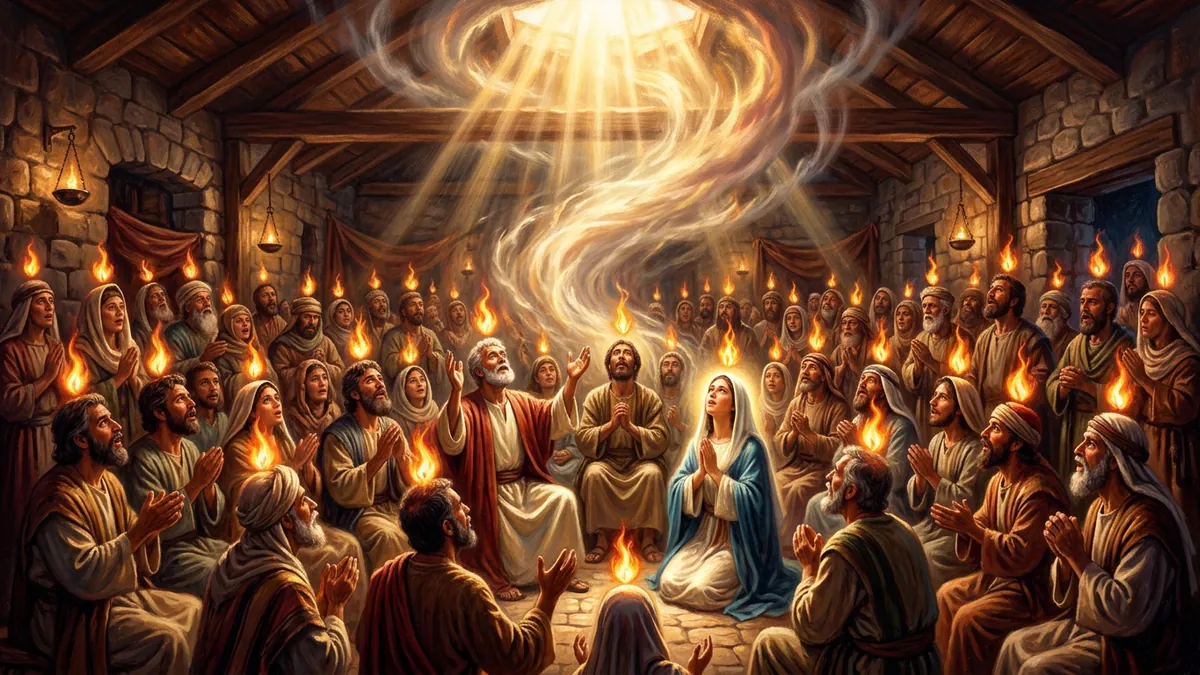
Yet inside the upper room, a different altar was burning. Luke records that they were gathered homothymadon—with one mind, in unified, harmonious accord. They were not strategizing marketing campaigns or debating political alliances. They were praying. Stripped of all human self-reliance, they clung to the parting promise of the King: 'Wait for the Promise of the Father... you shall be baptized with the Holy Spirit not many days from now.'
Acts 2:1–4: 'When the Day of Pentecost had fully come, they were all with one accord in one place. And suddenly there came a sound from heaven, as of a rushing mighty wind, and it filled the whole house where they were sitting. Then there appeared to them divided tongues, as of fire, and one sat upon each of them. And they were all filled with the Holy Spirit and began to speak with other tongues, as the Spirit gave them utterance.'
The Vortex from Heaven: Wind and Flame
It was the third hour of the day—9:00 AM—the precise moment when the morning incense was ignited upon the golden altar in the Temple courts below. Suddenly, the sky above Jerusalem split open, not with thunder, but with an acoustic theophany that defied human description.
Down from the celestial heavens roared a sound 'as of a rushing mighty wind' (hōsper pheromenēs pnoēs biaias). It was not a physical meteorological gale; the shutters did not bang, the dust on the floor was not scattered, not a single hem of their linen garments fluttered. Yet the sound was like the deafening vortex of a Category 5 hurricane, a roaring celestial freight train that localized directly inside the upper room, shaking the foundations of their souls with the holiness of God.
Then, the invisible presence became terrifyingly visible. Floating in the air of the room appeared a mass of pure, vibrating celestial fire. Before their awe-struck eyes, the fire divided—branching outward like golden flames—and separate, distinct tongues of fire hovered gracefully and rested upon the head of each person present. It rested upon Peter the fisherman; it rested upon John the beloved; it rested upon Mary the mother; it rested upon the humblest unnamed servant girl in the back corner.
In the Old Covenant, the Shekinah fire had descended upon the Tabernacle of Moses and the Temple of Solomon, dwelling in the dark seclusion of the Holy of Holies behind a sixty-foot curtain. But now, through the atoning blood of the Lamb, the veil was rent. Every believer was consecrated as a living sanctuary of the Living God!
The Miraculous Utterance of Nations
At that exact moment, the reservoir of heaven broke. All 120 disciples were filled to overflowing with the Holy Spirit (Pneuma Hagion). Divine electricity surged through their spirits, unloosing their tongues in supernatural praise. They began to speak in other languages (heterais glōssais) as the Spirit gave them utterance.
The supernatural sound from heaven had reverberated across the limestone ravines of Jerusalem. Thousands of pilgrims, hearing the mysterious roar, rushed in chaotic crowds toward the public colonnades of the Temple mount near Solomon's Porch. Down from the upper room marched the 120 believers, their faces glowing with celestial ecstasy, their arms raised, their voices pouring forth a symphony of divine praise.
What followed was an empirical miracle that pulverized human skepticism. Gathered in the courtyard were diaspora Jews from fifteen distinct geographic regions: Parthians, Medes, Elamites, dwellers in Mesopotamia, Judea, Cappadocia, Pontus, Asia, Phrygia, Pamphylia, Egypt, parts of Libya near Cyrene, visitors from Rome, Cretans, and Arabs. They leaned in, listening in paralyzed astonishment. These speakers were unlettered Galilean provincials, recognizable by their rough northern Aramaic accents—yet each foreign pilgrim heard them declaring the majestic deeds of God in his own native mother tongue!
In Genesis 11, at the Tower of Babel, human pride had resulted in the fracturing and scattering of human languages as divine judgment. Now, on the Day of Pentecost, the Holy Spirit redeemed those scattered languages, weaving them into a global tapestry of praise under the lordship of Jesus Christ!
Peter's Apostolic Thunderbolt
While the vast majority of the crowd stood in bewildered awe, cynical mockers sneered: 'They are full of new wine.'
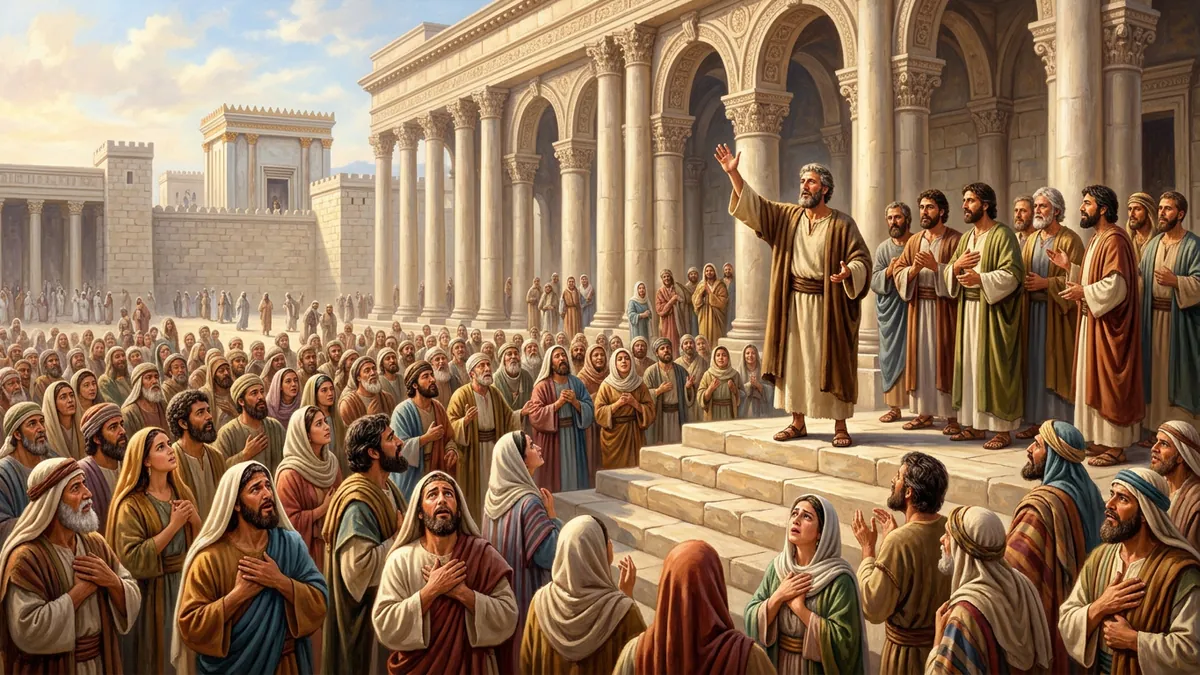
Instantly, the newly empowered leader of the Church stepped into the breach. Simon Peter stood up with the Eleven. Raising his voice with prophetic thunder that silenced the milling thousands, Peter confronted the sneering crowd:
'Men of Judea and all who dwell in Jerusalem, let this be known to you, and heed my words. For these are not drunk, as you suppose, since it is only the third hour of the day. But this is what was spoken by the prophet Joel: "And it shall come to pass in the last days, says God, that I will pour out of My Spirit on all flesh..."'
Peter dismantled the slander in a single breath: Jewish tradition strictly forbade eating or drinking wine before the morning sacrifice at the third hour. Then, turning from defense to devastating offense, Peter unleashed history's inaugural Christian sermon. He was no longer the trembling coward who cursed before a servant girl in Caiaphas' courtyard; he was a lion clothed in the dunamis of the Holy Ghost.
Peter walked the crowd through the crimson corridor of redemption: 'Jesus of Nazareth, a Man attested by God to you by miracles, wonders, and signs... Him, being delivered by the determined purpose and foreknowledge of God, you have taken by lawless hands, have crucified, and put to death; whom God raised up, having loosed the pains of death, because it was not possible that He should be held by it.'
Citing Psalm 16:8–11, Peter laid out an airtight theological proof: King David had written, 'You will not leave my soul in Sheol, nor will You allow Your Holy One to see corruption.' Peter gestured toward the southern ridge: 'Men and brethren, let me speak freely to you of the patriarch David, that he is both dead and buried, and his tomb is with us to this day.' David's bones were rotting in his sepulcher; David was not speaking of himself! David was prophesying the resurrection of his promised descendant, the Messiah.
Then Peter delivered the crushing climax that pierced Jerusalem's conscience:
'Therefore let all the house of Israel know assuredly that God has made this Jesus, whom you crucified, both Lord and Christ!'
The Heart-Piercing and the 3,000 Baptisms
The apostolic sermon struck the multitude like a broadsword. Luke uses the vivid medical Greek term katenygēsan tē kardia—they were stabbed, pierced, lacerated in their hearts. The horrific realization dawned upon thousands: they had demanded the murder of their own Promised King! The blood of the Messiah was upon their hands!
Crying out through tears of acute conviction, the crowd interrupted Peter: 'Men and brethren, what shall we do?'
Peter did not offer cheap psychological comfort. He proclaimed the uncompromising gospel demand:
'Repent (Metanoēsate), and let every one of you be baptized in the name of Jesus Christ for the remission of sins; and you shall receive the gift of the Holy Spirit. For the promise is to you and to your children, and to all who are afar off, as many as the Lord our God will call.'
The call to repent demanded an absolute reversal: abandoning religious self-righteousness, renouncing nationalistic pride, and surrendering unconditionally to the Lordship of the crucified and risen Christ. Baptism in His name was a public, costly declaration of allegiance that severed them from apostate Judaism and united them to the Kingdom of God.
That day, the waters of the vast public ritual immersion pools (mikva'ot) surrounding the Temple Mount churned continuously as the apostles baptized convert after convert. By sunset, three thousand souls were added to the Church!
The Golden Age of the Early Church
The revival did not evaporate into transient emotionalism. It crystallized into a revolutionary counter-cultural community that stunned the Roman world. Luke records the enduring fourfold DNA of this infant Church:
'And they continued steadfastly in the apostles' doctrine and fellowship, in the breaking of bread, and in prayers.'
They lived in radical, sacrificial koinonia. Believers sold lands and possessions to ensure that no brother or sister suffered lack. Daily they gathered with one accord in the temple courts for public witness, and broke bread from house to house with gladness and simplicity of heart, praising God and having favor with all the people.
The fire that fell in the Upper Room had ignited a conflagration that no Roman emperor, no Sanhedrin council, and no demonic power could ever extinguish. The Church of Jesus Christ was born, marching forward in invincible power, against which the gates of hell shall never prevail.
Ancient Near Eastern & Archaeological Context
Pentecost (from the Greek pentēkostē, 'fiftieth') was the Greek designation for the Hebrew pilgrimage festival of Shavuot ('Feast of Weeks'), celebrated seven weeks plus one day after Passover (Leviticus 23:15–21). As one of the three mandatory biblical pilgrimage festivals (Shalosh Regalim), Jewish males from throughout the Mediterranean diaspora were required to travel to Jerusalem. First-century Jerusalem, normally home to roughly 80,000 residents, swelled to over 500,000 international pilgrims during festivals. Diaspora Jews spoke diverse mother tongues and regional dialects influenced by Hellenistic, Persian, and Roman cultures: Parthian, Median, and Elamite from the Parthian Empire to the east; Mesopotamian Aramaic from the Tigris and Euphrates; Cappadocian, Pontic, and Phrygian from Asia Minor; Egyptian and Libyan dialects from North Africa; and Latin from Rome. The third hour of the day (9:00 AM) coincided exactly with the morning sacrifice in the Temple, when thousands of worshippers gathered in the expansive Court of the Gentiles and Solomon's Colonnade, providing the ideal public forum for Peter's apostolic declaration.
Practical Discipleship & Spiritual Application
- The Day of Pentecost is the eternal birthday of the Christian Church and the personal promise of empowerment for every follower of Jesus. The Holy Spirit was not poured out merely for emotional ecstasy, but for bold, transformative witness: 'You shall receive power... and you shall be witnesses.' Notice that the same Peter who cowered before a servant girl in Caiaphas' courtyard now stood unshakeable before thousands, proclaiming the Gospel without fear. When the Spirit fills our lives, human timidity is swallowed by holy boldness. We are called to live in the reality of Acts 2: steadfast in biblical doctrine, bonded in loving koinonia fellowship, cultivating radical generosity, and expecting the living God to convict hearts and add souls to His Church daily. The promise is not obsolete—it is for you, your children, and all who are far off, as many as the Lord our God will call.
Support Independent Biblical Research
Did this study bless you? Help support our independent bilingual research and interactive visual Bible tools.
⚡ Fast Facts
- The Double Typology of Shavuot: Pentecost occurred on the 50th day after Passover (Leviticus 23:15–16), celebrating the Firstfruits of the Wheat Harvest and, according to ancient Jewish rabbinic tradition, the giving of the Torah at Mount Sinai; while 3,000 perished at Sinai due to the Golden Calf (Exodus 32:28), exactly 3,000 souls were brought to life through the Spirit at Pentecost (Acts 2:41)
- The Meaning of Xenolalia: The miracle of tongues in Acts 2 was 'xenolalia'—speaking in known, authentic human languages unknown to the speaker; pilgrims from fifteen geographic territories explicitly verified that they heard their local regional dialects (dialektō) spoken with perfect fluency
- The Reversal of the Tower of Babel: In Genesis 11, human pride at Babel resulted in the confusing and scattering of human languages as divine judgment; at Pentecost, the Holy Spirit sanctified and redeemed those scattered languages, uniting all ethnicities under the lordship of Jesus Christ
- The Four Pillars of the Apostolic Church (Acts 2:42): Luke identifies the foundational DNA of the New Testament Church: 'proskarterountes' (steadfastly persevering) in apostolic teaching (didachē), fellowship (koinōnia), the breaking of bread (klasei tou artou), and prayers (proseuchais)
❓ Frequently Asked Questions (FAQs)
What is the biblical distinction between the sound of the wind and actual physical wind in Acts 2:2?
Acts 2:2 states: 'And suddenly there came a sound from heaven, as of a rushing mighty wind (hōsper pheromenēs pnoēs biaias), and it filled the whole house where they were sitting.' The text specifies that it was a 'sound as of' (hōsper)—an acoustic theophany. It was not a meteorological atmospheric cyclone blowing furniture around, but a deafening, supernatural sound resembling a category-five hurricane that originated directly from heaven and localized inside the Upper Room. In both Hebrew (Ruach) and Greek (Pneuma), the word for 'Spirit' is identical to 'breath' or 'wind'. The sound signaled the sovereign arrival of the Third Person of the Trinity, fulfilling Ezekiel 37:9 where the four winds breathed life into the valley of dry bones.
What was the theological purpose of the 'divided tongues as of fire' resting on each believer?
Throughout the Old Testament, supernatural fire was the signature of Yahweh's consuming holiness and divine presence: the burning bush at Horeb (Exodus 3), the pillar of fire in the wilderness (Exodus 13), the consuming flame upon the Tabernacle altar (Leviticus 9:24), and the fire descending upon Solomon's Temple (2 Chronicles 7:1). However, in the Old Covenant, the Shekinah fire was corporate and restricted to the physical sanctuary. At Pentecost, the fire divided (diamerizomenai) and rested upon each individual believer—men and women, apostles and laypersons alike. This signified that every believer in Jesus Christ has become a living, blood-bought temple of the Holy Spirit (1 Corinthians 6:19), consecrated for royal priesthood.
Why did Peter quote Joel 2 and Psalm 16 in his sermon, and what was his apologetic objective?
Peter's sermon was a masterpiece of apostolic hermeneutics. First, he quoted Joel 2:28–32 to prove that the ecstatic outpouring was not drunken revelry, but the arrival of the long-awaited Messianic 'Last Days,' where the Holy Spirit would be poured out upon all flesh regardless of gender, age, or social status. Second, Peter quoted Psalm 16:8–11 ('You will not leave my soul in Sheol, nor will You allow Your Holy One to see corruption'). Peter argued that King David died, was buried, and his tomb was visibly decaying outside Jerusalem's walls; therefore, David could not have been speaking of himself. David was speaking as a prophet foretelling the physical resurrection of his descendant, the Messiah. Peter demonstrated that the crucified Jesus had broken the bonds of death, ascended to the right hand of God, and poured forth the Holy Spirit.