The blazing sun of Lower Egypt illuminated the colossal limestone pylons of the Temple of Amon-Ra in Tanis. Chanted hieroglyphic incantations rose from gilded altars as priests offered perfumed fat to falcon-headed deities and sacred sacred crocodiles. For over four centuries, Egypt had reigned as the undisputed geopolitical and religious colossus of the ancient world. But into the majestic, columned audience chamber of Pharaoh strode two elderly Hebrew brothers—eighty-year-old Moses and eighty-three-year-old Aaron. Armed with nothing more than shepherd's staffs and an unshakable prophetic mandate, they delivered an ultimatum that stunned the royal court into breathless silence: "Thus says the LORD God of Israel: 'Let My people go, that they may hold a feast to Me in the wilderness!'" (Exodus 5:1).
1. The Royal Defiance: "Who is the LORD?"
Pharaoh reclined upon his golden throne beneath the royal cobra-crown (*Uraeus*), the symbol of supreme sovereignty. He looked down upon the two aged shepherds with cold, aristocratic condescension:
"Who is the LORD, that I should obey His voice to let Israel go? I do not know the LORD, nor will I let Israel go." (Exodus 5:2)
To Pharaoh, the gods of the earth were ranked by military conquest and territorial dominion. The Hebrews were slaves; therefore, their God was presumed weak, irrelevant, and non-existent. To punish their impudence, Pharaoh doubled their misery: ordering the taskmasters to withhold straw while demanding the exact same daily quota of mudbricks. The crushed Hebrews turned against Moses in bitter anger. Broken and bewildered, Moses fell upon his face before God: "Lord, why have You brought trouble on this people? Why is it You have sent me?"
Then Yahweh spoke with absolute celestial certainty: "Now you shall see what I will do to Pharaoh... Against all the gods of Egypt I will execute judgment: I am the LORD!"
2. The River of Blood and the Swarm of Frogs
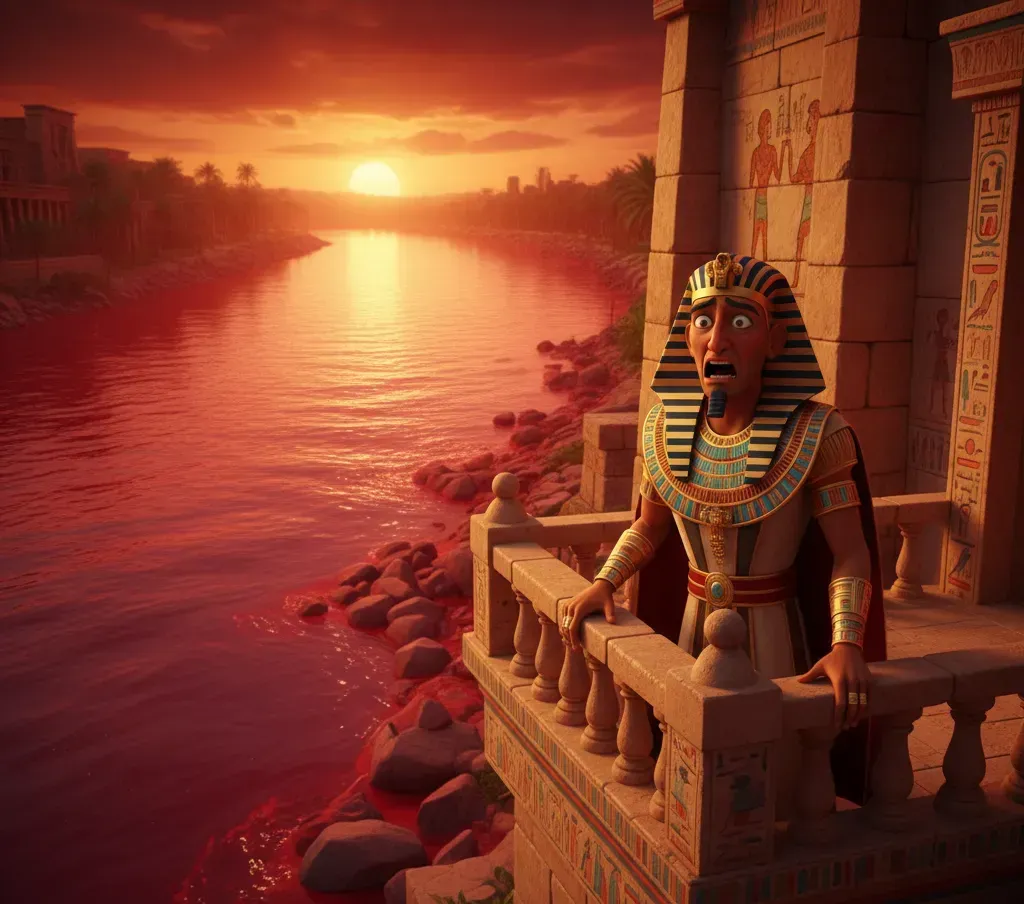
The cosmic showdown commenced on the banks of the sacred Nile. As Pharaoh stepped down to perform his morning water rituals, Moses stood in his path. Raising the wooden shepherd's staff, Aaron struck the sparkling waters of the river before the eyes of Pharaoh and his royal courtiers.
Instantly, in a horrifying chemical transformation, the entire Nile River turned to thick, dark, putrid blood! The fish died by the millions; a nauseating stench blanketed the delta; the sacred life-artery of Egypt became an open sewer of rot and death. For seven agonizing days, Egyptians dug frantically along the riverbanks for drinking water. The river gods *Hapi* and *Osiris* were judged. Yet Pharaoh's heart grew hard (*Kaved*).
Seven days later, Aaron stretched his staff over the waters, and the second plague exploded: swarms of frogs crawled out of the slime, invading royal bedrooms, leaping onto Pharaoh's dining couches, swarming into baking ovens and kneading troughs. The frog-headed fertility goddess *Heket* was turned into a stinking mockery: when the frogs died, the Egyptians gathered them into grotesque, rotting heaps that poisoned the air of the empire.
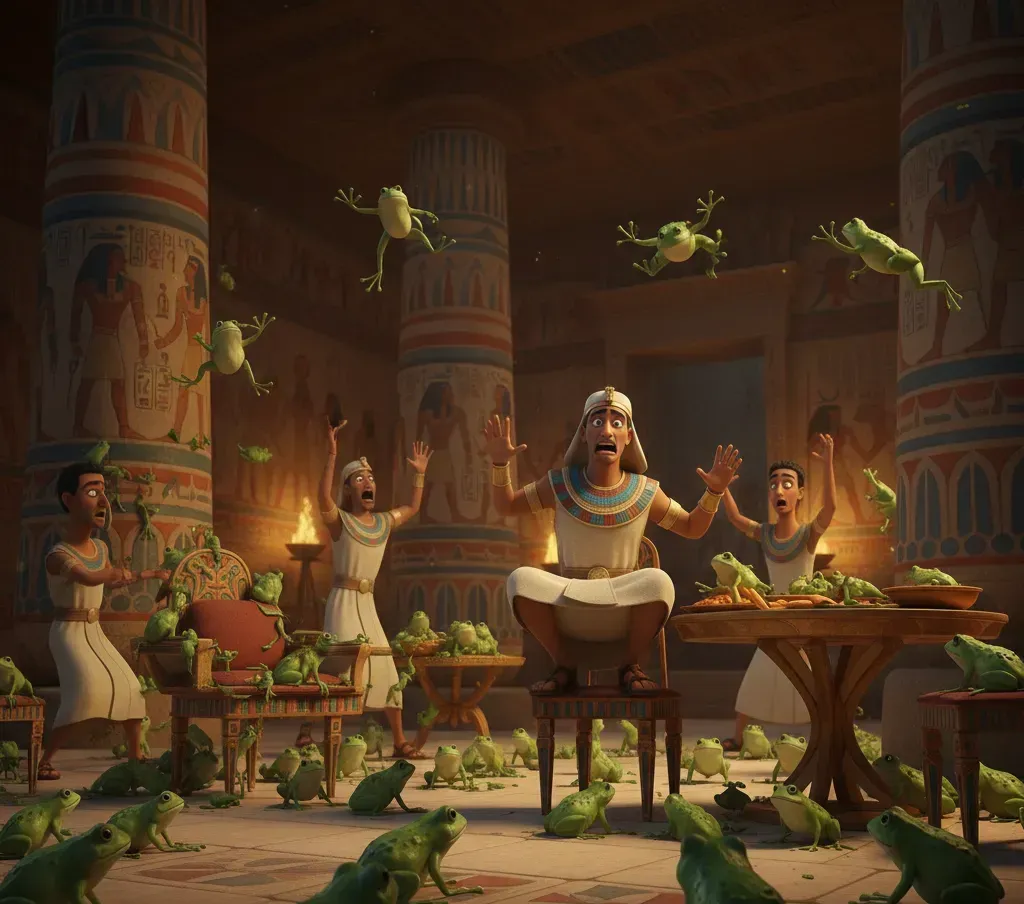
The Humiliation of the Gods: Heket, the frog-headed deity of fertility, is turned into a stinking scourge as millions of frogs overrun the royal chambers of Egypt.
3. The Finger of God and the Miraculous Distinction
Aaron struck the dust of the ground, and throughout all Egypt the fine sand erupted into swarming clouds of biting gnats and lice (*Kinnim*). It covered man and beast.
Pharaoh summoned his court magicians (*Chartummim*) to duplicate the sign using their occult arts. But their secret spells failed completely. Turning to Pharaoh with pale, trembling faces, the magicians confessed: "This is the finger of God!" (Exodus 8:19). The god of the earth, *Geb*, had been thoroughly dethroned.
With the fourth plague—dense swarms of biting flies (*Arov*) that ruined the land—God instituted a revolutionary theological boundary:
"And in that day I will set apart (*Palah*) the land of Goshen, in which My people dwell, that no swarms of flies shall be there, in order that you may know that I am the LORD in the midst of the land." (Exodus 8:22)
For the remainder of the plagues, Goshen was enveloped in an invisible supernatural sanctuary. While Egypt choked in devastation, the children of Israel enjoyed divine peace, health, and preservation.
4. Livestock Struck, Boils, and the Apocalyptic Hail
The judgments accelerated with terrifying momentum:
- The Fifth Plague (Murrain on Cattle): A devastating pestilence struck the horses, donkeys, camels, oxen, and sheep of Egypt, slaughtering the sacred Apis bulls and Hathor cows, while not one Hebrew animal died.
- The Sixth Plague (Boils): Moses took soot from a brick kiln and hurled it into the sky before Pharaoh; it became fine dust causing agonizing, festering ulcers on man and beast. The royal magicians could not even stand before Moses because of the boils covering their bodies.
- The Seventh Plague (Fire-Hail): Moses stretched his staff toward heaven, and Yahweh unleashed the most horrific tempest in Egyptian history: thunder roared, jagged lightning ran along the ground, and enormous hailstones mingled with roaring fire rained down, shattering every tree, flattening every flax and barley crop, and pulverizing every man and beast left in the open fields.
Pharaoh sent for Moses in panic: "I have sinned this time. The LORD is righteous, and my people and I are wicked. Entreat the LORD that there may be no more mighty thundering and hail!" But the moment the skies cleared, Pharaoh hardened his heart yet again.
5. The Devouring Locusts and the Three-Day Darkness
Pharaoh's own counselors pleaded with the stubborn monarch: "How long shall this man be a snare to us? Let the men go, that they may serve the LORD their God. Do you not yet know that Egypt is destroyed?" (Exodus 10:7).
Pharaoh offered compromised terms: "Go serve the LORD, but leave your children and flocks behind." Moses refused: "Not a hoof shall be left behind!"
Moses stretched forth his staff, and a howling east wind blew across the desert for twenty-four hours, bringing a dense, black cloud of locusts that covered the face of the whole earth so that the land was darkened. They devoured every green leaf, herb, and fruit that had survived the hail.
Then fell the penultimate judgment: three days of thick, palpable darkness. Moses stretched his hand toward heaven, and an impenetrable, supernatural gloom blanketed all the land of Egypt. For seventy-two continuous hours, no Egyptian could see another, nor did anyone arise from his place. The supreme god of Egypt, *Amon-Ra* the sun, was obliterated. Yet Scripture records the glorious contrast: "But all the children of Israel had light in their dwellings" (Exodus 10:23).
Furious, Pharaoh drove Moses out: "Get away from me! Take heed to yourself and see my face no more! For in the day you see my face you shall die!" Moses answered with chilling finality: "You have spoken well. I will never see your face again."
6. Midnight and the Blood of the Lamb
The final judgment was announced with solemn terror: at midnight, Yahweh Himself would pass through Egypt, and every firstborn—from the firstborn of Pharaoh upon his throne to the firstborn of the captive in the dungeon—would die.
To escape this universal stroke of divine justice, God instituted the Passover (*Pesach*). Every Hebrew household was commanded to take a male lamb of the first year, without blemish (*Tamim*). On the fourteenth day of the month of Nisan, at twilight, the lamb was slain. Its blood was caught in a basin and painted with a bunch of hyssop upon the two side posts and the upper lintel of the front door.
Inside the blood-sealed houses, the families roasted the lamb whole over the fire, eating it in haste with bitter herbs and unleavened bread, their loins girded, sandals on their feet, and staffs in their hands, ready for immediate departure. God promised:
"Now the blood shall be a sign for you on the houses where you are. And when I see the blood, I will pass over you; and the plague shall not be on you to destroy you when I strike the land of Egypt." (Exodus 12:13)
At midnight, a sound of unimaginable horror ripped through the Egyptian night. A great cry arose across the empire, for there was not a single house without someone dead. Pharaoh awoke in terror, looking upon the cold, lifeless body of his royal heir.
Broken, shattered, and terrified, Pharaoh summoned Moses and Aaron by night and screamed: "Rise up, get out from among my people, both you and the children of Israel! Go, serve the LORD as you have said... and bless me also!"
After four hundred and thirty years of bondage, over two million Hebrews walked out of Egypt into freedom under the full moon of Passover—plundering the wealth of their former masters, protected and redeemed exclusively by the blood of the Lamb.
Biblical Keywords & Theological Roots
Judgments, judicial acts of cosmic sentencing; used in Exodus 12:12 for the divine verdicts executed against the demonically backed pantheon of Egypt.
Heavy, weighed down, insensitive, unresponsive; describing the dense, unyielding obstinacy of Pharaoh's heart before the word of the Lord.
To sever, separate, make a miraculous distinction or division; used when God set apart the land of Goshen so that no plague touched His covenant people.
Passover; to skip over, spare, or hover protective wings over; describing Yahweh passing over blood-marked homes while the Destroyer struck the firstborn.
Blood; the vital carrier of physical life and sacred atonement, painted on the lintel and doorposts as a visible shield of substitutionary ransom.
Ancient Near Eastern & Archaeological Context
In ancient Egyptian religious cosmology, the Pharaoh was not merely an earthly monarch; he was the living incarnation of Horus, the son of the sun god Ra, tasked with maintaining *Ma'at* (cosmic truth, balance, and order) against chaos (*Isfet*). The pantheon of Egypt was intimately bound to the ecology of the land. The Ten Plagues documented in Exodus 7–12 were not random ecological disasters, but targeted theological assaults against specific deities presiding over Egypt's natural forces.
Plague 1 (the Nile turned to blood) disgraced *Hapi* (the Nile god of fertility), *Khnum* (guardian of the Nile source), and *Osiris* (whose bloodstream was mythological water). Plague 2 (frogs) humiliated *Heket*, the frog-headed goddess of childbirth and regeneration, turning her sacred emblem into putrid heaps of revulsion. Plagues 3 and 4 (gnats and flies) mocked *Geb* (god of the earth) and *Khepri* (the scarab/beetle god of the rising sun). Plague 5 (livestock pestilence) struck the sacred *Apis* bull and *Hathor* (the cow goddess of motherhood and nourishment). Plague 6 (boils) broke out before *Sekhmet* (goddess of healing and epidemics) and *Imhotep* (patron of physicians), leaving even the royal court magicians unable to stand before Moses. Plague 7 and 8 (fire-hail and locusts) devastated the crops of *Min* (god of agriculture) and *Seth* (storm god).
Plague 9 (three days of palpable darkness) struck the supreme heart of the Egyptian pantheon: *Amon-Ra*, the omnipotent sun god. For seventy-two hours, Egypt's divine sun was extinguished by the sovereign command of the Hebrew God. Finally, Plague 10 (death of the firstborn) demolished the royal household and *Pharaoh* himself as divine king, whose royal firstborn son was worshipped as a god destined to inherit the throne of Horus. In ancient Egyptian funeral ritualism (the *Book of the Dead*), the heart (*ib*) was weighed in the underworld against the feather of *Ma'at*. By declaring that Pharaoh's heart was 'heavy' (*Kaved*), the biblical narrative ironically indicted Pharaoh as spiritually condemned and deficient under the true cosmic Judge.
Practical Discipleship & Spiritual Application
- The Ultimate Demolition of Modern Idols: Just as God methodically judged every pagan deity of Egypt—their rivers, livestock, health, and economy—God will ultimately expose the bankruptcy of anything in our lives that takes His place. Whether we idolize wealth, career prestige, physical health, or human leaders, our ultimate security must rest exclusively upon the unshakeable throne of Yahweh.
- God's Miraculous Distinction for His People: When swarms of flies, deadly murrain, and pitch-black darkness covered Egypt, the land of Goshen radiated with light, health, and peace. God knows how to set apart His covenant children in the midst of a collapsing world. Walk in holy confidence: though ten thousand fall at your right hand, God's protective grace will preserve your soul (Psalm 91:7).
- The Peril of a Self-Hardened Heart: Pharaoh saw undeniable miracles, felt the stinging rod of judgment, made desperate promises of compromise, yet repeatedly hardened his heart the moment relief arrived. Sin is deceitful and blinding. When the Holy Spirit convicts you of compromise or rebellion, do not delay—soften your heart today, for delayed repentance breeds spiritual ruin.
- Salvation Exclusively Through the Blood of the Lamb: When the midnight Destroyer passed through Egypt, he did not examine the morality, wealth, education, or ethnicity of the inhabitants—he looked for only one thing: the applied blood on the doorposts. We are saved from the wrath of God not by our good works or religious heritage, but solely by the shed blood of Jesus Christ, the true Passover Lamb.
⚡ Fast Facts
- Cosmic Warfare on Egyptian Deities: Exodus 12:12 reveals the true objective of the plagues: 'Against all the gods of Egypt I will execute judgment: I am the LORD.' Each plague systematically humiliated specific Egyptian gods (Hapi of the Nile, Heket the frog goddess, Hathor the bovine deity, Ra the sun god, and Pharaoh the living god-king).
- The Three Literary Triads: The first nine plagues are arranged in three symmetrical cycles of three: Plagues 1, 4, and 7 are announced in the morning at the water; Plagues 2, 5, and 8 are warned in the palace; and Plagues 3, 6, and 9 fall without any prior warning.
- The Hardening of Pharaoh's Heart: The Hebrew text uses three distinct verbs: *Chazaq* (to grow stiff/stubborn), *Kaved* (to become heavy/insensitive, echoing the Egyptian concept of the heart weighed against truth in the underworld), and *Qashah* (to make obstinate). Pharaoh hardened his own heart repeatedly before God judicially confirmed him in his stubbornness.
- The Passover Lamb Prototype: The spotless yearling lamb, inspected for four days, slaughtered at twilight, its blood painted on lintels, roasted whole without a broken bone, and eaten in haste with bitter herbs and unleavened bread is the ultimate Old Testament prototype of Jesus Christ, 'our Passover Lamb sacrificed for us' (1 Corinthians 5:7).
❓ Frequently Asked Questions (FAQs)
Scripture demonstrates that for the first five plagues, Pharaoh repeatedly and voluntarily hardened his own heart (Exodus 7:13, 22; 8:15, 19, 32). He was given repeated opportunities, mercy, and relief. Only after Pharaoh persistently hardened his own conscience did God judicially 'give him over' to his obstinate rebellion (Exodus 9:12; Romans 1:24). God did not force a righteous man to become evil; He confirmed an arrogant tyrant in the very wickedness he actively chose.
Egyptian royal court sorcerers (*Chartummim*) were high-ranking priests trained in ritual magic (*Heka*) and hypnotic illusion. In Exodus 7-8, they mimicked the staff-turned-serpent, water to blood, and frogs using sleight-of-hand or demonic power. However, at the third plague (gnats/lice), their power collapsed completely, forcing them to confess before Pharaoh: 'This is the finger of God!' (Exodus 8:19).
In the previous plagues, God exempted the land of Goshen sovereignly. But in the tenth plague, God revealed that all human beings—Hebrews and Egyptians alike—stand guilty of sin before the absolute holiness of God and deserve judgment. The Hebrews were spared not because of ethnic superiority or moral perfection, but exclusively because a blameless substitute died in their place and its blood was visibly applied by faith.