The dark, muddy waters of the Nile lapped softly against the towering walls of the royal city of Avaris. Four centuries had passed since Joseph had welcomed his seventy family members into the lush pastures of Goshen. Now, the fertile delta teemed with millions of Hebrew descendants. But a seismic political revolution had swept across Egypt: a nationalist dynasty arose that "did not know Joseph" (Exodus 1:8). Terrified by the exponential demographic growth of the Hebrews, Pharaoh transformed the free covenant clan into a nation of chained slaves, forcing them under brutal taskmasters to quarry stone and mold mudbricks for the royal store-cities of Pithom and Raamses. Yet the more Egypt afflicted them, the more they multiplied.
1. The River of Blood and the Ark of Reeds
Furious that slavery failed to crush their spirits, Pharaoh unleashed the ultimate horror of state-sponsored infanticide: "Every son who is born you shall cast into the river, and every daughter you shall save alive" (Exodus 1:22). Egyptian soldiers raided the huts of Goshen, ripping newborn male infants from their mothers' arms and hurling them into the jaws of the Nile crocodiles.
In this dark shadow of genocide, a Levite couple named Amram and Jochebed gave birth to a baby boy. Looking upon his serene, beautiful face, they perceived that he was no ordinary child—he was a child marked by divine destiny (Hebrews 11:23). For three agonizing months, Jochebed muffled his cries behind heavy rugs. But when concealment was no longer possible, faith triumphed over fear.
She gathered stalks of tough Nile papyrus reeds (*Gome*), wove a small basket, and caulked it thoroughly with black bitumen (*Chamar*) and waterproof pitch (*Zefet*). Moses calls this tiny vessel a Tevah—the exact same Hebrew word used for Noah's Ark. Just as Noah's Ark had preserved the seed of humanity through the cosmic flood, so this tiny floating cradle would preserve the seed of Israel's redemption through the river of death.
Jochebed laid the sleeping infant inside the *Tevah* and gently tucked it among the tall water-reeds (*Suph*) along the shoreline of the Nile. Standing at a distance among the date palms, his seven-year-old sister Miriam watched with holding breath.
2. The Princess at the Riverbank and the Adopted Prince
The golden rays of the morning sun broke over the water as royal attendants approached the riverbank. It was the daughter of Pharaoh, arriving with her maidens to perform her morning ritual purification in the sacred Nile.
Glancing across the water, the princess spotted the odd, pitch-covered box lodged among the reeds. She dispatched her maidservant to fetch it. Prying open the lid, she looked inside: "And behold, the baby wept" (Exodus 2:6). That single infant cry pierced the royal woman's heart with overwhelming maternal compassion. She murmured softly: "This is one of the Hebrews' children."
Instantly, young Miriam stepped out from the shadows with breathtaking diplomatic poise: "Shall I go and call a nurse for you from the Hebrew women, that she may nurse the child for you?"
The princess replied, "Go."
Miriam sprinted through the village and brought Jochebed directly into the presence of Pharaoh's daughter! The princess placed the child back into his biological mother's arms, declaring: "Take this child away and nurse him for me, and I will pay you your wages." In a breathtaking display of divine irony, the very mother who had hidden her child in terror was now legally authorized and financially compensated by Pharaoh's treasury to nurse her own baby under royal protection!
When the child grew, Jochebed brought him to the palace, where Pharaoh's daughter adopted him as her legal son. She named him Moses (Egyptian *Mose*, meaning "son/born of", with the Hebrew wordplay *Mashah*, "drawn out"), declaring: "Because I drew him out of the water."
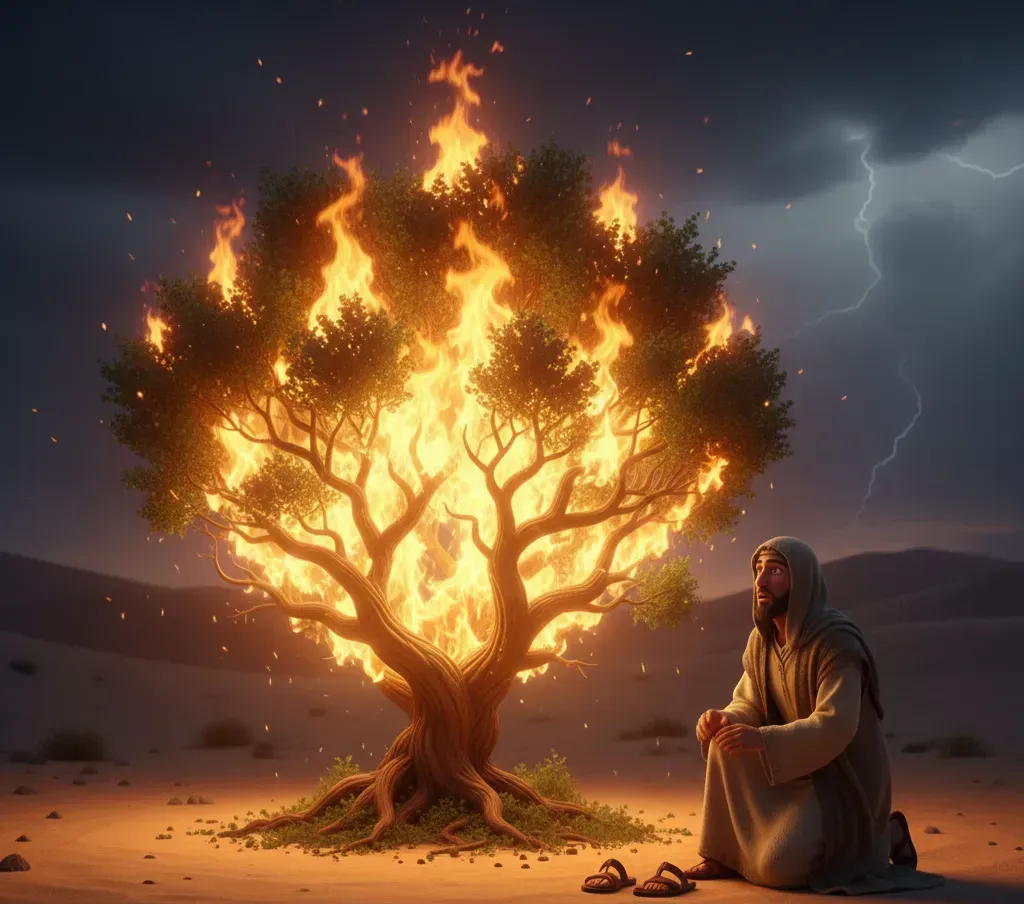
The Unconsumed Fire: At the base of Mount Horeb, eighty-year-old Moses removes his sandals before the burning acacia bramble as Yahweh speaks from the flames.
3. The Impulsive Murder and the Flight to Midian
For forty years, Moses lived in the marble palaces of Egypt. Acts 7:22 records that "Moses was learned in all the wisdom of the Egyptians, and was mighty in words and deeds." He was educated in statecraft, hieroglyphics, and military generalship. Yet deep within his heart, he knew he was not an Egyptian.
One day, walking among the construction sites, Moses witnessed an Egyptian taskmaster brutally flogging a defenseless Hebrew slave. Looking this way and that, and seeing no one watching, Moses' righteous indignation erupted into impulsive violence: he struck the Egyptian, killed him, and concealed his corpse in the desert sand.
Moses presumed his brethren would recognize that God was using his aristocratic power to deliver them (Acts 7:25). But the next day, attempting to mediate a dispute between two fighting Hebrews, one snarled: "Who made you a prince and a judge over us? Do you intend to kill me as you killed the Egyptian?"
Terror seized Moses. The murder was public knowledge. When Pharaoh heard of it, he signed an immediate warrant for Moses' execution. Stripped of his royal titles, his royal linen, and his princely status, forty-year-old Moses fled for his life across the scorching Sinai wastes into the barren wilderness of Midian.
4. Forty Years in the Crucible of the Wilderness
Arriving at an oasis well in Midian, Moses defended the seven daughters of Reuel (Jethro), priest of Midian, from aggressive desert shepherds. Welcomed into Jethro's household, Moses married his daughter Zipporah, settled into the nomadic pastoral life, and fathered a son, naming him Gershom ("A Stranger There"), confessing: "I have been a stranger in a foreign land" (Exodus 2:22).
Consider the profound psychological and spiritual dismantling of Moses during these decades. The former prince of Egypt—who had commanded armies and dined at royal banquets—spent forty long, monotonous years herding smelly sheep through the wind-swept, sun-bleached gorges of Sinai. Season after season, the desert sun burned away his self-importance; the silent granite canyons silenced his worldly eloquence. God was teaching him the ancient curriculum of patience, endurance, and humble shepherd-care, transforming the fiery revolutionary into the meekest man on the face of the earth (Numbers 12:3).
5. The Burning Bush: The Holy Ground of Horeb
Eighty years had passed since the ark of reeds. In Egypt, the old Pharaoh died, but the groaning of the enslaved Israelites rose as a desperate cry to heaven: "And God heard their groaning, and God remembered His covenant with Abraham, with Isaac, and with Jacob" (Exodus 2:24).
Meanwhile, eighty-year-old Moses was leading his father-in-law's flock to the back of the desert, arriving at the jagged granite foot of Horeb, the mountain of God. Scanning the dry, rocky slope, his eye caught a bizarre, supernatural anomaly: a common desert acacia bramble (*Seneh*) was blazing with roaring, crackling fire—yet the delicate leaves and dry twigs were not turning to ash!
Moses muttered to himself, "I will now turn aside and see this great sight, why the bush does not burn."
The moment Moses took a step toward the flames, an authoritative, thundering voice echoed from the heart of the fiery bramble:
"Moses, Moses!"
Trembling, the shepherd replied, "Here I am."
The voice commanded with terrifying majesty:
"Do not draw near this place. Take your sandals off your feet, for the place where you stand is holy ground. I am the God of your father—the God of Abraham, the God of Isaac, and the God of Jacob." (Exodus 3:5-6)
Moses hid his face in his shepherd's cloak, for he was terrified to look upon God. The Creator of the cosmos had descended into a common thorn-bush. Removing his dirty sandals was a total surrender of human rights, stepping barefoot into the unmediated presence of transcendent purity.
6. "I AM WHO I AM": The Commissioning and the Name
Yahweh declared His sovereign redemptive purpose:
"I have surely seen the oppression of My people who are in Egypt, and have heard their cry because of their taskmasters, for I know their sorrows. So I have come down to deliver them... Come now therefore, and I will send you to Pharaoh that you may bring My people, the children of Israel, out of Egypt." (Exodus 3:7-10)
Moses shrank back in panic. The proud forty-year-old who once killed an Egyptian now trembled as an eighty-year-old shepherd: "Who am I that I should go to Pharaoh?"
God answered not by flattering Moses, but by anchoring him in His own presence: "I will certainly be with you."
Moses pressed further: "Indeed, when I come to the children of Israel and say to them, 'The God of your fathers has sent me to you,' and they ask me, 'What is His name?' what shall I say to them?"
Then God spoke the supreme, self-existent memorial Name of the covenant:
"EHУЕН ASHER EHYEH — I AM WHO I AM."
"Thus you shall say to the children of Israel, 'I AM has sent me to you.' The LORD God of your fathers... this is My name forever, and this is My memorial to all generations." (Exodus 3:14-15)
To confirm his authority, God endowed Moses' wooden shepherd's staff with supernatural power (*Mofet*): thrown to the ground, it became a terrifying serpent; taken by the tail, it restored itself as a staff. He placed his hand into his bosom, and it emerged leprous as snow; replaced again, it was fully healed.
Armed with nothing more than the staff of God and the uncreated Name of Yahweh, eighty-year-old Moses turned his face toward Egypt. The boy of the papyrus ark, refined in the desert furnace, was returning to confront the greatest empire on earth and lead the covenant nation into freedom.
Biblical Keywords & Theological Roots
Ark, chest, or watertight vessel; used exclusively in Scripture for Noah's Ark and the papyrus basket preserving infant Moses upon the Nile.
Thorny bush, desert bramble, or wild acacia shrub; the humble vegetation through which God manifested His fiery theophany at Mount Horeb.
'I AM WHO I AM' or 'I WILL BE WHAT I WILL BE'; the absolute self-existent, eternal, immutable covenant Name of God revealed to Moses.
To slip off, strip away, cast off sandals or garments; indicating reverent disarming of oneself before the terrifying holiness of God.
A wonder, supernatural sign, portent, or miraculous token confirming divine authority and prophetic commissioning.
Ancient Near Eastern & Archaeological Context
The historical backdrop of Exodus 1–4 corresponds closely with the explosive expansion of the Egyptian New Kingdom (18th Dynasty, circa 1550–1450 BC). Following the expulsion of the Asiatic Hyksos rulers, native Egyptian pharaohs viewed the rapidly multiplying Semitic population in the northeastern delta (the land of Goshen) as a catastrophic national security threat. Pharaonic decrees instituted state-enforced corvée labor, forcing Hebrews to quarry stone and mold mudbrick for the royal store-cities of Pithom and Raamses.
When forced labor failed to crush Hebrew demographic growth, Pharaoh enacted a horrific decree of state-sponsored infanticide, commanding Egyptian midwives and taskmasters to cast all newborn Hebrew boys into the Nile—sacrificing them to the crocodile god Sobek and the life-giving river deity Hapy. Moses' mother Jochebed defied the royal edict by faith (Hebrews 11:23). She constructed an ark of papyrus reeds (*gome*), sealed it with bitumen (*chamar*) and pitch (*zefet*), and floated it among the reeds (*suph*) along the Nile shoreline.
Adoption of foreign children by royal Egyptian women is well attested in New Kingdom papyri. Pharaoh's daughter (often identified in historical scholarship with Princess Hatshepsut or a daughter of Thutmose I) bathed in the Nile as a religious purification ritual. By rescuing Moses and providing him with the highest royal education (*The Wisdom of the Egyptians*, Acts 7:22), Moses was trained in scribal administration, military generalship, and diplomacy—unconsciously equipping him to challenge Pharaoh decades later.
Furthermore, Midian (situated in the volcanic, desert highlands of northwest Arabia and southern Sinai) was inhabited by semi-nomadic Kenites and Midianite pastoralists descended from Abraham through Keturah (Genesis 25:2). Reuel (Jethro), the priest of Midian, preserved an ancient ancestral memory of the true Creator God. Mount Horeb (often identified with the jagged granite mass of Jabal Musa in southern Sinai) was renowned among nomads as a desolate, forbidding mountain of God. The desert acacia (*Acacia tortilis* or *Seneh*), equipped with lethal thorns and dense wood, was the standard scrub flora of the Sinai ravines.
Practical Discipleship & Spiritual Application
- God's Preservation of His Deliverers Through Fragile Means: When the world's greatest superpower commanded the extermination of every Hebrew baby boy, God mocked the wrath of the tyrant by using an ark of fragile papyrus reeds, a brave mother, a vigilant sister, and the tyrant's own daughter to preserve the deliverer. God's providential care often operates through the weakest, most vulnerable vessels to confound the mighty.
- The Necessity of Unlearning Worldly Self-Reliance: Moses spent forty years learning to be a 'somebody' in Egypt's royal courts, forty years learning to be a 'nobody' herding sheep in Midian, and forty years discovering what God can do with a surrendered nobody. Before God can use us for His kingdom, our pride, temper, and reliance on fleshly strength must be thoroughly dismantled in the desert of brokenness.
- Reverent Holy Awe in the Presence of Yahweh: God commanded Moses to remove his sandals because the unmediated presence of the Holy One sanctified common desert dirt into holy ground. In an era of casual, flippant religion, the burning bush calls us back to trembling, barefoot reverence before the blazing purity and majesty of Almighty God.
- Resting in the Sufficiency of the Great 'I AM': When Moses quivered with feelings of inadequacy, stuttering, 'Who am I that I should go to Pharaoh?' God did not flatter Moses' self-esteem. Instead, God deflected the question by revealing His own identity: 'I AM WHO I AM... I will certainly be with you.' Our adequacy is never found in who we are, but exclusively in who God is.
⚡ Fast Facts
- The Linguistic Mystery of the 'Ark': The Hebrew word used for Moses' papyrus basket (*Tevah*) appears in only one other narrative in the entire Old Testament: Noah's Ark (Genesis 6). In both instances, the *Tevah* represents a small, pitch-sealed vessel sovereignly preserving God's seed of salvation through waters of death.
- The Egyptian Name of Moses: The biblical name Moses corresponds directly to the widespread 18th-Dynasty Egyptian royal name-element *mose* (meaning 'born of' or 'son of', seen in Thutmose, Ahmose, Ramesses); while in Hebrew, it forms a prophetic wordplay with *Mashah* ('to draw out', Exodus 2:10).
- The Forty-Year Triad: Moses' life is divided into three distinct, symmetrical forty-year epochs: forty years as a prince in the palaces of Egypt, forty years as an obscure shepherd in the deserts of Midian, and forty years as the prophetic deliverer of Israel through the wilderness.
- The Self-Existent Name: At the burning bush, God revealed His covenant memorial Name for all generations: *Ehyeh Asher Ehyeh* ('I AM WHO I AM', Exodus 3:14), from which the sacred tetragrammaton **YHWH** (Yahweh, the eternal, uncreated, self-sustaining Lord) is derived.
❓ Frequently Asked Questions (FAQs)
In Egypt, Moses was educated in military tactics, hieroglyphics, diplomacy, and statecraft, and he initially presumed he could deliver Israel through his own political charisma and physical strength (Acts 7:22-25). Forty years of herding sheep in the desolate Sinai wilderness stripped Moses of his royal arrogance, broke his self-reliance, and taught him the patience, humility, and wilderness survival skills essential for shepherding two million contentious Israelites through the desert.
The humble desert thorn-bush (*Seneh*) symbolized the afflicted people of Israel, enduring the fiery furnace of Egyptian slavery without being eradicated, because Yahweh's presence dwelt in their midst. Moreover, it revealed the nature of God Himself: unlike all created beings whose energy relies upon external fuel, the uncreated God burns with self-sustaining holiness and infinite glory, needing nothing outside of Himself.
In the ancient Near East, sandals carried the dust and dirt of the fallen world. To remove sandals was a universal posture of surrender, reverence, and servitude. Furthermore, in ancient covenant legal customs, removing a shoe symbolized surrendering one's personal rights and jurisdiction (Ruth 4:7). At Horeb, the fugitive shepherd surrendered his personal autonomy and stepped barefoot onto sacred ground consecrated by the unmediated presence of the Holy One.