![The Parting of the Red Sea: Deliverance at the Waters - [object Object] | Bible Hunger](/images/stories/red_sea_parting.webp "The Parting of the Red Sea: Deliverance at the Waters")
The silver glow of the Passover moon had illuminated Israel's triumphant exodus from Rameses. Over two million freed Hebrew slaves—men, women, children, carrying the embalmed bones of the patriarch Joseph and driving vast herds of livestock—marched toward the wilderness under the supreme banner of Yahweh. By day, a colossal pillar of cloud rose like an ivory monolith into the azure desert sky, casting cooling shade over the multitude; by night, that same pillar flared into a pillar of roaring celestial fire, bathing the camp in divine warmth and guidance. But as they reached the edge of the wilderness, God gave an astonishing, counterintuitive command: "Speak to the children of Israel, that they turn and camp before Pi-Hahiroth, between Migdol and the sea, opposite Baal-Zephon" (Exodus 14:2).
1. Trapped at Pi-Hahiroth: The Impossible Cul-de-Sac
From a military perspective, Moses' route appeared completely insane. Instead of taking the direct, fortified northern coastal route ("the way of the land of the Philistines"), Israel was commanded to execute a sharp southward detour. They marched straight into a geographic funnel: on their flanks rose rugged, impassable desert mountain crags; ahead of them surged the deep, stormy waters of the Red Sea; behind them stretched the open desert wilderness.
In Tanis and Memphis, Egyptian royal scouts hurried into Pharaoh's audience hall with breathless reports: "The Israelites have lost their way! They are wandering in confusion! The wilderness has closed them in!"
Pharaoh's temporary remorse over the death of Egypt's firstborn instantly curdled into cold, venomous fury. The economic reality hit the royal court with crushing force: who would quarry the granite for their pyramids? Who would build their store-cities? Who would maintain their irrigation canals? Pharaoh cried aloud: "Why have we done this, that we have let Israel go from serving us?" (Exodus 14:5).
2. The Iron Thunder of Pharaoh's Chariots
The full military might of the Egyptian New Kingdom mobilized with terrifying speed. Pharaoh ordered his royal armor-bearers to harness his gilded battle chariot. Alongside him rode six hundred choice war chariots—the elite armored shock corps of the imperial guard—accompanied by all the cavalry regiments, archers, and armored infantry divisions of Lower Egypt.
As twilight settled over the Hebrew camp at Pi-Hahiroth, the earth began to tremble. A low, ominous roar rolled across the desert horizon like approaching thunder. Then, rising above the western sand dunes, the Israelites saw a terrifying sight: a massive cloud of yellow dust blotting out the setting sun, pierced by the blinding glint of polished bronze armor, fluttering royal banners, and the thunderous beat of thousands of galloping iron-shod war horses.
A wave of visceral, paralyzing panic tore through the Hebrew multitude. Four centuries of slave conditioning surged back into their veins. They surrounded Moses in hysterical terror:
"Because there were no graves in Egypt, have you taken us away to die in the wilderness? Why have you so dealt with us, to bring us up out of Egypt? Is this not the word that we told you in Egypt, saying, 'Let us alone that we may serve the Egyptians'? For it would have been better for us to serve the Egyptians than that we should die in the wilderness!" (Exodus 14:11–12)
3. "Stand Still and See the Salvation of the LORD"
Moses stood immovable before the screaming, terrified multitude. Behind him foamed the merciless waters of the sea; before him charged the finest armored killing machine on earth; all around him sounded the weeping of mothers and the despairing curses of men. Yet Moses did not flinch, reach for a sword, or bargain with Pharaoh. Raising his voice with thunderous, majestic authority, he spoke words that will echo through human history until the end of time:
"Do not be afraid. Stand still, and see the salvation (*Yeshua*) of the LORD, which He will accomplish for you today. For the Egyptians whom you see today, you shall see again no more forever. The LORD will fight for you, and you shall hold your peace!" (Exodus 14:13–14)
Then Yahweh spoke to Moses: "Why do you cry to Me? Tell the children of Israel to go forward! But lift up your rod, and stretch out your hand over the sea and divide it (*baqa*). And the children of Israel shall go on dry ground through the midst of the sea!"
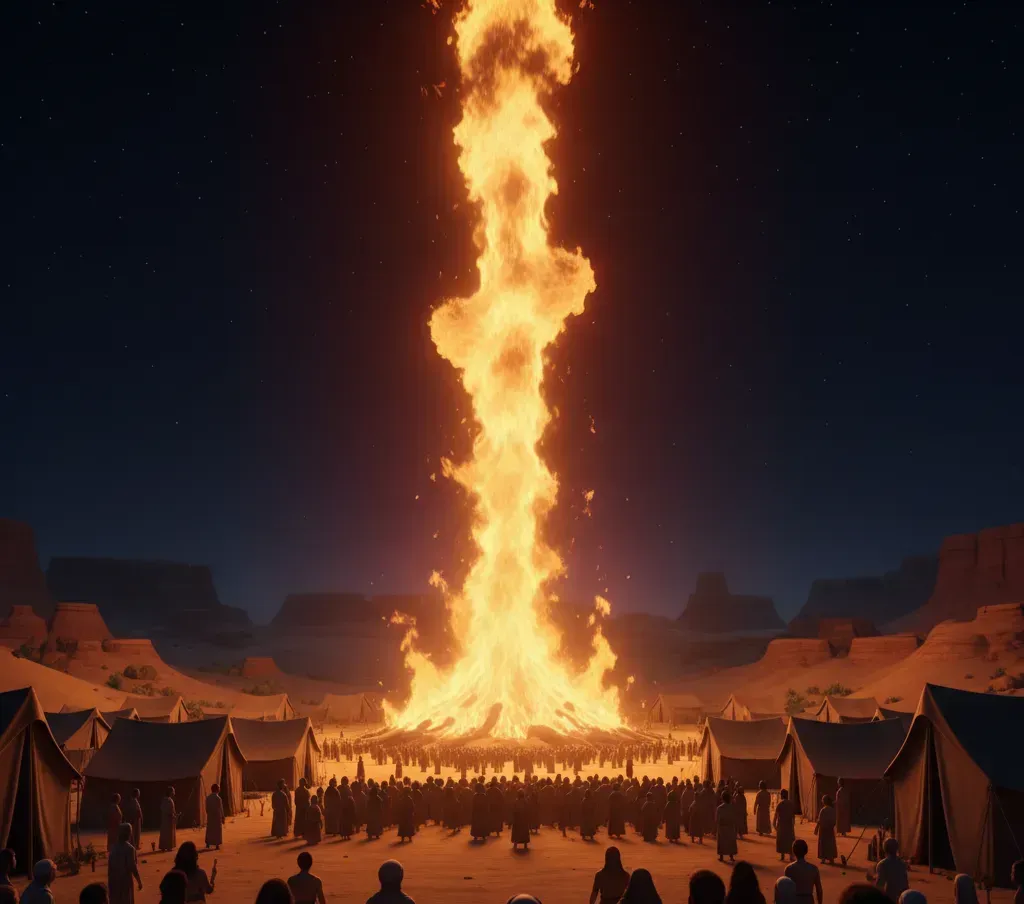
The Divine Vanguard: The supernatural Pillar of Cloud and Fire maneuvers behind Israel, casting blinding radiance upon the Hebrews while plunging Pharaoh's chariots into terrifying darkness.
4. The Shekinah Shift: Rearguard of Fire and Gloom
Before Moses even reached the shoreline, a supernatural maneuver of staggering cosmic proportions unfolded in the desert. The colossal Pillar of Cloud that had hovered at the front of the Hebrew column slowly, majestically lifted from the vanguard. It soared high into the darkening twilight, glided over the heads of the two million Hebrews, and settled firmly between the camp of Israel and the advancing armies of Pharaoh!
The effect was absolute and miraculous:
- Toward Israel: The pillar became a roaring furnace of incandescent Shekinah fire, flooding the entire shoreline with brilliant celestial light, banishing panic, and providing warmth against the biting cold of the desert night.
- Toward Egypt: The exact same pillar became an impenetrable wall of swirling pitch-black darkness and thick disorientation. Pharaoh's chariot drivers could not see twenty paces ahead. The warhorses balked, reared, and collided in blind panic. All through that fateful night, the Egyptians were completely paralyzed, unable to approach the Hebrews.
5. The Midnight East Wind and the Cleaving of the Deep
Standing upon a coastal promontory in the blazing illumination of the pillar of fire, Moses stretched out his wooden shepherd's staff over the dark waters of the sea.
Instantly, the atmosphere convulsed. Yahweh summoned a mighty, howling east wind (*Ruach Qadim*) that swept down from the wilderness throughout the entire night. The celestial wind drove into the depths of the sea with hydrodynamic fury. Before the astounded eyes of two million witnesses, the oceanic currents cleaved asunder (*baqa*)!
The raging waters congealed like solid battlements on either side. Giant vertical ramparts (*chomah*) of towering, translucent water stood upright to the right hand and to the left, revealing the ancient marine canyons beneath. Even more miraculous, the blast of divine wind did not leave a muddy, impassable quagmire; it instantly baked the seabed into hard, dry ground!
A wide, subterranean highway opened straight through the heart of the deep. In orderly tribal procession, illuminated by the fiery pillar behind them, millions of men, women, children, carts, and herds marched down into the dry chasm of the sea. All night long, the quiet rustle of footfalls, the creaking of wagon axles, and the lowing of cattle echoed between the frozen liquid walls as Israel passed through the jaws of death into resurrection freedom.
6. The Morning Watch: Chaos, Collapse, and Miriam's Song
As the gray light of dawn began to break over the eastern desert, the final Hebrew family stepped up onto the opposite shore. Behind them, the pillar of cloud lifted from before the Egyptian army.
Seeing the empty camp and the vast dry highway stretching through the cleaved sea, Pharaoh's military pride completely overwhelmed his reason. He raised his golden scepter and screamed the fatal order: "Charge!"
Six hundred elite chariots, thousands of armored cavalry, and screaming infantry plunged headlong down the slippery slopes into the oceanic chasm in hot pursuit. But during the morning watch (between 2:00 AM and 6:00 AM), Yahweh looked down upon the Egyptian army from the pillar of fire and cloud, and unleashed catastrophic supernatural panic.
The dry seabed suddenly turned to treacherous, churning mud. Chariot wheels bound, twisted, and broke off their bronze axles. The war chariots dragged helplessly, capsizing in tangled heaps of screaming horses and trapped drivers. The terrifying realization struck the Egyptian officers:
"Let us flee from the face of Israel, for the LORD fights for them against the Egyptians!" (Exodus 14:25)
It was too late. The Lord said to Moses: "Stretch out your hand over the sea, that the waters may come back upon the Egyptians, on their chariots, and on their horsemen."
Moses stretched his staff over the sea in the morning light. The divine restraint was instantly released. With a deafening, thunderous roar that shook the very foundations of the earth, the suspended oceanic battlements collapsed! Billions of tons of churning, foaming sea surged back from both sides with apocalyptic kinetic force.
The screaming warriors, the gilded chariots, the armored stallions, and Pharaoh's proud commanders were swallowed whole by the raging abyss. The waters covered the chariots, the horsemen, and all the army of Pharaoh that came into the sea after them. Not so much as one of them remained! (Exodus 14:28).
The morning sun rose over a glassy, calm sea. Lapping gently upon the eastern sands were the washed-up shields, broken chariot wheels, and corpses of their former tormentors. Israel saw the great work which the LORD had done against the Egyptians; so the people feared the LORD, and believed the LORD and His servant Moses.
Then Miriam the prophetess, the sister of Aaron, took a timbrel in her hand, and all the women went out after her with timbrels and with dances. Her voice rang out across the desert sky in triumphant celebration:
"Sing to the LORD, for He has triumphed gloriously! The horse and its rider He has thrown into the sea!" (Exodus 15:21)
Biblical Keywords & Theological Roots
The biblical Hebrew designation 'Yam Suph' literally translates as 'Sea of Reeds' or 'Sea of Seaweed' (suph refers to reeds, rushes, or marine algae). In the Septuagint (LXX), the Jewish translators rendered it as 'Erythra Thalassa' (Red Sea). Scholars note that 'Yam Suph' designates both the bodies of water along the modern Suez/Sinai frontier and extending into the Gulf of Aqaba (1 Kings 9:26). Far from a shallow marsh, Scripture emphasizes deep oceanic chasms ('tehomot') where massive military chariots were utterly submerged and engulfed.
A potent Hebrew verb signifying a violent mechanical rupture, fracture, or dividing in two. Used in Exodus 14:16 when God commands Moses: 'Lift up your rod, and stretch out your hand over the sea and divide it (u-veqa'ehu).' It depicts the absolute rending of natural hydrodynamics—water parting as if cut through by a celestial blade, standing upright like solid stone walls on either side.
The supernatural vehicle of the Shekinah—the uncreated Glory of God. In Exodus 14:19-20, the Angel of God and the Pillar miraculously relocated from leading the vanguard to fortifying the rearguard. To the fleeing Hebrews, it radiated brilliant celestial illumination; to the pursuing Egyptians, it cast terrifying, disorienting black darkness, locking the two armies in supernatural separation throughout the night.
When the terrified Israelites saw Pharaoh's army and surrendered to panic, Moses roared: 'Hityatzevu u-r'u et-Yeshu'at Yahweh' ('Stand firm and behold the salvation of the LORD'). This word 'Yeshua' is the precise etymological root of the Name of Jesus (Yeshua Hamashiach)—the Ultimate Deliverer who parts the impossible waters of sin and death to shepherd His redeemed into eternal life.
Exodus 14:22 explicitly records that 'the waters were a wall (chomah) to them on their right hand and on their left.' Chomah is the standard military term for the colossal stone ramparts protecting fortified Bronze Age cities. The liquid currents were miraculously congealed, standing motionless like two towering granite ramparts while millions walked across the ocean bed.
Ancient Near Eastern & Archaeological Context
The geopolitical and tactical setting of the Exodus reflects the supreme zenith of New Kingdom Egyptian military power (18th/19th Dynasty). Pharaoh commanded an elite force of 600 chosen war chariots (*merkabot*) alongside thousands of regular cavalry, archers, and armored infantry. Egyptian war chariots were masterpieces of ancient military engineering: ultra-lightweight bent-wood chassis, low center of gravity, spoked wheels with bronze hubcaps, and manned by two warriors—a driver (*ketzen*) and an archer-lancer armed with deadly composite recurve bows capable of firing armor-piercing arrows at long ranges. Geographically, God deliberately ordered Israel to reverse direction and camp before *Pi-Hahiroth*, between *Migdol* and the sea, opposite *Baal-Zephon* (Exodus 14:2). Ancient reconnaissance outposts reported to Pharaoh that the fleeing slaves were 'entangled in the wilderness' (*nevucheem hem ba'aretz*). Baal-Zephon was the ancient Canaanite and maritime shrine dedicated to Hadad/Zephon, the god of storms and coastal waters. By staging the final confrontation precisely at the feet of this sea deity, Yahweh set a geopolitical and theological ambush, proving that even the violent surges of the storm seas were completely subject to His spoken command.
Practical Discipleship & Spiritual Application
- The Battle of Paralysis: When Trapped at Pi-Hahiroth: There are seasons in life where all human avenues of escape vanish—behind you lies an attacking enemy, in front of you an impassable sea, and rocky crags on both sides. In such moments, natural instinct surrenders to frantic despair or bitter blame. Hear God's command: 'Do not be afraid. Stand still, and see the salvation of the LORD!' Stillness is not apathy; it is the radical spiritual posture of entrusting your vindication entirely into the hands of an Almighty Father.
- Faith Demands Movement Before Waters Part: God said to Moses: 'Why do you cry to Me? Tell the children of Israel to go forward!' (Exodus 14:15). God did not dry up the Red Sea while Israel sat passively in their tents. The priests and families had to march forward toward the foaming shoreline in active obedience. Expect divine breakthroughs only when your feet are actively moving in obedience to God's revealed will.
- The Total Destruction of Generational Bondage: Moses gave a prophetic guarantee that echoes through eternity: 'The Egyptians whom you see today, you shall see again no more forever!' When God redeems a soul through the blood of Christ, He does not broker a temporary truce with our spiritual adversaries; He drowns the tyranny of sin, guilt, and satanic condemnation beneath the ocean of His sovereign grace.
- The Baptism of the Red Sea: As the Apostle Paul reveals in 1 Corinthians 10:1-2, Israel's crossing beneath the cloud and through the cleaved waters was a profound prophetic type of Christian baptism. They entered the seabed as terrified runaway slaves; they emerged on the eastern shore as a liberated, consecrated nation bound in covenant to their King. When you pass through waters of trial with Christ, you leave your chains behind forever.
⚡ Fast Facts
- The East Wind Blew All Night: Exodus 14:21 states that Yahweh caused the sea to go back by a strong east wind all night (*Ruach Qadim*), demonstrating that God often utilizes natural atmospheric forces orchestrated with supernatural precision to accomplish His miracles.
- Pharaoh's 600 Elite Chariots: The Egyptian war machine mobilized six hundred choice chariots (*Shesh-me'ot rechev bachur*)—the royal armored shock troops of the empire—along with every standard chariot in Egypt.
- Congealed Waters: In the Song of Moses, Exodus 15:8 uses the poetic Hebrew term 'Qaphu' ('the depths congealed in the heart of the sea'), describing waters turning semi-solid like gelatinous walls.
- New Testament Baptism Typology: 1 Corinthians 10:1-2 explicitly connects the crossing of the Red Sea to New Testament baptism: 'All were baptized into Moses in the cloud and in the sea.'
❓ Frequently Asked Questions (FAQs)
Skeptics often claim Israel crossed the 'Reed Sea,' suggesting a knee-deep marsh or lake in the Nile delta. However, the biblical text completely refutes this notion. Exodus 15:4-5 celebrates that Pharaoh's chosen captains 'drowned in the Red Sea' and that 'the depths covered them; they sank to the bottom like a stone.' Furthermore, Exodus 14:22 records that the waters stood as a 'wall' (*chomah*) on both their right hand and left hand. Knee-deep swamp water neither drowns armored chariot divisions nor forms towering vertical walls.
Psalm 136:15 declares that the LORD 'overthrew Pharaoh and his army in the Red Sea.' While some historical records of Pharaohs do not record battlefield deaths due to royal Egyptian propaganda, the biblical narrative clearly emphasizes the total annihilation of the pursuing monarch's military force, leaving not a single survivor among the cavalry and chariot regiments that charged into the chasm (Exodus 14:28).
The Red Sea crossing is the supreme Old Testament type of redemption and regeneration. As Paul explains in 1 Corinthians 10:1-2, passing through the cleaved sea beneath the glory cloud symbolized baptism—dying to the old life of slavery in Egypt and rising to walk in holy covenant freedom. It proves that no obstacle, addiction, or spiritual adversary can thwart God's sovereign rescue plan when His people step forward in obedient faith.