Recorded in Luke 19:11-27, the Parable of the Ten Minas is Christ's masterful corrective to apocalyptic impatience. Delivered in the oasis city of Jericho on His final ascent to Jerusalem, Jesus dismantled the widespread expectation that the Kingdom of God was about to be inaugurated through an immediate political triumph, establishing instead that His departure would usher in a long era of active stewardship followed by an unsparing final audit.
1. The Delusion of an Immediate Kingdom and the Historical Nobleman
The Gospel writer records the precise historical trigger: "While they were listening to this, he went on to tell them a parable, because he was near Jerusalem and the people thought that the kingdom of God was going to appear at once" (Luke 19:11). The disciples and pilgrims expected Jesus to enter Jerusalem, depose the Roman prefect, and immediately establish the Messianic empire. To shatter this fantasy, Jesus introduced a nobleman who "went to a distant country to have himself appointed king and then to return" (Luke 19:12). This was a direct echo of Herod Archelaus traveling to Rome in 4 BC to secure his crown—a familiar, bloody precedent in Jericho's local history.
2. The Universal Deposit: "Do Business Until I Return"
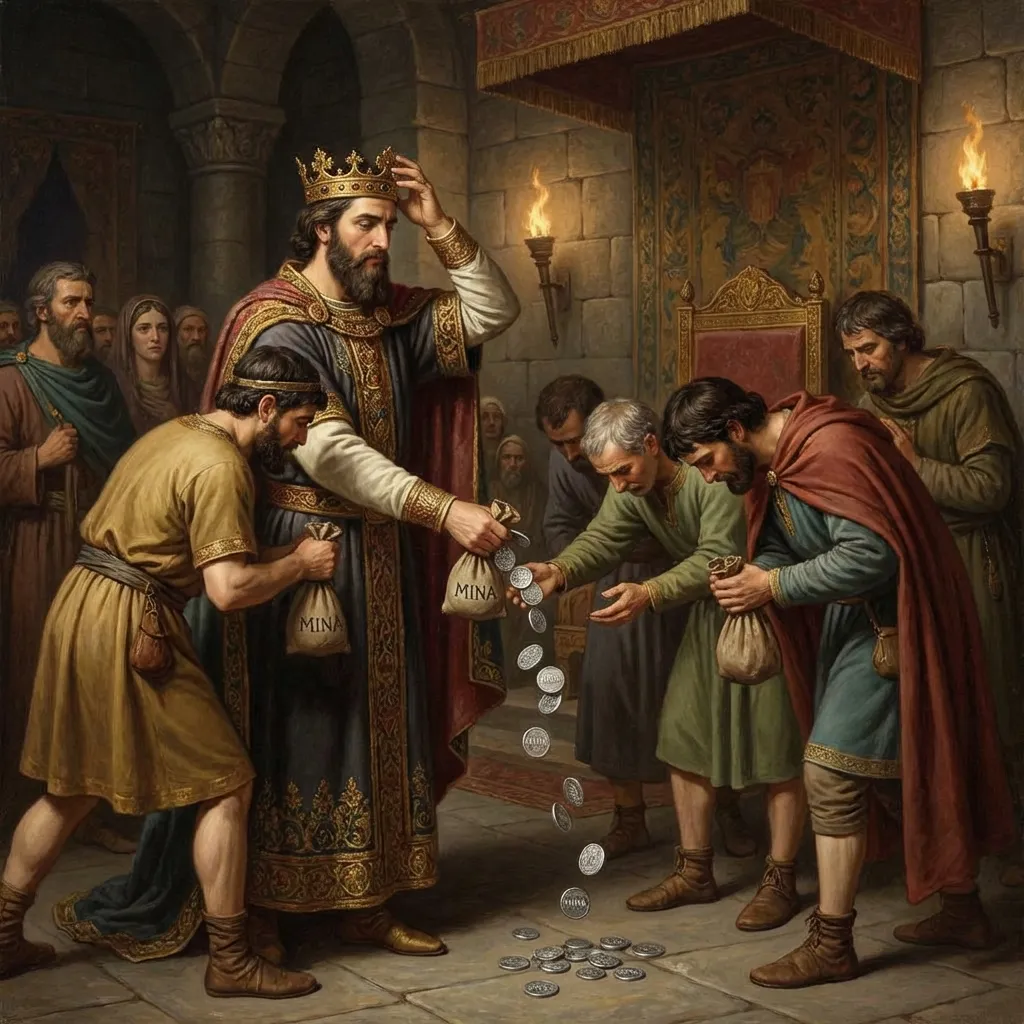
Before his departure, the nobleman called ten of his servants and entrusted each with a single silver mina (roughly three months' wages for an agricultural laborer): "Put this money to work until I come back," he said (Luke 19:13). The Greek imperative is pragmateusasthe—trade, do business, actively multiply capital! The master did not issue detailed micromanaged blueprints; he gave them resources and freedom, demanding dynamic initiative. Meanwhile, his rebellious subjects dispatched a delegation after him, protesting: "We don't want this man to be our king" (Luke 19:14).
3. The Day of Reckoning: Multiplication and Governance
Having received the crown, the King returned and summoned his servants for an audit. The first stepped forward with joyful triumph: "Sir, your mina has earned ten more." The King responded with overflowing commendation: "Well done, my good servant! Because you have been trustworthy in a very small matter, take charge of ten cities" (Luke 19:16-17). The second reported: "Sir, your mina has earned five more." He was granted authority over five cities. Notice the radical disproportion of kingdom economics: faithfulness with a modest three-month silver deposit was rewarded with geopolitical governance over major cities in the King's empire!
4. The Tragedy of the Sweat-Cloth: Paralyzed by Fear
Then came the tragic third servant: "Sir, here is your mina; I have kept it laid away in a piece of cloth. I was afraid of you, because you are a hard man. You take out what you did not put in and reap what you did not sow" (Luke 19:20-21). He wrapped the coin in a soudarion (a sweat-cloth worn around the neck to wipe perspiration during hard labor). The very cloth designed for sweaty toil was used to cocoon his lazy disobedience! Blaming the King for his own sloth, he justified his cowardice with a slanderous, legalistic portrait of the master's character. The King condemned him out of his own mouth: if he truly thought the master was severe, why did he not at least deposit the silver with bankers to earn interest?
5. The Sovereign Law of Kingdom Multiplication and Retribution
The King commanded: "Take his mina away from him and give it to the one who has ten minas." When onlookers protested, the King announced the eternal principle: "I tell you that to everyone who has, more will be given, but as for the one who has nothing, even what they have will be taken away" (Luke 19:24-26). Spiritual giftings and opportunities are not static entitlements; they must be actively multiplied. The parable concluded with a terrifying eschatological verdict against the rebellious citizens: "But those enemies of mine who did not want me to be king over them—bring them here and kill them in front of me" (Luke 19:27). When the Son of Man returns in glory, His faithful stewards will reign with Him, but those who defiantly rejected His grace will face absolute, everlasting ruin.
Biblical Keywords & Theological Roots
Mina; a substantial Greek silver weight equal to 100 silver drachmas (roughly three to four months of a laborer's wages).
To trade, do business, actively invest and multiply capital until the master returns.
Severe, harsh, exacting, austere; the distorted, legalistic caricature of the King held by the slothful, terrified servant.
Ancient Near Eastern & Archaeological Context
The geopolitical backdrop of Luke 19:12 was instantly recognizable to Jesus' listeners. When King Herod the Great died in 4 BC, his will partitioned his realm, appointing his brutal son Herod Archelaus as ethnarch of Judea and Samaria. Under Roman imperial law, a client ruler had to travel to Rome to have his royal title confirmed by Caesar Augustus. A Jewish delegation of fifty prominent ambassadors immediately traveled to Rome to protest his coronation. Augustus confirmed Archelaus' rule over Judea, and upon his return to his magnificent winter palace in Jericho, Archelaus brutally retaliated against his political opponents. Jesus seized upon this real-life historical incident familiar to everyone in Jericho to illustrate the absolute sovereignty, patience, and coming judgment of the King of Kings.
🔑 Key Spiritual Takeaways
- Interim Stewardship Before the Return: The Kingdom will not consummate instantaneously; believers live in a prolonged interim era charged with active Gospel investment.
- Faithfulness Multiplies Capital: Every believer has been entrusted with the deposit of the Gospel and spiritual gifts, expected to generate redemptive fruit for the King.
- The Danger of a Distorted View of God: Viewing God as harsh and tyrannical paralyzes faith and breeds disobedient, fearful passivity.
- Rebellion Meets Just Retribution: Those who openly reject the rightful reign of the King face total eschatological destruction at His glorious return.
Support Independent Biblical Research
Did this study bless you? Help support our independent bilingual research and interactive visual Bible tools.
⚡ Fast Facts
- Jericho Road Setting: Jesus delivered this parable as He left Jericho on the final ascent to Jerusalem, because the crowds 'thought that the kingdom of God was going to appear at once' (Luke 19:11).
- Historical Parallel of Archelaus: In 4 BC, Herod the Great's son Archelaus traveled to Rome to receive his kingship; a delegation of fifty Jewish citizens sailed after him to petition Caesar Augustus: 'We do not want this man to be our king.'
- Equal Investment, Varied Return: Unlike the Talents where servants received unequal amounts, here all ten servants received the exact same initial investment (one mina each), rewarding differing degrees of diligence (ten cities vs five cities).
- The Slothful Handkerchief: The unfaithful servant wrapped his mina in a *soudarion* (sweat-cloth)—meant to wipe a working laborer's brow, ironically used to wrap up his idle passivity.
❓ Frequently Asked Questions (FAQs)
What is the difference between the Parable of the Ten Minas and the Parable of the Talents?
In Matthew 25 (Talents), three servants receive varied amounts (5, 2, 1) based on their differing abilities, and faithful servants receive identical commendations. In Luke 19 (Minas), all ten servants receive the exact same deposit (one mina each), and rewards are proportional to their diligence: ten cities and five cities. Furthermore, the Minas includes the political narrative of the rebellious citizens.
What does 'trade with this until I come' (pragmateusasthe) mean for the Church?
The Greek imperative *pragmateusasthe* means to actively conduct business, invest, and maximize return. Christ commands His disciples not to retreat into passive survivalism awaiting the rapture, but to aggressively deploy the Gospel, their spiritual gifts, time, and resources to expand His Kingdom.
Why did the nobleman take the mina from the fearful servant and give it to the one with ten?
Spiritual capacity is dynamic, not static. In God's Kingdom, faithfulness compounds: those who faithfully invest God's grace receive greater spiritual capacity and eternal authority, while those who hoard and bury their gifts forfeit even the meager opportunity they possessed.