The heavens had barely closed after the thunderous benediction at the Jordan River. The sacred water of baptism still dampened the garments of Jesus of Nazareth, and the majestic resonance of the Father's voice—"You are My beloved Son, in whom I am well pleased"—still echoed across the river reeds. Yet the Holy Spirit did not usher the newly anointed Messiah into a royal court of acclamation or a festive palace banqueting hall. Instead, Mark records with raw, startling force: "Immediately the Spirit drove Him into the wilderness" (Mark 1:12). The Greek verb ekballei conveys an irresistible sovereign impulse: Christ was thrust into the ring of cosmic warfare. For forty grueling days and forty sleepless nights, the destiny of the human race hung upon the moral steadfastness of one solitary Man confronting the darkness of the abyss!
1. The Jeshimon Wasteland: The Arena of the Last Adam
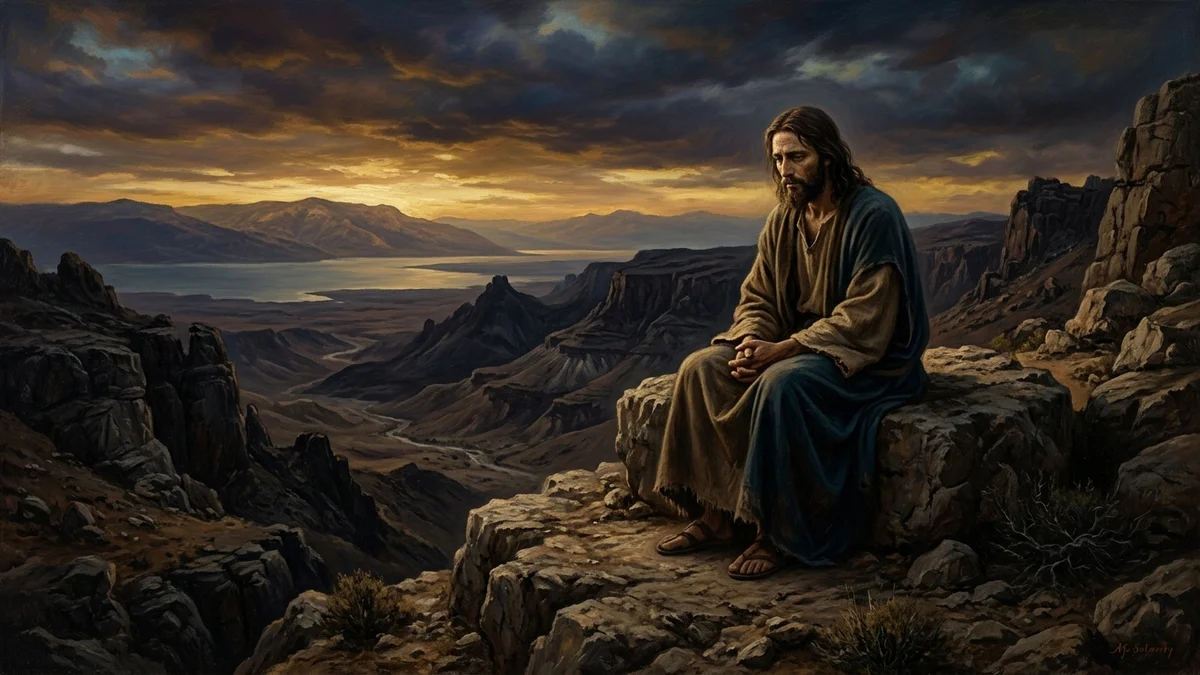
The geography of Christ's testing was neither accidental nor symbolic. The Judean desert, known to the ancient Hebrews as the Jeshimon ("the Devastation"), is an unforgiving badland of blistered chalk terraces, crumbling limestone ridges, and suffocating silence. Here, between the mountain spine of Judea and the sunken salt basin of the Dead Sea, vegetation vanishes. By day, the unrelenting Mediterranean sun bakes the earth into furnace heat; by night, bone-chilling desert winds howl through the gorges, stripping away the warmth of mortal flesh.
Mark adds an eerie, evocative detail omitted by the other Evangelists: "And He was there in the wilderness forty days, tempted by Satan, and was with the wild beasts" (Mark 1:13). In the first century, Syrian brown bears, desert leopards, jackals, and lethal horned vipers inhabited these crags. Christ walked without sword, shield, or human companion. He took neither barley loaf nor water skin.
The biblical typology is breathtaking. When the first Adam was tested, he stood in Eden—a garden of lush, unblemished splendor, surrounded by every fruit-bearing tree imaginable, possessing a companion, and enjoying unbroken fellowship with God. Yet in that paradise of abundance, Adam surrendered to the whisper of the serpent. The Last Adam (1 Corinthians 15:45), by stark contrast, entered the ring under the most severe disadvantages conceivable: isolated, parched, physically emaciated, surrounded by predatory beasts, and battling an adversary who had spent four millennia perfecting his lethal craft of human deception. Where Adam failed in paradise, Christ stood unconquered in the dust!
2. The First Assault: The Seduction of the Stones
Luke records the agonizing threshold of Christ's humanity: "And in those days He ate nothing, and afterward, when they had ended, He was hungry" (Luke 4:2). Forty days represents the absolute physiological boundary of human fasting. At this stage, the body exhausts its fat reserves and begins to consume muscle tissue; the stomach contracts into excruciating cramping, and the mind battles dizziness and disorientation. It was precisely at this moment of extreme physical vulnerability that the shadowy adversary stepped from the twilight:
"Now when the tempter came to Him, he said, 'If You are the Son of God, command that these stones become bread.'" (Matthew 4:3).
The landscape of the Judean wilderness is littered with smooth, oval limestone nodules that bear an uncanny visual resemblance to the flat barley loaves baked by Galilean peasants. Satan’s opening gambit was a masterpiece of insidious psychology. Notice the opening word: "If" (Greek: Ei). The tempter did not challenge God's existence; he attacked Christ's relationship with the Father. Only forty days earlier, heaven had declared, "You are My beloved Son." Now Satan whispered: "Look at Yourself. Starving, shriveled, abandoned in the scorching dust among jackals. Is this how a Father treats His beloved Son? If You truly hold that title, prove it! Seize Your divine prerogative. Turn these cold rocks into warm bread and satisfy Your legitimate physical craving!"
The temptation was not merely about food; it was about authority and trust. Satan urged Jesus to bypass the Father's timeline, distrust the Father's wilderness provision, and weaponize His divine attributes for self-gratification. It was the same lie spoken in Eden: "God is withholding good things from you; take matters into your own hands!"
Weak in body but blazing with divine resolve, Jesus did not debate the tempter. He unsheathed the Sword of the Spirit:
"It is written: 'Man shall not live by bread alone, but by every word that proceeds from the mouth of God.'" (Matthew 4:4; Greek: Gegraptai).
Jesus quoted Deuteronomy 8:3—the exact passage where Moses reminded Israel that God allowed them to hunger in the wilderness so they would learn that physical bread does not sustain ultimate life, but absolute surrender to the sovereign decrees of Yahweh. Jesus declared that physical survival obtained through disobedience to the Father is worse than death. Better to starve in the will of God than feast in alliance with the devil! The first fiery dart shattered against the shield of scripture.
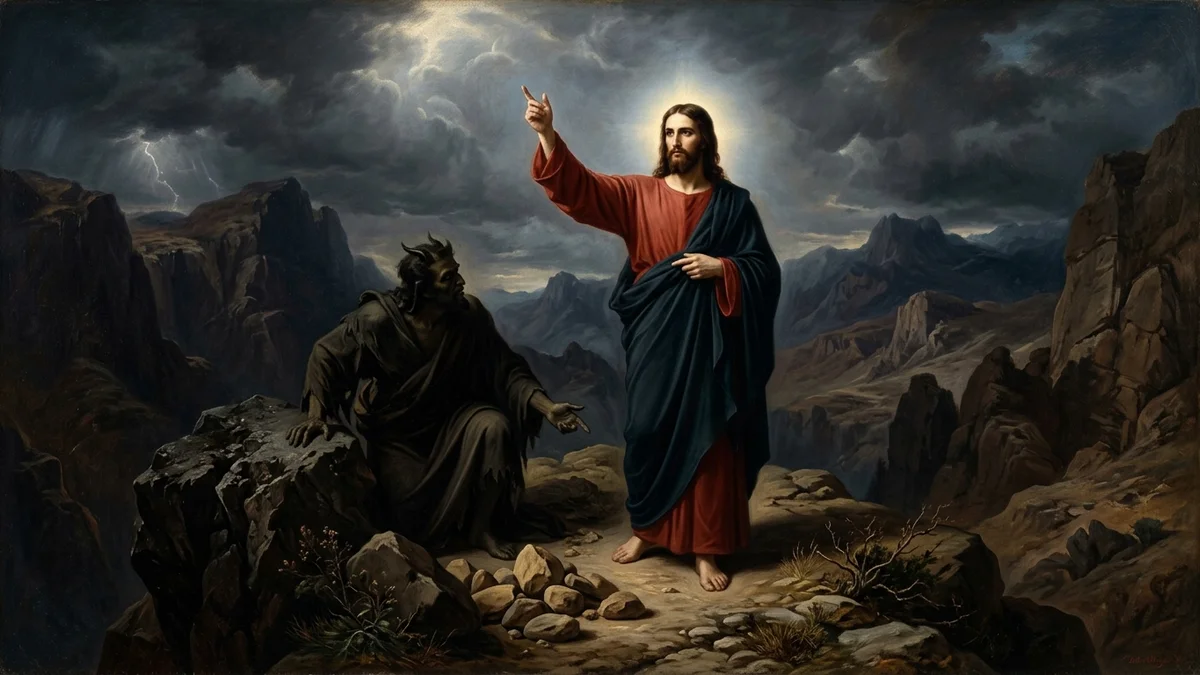 Fine-art depiction of Christ standing resolute upon the rocky crags of the Judean wilderness, pointing authoritatively to heaven while rejecting Satan's treacherous solicitations.
3. The Second Assault: Presumption on the Temple Pinnacle
Realizing that Jesus could not be enticed by physical appetite or tempted into distrusting scripture, the adversary shifted his tactical approach with diabolical cunning. If the Nazarene lived by scripture alone, Satan would weaponize scripture itself!
Matthew records: "Then the devil took Him up into the holy city, set Him on the pinnacle of the temple, and said to Him, 'If You are the Son of God, throw Yourself down. For it is written: He shall give His angels charge over you, and in their hands they shall bear you up, lest you dash your foot against a stone.'" (Matthew 4:5-6).
The pinnacle of the Temple (Greek: pterygion tou hierou) was the dizzying southeast parapet of Solomon’s Royal Stoa on the Temple Mount. Built by Herod the Great with gargantuan ashlar blocks, this stone balcony jutted directly over the sheer drop into the Kidron Valley below. The Jewish historian Flavius Josephus wrote that anyone looking down from this vantage point would experience instant vertigo, as the dizzying depth descended over four hundred and fifty feet to the dry riverbed below!
Satan quoted Psalm 91:11-12—a beloved Messianic psalm promising angelic guardianship. But notice the deceitful mutilation of the text: Satan deliberately omitted the crucial phrase "in all your ways"—the ways of humble obedience! Satan whispered: "You trust the Father’s word so completely? Then leap into the abyss! Let thousands of worshippers standing in the Temple courtyards see You floating miraculously on angelic pinions. Prove Your Messianic claim with an undeniable, sensational sign!"
This was the subtle temptation of spiritual presumption—forcing God’s hand, manufacturing artificial crises to test divine loyalty, and seeking theatrical popularity instead of the pathway of suffering obedience.
Jesus pierced the counterfeit quotation with razor-sharp theological precision:
"It is written again: 'You shall not tempt the Lord your God.'" (Matthew 4:7; citing Deuteronomy 6:16).
To test God is not faith; it is unbelief cloaked in religious piety. True faith rests securely in God's promises during trials that God permits; presumption recklessly manufactures dangers to demand that God perform on command like a magician. Jesus refused to turn faith into a sideshow spectacle. The second assault collapsed in ruin!
4. The Third Assault: The Crown Without the Cross
Furious and desperate, the adversary unleashed his supreme, unmasked ambition. Dropping religious disguises, Satan laid bare the true driving obsession of his fallen nature: the usurpation of cosmic worship!
Luke records: "Then the devil, taking Him up on a high mountain, showed Him all the kingdoms of the world in a moment of time. And the devil said to Him, 'All this authority I will give You, and their glory; for this has been delivered to me, and I give it to whomever I wish. Therefore, if You will worship before me, all will be Yours.'" (Luke 4:5-7).
From a supernatural vantage point, Satan paraded before Christ's eyes the glittering panorama of human empire: the marble palaces of Rome under Tiberius, the golden temples of Greece, the silk-draped dynasties of the Orient, the legions of marching soldiers, the accumulated treasuries, and the applause of millions.
Satan offered Jesus a catastrophic shortcut: "Why tread the path of the Suffering Servant foretold by Isaiah? Why endure the scourge, the mocking spit, the crown of thorns, and the agonizing nails of Calvary? Bow before me for a single second in private acknowledgment, and I will hand over the keys to the planet without shedding a single drop of Your blood!"
It was an invitation to bypass the Cross and seize the Crown through treason against heaven. But the kingdom Satan offered was a rotting corpse—a kingdom built on pride, slavery, and death. Jesus did not come to compromise with the darkness; He came to destroy the works of the devil (1 John 3:8)!
With royal majesty and incandescent holy indignation, the King of kings issued an imperial command that shook the spiritual cosmos:
"Away with you, Satan! For it is written: 'You shall worship the Lord your God, and Him only shall you serve!'" (Matthew 4:10; Greek: Hypage, Satana! citing Deuteronomy 6:13).
Christ unmasked the devil's name: Satan, the Adversary. He reaffirmed the absolute, uncompromised sovereignty of Yahweh: Worship belongs to God alone! No throne, no empire, no temporal shortcut could ever dethrone the eternal commandment of the Lord. At that thunderous rebuke, the prince of darkness had no weapon left in his arsenal. The serpent was crushed under the bruised heel of the obedient Son!
5. Angelic Consolation and the Victory of the Kingdom
Matthew records the glorious aftermath: "Then the devil left Him, and behold, angels came and ministered to Him." (Matthew 4:11).
Luke adds a chilling, prophetic note: "Now when the devil had ended every temptation, he departed from Him until an opportune time" (Luke 4:13; Greek: achri kairou). Satan would return—through the carnal advice of Peter (Matthew 16:23), through the betrayal of Judas, and in the blood-sweating agony of Gethsemane. But the decisive inaugural victory was won.
As the shadow fled across the limestone crags, the veil between heaven and earth parted. Bright, holy angels descended into the dust of the Judean wasteland. The Greek verb diēkonoun ("they ministered") indicates they tenderly served Him food and water, strengthening His emaciated body just as an angel had once baked hearth-cakes for exhausted Elijah under the desert broom tree (1 Kings 19:5-6).
Christ emerged from the wilderness not weakened, but pulsating with the power of the Holy Spirit (Luke 4:14). He had proven that human flesh, surrendered to the Word of God and empowered by the Spirit, can utterly vanquish the worst fury of hell. The wilderness was the training ground; the universe was the prize; and the victory belonged forever to the spotless Lamb of God!
Biblical Keywords & Theological Roots
To test, try, or tempt; used both of positive testing to prove authenticity and of demonic solicitation to evil.
Perfect passive indicative of grapho: 'It stands written forever'; an unalterable, eternally binding divine decree in Scripture.
Little wing, pinnacle, or highest parapet; specifically the dizzying architectural projection of Herod's Temple above the Kidron ravine.
Slanderer, false accuser, malignant adversary; from dia (through) and ballo (to throw), one who casts accusations to fracture fellowship.
Ancient Near Eastern & Archaeological Context
The Judean Wilderness (Hebrew: Jeshimon, 'the Devastation') stretches eastward from the central hill country of Judea down to the hypersaline shores of the Dead Sea. It is a forbidding, bone-white lunar landscape of fissured chalk hills, razor-sharp flint ridges, and cavernous limestone ravines. During winter and spring, temperatures swing violently from blistering daytime sun to near-freezing nocturnal chill. First-century Roman-era desert fauna included Asiatic lions, Syrian brown bears, leopards, striped hyenas, and venomous horned vipers. In this desolate arena, stripped of all human comfort, Jesus went toe-to-toe with the ancient serpent.
Support Independent Biblical Research
Did this study bless you? Help support our independent bilingual research and interactive visual Bible tools.
⚡ Fast Facts
- Mark uses the forceful Greek verb 'ekballei' (casts out / drives) to describe the Holy Spirit propelling Jesus into the desert, highlighting divine initiative in spiritual warfare
- The 40-day fast typologically mirrors Moses on Mount Sinai (Exodus 34:28), Elijah trekking to Mount Horeb (1 Kings 19:8), and Israel's 40 years of wilderness wandering
- Every single defensive scripture Jesus quoted against the adversary was taken from the Book of Deuteronomy (Deuteronomy 8:3; 6:16; 6:13)
- The pinnacle of the Temple ('pterygion tou hierou') refers to the dizzying southeast portico corner of Solomon's Porch, hanging over 450 feet sheer above the Kidron Valley
❓ Frequently Asked Questions (FAQs)
Jesus was tempted not because of any internal sinful impulse, but to stand as the Last Adam and federal head of redeemed humanity (Romans 5:12–19; Hebrews 4:15). Where the first Adam fell in a luxurious garden filled with every good tree, Christ triumphed in a barren desert while starved. His victory proved His flawless qualification as our compassionate High Priest who was tempted in all points as we are, yet without sin.
At Christ's baptism, the Father had just declared: 'You are My beloved Son' (Matthew 3:17). The tempter's subtle strategy was to plant doubt regarding the Father's love and provision—insinuating that if God truly loved Him, He would not leave Him starving in a desolate wasteland. By refusing to turn stones into bread, Jesus refused to act independently of the Father's will or weaponize His divine attributes for self-preservation.
In Luke 4:6, Satan claimed that authority over the world had been delivered to him through mankind's rebellion in the Fall. Scripture recognizes Satan as the 'ruler of this world' (John 12:31) and the 'god of this age' (2 Corinthians 4:4) in a usurped, provisional sense under God's ultimate sovereignty. Satan offered Jesus a crown without the cross—a shortcut to global dominion without the agonizing atonement of Calvary. Jesus rejected the counterfeit prize to earn the nations through sacrificial obedience.