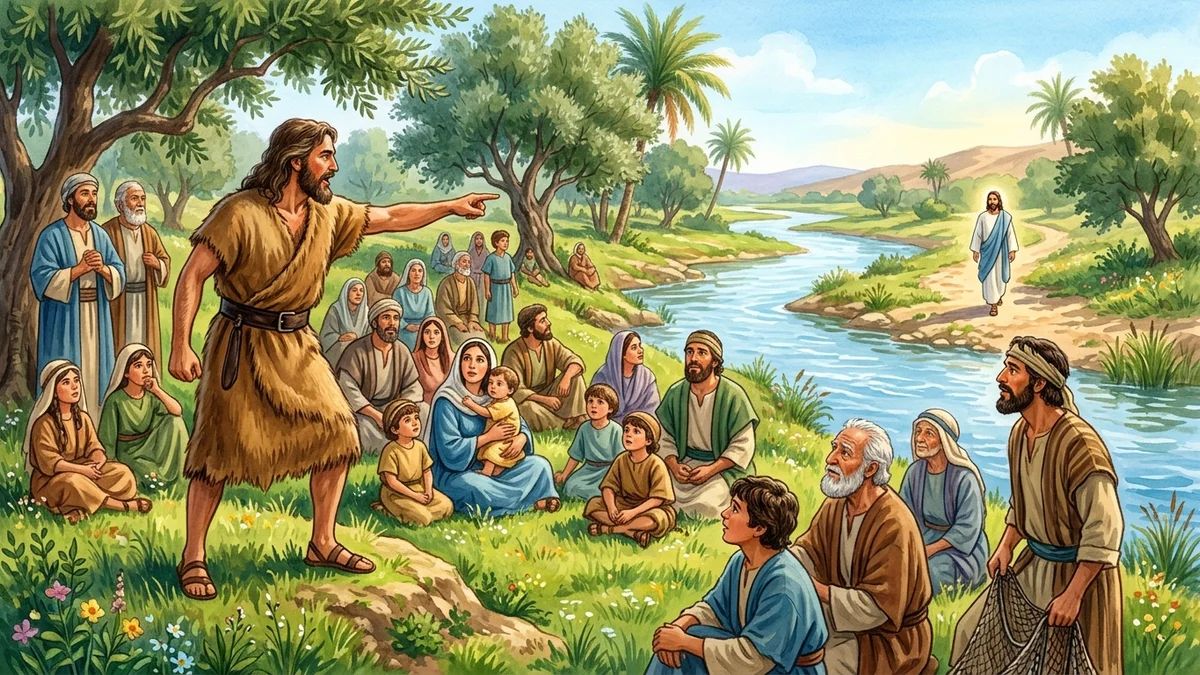
For nearly three decades, the limestone hills of Judea had remained silent, awaiting the spark that would ignite the final prophetic countdown. In the desolate, sun-scorched badlands of the Jordan Rift Valley, where sulfur deposits and twisted tamarisks lined the muddy waters, that spark exploded. A fiery prophet emerged from the wilderness, clothed in coarse camel's hair with a leather belt around his waist, surviving on wild locusts and desert honey. It was John the Baptist—the voice crying in the wilderness foretold by Isaiah (Isaiah 40:3) and Malachi (Malachi 3:1). Crowds from Jerusalem, Judea, and all the region around the Jordan poured out into the desert, weeping under conviction and confessing their sins. Yet John constantly pointed beyond himself: "He who is coming after me is mightier than I, whose sandals I am not worthy to carry. He will baptize you with the Holy Spirit and fire!" (Matthew 3:11). Then, on an ordinary morning, an unassuming carpenter from Nazareth stepped down into the muddy waters. The hour of the Messiah had arrived!
1. The Voice in the Wasteland and the Jordan Waters
Luke anchors John’s ministry within the iron framework of the Roman Empire: "Now in the fifteenth year of the reign of Tiberius Caesar, Pontius Pilate being governor of Judea, Herod being tetrarch of Galilee... Annas and Caiaphas being high priests, the word of God came to John the son of Zechariah in the wilderness." (Luke 3:1-2).
Notice the divine irony: The word of God bypassed the imperial marble palaces of Tiberius in Rome, bypassed the fortified Antonia Fortress of Pilate in Jerusalem, and bypassed the gilded temple chambers of Annas and Caiaphas. The prophetic thunder broke over a desolate wilderness!
John preached at *Bethany beyond the Jordan* (John 1:28; Aramaic: Bethabara—"House of the Crossing"). This was holy ground. It was the exact ford where Joshua had led the children of Israel across the parted Jordan River twelve centuries earlier; it was the exact location where Elijah had struck the waters with his mantle before being swept up to heaven in a chariot of fire (2 Kings 2:8).
John’s baptism was revolutionary. In first-century Judaism, ceremonial immersion (*mikveh*) was practiced for ritual cleanliness, and Gentile converts to Judaism underwent baptism to wash away pagan pollution. But John demanded that biological descendants of Abraham step into the muddy Jordan, declaring that outward ancestry was worthless without genuine, fruit-bearing repentance: "God is able to raise up children to Abraham from these stones!" (Matthew 3:9).
2. The Sinless One Steps into the River
Matthew records the breathtaking turning point of redemptive history: "Then Jesus came from Galilee to John at the Jordan to be baptized by him." (Matthew 3:13).
Jesus had walked over sixty miles southward from Nazareth. He was now approximately thirty years of age (Luke 3:23). He did not arrive with fanfare, heralds, or angelic trumpets. He walked down the slippery, reed-choked riverbank, taking His place in line among convicted adulterers, extortionate tax collectors, and broken sinners.
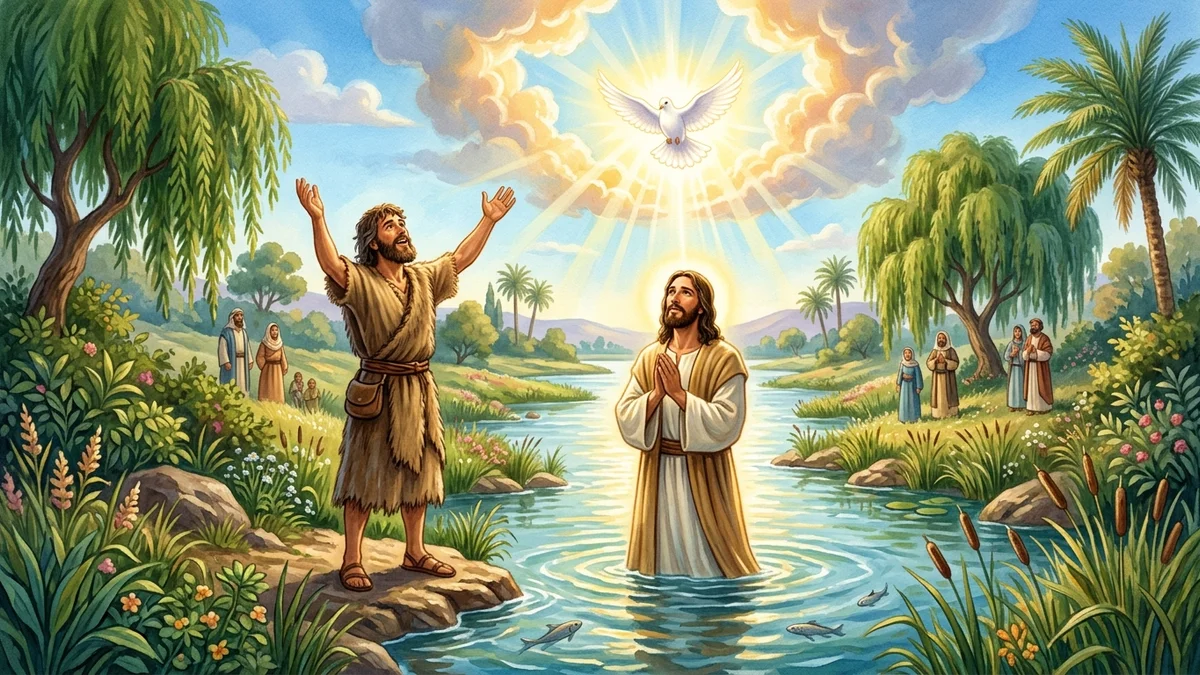
When Jesus stepped into the murky brown water and stood face-to-face with John, the fiery prophet froze. John had unflinchingly rebuked Roman soldiers and called the powerful Pharisees a "brood of vipers." But as his eyes met the pure, gaze of Jesus of Nazareth, the prophet was overwhelmed by an aura of unblemished holiness:
"And John tried to prevent Him, saying, 'I need to be baptized by You, and are You coming to me?'" (Matthew 3:14).
John’s theology was razor-sharp: His baptism was a baptism of repentance for the remission of sins. But Jesus had no sins to confess! He was the spotless Lamb of God. John recognized that the natural order was being radically inverted: The lesser was being asked to baptize the Greater; the finite creature was being asked to plunge his Creator beneath the waters!
 Piero della Francesca's transcendent masterwork 'The Baptism of Christ' (c. 1450, National Gallery, London), capturing the descending dove of the Holy Spirit hovering in radiant light as Christ is baptized in the Jordan.
3. Fulfilling All Righteousness: The Priestly Consecration
Jesus looked upon His cousin with calm, sovereign authority, speaking the profound words that unlock the theological meaning of the entire event:
"Permit it to be so now, for thus it is fitting for us to fulfill all righteousness." (Matthew 3:15).
What did Jesus mean by "fulfilling all righteousness"? Three monumental theological realities were being established:
- Vicarious Identification with Sinners: Although sinless, Christ entered the waters to identify Himself completely with fallen humanity. Just as the Old Testament scapegoat stood with the sins of the nation laid upon its head, Jesus took His place in the waters where our sins were symbolically washed, stepping into our shoes to become our representative and substitute.
- Old Testament Priestly Washing: Under Exodus 29:4 and Leviticus 8:6, Aaron and his sons could not begin their high priestly service until they were washed with water at age thirty. Jesus, our eternal Great High Priest according to the order of Melchizedek, was washed in the Jordan at age thirty before offering the ultimate sacrifice of Himself!
- A Prefiguration of Calvary and Resurrection: Baptism is a symbol of death, burial, and resurrection. By descending beneath the dark surface of the Jordan and rising out of it, Jesus prophetically dramatized His coming immersion into death at Golgotha and His triumphant emergence from the garden tomb!
Hearing the divine command, John surrendered his objections. He placed his trembling hands upon the shoulders of the Son of God, tilted Him backward into the surging river, and raised Him up out of the depths.
4. Schizomenous: The Heavens Violently Torn Open
Luke adds a crucial detail: "When all the people were baptized, it came to pass that Jesus also was baptized; and while He PRAYED, the heaven was opened." (Luke 3:21).
Mark uses a Greek verb of astonishing, violent power: "And immediately, coming up from the water, He saw the heavens TORN OPEN..." (Mark 1:10). The Greek word is schizomenous. It does not mean a gentle parting of clouds. It signifies a violent, irrevocable rending—the violent splitting of the celestial veil!
For centuries, the prophet Isaiah had pleaded with heaven in agonizing intercession: "Oh, that You would rend the heavens! That You would come down!" (Isaiah 64:1). At the Jordan River, that ancient prayer was answered forever. The barrier between holy God and fallen earth was torn asunder, never to be closed again.
Strikingly, the only other time Mark uses this exact verb schizo is at the climax of the Crucifixion: "Then the veil of the temple was torn in two (eschisthe) from top to bottom" (Mark 15:38). What was begun at the Jordan River in water was finished at Calvary in blood!
5. The Descending Dove and the Father's Thunder
As the heavens were rent, an extraordinary double revelation occurred:
"...and the Holy Spirit descended in bodily form like a dove upon Him, and a voice came from heaven which said, 'You are My beloved Son; in You I am well pleased.'" (Luke 3:22).
Why a dove? In Genesis 1:2, at the dawn of the physical universe, the Spirit of God hovered over the primordial waters, brooding life into creation. Now, over the waters of the Jordan, the Holy Spirit hovered again, inaugurating the **New Creation** in Christ! The dove also represented purity, gentleness, and peace. While earthly empires conquered under the emblem of ferocious beasts—the Roman eagle, the Babylonian lion, the Persian bear—the kingdom of Jesus Christ would conquer the world through the meekness and sacrificial power of the Holy Spirit.
The Spirit did not merely touch Jesus; the Gospel of John emphasizes that He "remained upon Him" (John 1:32). This was the Messianic anointing promised in Isaiah 61:1: "The Spirit of the Lord God is upon Me, because the Lord has anointed Me to preach good tidings to the poor!"
Then, shattering the silence of the cosmos, the audible voice of God the Father reverberated across the Judean canyon:
"YOU ARE MY BELOVED SON, IN WHOM I AM WELL PLEASED!" (Matthew 3:17; Greek: Su ei ho huios mou ho agapetos, en soi eudokesa).
In this single sentence, the Father wove together two towering Old Testament prophecies:
- "You are My Son" echoes **Psalm 2:7**, the coronation anthem of the Davidic Messiah King who reigns over all nations.
- "In whom I am well pleased" echoes **Isaiah 42:1**, the introduction of the Suffering Servant upon whom God puts His Spirit to bring forth justice to the Gentiles.
Here, on the banks of the muddy Jordan, stands the supreme revelation of the **Holy Trinity**: The Father speaks with an audible voice from heaven; the Son stands in the waters as the obedient Redeemer; and the Holy Spirit descends in visible bodily form as a dove. One God in three eternal Persons, united in the glorious mission of human redemption!
6. Behold the Lamb of God: The Ministry Unleashed
The next day, as John saw Jesus walking toward him, the prophet raised his arm and shouted the immortal proclamation that defined Christ's entire mission on earth:
"BEHOLD! THE LAMB OF GOD WHO TAKES AWAY THE SIN OF THE WORLD!" (John 1:29).
John did not say "Behold the conquering general," or "Behold the political liberator." He pointed to a sacrificial victim. All the blood of bulls and goats, all the Passover lambs slain since Egypt, all the morning and evening temple sacrifices found their ultimate, eternal reality in this one Man from Nazareth.
Immediately following His baptism, the Holy Spirit drove Jesus into the barren Judean wilderness to fast for forty days and engage in cosmic combat with Satan (Matthew 4:1). The waters of the Jordan were the launchpad. Filled with the Holy Spirit and authenticated by the Father's voice, Jesus Christ stepped forth from the river to heal the sick, raise the dead, preach the Kingdom of God, and march resolutely toward the cross of Calvary!
Biblical Keywords & Theological Roots
Torn open, violently rent asunder, cleaved; used in Mark 1:10 for the heavens tearing open, and Mark 15:38 for the Temple veil tearing at the Crucifixion.
Beloved, dearly loved, uniquely esteemed; the Father's eternal delight in His only begotten Son (Matthew 3:17).
To be well pleased, to take supreme delight, to choose willingly; reflecting Isaiah 42:1 regarding the Servant of the Lord.
Ancient Near Eastern & Archaeological Context
Around AD 26–28, during the fifteenth year of the reign of Tiberius Caesar, Pontius Pilate was governor of Judea, and Annas and Caiaphas held the high priesthood (Luke 3:1–2). The river Jordan near Bethany beyond the Jordan (Al-Maghtas) was the ancient spiritual highway into Canaan. John the Baptist lived as a lifelong Nazirite, preaching in the scorched Judean wilderness. Under Jewish law (Tractate Yoma), immersion (mikveh) was practiced for ritual purification and for Gentile proselytes converting to Judaism. John's revolutionary act was demanding that ethnic Jews themselves undergo baptism, declaring that genetic descent from Abraham was insufficient without genuine ethical repentance.
Support Independent Biblical Research
Did this study bless you? Help support our independent bilingual research and interactive visual Bible tools.
⚡ Fast Facts
- Mark uses the violent Greek verb 'schizomenous' (torn open) to describe the heavens rending at Christ's baptism—the exact same word used for the Temple veil tearing at His crucifixion (Mark 15:38)
- According to Leviticus 8 and Exodus 29:4, Old Testament priests had to be washed with water at age thirty before assuming their high priestly office
- The Father's voice combined Psalm 2:7 ('You are My Son') and Isaiah 42:1 ('My Servant in whom My soul delights'), uniting Christ's royal kingship with His role as the Suffering Servant
- The Baptism of Jesus is one of the clearest moments in Scripture where all three Persons of the Trinity are manifested simultaneously: the Father speaks, the Son is baptized, and the Spirit descends
❓ Frequently Asked Questions (FAQs)
Jesus did not receive baptism for personal repentance or cleansing from sin, as He was entirely sinless (Hebrews 4:15). Instead, He was baptized to 'fulfill all righteousness' (Matthew 3:15): identifying Himself completely with sinful humanity as our representative, endorsing John's prophetic ministry, fulfilling the priestly washing mandated by the Law (Exodus 29:4), and formally inaugurating His public Messianic mission.
The dove echoes Genesis 1:2, where the Spirit of God hovered over the face of the primeval waters, signifying that Christ's baptism marks the beginning of a New Creation. The dove also symbolized purity, meekness, and peace, contrasting with imperial symbols like the Roman eagle, demonstrating that Christ's kingdom conquers through sacrificial love rather than violent coercion.
John 1:28 places the baptism at 'Bethany beyond the Jordan' (Aramaic: Bethabara, 'House of the Crossing'). This was the historic ford near Jericho where Joshua and the children of Israel crossed the parted Jordan River into the Promised Land, and where Elijah parted the waters before ascending to heaven in a chariot of fire.