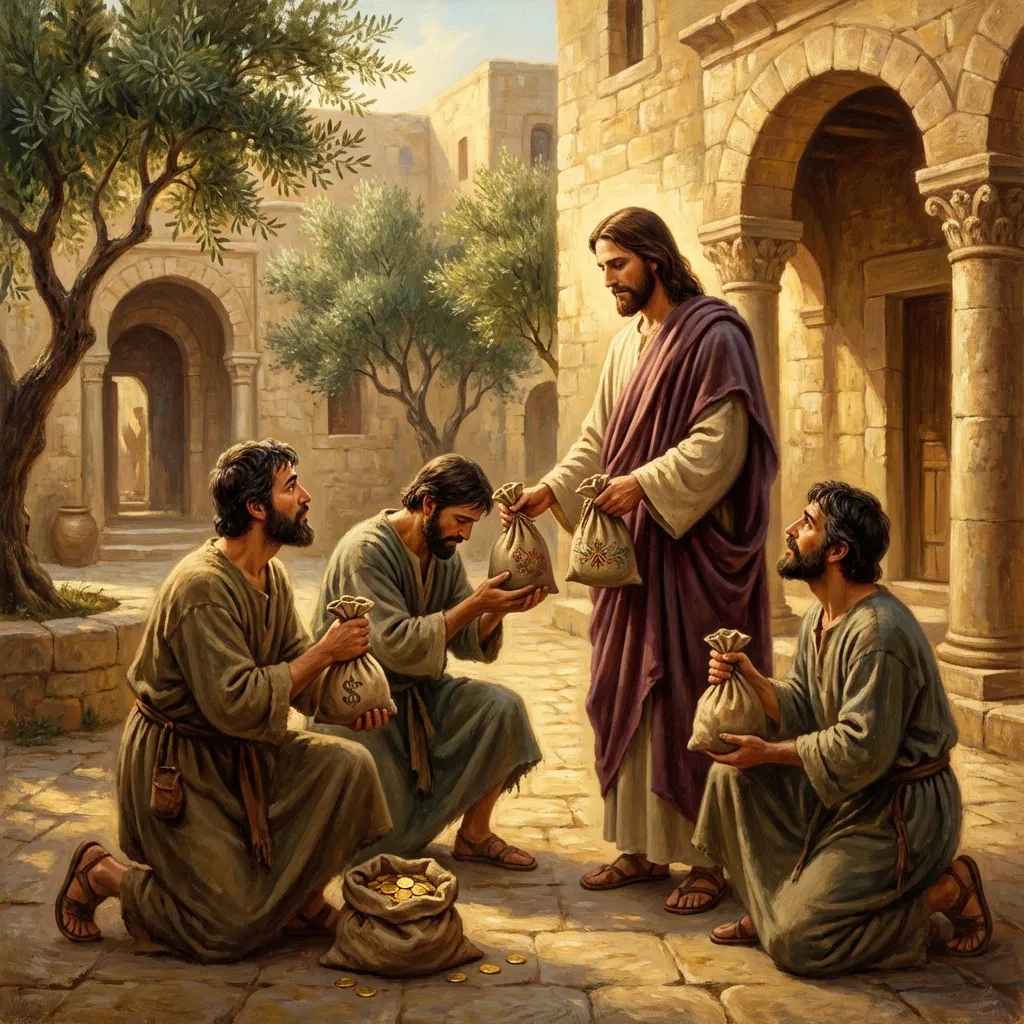
Immediately following the Parable of the Ten Virgins in Matthew 25:14-30, Jesus delivered the Parable of the Talents. While the ten virgins warn against passive unreadiness, the talents warn against active unfaithfulness. Christ confronts every believer with an inescapable reality: the Master will return, and every steward will give an account of how they invested what was entrusted to them.
1. The Staggering Wealth of the Master
Jesus described a wealthy master going on a long journey, calling his slaves and entrusting his property to them. To one he gave five talents, to another two, and to another one—"each according to his own ability." In the first-century Roman world, a talent (talanton) was not a pocket coin; it was an enormous ingot of silver worth 6,000 denarii (twenty years of continuous manual labor). Five talents was an astronomical fortune equal to a century of wages. God never entrusts trivialities; His gifts are of infinite worth.
2. The Courage to Trade and Multiply
The servant with five talents went at once, invested the capital, and gained five more. The servant with two talents acted identically, doubling his investment to four. They understood that the master's resources were not meant to be hoarded in fear, but risked boldly in creative kingdom trade. Ministry requires holy entrepreneurship—stepping out in faith to proclaim truth, serve the broken, and multiply eternal fruit.
3. The Sloth of the Burying Servant
In tragic contrast, the servant who received one talent went off, dug a hole in the dirt, and hid his master's silver. Digging in the earth was the rabbinic method for legally safeguarding money from thieves. But safety is not stewardship. This servant operated entirely out of self-protective fear, refusing to take any initiative for the glory of his lord.
4. The Joy of the Lord
After a long time, the master returned to settle accounts. The five-talent and two-talent servants stepped forward and presented their doubled investments. The master did not compare their totals; He commended their identical percentage of faithfulness with the exact same words: "Well done, good and faithful servant! You have been faithful with a few things; I will put you in charge of many things. Come and share your master's happiness!" (Matthew 25:21). Eternal reward is not based on visibility, but on fidelity.
5. The Unmasking of the Wicked Heart
Finally, the one-talent servant stepped forward with an arrogant excuse: "Master, I knew that you are a hard man, harvesting where you have not sown... So I was afraid and went out and hid your talent in the ground. See, here is what belongs to you" (Matthew 25:24-25). He blamed his laziness on bad theology, accusing the master of extortion. The master stripped the talent from his hands, gave it to the one with ten, and cast the worthless servant into outer darkness. Faith without works is dead; genuine grace always produces active investment for the King.
Biblical Keywords & Theological Roots
Talent; an enormous weight unit of precious metal (gold or silver) worth approximately 6,000 denarii (twenty years of a common laborer's wages).
'Well done, good and faithful servant!'; the supreme eternal commendation bestowed on faithful stewards upon the Master's return.
Slothful, sluggish, lazy, hesitant; the Master rebuked the one-talent servant who hid his resource in the dirt: 'You wicked and lazy servant!'
Ancient Near Eastern & Archaeological Context
In the Greco-Roman monetary system, a single silver talent (*talanton*) was not a small coin, but an immense commercial bullion weight of approximately 6,000 denarii—representing roughly twenty full years of continuous daily labor for an ordinary working man! Five talents represented an astronomical fortune equivalent to an entire century of wages. Entrusting five, two, and one talent to domestic stewards (*douloi*) displayed immense entrepreneurial confidence. Roman and Hellenistic commercial law permitted masters to establish working capital (*peculium*) for slaves to invest in maritime trade, real estate, and banking exchanges (*trapezitai*), expecting capital multiplication upon the master's return.
🔑 Key Spiritual Takeaways
- God Expects Multiplication, Not Stagnation: Everything we possess—time, money, spiritual gifts, intellect—belongs to God and must be invested for Kingdom expansion.
- Faithfulness Over Quantity: Both the five-talent and two-talent servants received the exact same praise: 'Well done, good and faithful servant!' God rewards percentage of faithfulness, not volume.
- Misjudging God Breeds Sloth: The wicked servant viewed his master as harsh and unfair, using bad theology as an excuse for disobedience.
- Use It or Lose It: 'To everyone who has, more will be given... but from the one who has not, even what they have will be taken away.'
Support Independent Biblical Research
Did this study bless you? Help support our independent bilingual research and interactive visual Bible tools.
⚡ Fast Facts
- Astronomical Sum: A single silver talent was worth 6,000 denarii (20 years' wages). Five talents represented a staggering century of labor—an imperial fortune.
- According to Ability: Matthew 25:15 notes the master distributed talents 'each according to his own ability'—God’s expectations are perfectly tailored to our capacity.
- Fear Paralyzes Fruitfulness: The one-talent servant confessed he buried the money because he was afraid, proving that fear of failure destroys spiritual stewardship.
- Outer Darkness Judgment: The lazy servant was not punished for losing money, but for doing absolutely nothing with what was entrusted to him.
❓ Frequently Asked Questions (FAQs)
What is the modern application of a 'talent' in this parable?
While originally a unit of currency, the English word 'talent' entered our language directly from this parable. It applies to every resource God entrusts to us: natural aptitudes, spiritual gifts, financial wealth, leadership influence, and the precious hours of our lifetime.
Why was the master so harsh with the servant who merely buried his talent?
Burying the talent demonstrated contempt for the master's mission. The servant accused the master of being a hard, grasping thief ('harvesting where you haven't sown'). His inaction was an act of passive-aggressive rebellion, revealing he did not love or trust his lord.
What is the reward promised to the faithful servants?
The reward is twofold: increased responsibility ('I will put you in charge of many things') and eternal intimacy ('Enter into the joy of your master!'). Faithfulness in this temporary life prepares believers for reigning with Christ in eternity.