The strategic stronghold of Gibeon was under catastrophic siege. Perched six miles northwest of Jerusalem upon a commanding highland plateau, the royal city of Gibeon had recently executed a daring diplomatic coup: terrified by the supernatural obliteration of Jericho and Ai, the Gibeonites had disguised themselves in ragged garments with dry, moldy bread, successfully duping Joshua into ratifying an inviolable covenant of peace in the name of Yahweh (Joshua 9). But their peace came at a terrifying price. When Adoni-Zedek, the Amorite king of Jerusalem, learned that Gibeon—a massive royal city populated by formidable warriors—had defected to Israel, raw panic seized the Canaanite kingdoms. The strategic corridor connecting the Judean hill country to the Mediterranean coast was now wide open to the Hebrews.
Adoni-Zedek forged an emergency five-nation military confederacy with Hoham of Hebron, Piram of Jarmuth, Japhia of Lachish, and Debir of Eglon. Surrounding Gibeon with a massive combined host of heavy infantry, siege engines, and scythe-wheeled war chariots, the Amorite kings prepared to slaughter the defectors as a warning to all Canaan. Desperate runners slipped through the siege lines under cover of darkness, sprinting down into the Jordan Rift Valley to the Hebrew camp at Gilgal. Standing breathless before Joshua, they cried out: "Do not abandon your servants! Come up to us quickly, save us and help us, for all the kings of the Amorites who dwell in the mountains have gathered together against us!" (Joshua 10:6).
Joshua faced an intense moral and strategic crossroad. The Gibeonites had obtained their treaty through fraudulent deception. Human logic whispered that Joshua should let the Amorites wipe them out, eliminating a duplicitous neighbor. But Joshua belonged to the God of absolute covenant integrity. Israel had sworn by Yahweh; an oath made in the name of the living God was sacred and irrevocable (Psalm 15:4). Furthermore, Yahweh spoke directly to Joshua's soul with an electrifying promise: "Do not fear them, for I have delivered them into your hand; not a man of them shall stand before you!" (Joshua 10:8).
What followed was an act of legendary military stamina. Setting out from Gilgal at twilight, Joshua led his elite battle-hardened troops on a brutal nocturnal forced march. From the sunken floor of the Jordan Valley (eight hundred feet below sea level) to the mountain plateau of Gibeon (twenty-four hundred feet above sea level), the Hebrew soldiers climbed over three thousand two hundred vertical feet across twenty miles of pitch-black, rugged limestone gorges in a single night! As the first rays of dawn broke across the mountain ridges, the exhausted but resolute Hebrew army burst upon the sleeping Amorite encampment like a ferocious desert tempest.
The tactical surprise was total. Blind panic swept through the coalition. The Canaanite chariot lines fractured before they could deploy; soldiers trampled their own comrades in the terror of dawn. As the Hebrews pressed the assault, the shattered Amorite armies fled westward down the narrow, terrifying mountain descent of Upper and Lower Beth-Horon (*Ma'aleh Beit-Horon*) toward the Valley of Aijalon. Trapped along the steep, fractured limestone drops, the retreating thousands bottlenecked in helpless confusion.
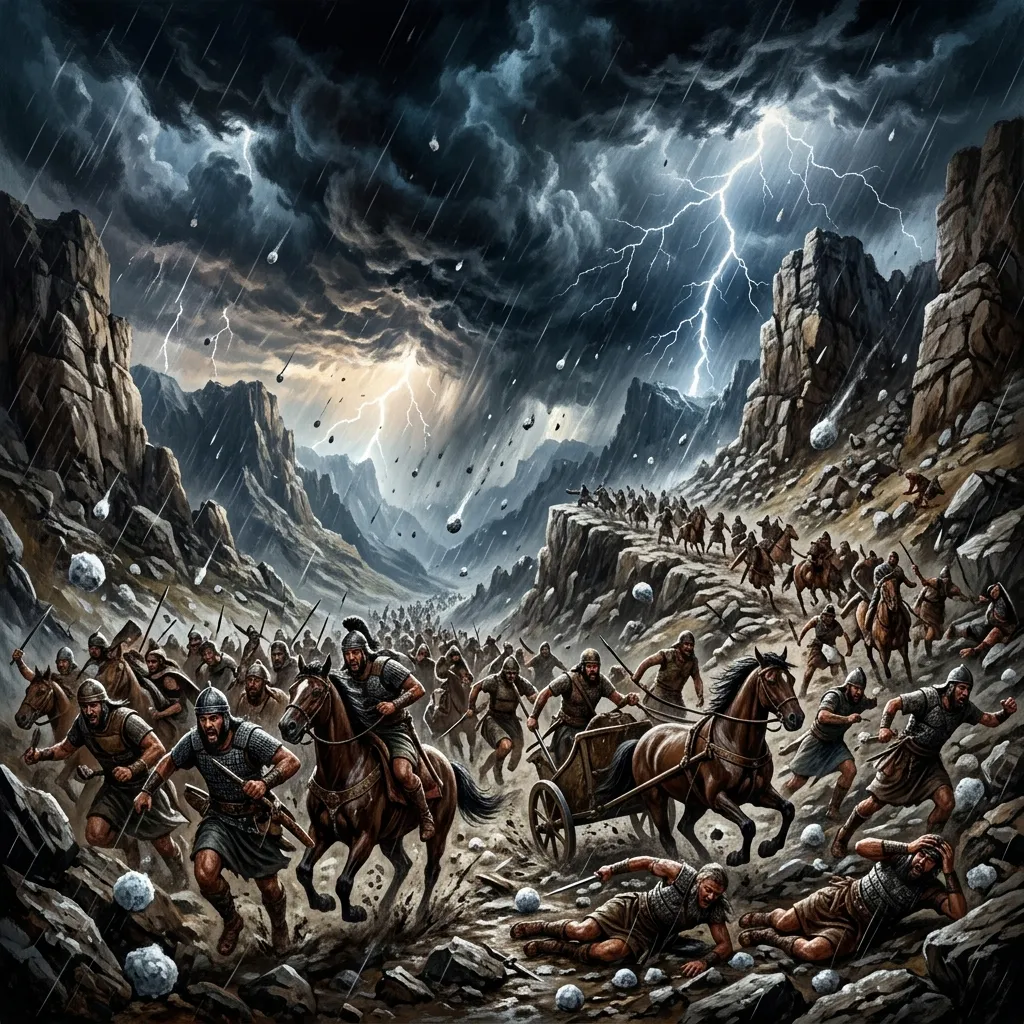
Then, the God of heaven stepped onto the battlefield. As the Amorites tumbled down the crags of Beth-Horon toward Azekah and Makkedah, the skies turned black with an unprecedented meteorological supercell storm. Suddenly, heaven unleashed a barrage of massive, frozen artillery: "Yahweh cast down large hailstones (avnei barad) from heaven on them as far as Azekah, and they died. There were more who died from the hailstones than the children of Israel killed with the sword!" (Joshua 10:11). The frozen stones battered the pagan infantry, crushing armor and bone with divine precision while sparing the pursuing Hebrews.
Yet as the fierce battle raged along the ridges and the afternoon began to wane, Joshua realized a looming tactical catastrophe. The rugged, cavernous terrain of Judea offered endless hiding places. If darkness fell, the surviving Amorite forces would melt into the mountain forests, slip into fortified bastions like Jerusalem and Lachish, and regroup to wage an exhausting guerrilla war against Israel. Full covenant victory demanded the total annihilation of the coalition before nightfall.
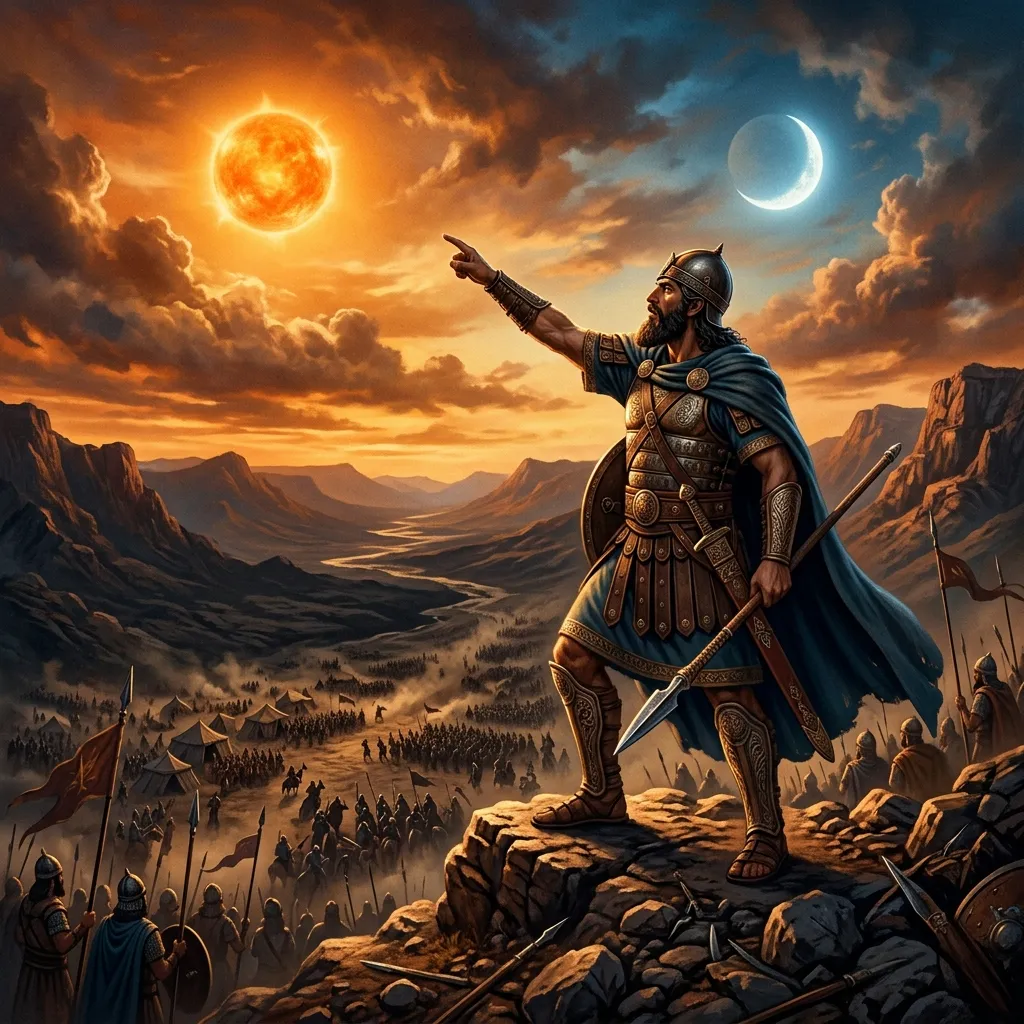
Standing upon a high ridge overlooking Gibeon to the east and the Valley of Aijalon to the west, with the sweat of battle stinging his eyes and the Spirit of God burning in his bones, Joshua raised his staff toward the heavens. In the sight and hearing of all Israel, he uttered one of the most audacious prayers in human history: "Sun, stand still over Gibeon; and Moon, in the Valley of Aijalon!" (Joshua 10:12).
The response of heaven shook the cosmos! Scripture records the astonishing miracle with sublime simplicity: "So the sun stood still (shemesh dom), and the moon stopped, till the people had revenge upon their enemies. Is this not written in the Book of Jashar? So the sun stood still in the midst of heaven, and did not hasten to go down for about a whole day" (Joshua 10:13). The celestial order bent before the voice of its Creator. The fiery orb of the sun paused in the zenith of the sky; the cool crescent of the moon hung motionless over the valley floor. For an estimated twenty-four hours of unbroken daylight, time itself seemed suspended under the sovereign hand of God!
Empowered by this celestial illumination, the Hebrew warriors relentlessly pursued the fleeing enemy across the Shephelah, hunting down the remnants of the confederacy as far as Makkedah. The five Amorite kings abandoned their troops and scrambled into a dark cave at Makkedah. Informed of their hiding place, Joshua commanded large boulders to be rolled over the mouth of the cave, sealing the kings inside while the army mopped up the remaining stragglers.
When the battle was finished, Joshua summoned the captains of the men of war. Opening the cave, he brought out the five kings—Adoni-Zedek, Hoham, Piram, Japhia, and Debir—and commanded his commanders: "Come near, put your feet on the necks of these kings!" (Joshua 10:24). As the Hebrew captains placed their sandals upon the necks of the proud Canaanite monarchs, Joshua declared the prophetic guarantee that anchors every believer in spiritual warfare: "Do not fear, nor be dismayed; be strong and of good courage, for thus Yahweh will do to all your enemies against whom you fight!" (Joshua 10:25). The kings were executed and buried in the cave, marked by a massive mound of stones.
Scripture concludes the account of this miraculous day with a tribute unmatched in all the annals of redemptive history: "And there has been no day like that, before it or after it, that Yahweh heeded the voice of a man; for Yahweh fought for Israel!" (Joshua 10:14). Gibeon stands forever as a blazing beacon of kingdom truth: when God's people honor their covenant promises with sacrificial diligence, and dare to pray with kingdom audacity, heaven will alter the very fabric of nature to fight on their behalf and secure total victory!
Biblical Keywords & Theological Roots
Sun, be still / stand silent / cease motion; an authoritative imperative commanding the celestial luminary to halt its solar circuit across the heavens.
Stones of hail; lethal, frozen meteorological ordnance cast down by Yahweh to annihilate the fleeing pagan armies along the Beth-Horon descent.
Book of the Upright / Jashar; an ancient, authoritative national poetic chronicle recording monumental covenant victories and heroic acts of faith.
Amorite / highlander; the powerful, entrenched mountain clans whose systemic iniquity had reached full measure and faced divine eviction.
To fight, wage war, engage in combat; summarizing the ultimate theological reality: 'for Yahweh fought for Israel.'
Ancient Near Eastern & Archaeological Context
The Battle of Gibeon and the subsequent pursuit down the Beth-Horon ridge represents one of the most brilliant strategic military campaigns in antiquity. Topographically, the city of Gibeon (modern el-Jib, six miles northwest of Jerusalem, where American archaeologist James Pritchard excavated the famous massive rock-cut water pool, spiral staircase, and inscribed wine-jar handles) controlled the central highland plateau and the primary arterial trade route connecting the Judean hills to the coastal plain via the pass of Beth-Horon (*Ma'aleh Beit-Horon*). When the Amorite coalition under Adoni-Zedek of Jerusalem, Hoham of Hebron, Piram of Jarmuth, Japhia of Lachish, and Debir of Eglon besieged Gibeon, Joshua executed an extraordinary tactical maneuver: a nocturnal forced march from the Jordan Valley floor at Gilgal (elevation ~800 feet below sea level) to the Gibeon plateau (elevation ~2,400 feet above sea level). This required climbing over 3,200 vertical feet across twenty miles of pitch-black, limestone ravines in a single night. Surprising the coalition at dawn, the Israelites drove the panicking Canaanite charioteers and infantry westward into the bottleneck descent of Upper and Lower Beth-Horon. As the fleeing troops bottlenecked along the steep, fractured stone terraces, a catastrophic meteorological supercell storm struck, hurling down giant hailstones (*avnei barad*) that pulverized the enemy ranks. Astronomical and literary scholarship regarding Joshua's command to the sun (*dom*, meaning to be silent, stand motionless, or cease activity) points to a cosmic miraculous suspension of celestial rotation or a prolonged atmospheric refraction phenomenon that extended daylight over Gibeon and maintained lunar illumination over the Valley of Aijalon, providing Israel the necessary visibility to eliminate the five kings before they could regroup in their fortified cities.
Practical Discipleship & Spiritual Application
- Radical Covenant Integrity in an Opportunistic World: The Gibeonites deceived Joshua with moldy bread and worn sandals (Joshua 9), yet because Israel had sworn an oath in the name of Yahweh, Joshua defended them with his own life. Biblical believers must keep their word even when it hurts (Psalm 15:4). In a culture that treats promises and vows as disposable contracts, the follower of Christ is called to unshakeable, costly fidelity.
- Exhausting Diligence Meets Supernatural Grace: Joshua did not sit passively in Gilgal waiting for celestial miracles. He and his soldiers marched twenty brutal uphill miles through the pitch-black night, climbing over 3,000 vertical feet to relieve their allies at dawn. God's miraculous intervention never rewards spiritual laziness; heaven unleashes supernatural power when consecrated believers push their obedience to the point of sacrificial exhaustion.
- Audacious, Kingdom-Expanding Prayer: Joshua's prayer—commanding the sun and moon to stand still—was not born of selfish vanity or personal convenience. He prayed audaciously because he needed daylight to complete the redemptive assignment God had ordained. When our hearts are completely consumed with the glory of God and the destruction of darkness, we can approach the throne of grace and ask for cosmic impossibilities in Jesus' name.
- The Battle Belongs to the Lord: Scripture explicitly notes that more Amorites died from heaven's hailstones than by the swords of the Hebrew warriors (Joshua 10:11). In our deepest spiritual warfare, human strategy, education, and effort are only instruments; the crushing blow against the powers of hell is always struck by the sovereign hand of the Almighty God.
⚡ Fast Facts
- Joshua and his elite warriors completed a nocturnal forced march from Gilgal to Gibeon, ascending over 3,200 vertical feet across twenty mountainous miles in a single night to achieve tactical surprise (Joshua 10:9).
- Scripture explicitly records that 'there were more who died from the hailstones than the children of Israel killed with the sword' along the descent of Beth-Horon (Joshua 10:11).
- The five defeated Amorite kings fled and hid in a cave at Makkedah, where Joshua sealed them with massive boulders until the daylight victory was sealed (Joshua 10:16–18).
- The inspired text immortalizes the event with the unmatched tribute: 'And there has been no day like that, before it or after it, that Yahweh heeded the voice of a man; for Yahweh fought for Israel' (Joshua 10:14).
❓ Frequently Asked Questions (FAQs)
Joshua 10:12–14 records: 'So the sun stood still, and the moon stopped, till the people had revenge upon their enemies... The sun stood still in the midst of heaven, and did not hasten to go down for about a whole day.' Christian scholars, physicists, and astronomers approach this profound text through three primary, scientifically and textually plausible viewpoints. The first is the **Literal Earth-Deceleration Miracle**: the Almighty Creator, who established cosmic mechanics, momentarily decelerated or suspended the rotation of the earth upon its axis, preventing catastrophic inertial displacement (such as oceans sloshing across continents) through His omnipotent upholding power (Hebrews 1:3). The second is the **Supernatural Atmospheric Refraction Miracle**: God utilized an extraordinary optical miracle through an atmospheric supercell inversion—intensified by the massive, freezing hailstorm—supernaturally refracting and bending solar and lunar rays over the horizon, providing persistent daylight long after the celestial bodies had physically dipped below the horizon. The third is the **Cease-Heat / Prolonged Shade Interpretation**: based on the Hebrew verb *dom* (which fundamentally means 'to be silent, cease, or rest'), some Semitic scholars argue that Joshua prayed for the blistering midday sun to cease its scorch and for the clouds to prolong the cool morning battle conditions so his troops would not collapse from heat exhaustion, which God answered with a massive hailstorm that blocked the sun and prolonged the day's visibility. Whichever mechanism God utilized, the text affirms an undeniable, historical divine intervention where Yahweh altered celestial reality in response to the prayer of a man.
In Joshua chapter 9, the Gibeonites dispatched emissaries dressed in tattered rags, carrying dry, moldy bread and cracked, patched wineskins, claiming they had traveled from a distant land to enter a treaty with Yahweh's people. Joshua and the elders committed a severe blunder: 'the men of Israel took some of their provisions, but did not ask counsel of Yahweh' (Joshua 9:14), swearing a solemn covenant of peace (*berith*) confirmed by an oath in Yahweh's holy name. When their deception was exposed three days later, the congregation demanded the treaty be revoked. Joshua refused, declaring: 'We have sworn to them by Yahweh God of Israel; now therefore, we may not touch them' (Joshua 9:19). Why did God honor this compromised treaty? Because in biblical theology, an oath sworn in the name of the living God is an inviolable, sacred bond that must never be broken, even if it leads to personal disadvantage: 'He who swears to his own hurt and does not change... shall never be moved' (Psalm 15:4). To break an oath made in Yahweh's name would profane God's holy character before the pagan nations. God so deeply honored this covenant that when five kings attacked Gibeon, Yahweh commanded Joshua to defend them, fought on their behalf with celestial hailstones, and stopped the sun in heaven! Centuries later, when King Saul broke this covenant by massacring Gibeonites in carnal zeal, God sent a three-year famine upon Israel, which was lifted only when justice was rendered (2 Samuel 21:1–9).
Joshua 10:13 states: 'Is this not written in the Book of Jashar? So the sun stood still in the midst of heaven...' The *Sefer ha-Yashar* (literally 'The Book of the Upright' or 'Book of the Righteous One') was a well-known ancient Hebrew non-canonical anthology of epic national poetry, heroic battle songs, and theological anthems commemorating monumental acts of faith and covenant faithfulness in Israel's history. It is cited twice in the Old Testament: here in Joshua 10:13 regarding the prolonged day of battle at Gibeon, and in 2 Samuel 1:18, where King David commands that his tragic, poignant funeral dirge for Saul and Jonathan ('The Song of the Bow') be inscribed in the Book of Jashar. The book itself was not an inspired biblical book of the canon, but an authoritative historical-poetic compendium widely known to the original readers. Biblical authors frequently cited respected secular or historical records (such as the *Book of the Wars of Yahweh* in Numbers 21:14, the *Chronicles of the Kings of Israel*, or Paul quoting Aratus and Epimenides in Acts 17:28 and Titus 1:12) to provide external, historical verification. The citation in Joshua demonstrates that the miraculous standing still of the sun was not a private, hidden event, but an earth-shattering public reality celebrated across the ancient world and immortalized in Israel's earliest national literature.