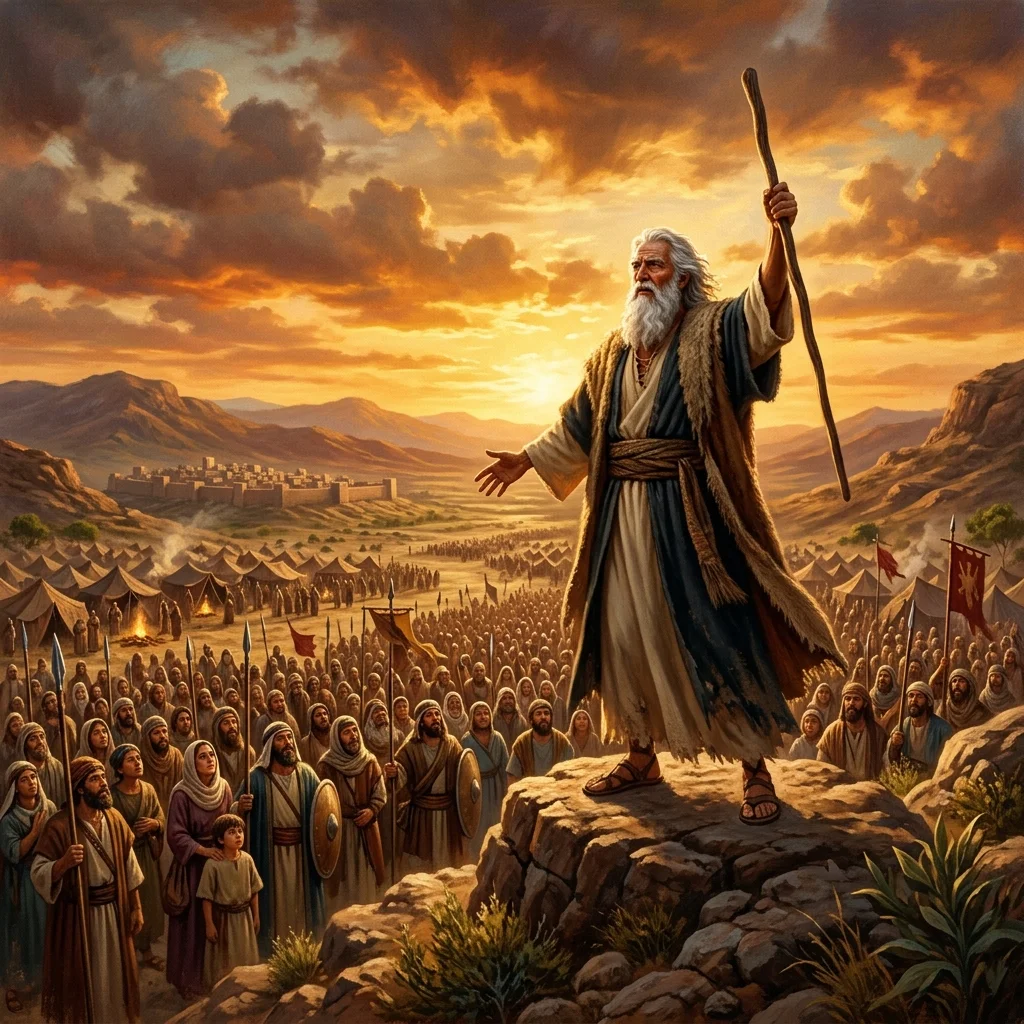
The sun was dipping low over the central highlands of Canaan, casting elongated shadows across the rugged limestone amphitheater of Shechem. Many years had passed since Yahweh had granted the twelve tribes rest from their surrounding enemies. Joshua, the veteran general who had once held Moses' hands steady on the heights of Rephidim, spied out the land with Caleb in unyielding faith, and commanded the sun to stand still in the heavens over Gibeon, was now an old man, full of years and divine wisdom. At one hundred and ten years of age, he understood with profound clarity that his earthly pilgrimage was drawing to an end. Before laying down his mantle, however, Joshua bore an inescapable burden: he had to summon the leadership and congregation of Israel for one final, monumental assembly that would forever define their covenant identity.
The summons went out to all the tribes across the promised inheritance. From the maritime plains of Asher in the far north to the arid desert ridges of Simeon in the deep south, the elders, tribal chiefs, judges, and administrative officers converged upon Shechem. No location on earth held deeper ancestral resonance for the Hebrew consciousness. It was here, nearly five centuries earlier, that Abram had first pitched his tent beneath the great terebinth tree of Moreh, where Yahweh had appeared to him in blazing glory and declared: "To your descendants I will give this land" (Genesis 12:7). It was here that Jacob had returned from Mesopotamia, commanded his family to put away all their foreign pagan amulets, and buried the idolatrous relics beneath the sacred oak (Genesis 35:4). And it was here, in the natural acoustic amphitheater cradled between the sheer precipices of Mount Ebal and Mount Gerizim, that Joshua had previously assembled the entire nation to proclaim the blessings and curses of the Mosaic Law (Joshua 8:30-35).
Standing before the silent, assembled thousands beneath the sacred oak near the sanctuary of Yahweh, Joshua did not begin with sentimental reminiscences or boastful military chronicles. Instead, he spoke with the thundering authority of a prophetic ambassador, uttering the venerable covenant formula: "Thus says Yahweh, God of Israel!" (Joshua 24:2). What followed was a sweeping, breathtaking historical prologue—a grand theological review of redemptive history demonstrating that Israel existed solely because of God's unmerited, sovereign grace.
Joshua marched them through the centuries: "Your fathers, including Terah, the father of Abraham and the father of Nahor, dwelt on the other side of the River in old times; and they served other gods. Then I took your father Abraham from the other side of the River, led him throughout all the land of Canaan, and multiplied his descendants" (Joshua 24:2-3). God was the primary actor in every epoch. Yahweh had graciously extracted their ancestor from Mesopotamian paganism; Yahweh had given Isaac; Yahweh had dispatched Moses and Aaron with supernatural plagues to shatter Pharaoh's stubborn defiance; Yahweh had cleaved the roaring waters of the Red Sea and swallowed the Egyptian chariot corps; Yahweh had preserved them through forty years of barren wilderness; and Yahweh had paralyzed the hearts of the Amorite, Canaanite, and Hittite kings, casting them out not by Hebrew swords or bows, but by the mysterious terror of the divine hornet!
"I have given you a land for which you did not labor, and cities which you did not build, and you dwell in them; you eat of the vineyards and olive groves which you did not plant!" (Joshua 24:13). Every vineyard they plucked, every well that quenched their thirst, and every fortified stone home in which they slept stood as an undeniable testimony of unmerited mercy. They were not tenants by conquest; they were recipients of a holy covenant bequest.
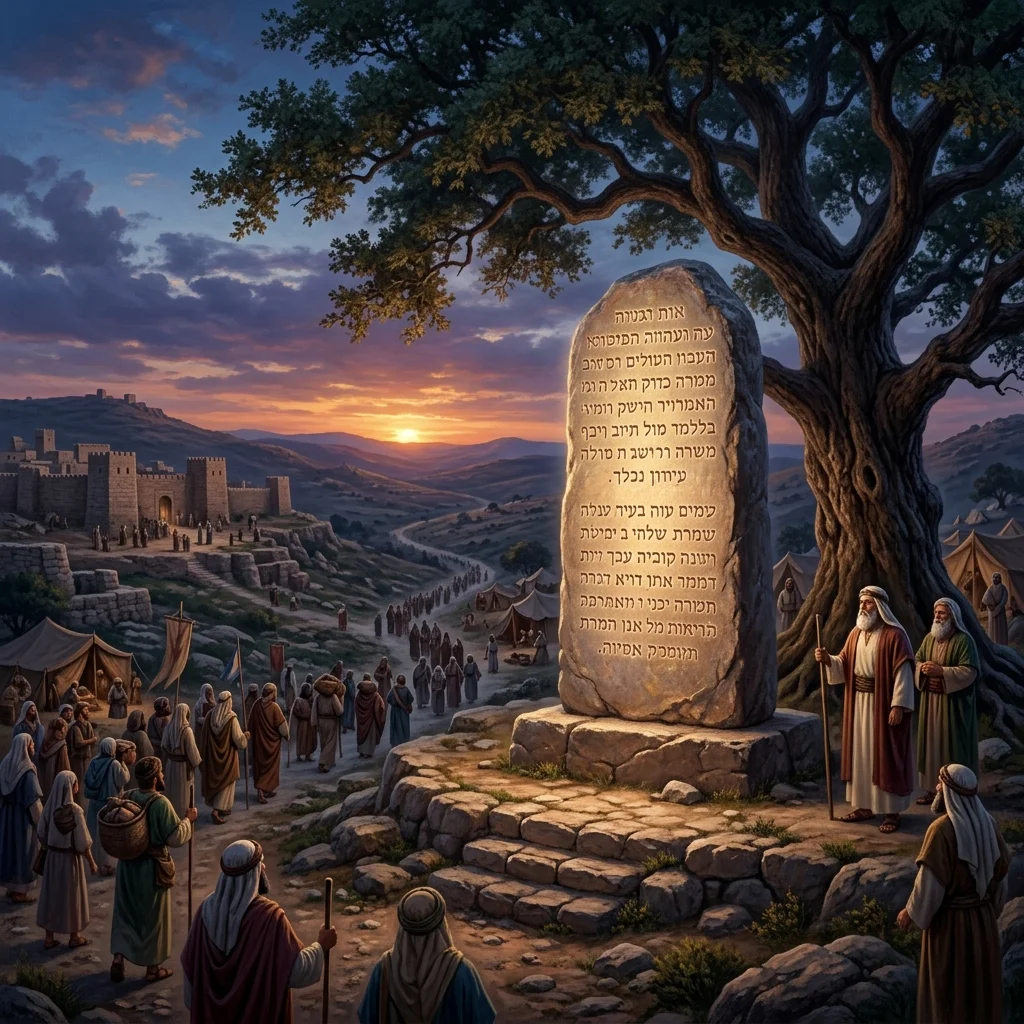
Having established the immense weight of God's past faithfulness, Joshua turned toward the congregation with piercing intensity. The moment of decision had arrived: "Now therefore, fear Yahweh, serve Him in sincerity and in truth (tamim), and put away the gods which your fathers served on the other side of the River and in Egypt. Serve Yahweh!" (Joshua 24:14). Joshua exposed the secret syncretism lingering within Hebrew tents. Many still secretly harbored Mesopotamian talismans or Egyptian idols, trying to hedge their spiritual bets. Joshua dismantled their duplicity with legendary boldness:
"And if it seems evil to you to serve Yahweh, choose for yourselves this day whom you will serve (bacharu lakhem ha-yom), whether the gods which your fathers served that were on the other side of the River, or the gods of the Amorites, in whose land you dwell. But as for me and my house, we will serve Yahweh!" (Joshua 24:15). It was an uncompromising ultimatum. Spiritual neutrality was an impossibility. If they preferred the impotent wooden idols of Babylon or the blood-stained fertility deities of Canaan, let them openly worship them; but Joshua and his household had already cast their eternal anchor in the living God of Israel!
The vast assembly responded with immediate, emotional acclaim: "Far be it from us that we should forsake Yahweh to serve other gods! For Yahweh our God is He who brought us and our fathers up out of the land of Egypt, from the house of bondage... Therefore we also will serve Yahweh, for He is our God!" (Joshua 24:16-18). Their words sounded impeccably pious, yet Joshua knew the fickle, shallow impulses of human enthusiasm. He refused to let them enter into an eternal covenant with cheap, sentimental promises.
In a shocking display of spiritual shock therapy, Joshua rebuked their hasty confidence: "You cannot serve Yahweh, for He is a holy God (Elohim qadoshim). He is a jealous God (El-qanna); He will not forgive your transgressions nor your sins. If you forsake Yahweh and serve foreign gods, then He will turn and do you harm and consume you, after He has done you good!" (Joshua 24:19-20). Joshua was not discouraging worship; he was stripping away their superficial self-reliance. Yahweh was not a tame tribal mascot who could be accommodated alongside compromise. His holy jealousy consumed half-hearted hypocrites.
Grasping the solemn terror and glory of the covenant, the people pressed forward, crying out with renewed conviction: "No, but we will serve Yahweh!" (Joshua 24:21). Joshua answered: "You are witnesses against yourselves that you have chosen Yahweh for yourselves, to serve Him!" And they shouted back in unified cadence: "We are witnesses!"
To seal this sacred transaction, Joshua drew up an official legal document containing the statutes and ordinances of the covenant, recording them in the Book of the Law of God. Then, he undertook a monumental physical act: he took a massive stone monolith (*even gedolah*) and set it up upright beneath the sprawling branches of the sacred oak that stood beside the sanctuary of Yahweh. Pointing toward the imposing stone monument, Joshua declared to the breathless nation: "Behold, this stone shall be a witness to us, for it has heard all the words of Yahweh which He spoke to us. It shall therefore be a witness to you, lest you deny your God!" (Joshua 24:27).
With the covenant ratified and the great stone witness firmly anchored in the soil of Shechem, Joshua dismissed the people, each tribe returning to their assigned territorial inheritance. Shortly thereafter, at the age of one hundred and ten, having fought the good fight and kept the covenant faith, Joshua the son of Nun, the servant of Yahweh, breathed his last. They buried him with profound honor in the border of his inheritance at Timnath-Serah in the rugged hill country of Ephraim.
The sacred narrative concludes with two deeply moving testaments of covenant fulfillment. First, Israel remained faithful to Yahweh throughout all the days of Joshua and all the days of the elders who outlived him. Second, the embalmed bones of the patriarch Joseph—which had been reverently carried through the wilderness across four decades of wandering—were finally interred in Shechem, in the very parcel of ground Jacob had bought for a hundred pieces of silver. The promises made to Abraham, Isaac, Jacob, and Joseph had reached their triumphant, terrestrial resting place under the sovereign orchestration of God!
Biblical Keywords & Theological Roots
Imperative plural of 'bachar' (to choose, select, decide upon). Denotes a conscious, deliberate, decisive act of the will in selecting between moral and spiritual alternatives.
To work, serve, worship, or yield total allegiance. In covenant theology, it encompasses both liturgical adoration in the sanctuary and ethical obedience in daily conduct.
Great stone; a monumental standing monolith (massebah) erected as a visible, enduring legal witness to a solemn covenant ratified between Yahweh and His people.
Shoulder, ridge, or saddle. The ancient city nestled between Mount Ebal and Gerizim, serving as the historical cradle of patriarchal altars and national assemblies.
Complete, whole, sound, blameless, sincere, unblemished integrity. Used in Joshua 24:14 to describe the pure, undivided, uncorrupted devotion owed exclusively to Yahweh.
Ancient Near Eastern & Archaeological Context
Ancient Shechem (modern Tell Balata, adjacent to Nablus) occupied an indispensable geographical and spiritual nexus in ancient Palestine. Situated in the narrow pass between Mount Ebal (the mountain of the curse) and Mount Gerizim (the mountain of the blessing), Shechem was the exact location where Abram first received Yahweh's covenant promise of the land and constructed his premier altar (Genesis 12:6-7), and where Jacob purified his household of foreign idols, burying them beneath the sacred terebinth tree (Genesis 35:4). Joshua's farewell assembly (Joshua 24) adheres precisely to the classical Late Bronze Age Hittite Suzerainty Treaty structure: (1) Preamble identifying the Great King (24:2a); (2) Historical Prologue detailing Yahweh's benevolent acts from Abraham to the Conquest (24:2b-13); (3) Covenant Stipulations demanding exclusive loyalty and eradication of pagan gods (24:14-24); (4) Deposit of the Covenant Document in the sanctuary (24:25-26); and (5) Witnesses, uniquely manifested in the megalithic standing stone (*massebah*) erected beneath the sacred oak (24:26-27). Archaeology at Tell Balata has uncovered the massive foundations of a Bronze Age fortress-temple (*Migdal*) and an enormous limestone megalith in the courtyard, powerfully confirming the ancient monumental setting described in Joshua 24.
Practical Discipleship & Spiritual Application
- Confront Hidden Syncretism: We cannot claim Christ as Savior while secretly cherishing cultural idols of greed, approval, pride, or worldly security. Uncompromising discipleship demands opening every hidden compartment of our heart and burying our idols at the foot of the Cross.
- Exercise Intentional Family Leadership: Joshua did not wait for the national consensus before taking a stand; he proclaimed, 'As for me and my house, we will serve Yahweh.' Christian believers must courageously establish spiritual culture and biblical truth within their own households regardless of prevailing cultural currents.
- Reflect on God's Historical Faithfulness: When facing future anxieties or spiritual weariness, deliberately recount the milestones where God delivered, sustained, and provided for you. Remembering God's past miracles fuels unwavering faith for tomorrow's battles.
- Establish Tangible Spiritual Milestones: Just as Joshua erected the great stone of witness beneath the oak, create concrete, visible reminders of God's miraculous answers to prayer in your personal and family life to instruct and anchor future generations.
⚡ Fast Facts
- Joshua was one hundred and ten years old when he delivered his final farewell addresses and died in the hill country of Ephraim (Joshua 24:29).
- Shechem was the exact patriarchal site where God first promised Canaan to Abraham (Genesis 12:6-7) and where Jacob buried household idols (Genesis 35:4).
- Joseph's bones, which had been carried by the Israelites throughout forty years of wilderness wandering, were finally buried at Shechem in the plot Jacob had purchased (Joshua 24:32).
- The monumental standing stone (*massebah*) erected by Joshua beneath the oak tree served as a permanent legal witness to Israel's ratified covenant with Yahweh.
❓ Frequently Asked Questions (FAQs)
Joshua's shocking statement was not fatalistic pessimism, but a profound theological shock therapy designed to shatter Israel's shallow, self-confident presumption. The people glibly answered, 'Far be it from us to forsake Yahweh... we also will serve Yahweh!' without understanding the utter holiness (*qadosh*) and righteous jealousy (*el-qanna*) of God. God cannot be worshipped casually alongside personal sins or foreign talismans; He demands absolute, undivided consecration. By declaring their natural inability, Joshua forced them to recognize the gravity of their solemn vow and their desperate need for genuine heart repentance and divine grace rather than superficial fleshly enthusiasm.
Archaeological excavations at Tell Balata (ancient Shechem) have unearthed monumental Middle and Late Bronze Age defensive fortifications, a colossal fortress-temple (*Migdal* temple of El-Berith / Baal-Berith, mentioned in Judges 9), and a massive limestone megalithic standing stone (*massebah*) erected in the sacred courtyard. This standing monolith, measuring over five feet high and perfectly aligned with the sacred enclosure, matches the exact biblical description in Joshua 24:26 of a 'great stone' (*even gedolah*) erected beneath the sacred oak by the sanctuary of Yahweh. Geographically, Shechem sits directly in the amphitheater between Mount Gerizim and Mount Ebal, providing natural acoustics for large national assemblies.
The burial of Joseph's bones at Shechem (Joshua 24:32) brings majestic theological closure to Genesis 50:24-25, where the dying patriarch made the sons of Israel swear an oath to carry his mummified remains into the Promised Land. For over four centuries in Egypt, through the Red Sea, across forty years in the scorching Sinai wilderness, and throughout the seven-year Canaanite conquest, the casket of Joseph had traveled with Israel as an immovable physical testimony of resurrection hope and unwavering faith in God's promises (Hebrews 11:22). Burying Joseph in the parcel of ground Jacob had purchased outside Shechem signaled that the patriarchal promise was fulfilled: Israel had inherited the land, and the wanderings were finished.