 The golden morning light broke over the central highlands of Benjamin, illuminating the historic sanctuary of Gibeon. Six miles northwest of Jerusalem, upon a prominent limestone summit, stood the sacred relics of Israel's desert wanderings: the ancient Tabernacle of the Tent of Meeting crafted under Moses in Sinai, and the weathered bronze altar beaten into form centuries earlier by the master craftsman Bezalel (2 Chronicles 1:3–5). It was here that young King Solomon, newly confirmed upon the throne of David following the passing of his father, gathered the princes, judges, and commanders of Israel for an unprecedented demonstration of covenant devotion. Solomon ascended the ramp of the bronze altar and offered an astounding sacrifice of one thousand burnt offerings to Yahweh (1 Kings 3:4). The smoke of the consecrated rams and bullocks rose as a sweet-smelling aroma into the Judean skies, testifying that the young monarch sought neither royal leisure nor political alliances, but the favor of the living God.
That night, as Solomon slept within the sacred precinct of Gibeon, the stillness of the chamber was suddenly engulfed by a divine vision. Yahweh appeared to the young king in a dream and issued an extraordinary, unrestricted divine blank check that would have intoxicated any ordinary monarch: "Ask what I shall give you" (1 Kings 3:5).
Any surrounding pagan potentate would have seized the moment to demand limitless imperial conquests, boundless treasuries of gold, decades of prolonged life, or the utter annihilation of foreign rivals. But Solomon stood in the spiritual shadow of his father David. Falling prostrate in spirit before the King of Kings, the young ruler poured out a prayer marked by profound humility and spiritual maturity:
"You have shown great and steadfast love to your servant David my father, because he walked before you in faithfulness, in righteousness, and in uprightness of heart toward you. And you have kept for him this great and steadfast love and have given him a son to sit on his throne this day. And now, O Yahweh my God, you have made your servant king in place of David my father, although I am but a little child. I do not know how to go out or come in. And your servant is in the midst of your people whom you have chosen, a great people, too many to be numbered or counted for multitude. Give your servant therefore an understanding heart (*lev shome'a*) to govern your people, that I may discern between good and evil, for who is able to govern this your great people?" (1 Kings 3:6–9).
Solomon requested neither sword nor scepter; he asked for a "listening heart"—a soul attuned to hear the voice of divine justice and administer equity among God's covenant flock. The sacred text records the divine delight in this selfless petition: "It pleased the Lord that Solomon had asked this" (1 Kings 3:10). God answered from heaven with overwhelming grace:
"Because you have asked this, and have not asked for yourself long life or riches or the life of your enemies, but have asked for yourself understanding to discern what is right, behold, I now do according to your word. Behold, I give you a wise and discerning mind (*chokhmah*), so that none like you has been before you and none like you shall arise after you. I give you also what you have not asked, both riches and honor, so that no other king shall compare with you, all your days" (1 Kings 3:11–13).
Returning to Jerusalem, Solomon stood before the Ark of the Covenant, offered peace offerings, and hosted a celebratory feast for all his servants. The reality of his divinely imparted wisdom was immediately tested in a sensational courtroom drama that transfixed the nation.
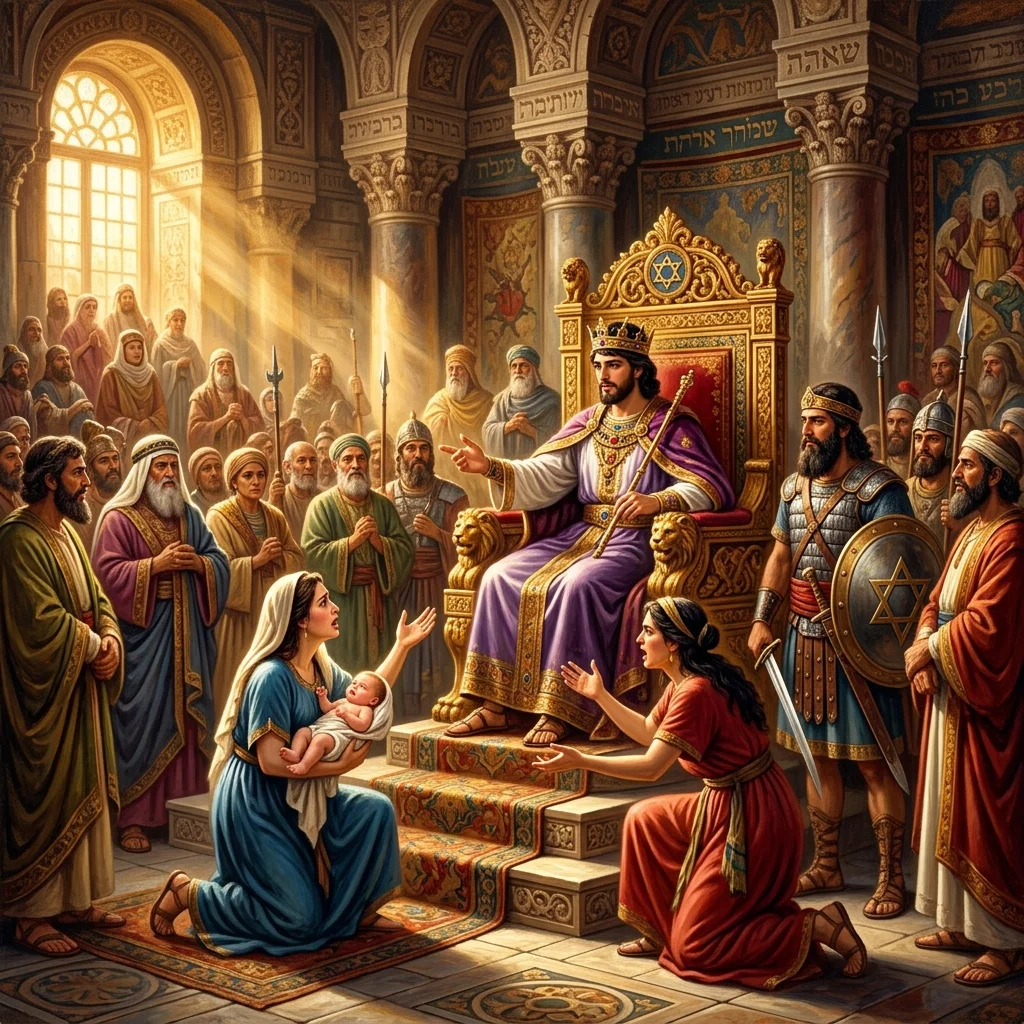
Two harlots who lived alone in a common dwelling approached the royal throne. One of the women stepped forward, clutching a weeping infant, and presented a perplexing and agonizing case: "Oh, my lord, this woman and I live in the same house, and I gave birth to a child while she was in the house. Then on the third day after I gave birth, this woman also gave birth. And we were alone. There was no one else with us in the house; only we two were in the house. And this woman's son died in the night, because she lay on him. And she arose at midnight and took my son from beside me, while your servant slept, and laid him at her breast, and laid her dead son at my breast. When I rose in the morning to nurse my child, behold, he was dead. But when I looked at him closely in the morning, behold, he was not the son that I had borne!" (1 Kings 3:17–21).
Instantly, the other woman shouted in fierce denial: "No, the living child is mine, and the dead child is yours!" The first woman retaliated with equal fury: "No, the dead child is yours, and the living child is mine!"
There were no witnesses, no physical evidence, and no third-party testimony. The judges of the court sat paralyzed in perplexity. How could any human tribunal uncover the truth between two desperate, competing mothers?
King David's son sat calmly upon the cedar throne. Looking down at his royal guards, Solomon issued a startling, chilling command: "Bring me a sword." A soldier drew a gleaming bronze blade and stood before the king. Without a flicker of hesitation, Solomon declared: "Divide the living child in two, and give half to the one and half to the other!" (1 Kings 3:24–25).
A collective gasp echoed across the judgment hall. The second woman sneered with cold, vindictive indifference: "He shall be neither mine nor yours; divide him!" But the first woman—her heart churning with fierce, protective motherly love (*rachamim*)—screamed in agony, falling to her knees: "Oh, my lord, give her the living child, and by no means put him to death!" (1 Kings 3:26).
In that electric moment, the psychological brilliance of the young king was unveiled. Pointing to the weeping woman, Solomon commanded with absolute authority: "Give the living child to the first woman, and by no means put him to death; she is his mother" (1 Kings 3:27). When the news spread across the twelve tribes, all Israel stood in holy awe of their monarch, recognizing that the very wisdom of God was within him to execute justice.
With peace established across the borders and his sovereign administration secured, Solomon turned his full energies toward the monumental task assigned to him by Yahweh and his father David: the construction of the Temple of God upon Mount Moriah.
Entering an international maritime and commercial alliance with King Hiram of Tyre, Solomon mobilized the vast resources of the Mediterranean basin. Hiram provided towering cedar and cypress logs from the snowy peaks of Lebanon (*Cedrus libani*), which were bound into massive timber rafts, floated down the Mediterranean coast to Joppa, and hauled up the steep mountain ridges to Jerusalem. In exchange, Solomon supplied Tyre with twenty thousand cors of wheat and twenty cors of pure beaten olive oil annually.
The logistical scope of the Solomonic construction campaign was staggering. Solomon raised a national labor levy of thirty thousand men sent to Lebanon in rotating shifts of ten thousand a month. In addition, he marshaled seventy thousand burden-bearers and eighty thousand stonecutters in the hill country, supervised by three thousand three hundred chief officers (1 Kings 5:13–16).
On the ancient bedrock of Mount Moriah—the very ridge where Abraham had bound Isaac upon the altar of Moriah, and where David had purchased the threshing floor of Araunah the Jebusite—the sacred house began to rise. A profound architectural sanctity governed the construction site: "When the house was built, it was with stone prepared at the quarry, so that neither hammer nor axe nor any tool of iron was heard in the house while it was being built" (1 Kings 6:7). The massive limestone blocks were quarried, chiseled, and numbered deep within the subterranean caverns beneath Jerusalem, so that upon the holy mountain itself, the temple was assembled in profound, reverent silence.
The Temple was ninety feet long, thirty feet wide, and forty-five feet high. Its interior walls were lined with aromatic carved cedar planks adorned with exquisite motifs of gourds, open flowers, palm trees, and cherubim, overlaid entirely with pure hammered gold. In the innermost sanctuary—the Holy of Holies (*Devir*)—stood two colossal cherubim carved from olive wood, each fifteen feet tall, their outstretched golden wings spanning thirty feet from wall to wall, overshadowing the sacred platform.
Outside the sanctuary, a master Phoenician bronzeworker named Hiram-abi cast monumental masterpieces: two immense bronze pillars named Jachin ("He will establish") and Boaz ("In Him is strength") flanking the vestibule, and the colossal "Bronze Sea"—an immense circular basin holding over ten thousand gallons of water, resting upon the backs of twelve life-size bronze oxen facing the four cardinal directions.
After seven years of meticulous labor, in the eleventh year of Solomon's reign, the Temple was completed.
 In the seventh month, during the joyful autumn festival of the Feast of Tabernacles, Solomon summoned the elders, tribal chiefs, and all the men of Israel to Jerusalem for the dedication. The Levitical priests lifted the ancient, gold-covered Ark of the Covenant from its temporary tent in the City of David and carried it reverently up Mount Moriah, placing it deep within the Holy of Holies beneath the wings of the olive-wood cherubim. Inside the sacred chest rested only the two stone tablets of the Ten Commandments given to Moses at Mount Horeb.
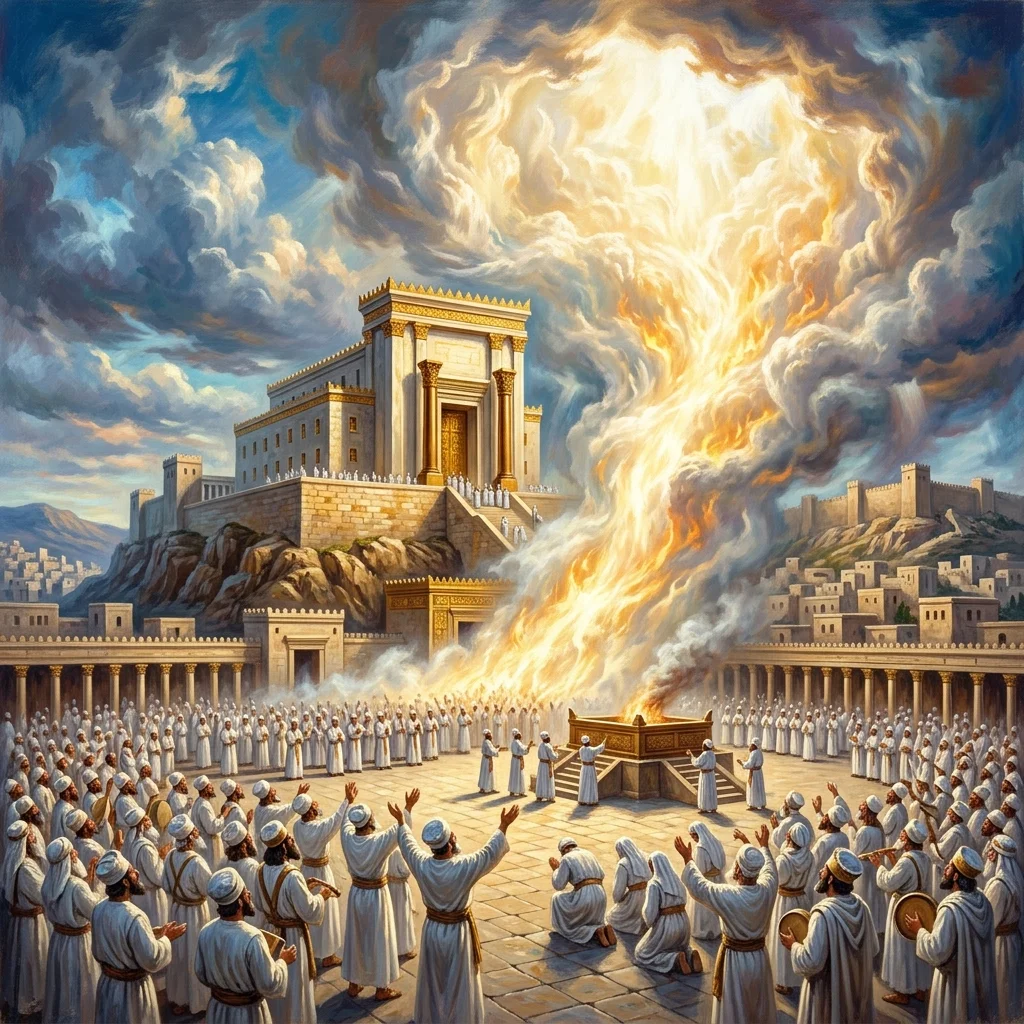
As the priests withdrew from the Holy Place, a host of Levitical musicians clothed in fine linen—Asaph, Heman, and Jeduthun—clashed cymbals, played harps, and blew one hundred and twenty silver trumpets in glorious, unified harmony, praising Yahweh: "For He is good, for His steadfast love endures forever!"
Suddenly, the heaven of heavens descended. An overwhelming, thick, luminous glory cloud—the *Shekinah* (*kavod Yahweh*)—filled the Temple of the LORD with such supernatural weight that the priests were physically unable to stand to minister (1 Kings 8:10–11; 2 Chronicles 5:14).
King Solomon turned to face the vast assembly, blessed the people, and knelt before the bronze altar. Spreading his hands toward heaven before all Israel, Solomon poured out one of the most magnificent prayers in sacred literature:
"O Yahweh, God of Israel, there is no God like you, in heaven above or on earth beneath, keeping covenant and showing steadfast love to your servants who walk before you with all their heart... But will God indeed dwell on the earth? Behold, heaven and the highest heaven cannot contain you; how much less this house that I have built! Yet have regard to the prayer of your servant and to his plea, O Yahweh my God... that your eyes may be open night and day toward this house... And listen to the plea of your servant and of your people Israel, when they pray toward this place. And listen in heaven your dwelling place, and when you hear, forgive!" (1 Kings 8:23, 27–30).
Prophetically, Solomon prayed not only for Israel in seasons of famine, drought, defeat, and exile, but also for the gentile foreigner who would hear of Yahweh's renowned name: "When a foreigner, who is not of your people Israel, comes from a far country for your name's sake... and prays toward this house, hear in heaven your dwelling place and do according to all for which the foreigner calls to you, in order that all the peoples of the earth may know your name and fear you!" (1 Kings 8:41–43).
As Solomon finished praying, fire flashed down from heaven and consumed the burnt offerings and the sacrifices, and the glory of Yahweh filled the temple (2 Chronicles 7:1). When all the people of Israel saw the heavenly fire descend and the glory of Yahweh resting upon the temple, they fell on their faces to the stone pavement, worshiping and giving thanks to Yahweh: "For He is good, for His steadfast love endures forever!"
Solomon and all Israel dedicated the house of Yahweh with an astronomical sacrifice of twenty-two thousand cattle and one hundred and twenty thousand sheep. For fourteen days, the nation celebrated with boundless joy, returning to their homes glad of heart for all the goodness that Yahweh had shown to David His servant and to Israel His people. Zion stood at the absolute zenith of its glory—an earthly shadow of the eternal City of God, where the true Temple, Jesus Christ, would one day Tabernacle among His redeemed people forever.
Biblical Keywords & Theological Roots
A listening or understanding heart. In 1 Kings 3:9, Solomon asks not for abstract philosophical intellect, but for a responsive heart attuned to hear the voice of God and judge with righteous empathy.
Wisdom, skill, and moral discernment. Denotes divinely endowed capacity to live life in accordance with divine order, administer state affairs, and govern with cosmic insight.
Innermost sanctuary, oracle room, or Holy of Holies (1 Kings 6:19). The perfect twenty-cubit golden cube inside the Temple housing the Ark of the Covenant, representing the throne room of Yahweh.
The Glory of the LORD. The tangible, luminous, weighty manifest presence of Yahweh (the Shekinah) that filled the Temple at dedication, overwhelming human strength (1 Kings 8:11; 2 Chron 7:1–2).
Prayer or intercession. Solomon's grand dedicatory prayer before the bronze altar (1 Kings 8:22–53), petitioning God to hear from heaven whenever His repentant people pray toward this sanctuary.
Ancient Near Eastern & Archaeological Context
The reign of Solomon (circa 970–931 BC) marked the zenith of ancient Israel's economic, architectural, and political golden age. Situated strategically across the primary trade arteries connecting Egypt, Mesopotamia, Arabia, and Anatolia (the Via Maris and King's Highway), Solomon commercialized international caravans, established a merchant fleet at Ezion-Geber on the Red Sea in partnership with Phoenician navigators, and imported Arabian incense, Ophir gold, and Egyptian chariots. The construction of the Temple on Mount Moriah (the threshing floor of Araunah/Ornan purchased by David, 2 Chron 3:1) linked the sanctuary directly with Abraham's binding of Isaac (Gen 22). Architecturally, the tripartite floor plan—Ulam (vestibule), Heikhal (main hall), and Devir (Holy of Holies)—mirrored Late Bronze and Iron Age Syrian-Levantine royal temples (such as Tell Tayinat and Ain Dara), but was uniquely adapted to strict Yahwistic aniconic theology. Hiram of Tyre supplied Lebanon cedar (*Cedrus libani*) and skilled Phoenician bronze-smiths, most notably Hiram-abi, who cast the colossal twin bronze pillars (Jachin and Boaz) and the immense 'Bronze Sea' holding over 10,000 gallons of water for priestly ablutions. Archaeological remnants of Solomonic monumental gate fortifications at Megiddo, Hazor, and Gezer (featuring identical six-chambered casemate designs, 1 Kings 9:15) corroborate the centralized administrative and construction bureaucracy required to mobilize a national corvée labor force of 30,000 Israelites and 150,000 Canaanite conscripts.
Practical Discipleship & Spiritual Application
- Prioritize Spiritual Discernment in Prayer: When God offers to meet your desires, do not squander prayers on trivial, selfish pleasures. Seek the wisdom of God, a tender conscience, and spiritual understanding, trusting God to supply your temporal needs.
- Honor God with Your Utmost Resources: Solomon spared no expense in building the Temple, plating the walls with pure gold, importing precious stones, and offering sacrifices beyond measure. Give God your very best, not your leftover energy, time, or finances.
- Cultivate Holy Reverence in the Presence of God: The stones of the Temple were shaped quietly at the quarry so that reverence filled the building site. Enter God's presence with quiet contemplation, submissive hearts, and awe rather than hurried distractions.
- Intercede for the Nations and the Lost: Solomon prayed not only for Israel, but that all the peoples of the earth might know Yahweh's name. Cultivate a global missionary heart that intercedes passionately for the salvation of unreached peoples.
Support Independent Biblical Research
Did this study bless you? Help support our independent bilingual research and interactive visual Bible tools.
⚡ Fast Facts
- At Gibeon, Solomon offered an astounding sacrifice of one thousand burnt offerings upon the ancient bronze altar crafted by Bezalel in the wilderness (1 Kings 3:4; 2 Chron 1:5–6).
- The Temple took exactly seven years to build on Mount Moriah, utilizing 30,000 Israelites on rotating shifts, 70,000 burden-bearers, and 80,000 stonecutters in the mountains (1 Kings 5:13–15; 6:38).
- The massive bronze basin outside the Temple, known as the 'Bronze Sea' (Yam ha-Nechoshet), measured fifteen feet in diameter and was supported by twelve life-size bronze oxen facing north, south, east, and west (1 Kings 7:23–26).
- During the Temple's dedication, the sacrifices offered were so astronomical—22,000 oxen and 120,000 sheep—that the bronze altar was too small, requiring Solomon to consecrate the middle of the courtyard to burn the offerings (1 Kings 8:63–64).
❓ Frequently Asked Questions (FAQs)
Why did God appear to Solomon at Gibeon rather than in Jerusalem?
Although King David had brought the sacred Ark of the Covenant to a tent in Jerusalem (2 Sam 6), the original Mosaic Tabernacle of the wilderness and the ancient bronze altar constructed by Bezalel were still stationed at the great high place of Gibeon, six miles northwest of Jerusalem (1 Chron 16:39; 2 Chron 1:3–5). Solomon traveled to Gibeon to offer sacrifices upon that historic altar, demonstrating his continuity with the covenant of the Exodus before centralizing all worship in the permanent Temple.
How did Solomon's judgment between the two harlots prove his divine wisdom?
In an era without eyewitnesses, physical evidence, or DNA forensics, two women living alone brought a disputed dispute: one baby had died during the night by being lain upon, and both claimed the living child. By commanding a soldier to fetch a sword and cut the living infant in half, Solomon created an emotional crucible. The false mother callously accepted the slaughter ('It shall be neither mine nor yours; divide it!'), while the true mother's maternal womb (*rachamim*) yearned for her child, begging that the baby be given to the other woman alive. Solomon instantly identified the true mother, showcasing divine psychological insight.
Why was no hammer, chisel, or iron tool heard at the Temple building site?
First Kings 6:7 records that the stones were fully shaped and pre-dressed at the quarry before being brought to Mount Moriah. This practiced obedience to the ancient Torah principle found in Exodus 20:25 and Deuteronomy 27:5, which prohibited lifting iron tools upon sacred altars. Symbolically, iron was the metal of warfare and bloodshed; God's house was to be an embassy of divine peace, built in holy quietude and reverence without the clatter of worldly strife.