 Beneath the towering gates of Jerusalem, the early morning sun glistened upon the polished bronze chariots and prancing warhorses of Crown Prince Absalom. For four meticulously planned years following his return from exile in Geshur, the third son of David had orchestrated a masterpiece of subversive populist demagoguery. Endowed with breathtaking physical perfection—from the sole of his foot to the crown of his head, without blemish in all Israel—Absalom dazzled the crowds with his royal charisma. Annually, when he sheared his extraordinarily thick, flowing mane of hair, the cut locks weighed two hundred shekels by the royal standard—nearly five pounds of regal ornament. Fifty armed runners preceded his golden chariot through the streets, projecting an aura of imperial grandeur that starkly eclipsed the aging David's modest administrative demeanor.
Yet Absalom's most potent weapon was not his chariot, but his tongue. Every morning at dawn, the prince positioned himself along the approach to the city gate, where ordinary citizens from every tribe arrived seeking royal arbitration from King David's supreme court. Intercepting litigants before they reached the palace, Absalom would warmly embrace them, kiss their hands, and feign deep personal anguish: "Look, your claims are good and right, but there is no man deputed by the king to hear you! Oh, that I were made judge in the land! Then every man with a dispute could come to me, and I would give him justice" (2 Samuel 15:3–4). By flattering the grievances of the populace while subtly undermining the integrity of his father's administration, the sacred text records the devastating outcome: "So Absalom stole the hearts (*ganav lev*) of the men of Israel" (2 Samuel 15:6).
When the conspiracy was fully ripened, Absalom approached King David under the pious pretext of fulfilling a religious vow made during his exile in Geshur, requesting permission to worship Yahweh in Hebron—the ancient ancestral capital of Judah where David himself had first been anointed king. The unsuspecting father blessed his son: "Go in peace." But as soon as Absalom arrived in Hebron, secret messengers were dispatched throughout all the tribes of Israel with a coordinated battle cry: "As soon as you hear the sound of the trumpet, then say, 'Absalom is king at Hebron!'" (2 Samuel 15:10).
Two hundred unsuspecting noblemen accompanied Absalom from Jerusalem, lending royal legitimacy to his gathering rebellion. Then came the crowning blow of political betrayal: Ahithophel the Gilonite, David's foremost strategic counselor—whose counsel was revered as if one had inquired of the divine oracle of God—defected to Absalom. Ahithophel was the grandfather of Bathsheba; years of buried outrage over David's seduction of his granddaughter and the cold-blooded murder of Uriah the Hittite now erupted in catastrophic retribution against the crown.
When breathless couriers reached the Citadel of Zion crying, "The hearts of the men of Israel have gone after Absalom!" King David immediately understood the catastrophic magnitude of the crisis. Rather than subjecting Jerusalem and its civilian populace to the horrors of a protracted siege and urban slaughter, David commanded an immediate evacuation: "Arise, and let us flee, or else there will be no escape for us from Absalom!" (2 Samuel 15:14).
The departure from Jerusalem was an agonizing pageant of royal humiliation. Leaving ten concubines behind to keep the palace, the king marched out on foot, surrounded by his veteran bodyguards—the Cherethites, the Pelethites, and six hundred loyal Gittite warriors under the command of Ittai the Philistine exile, who refused to abandon his covenant king. When Zadok and Abiathar carried the sacred Ark of the Covenant out of the city to accompany him, David demonstrated supreme spiritual submission, commanding them to return the Ark to Zion: "Carry the ark of God back into the city. If I find favor in the eyes of Yahweh, he will bring me back and let me see both it and his dwelling place. But if he says, 'I have no pleasure in you,' behold, here I am, let him do to me what seems good to him" (2 Samuel 15:25–26).
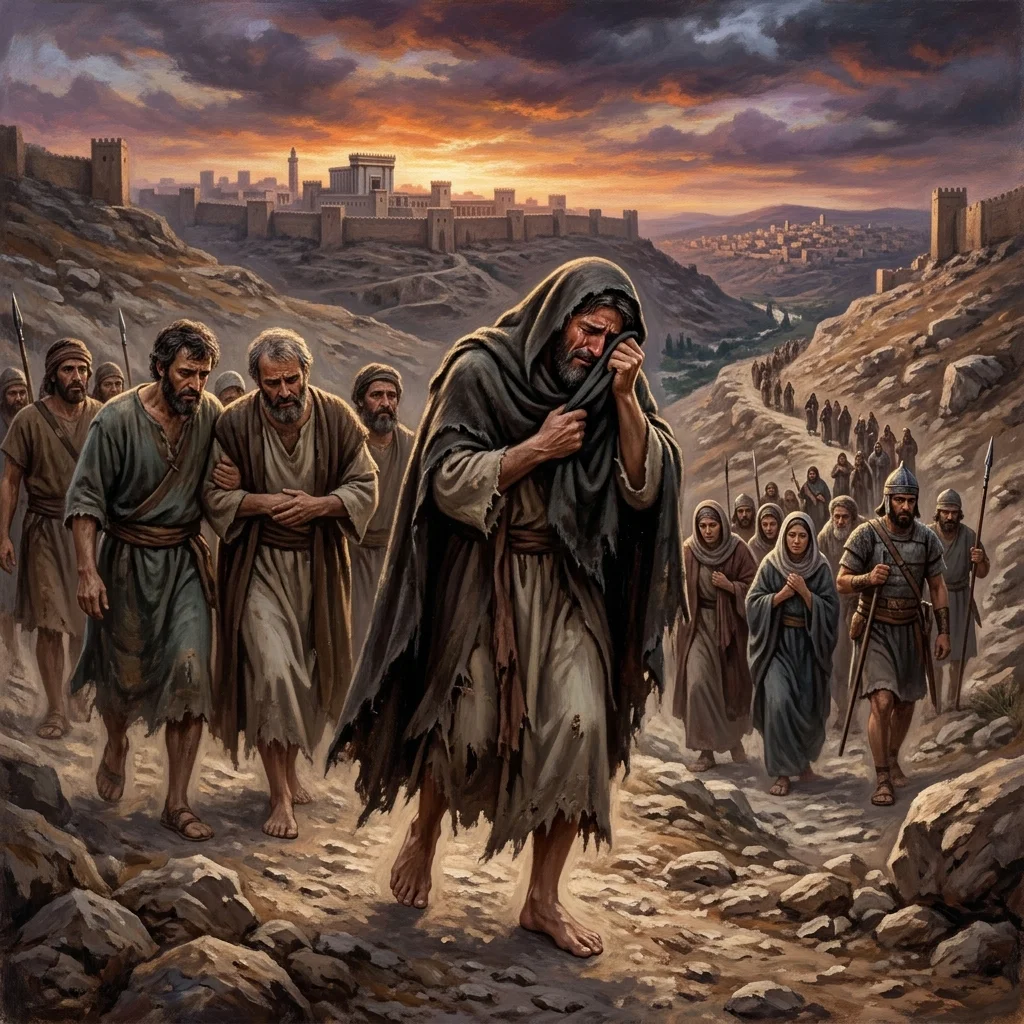
Ascending the rugged path of the Mount of Olives, King David walked with covered head, weeping barefoot, while all the people with him covered their heads and wept as they climbed. As news reached the fleeing monarch that his trusted counselor Ahithophel had joined the conspiracy, David uttered a brief, targeted prayer to heaven: "O Yahweh, turn the counsel of Ahithophel into foolishness (*hafakh etzah*)!" (2 Samuel 15:31). Upon the wind-swept crest of the mountain, in the crucible of public shame, David poured out his heart in the immortal verses of Psalm 3: "O Yahweh, how many are my foes! Many are rising against me; many are saying of my soul, 'There is no salvation for him in God.' But you, O Yahweh, are a shield about me, my glory, and the lifter of my head!" (Psalm 3:1–3).
At the summit of the Mount of Olives, God immediately provided the answer to David's prayer. Hushai the Archite, David's loyal friend, met him with torn robes and dust upon his head. Recognizing Hushai's supreme strategic value, David sent him back into Jerusalem as an undercover spy: "If you go back to the city, you can defeat for me the counsel of Ahithophel" (2 Samuel 15:34).
When Absalom and his rebel host entered Jerusalem in triumph, Hushai prostrated before the usurper, shouting: "Long live the king! Long live the king!" When Absalom questioned his loyalty to his father, Hushai delivered a masterclass of diplomatic deception, assuring him that he served whomever Yahweh and the men of Israel chose. To demonstrate absolute, irreversible rupture with his father and lay formal claim to the dynasty, Absalom pitched a tent on the palace roof—the very rooftop where David had first gazed upon Bathsheba—and publicly cohabited with David's ten concubines in the sight of all Israel, fulfilling Nathan's dreadful prophecy to the letter (2 Samuel 16:21–22).
Ahithophel then pressed for immediate, lethal action: "Let me choose twelve thousand men, and I will arise and pursue David tonight. I will come upon him while he is weary and discouraged and throw him into a panic... I will strike down only the king, and I will bring all the people back to you" (2 Samuel 17:1–3). It was a brilliant, flawless military strategy that would have sealed David's doom before morning.
Absalom summoned Hushai for a second opinion. Hushai skillfully appealed to Absalom's vanity and latent fear. "This time the counsel that Ahithophel has given is not good," Hushai argued persuasively. "You know that your father and his men are mighty men, and they are enraged, like a bear robbed of her cubs in the open field... Even the valiant man whose heart is like the heart of a lion will utterly melt with fear, for all Israel knows that your father is a mighty man!" Instead, Hushai proposed a grandiose alternative: assemble all the fighting men of Israel "from Dan to Beersheba, like the sand by the sea for multitude," and let Absalom personally lead this colossal imperial host into battle to swallow David and his followers completely.
Blinded by arrogance and narcissistic lust for glory, Absalom and the elders of Israel declared: "The counsel of Hushai the Archite is better than the counsel of Ahithophel!" The sacred chronicler unveils the invisible hand of God behind the scene: "For Yahweh had ordained to defeat the good counsel of Ahithophel, so that Yahweh might bring evil upon Absalom" (2 Samuel 17:14).
Recognizing that the rebellion was irrevocably doomed by this fatal delay, Ahithophel saddled his donkey, rode home to his ancestral estate in Giloh, set his household in order, and hanged himself.
Meanwhile, secret couriers sent by Hushai alerted David, allowing his forces to cross the Jordan River and establish a fortified garrison at Mahanaim in Gilead. Wealthy chieftains—including Machir of Lo-Debar and Barzillai the Gileadite—showered the exhausted royal troops with wheat, barley, honey, cheese, and sleeping mats. David organized his veteran legions into three divisions under the battle-hardened commanders Joab, Abishai, and Ittai. As the troops marched out to meet Absalom's overwhelming rebel army, the king stood beside the city gate and issued a solemn, heartfelt plea that rang in the ears of every soldier: "Deal gently for my sake with the young man Absalom!" (2 Samuel 18:5).
 The catastrophic clash occurred in the dense, rocky forest of Ephraim. The seasoned tactical discipline of David's veterans shattered the undisciplined rebel legions, routing them through the treacherous limestone ravines. Twenty thousand rebel soldiers fell in the slaughter, and the sacred text observes: "The forest devoured more people that day than the sword" (2 Samuel 18:8).
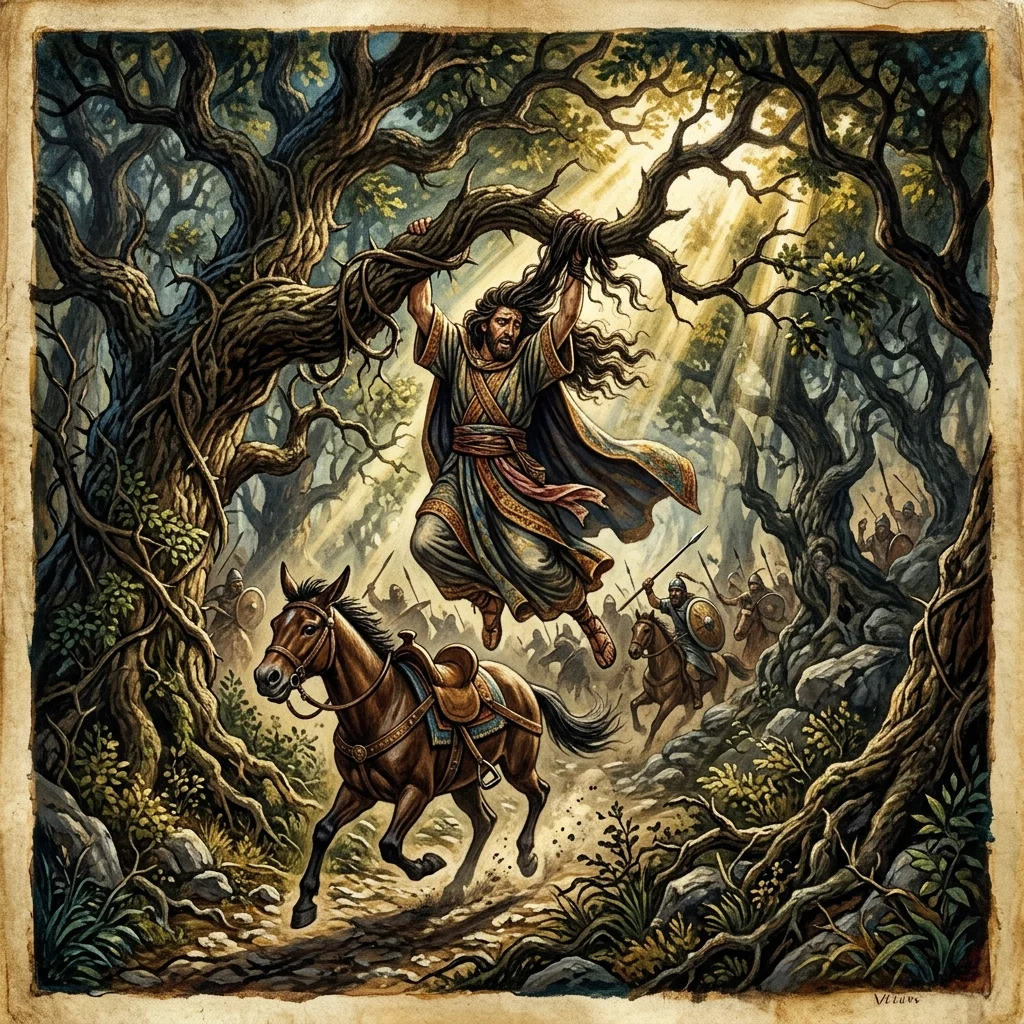
In the midst of the chaos, Absalom found himself cut off and fleeing for his life. Riding frantically upon his royal mule, he plunged down an overgrown mountain path beneath the low-hanging boughs of an ancient oak terebinth (*Elah Gedolah*). In a terrifying stroke of divine irony, the prince's pride became his fatal snare: his magnificent, celebrated hair became violently entangled in the thick, knotted branches. As his royal mule surged forward and bolted down the trail, Absalom was jerked from the saddle, left dangling helplessly between heaven and earth.
A soldier spotted the trapped prince and hurried to inform the commanding general: "I saw Absalom hanging in an oak!" Joab demanded furiously, "Why did you not strike him there to the ground? I would have given you ten pieces of silver and a belt!" The soldier replied with unyielding covenant integrity: "Even if I felt in my hand the weight of a thousand pieces of silver, I would not reach out my hand against the king's son; for in our hearing the king commanded you and Abishai and Ittai, 'For my sake protect the young man Absalom!'"
Joab, ruthless and pragmatically unsentimental, had no patience for moral scruples. Seizing three wooden javelins, he marched directly to the great oak. While Absalom dangled alive in the heart of the terebinth, Joab thrust the three darts directly through the prince's chest. Ten of Joab's armor-bearers closed in and completed the slaughter, hacking the rebel's body to pieces. Blowing the ram's horn to halt the pursuit of the routed Israelites, Joab's men cast Absalom's mutilated corpse into a deep pit in the forest and piled an immense heap of rough stones over him. The proud prince, who had carved an opulent marble monument for himself in the King's Valley to immortalize his name, lay buried in an unmarked, ignominious grave of shame.
At the gateway of Mahanaim, King David sat anxiously between the inner and outer gates, his eyes scanning the horizon. When the Cushite runner arrived shouting, "Good news for my lord the king! For Yahweh has delivered you this day from the hand of all who rose up against you!" the king asked only one trembling question: "Is it well with the young man Absalom?"
The Cushite replied with solemn gravity: "May the enemies of my lord the king and all who rise up against you for evil be like that young man."
The king was shaken to the depths of his being. Turning away from his officers, weeping uncontrollably, David climbed the narrow stone stairs to the chamber over the gate. As he walked, his agonizing wails echoed across the rooftops of Mahanaim in words of timeless, heartbreaking grief:
"O my son Absalom! My son, my son Absalom! Would God I had died for you, O Absalom, my son, my son!" (*Beni Avshalom, beni, beni Avshalom! Mi yitten muti ani tachtekha, Avshalom beni, beni!*, 2 Samuel 18:33).
The royal victory was swallowed up in mourning that day. The weeping king revealed not the vengeful triumph of an earthly potentate, but the unfathomable, bleeding heart of a father whose sorrow foreshadowed the cross—where the true King would not merely wish to die in the place of rebellious sons, but would actually lay down His life upon a tree to rescue a fallen world.
Biblical Keywords & Theological Roots
To steal the heart. Used in 2 Samuel 15:6 to describe Absalom's insidious, deceitful flattery at the city gates, systematically undermining public trust in lawful authority through populist charm.
A Psalm of David when he fled from Absalom his son (Psalm 3:1). A poetic prayer composed in the midst of public humiliation, expressing unshakable trust in Yahweh as shield, glory, and lifter of the head.
To overturn, frustrate, or turn counsel into foolishness. David's target prayer on the Mount of Olives (2 Samuel 15:31) asking God to neutralize Ahithophel's lethal strategic brilliance.
Great oak or terebinth tree. The ancient, thick-branched Mediterranean terebinth in the forest of Ephraim (2 Samuel 18:9) whose tangled canopy ensnared Absalom by his head and hair.
My son Absalom! The anguished, fivefold cry of King David weeping in the chamber over the gate of Mahanaim (2 Samuel 18:33), expressing the profound, unconditional agony of fatherly love over a fallen, rebellious child.
Ancient Near Eastern & Archaeological Context
Absalom's rebellion (circa 979 BC) represents the dark political fulfillment of Nathan's prophecy: 'I will raise up evil against you out of your own house' (2 Sam 12:11). Absalom was the son of Maacah, daughter of Talmai, king of Geshur (an Aramean principality northeast of the Sea of Galilee, 2 Sam 3:3). His maternal royal bloodline gave him international geopolitical ties and royal entitlement. In ancient Semitic culture, the city gate was the supreme locus of judicial administration, legal trade, and civil assembly; by intercepting litigants before they reached David's royal tribunal, Absalom subverted the core judicial apparatus of the state. His acquisition of fifty runners and chariots mirrored the regal pomp of Egyptian and Hittite pharaohs, projecting majesty over David's modest administrative style. Ahithophel's defection was intensely personal: as the grandfather of Bathsheba (daughter of Eliam son of Ahithophel, 2 Sam 11:3; 23:34), his treason was fueled by deep-seated thirst for retribution against David for the dishonor and murder of Uriah. Furthermore, Ahithophel's advice that Absalom publicly cohabit with David's concubines on the palace roof (2 Sam 16:21–22) was an ancient Near Eastern legal declaration of dynamic succession, demonstrating total, irreversible conquest of the prior monarch's sovereignty. The battle in the 'forest of Ephraim' (located east of the Jordan in Gilead near Mahanaim) took place in treacherous, broken karstic terrain overgrown with dense Mediterranean oak (*Quercus calliprinos*) and terebinths (*Pistacia atlantica*), which historically claimed more casualties through craggy ravines, panic, and entanglement than the sword itself.
Practical Discipleship & Spiritual Application
- Beware the Peril of Narcissistic Self-Exaltation: Absalom built a monument to himself in the King's Valley because he had no son to keep his name in remembrance (2 Samuel 18:18). Self-absorbed ambition and vanity always lead to spiritual entrapment and ruin. Cultivate humble servant leadership.
- Entrust Slander and Betrayal to God's Righteous Hand: When Shimei cursed David and hurled stones, Abishai offered to decapitate him. David restrained him: 'Let him alone, and let him curse, for Yahweh has told him to' (2 Samuel 16:11). Leave personal vindication to God rather than retaliating in anger.
- Recognize God's Power to Frustrate the Cleverest Schemes: Ahithophel possessed peerless intellectual brilliance, but his godless conspiracy ended in suicide when his advice was rejected. Worldly power and human intellect can never override God's sovereign decrees.
- Embrace the Sacrificial Love of the Cross: David longed to die in the place of his rebellious son: 'Would God I had died for thee!' What David could only wish for, Jesus Christ accomplished on Calvary: dying in the place of rebellious sinners so that we might live as sons of God.
Support Independent Biblical Research
Did this study bless you? Help support our independent bilingual research and interactive visual Bible tools.
⚡ Fast Facts
- Absalom's hair was so exceptionally thick and heavy that when cut annually, it weighed two hundred shekels by the royal standard—approximately five pounds (2 Samuel 14:26).
- Ahithophel was the grandfather of Bathsheba, which explains why he abandoned David to join Absalom's conspiracy—seeking vengeance for Uriah's murder and Bathsheba's dishonor (2 Samuel 11:3; 23:34).
- When Ahithophel saw that Absalom followed Hushai's counsel rather than his own, he accurately deduced that the rebellion was doomed, rode home to Giloh, set his house in order, and hanged himself (2 Samuel 17:23).
- Absalom had erected a massive stone monument in the King's Valley to preserve his own memory, but instead of being buried beneath it, his corpse was thrown into a pit in the forest of Ephraim and covered with a heap of stones (2 Samuel 18:17–18).
❓ Frequently Asked Questions (FAQs)
Why did King David choose to evacuate Jerusalem rather than defending the fortified city against Absalom?
David evacuated Jerusalem for two primary reasons: first, to spare the holy city and its civilian population from the catastrophic devastation of a bloody siege and urban warfare (2 Sam 15:14); and second, because he recognized the rebellion as the fulfillment of Nathan's prophecy regarding divine chastening upon his house (2 Sam 12:11). In deep humility, David placed his fate entirely in Yahweh's sovereign hands: 'If I find favor in the eyes of Yahweh, he will bring me back... but if he says, I have no pleasure in you, behold, here I am, let him do to me what seems good to him' (2 Sam 15:25–26).
How did Hushai the Archite successfully defeat Ahithophel's military advice?
Ahithophel urged an immediate night strike with 12,000 elite troops to assassinate David while he was weary and vulnerable, leaving the rest of the nation unharmed (2 Sam 17:1–4). Hushai skillfully played upon Absalom's vanity and fear: he reminded Absalom that David and his men were seasoned warriors who would not sleep among ordinary troops, warned of panic if a vanguard strike failed, and flattered Absalom by proposing that he gather all Israel 'from Dan to Beersheba' and personally lead a massive imperial army into battle. Absalom's ego fell into Hushai's trap, giving David time to organize his forces across the Jordan (2 Sam 17:7–14).
Why did Joab execute Absalom in direct defiance of King David's explicit royal command?
Before the battle, King David stood at the gate of Mahanaim and commanded all his generals before the entire army: 'Deal gently for my sake with the young man Absalom' (2 Sam 18:5). However, Joab was a cold, pragmatic military realist. He understood that as long as charismatic, treacherous Absalom remained alive, the kingdom would never know peace, David would remain vulnerable to future coups, and civil war would flare perpetually. Seeing Absalom hanging helpless in the oak tree, Joab cast aside the king's emotional plea and drove three darts through the usurper's heart to permanently terminate the rebellion (2 Sam 18:14).