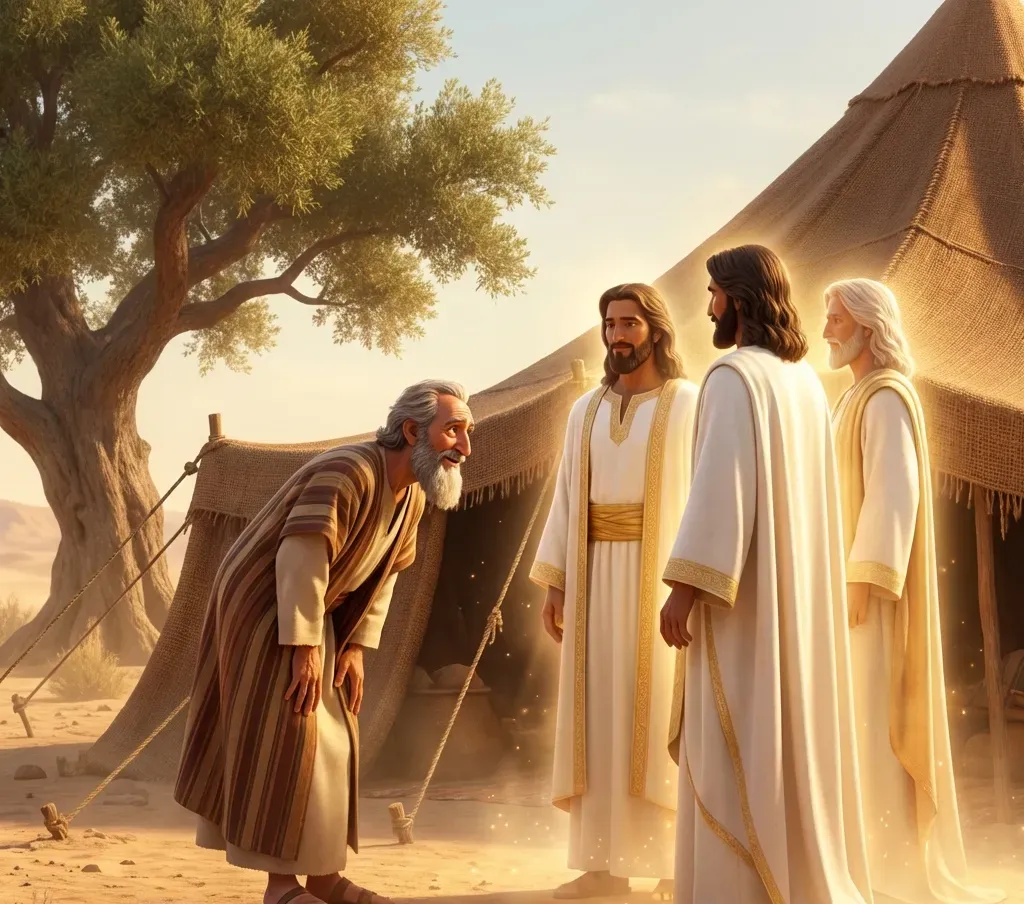
Under the scorching heat of the Judean noon, beneath the whispering terebinth trees of Mamre, an unassuming nomad sat at the entrance of his goat-hair tent. Abraham lifted his eyes and beheld three travelers standing along the dusty ridgeline. Instantly discerning an aura of uncreated majesty concealed beneath mortal garments, the patriarch did not merely walk; he ran to prostrate himself in the dust. This spontaneous posture of reverent hospitality initiated one of the most profound encounters in biblical history: an afternoon meal that shifted from covenant intimacy to a chilling disclosure of impending cosmic judgment against the decadent cities of the Jordan Plain.
1. The Theophany at Mamre and the Covenant Friendship
In the ancient Near East, hospitality to the stranger was a sacred civilizational pillar, but Abraham's response transcended social convention. He addressed the central figure as Adonai ('My Lord') and implored Him not to pass by His servant. Hurrying into the dark tent, he urged Sarah to knead three measures of the finest flour—enough to feed a royal retinue—while he personally ran to the herd to select a tender, choice calf. When the banquet of curds, fresh milk, and roasted meat was served beneath the cooling shade of the oak, the eternal Sovereign of the universe condescended to dine with mortal dust.
Here, God reaffirmed the miraculous covenant promise: within one year, barren, ninety-year-old Sarah would cradle a biological son in her arms. When Sarah laughed in silent, skeptical amazement behind the woven tent curtain, the Lord pierced her interior thoughts with the timeless rhetorical challenge: 'Is anything too hard for the LORD?' (Genesis 18:14). The covenant seed was unconditional and imminent. But as the heavenly visitors arose to depart, turning their faces eastward toward the sun-drenched drop of the Rift Valley, the tone of the meeting shifted from pastoral comfort to judicial gravity.
Yahweh paused on the heights overlooking the shimmering blue expanse of the Salt Sea and posed a searching question: 'Shall I hide from Abraham what I am about to do, seeing that Abraham shall surely become a great and mighty nation, and all the nations of the earth shall be blessed in him?' (Genesis 18:17-18). God honored Abraham not merely as a servant, but as His trusted covenant friend (Isaiah 41:8, James 2:23), inviting him into the celestial council where the fate of human empires is weighed and determined.
2. The Agonized Cry of Injustice and the Intercessory Stance
The Lord declared that the outcry against Sodom and Gomorrah was extraordinarily immense, and their sin intolerably grave. The Hebrew term employed, Tze'akah, signifies far more than generic moral wrongdoing; it is the blood-curdling screech of the oppressed, the desperate shriek of victims subjected to brutal institutionalized violence, predatory extortion, and cruel abuse. God descended not because He lacked omniscience, but to enact a formal, incontrovertible judicial investigation before human history, demonstrating that divine retribution is never arbitrary, reckless, or malicious, but grounded in meticulous, verified evidence.
As the two attendant angels departed down the descending gorges toward the Jordan depression, Abraham remained standing before Yahweh on the wind-swept heights. Aware of God's unbending holiness and mindful that his nephew Lot dwelt within Sodom's gates, the patriarch stepped forward. His posture was neither arrogant defiance nor passive indifference; it was the sacred audacity of faith. Abraham appealed to the foundational moral nature of the Creator: 'Far be it from You to do such a thing—to put the righteous to death with the wicked, so that the righteous fare as the wicked! Far be that from You! Shall not the Judge of all the earth do what is right?' (Genesis 18:25).
Then began the most breathtaking intercessory dialogue recorded in sacred scripture. Abraham pleaded: If fifty righteous souls reside in the metropolis, will You spare the entire place? God immediately agreed. Gripped by awe, confessing that he was merely 'dust and ashes' (afar va'efer), Abraham steadily reduced the threshold: forty-five, forty, thirty, twenty, and finally ten. Six distinct times, Abraham pressed the boundaries of divine mercy; six distinct times, Yahweh granted his petition. At ten souls, Abraham ceased. In ancient Semitic clan structures, ten adult members constituted a complete legal household. Abraham rested confident that between Lot, his wife, his daughters, and their prospective grooms, a remnant of ten would easily preserve the valley.
3. The Moral Twilight of the Valley
At dusk, the two angelic envoys arrived at the fortified gateway of Sodom. Lot was seated in the gate—the traditional seat of municipal justice, commerce, and civic administration. Years earlier, Lot had looked greedily upon the lush plains of the Jordan and 'pitched his tent toward Sodom' (Genesis 13:12). Now, he was fully integrated into its civic fabric. Yet, when he saw the radiant travelers, remnants of Abraham's righteous training surfaced within him. He rose, bowed low, and vehemently insisted that they enter his private dwelling for shelter, safety, and foot-washing.
Lot understood the predatory horrors of the city streets after nightfall. The angels initially tested his resolve by stating they would sleep in the open public square, but Lot pressed them intensely until they entered his house. He baked unleavened bread and prepared a meal for them. But before they could lie down to sleep, the dark soul of the city manifested in terrifying reality. The men of Sodom—both young and old, from every quarter of the city without exception—surrounded the house like ravenous wolves, pounding against the cedar door and shouting: 'Where are the men who came to you tonight? Bring them out to us, that we may know them carnally!' (Genesis 19:5).
This depraved scene utterly validated the heavenly Tze'akah. Hospitality had been murdered; violent sexual exploitation and predatory humiliation were weaponized against vulnerable foreigners. Lot stepped outside, shutting the heavy door behind him, and pleaded: 'Please, my brothers, do not act so wickedly!' In desperate moral confusion, poisoned by the vile ethos around him, Lot offered his two virgin daughters to appease the frenzied mob. But the corrupt citizens scoffed with contempt: 'This fellow came in as an alien, and now he acts as our judge! Now we will deal worse with you than with them!'
As the violent mob lunged forward to smash the doorway and lynch Lot, the two angelic visitors reached out through the portal, pulled Lot into the safety of the house, and struck the violent crowd with blinding supernatural blindness (sanverim). Groping in total confusion, bruised and exhausted, the mob spent itself trying to find the doorway, oblivious that their doom was now irrevocably sealed.
4. The Hesitation of Lot and the Grace that Compels
Inside the house, the atmosphere transformed into urgent military evacuation. The angels announced to Lot: 'Whomever you have here—son-in-law, your sons, your daughters, and whomever you have in the city—bring them out of this place! For we are about to destroy this place, because the outcry against them has grown great before the face of the LORD, and the LORD has sent us to destroy it.' (Genesis 19:12-13).
In the dead of night, Lot rushed through the winding stone alleys to the homes of his prospective sons-in-law who were pledged to marry his daughters. Trembling with urgency, he warned them: 'Get up! Flee this place, for the Lord is about to destroy the city!' But his words fell upon dead ears; to his worldly sons-in-law, his warnings sounded like the deranged babbling of a drunken jester. Lot's lifelong compromises had completely destroyed his spiritual authority.
When dawn broke across the eastern mountain ridges of Moab, the angels urged Lot with desperate intensity: 'Arise, take your wife and your two daughters who are here, lest you be swept away in the punishment of the city!' Yet, in a staggering display of spiritual paralysis, Lot lingered. His heart, his accumulated wealth, his lands, and his memories were anchored in the doomed valley. In that moment of fatal hesitation, sheer sovereign mercy intervened: 'While he lingered, the men took hold of his hand, his wife's hand, and the hands of his two daughters, the LORD being merciful to him; and they brought him out and set him outside the city.' (Genesis 19:16). It was grace with teeth—compassion that physically dragged a reluctant family away from the brink of the abyss.
 Sovereign mercy dragged Lot and his daughters out of the valley before celestial fire rained upon the corrupt plain.
5. Brimstone, Fire, and the Fatal Backward Glance
Once outside the city gates, the angelic commander gave a non-negotiable decree: 'Escape for your life! Do not look behind you nor stay anywhere in the plain! Escape to the mountains, lest you be destroyed!' Still bargaining, Lot begged to flee to a small nearby settlement called Zoar ('Little'), claiming the mountain journey was too arduous. In astonishing forbearance, God granted his request, promising not to overthrow Zoar until Lot arrived safely within its walls.
The morning sun had risen over the earth when Lot reached Zoar. Then, the heavens were cleaved. The text records with chilling clarity: 'Then the LORD rained upon Sodom and Gomorrah brimstone and fire from the LORD out of heaven. So He overthrew those cities, all the plain, all the inhabitants of the cities, and what grew on the ground.' (Genesis 19:24-25). Tectonic fractures ruptured subterranean petroleum and bitumen basins; celestial fire ignited the hydrocarbon fumes, raining down molten sulfur, superheated ash, and choking smoke that incinerated every structure, organism, and vegetation layer across the valley floor.
In the midst of this deafening apocalyptic fury, tragedy struck the fleeing family. Lot's wife, walking behind him, defied the explicit angelic command: she looked back. This was not a momentary, frightened glance over her shoulder; the Hebrew syntax denotes an intentional, longing contemplation. Her heart belonged to Sodom; her treasure, her comforts, and her friends were incinerated behind her. Paralyzed by grief and idolatry, she was instantly engulfed by the toxic, mineral-saturated pyroclastic surge, encrusted in sodium chloride and mineral slag, transformed into an enduring, lifeless pillar of salt.
6. The Smoke of the Furnace and Covenant Remembrance
Early that same morning, Abraham ascended the stony ridges of Mamre to the very place where he had stood before the Lord. Looking down through the misty morning air toward the Jordan Rift Valley, he beheld an awesome and terrible sight: dense, black, billowing smoke rising from the land like the smoke of a great smelting furnace. The prosperous green basin of Jordan had been wiped out of existence.
Yet the inspired narrator provides the theological heart of the entire narrative in Genesis 19:29: 'And it came to pass, when God destroyed the cities of the plain, that God remembered Abraham, and sent Lot out of the midst of the overthrow, when He overthrew the cities in which Lot had dwelt.' Lot was not saved because of his own spiritual virtue, his moral courage, or his wisdom. Lot was delivered because God remembered Abraham. The fervent, selfless intercession of the covenant friend had constructed a spiritual canopy under which mercy plucked Lot from the very jaws of wrath.
Theological Summary:
- Divine Holiness and Moral Accountability: God is not an indifferent bystander to human atrocities. Sin creates an inescapable cosmic outcry (Tze'akah) that demands sovereign moral restitution.
- The Necessity of Radical Separation: Worldly compromise is spiritually lethal. Lot lost his family, his testimony, and his dignity because he pitched his tent toward Sodom rather than walking in holy detachment.
- The Supreme Power of Intercession: Abraham's intercession demonstrates that the prayers of the righteous have supernatural potency, moving the hand of God to spare and deliver even amidst civilizational ruin.
- Christological Warning and Hope: Jesus cited Sodom as an archetype of the sudden, final judgment that will overtake an unsuspecting, self-indulgent world (Luke 17:28-30). Christ is our heavenly Intercessor whose blood speaks a better word than Abel, delivering all who trust in Him from the wrath to come.
Biblical Keywords & Theological Roots
An agonized outcry of oppression, injustice, or victims crying out under extreme cruelty, demanding divine judicial intervention.
The Judge of all the earth (Genesis 18:25); title affirming Yahweh's universal moral sovereignty and intrinsic justice over all nations.
To overturn, overthrow, turn upside down, or radically invert; describing the total catastrophic destruction of the cities of the plain.
To spare, pity, or display tender sovereign compassion; highlighting the divine mercy that seized Lot's hand when he lingered.
To look intently, contemplate with longing, or gaze backward with emotional attachment; describing Lot's wife's fatal look.
Ancient Near Eastern & Archaeological Context
In the Middle Bronze Age (c. 2000–1800 BC), the fertile Jordan River Valley and the circular plain known as the Kikkar supported thriving, fortified city-states. Fed by perennial mountain streams and subterranean springs, the valley was celebrated as 'well watered everywhere, like the garden of the LORD' (Genesis 13:10). This agricultural opulence generated immense wealth, trade monopolies, and strategic influence. However, prophetic scripture reveals that Sodom's material luxury birthed deep moral decadence: 'Now this was the sin of your sister Sodom: She and her daughters were arrogant, overfed and unconcerned; they did not help the poor and needy' (Ezekiel 16:49).
Ancient Near Eastern culture was strictly governed by sacred codes of hospitality (the protection of traveling strangers under the roof of the host). In Sodom, this civilizational bedrock had inverted into predatory mob violence, institutional depravity, and shameless sexual exploitation. Geologically, the Dead Sea Rift sits atop an active fault line characterized by extensive bitumen seeps, petroleum springs, and highly combustible sulfur deposits. When divine judgment descended, tectonic subduction combined with celestial ignition ignited the subterranean hydrocarbons, creating a devastating cataclysm that permanently turned a flourishing agricultural basin into an arid, hypersaline wasteland.
Practical Discipleship & Spiritual Application
- The Calling to Bold Intercessory Prayer: Like Abraham standing reverently yet courageously before Yahweh, believers are called to stand in the spiritual gap for corrupted cities, nations, and loved ones, anchoring our petitions in God's immutable justice and boundless mercy.
- The Subtle Deception of Lingering Compromise: Lot pitched his tents toward Sodom, eventually sat in its city gates as a civic leader, and hesitated when commanded to flee. Worldly compromise never happens instantly; it begins with casual proximity and ends in spiritual paralyzation.
- The Lethal Cost of Looking Back: Jesus warned His disciples, 'Remember Lot's wife' (Luke 17:32). We cannot follow Christ toward eternal life while harboring secret longing for the decadent treasures and sinful comforts of the world we were redeemed out of.
- The Unshakable Deliverance of God's Remnant: Genesis 19:29 records that when God destroyed the cities of the plain, 'He remembered Abraham, and He brought Lot out of the catastrophe.' God's covenant remembrance of Christ our Intercessor guarantees our absolute security amidst collapsing worldly empires.
⚡ Fast Facts
- The Outcry of Oppression: The Hebrew term 'Tze'akah' denotes an agonizing cry of victims suffering systemic violence, oppression, and cruelty that ascends directly to God's heavenly throne.
- The Theophany at Mamre: Yahweh appeared to Abraham alongside two angels in human form, receiving lavish Semitic hospitality beneath the oaks before revealing His sovereign judicial investigation.
- The Extent of Intercession: Abraham boldly pleaded six consecutive times, stepping down the threshold of righteousness from fifty down to ten souls, unveiling God's immense patience.
- Cataclysmic Geologic Inversion: The catastrophic destruction involved subterranean petroleum, bitumen, and sulfur deposits ignited by celestial fire, permanently altering the Dead Sea basin.
❓ Frequently Asked Questions (FAQs)
In ancient Near Eastern patriarchal society, ten adult members constituted the minimal legal quorum for a complete family clan or civil community (a concept preserved later in the Jewish 'minyan'). Abraham reasonably assumed that between Lot, his wife, their married daughters, sons-in-law, and betrothed suitors, a faithful family unit of ten would easily be found to spare the entire city.
Excavations in the southern and northern Dead Sea Rift Valley (particularly at Bab edh-Dhra, Numeira, and Tall el-Hammam) have uncovered catastrophic destruction layers characterized by intense thermal incineration, melted pottery, vitrified mudbricks, and high concentrations of sulfur and sulfate salts dating to the Middle Bronze Age, consistent with a sudden, devastating cosmic or atmospheric thermal event.
Her backward glance was not a momentary curiosity, but a tragic revelation of an divided heart. The Hebrew verb 'tabat' indicates a lingering, longing contemplation. Though her body had been physically pulled out of Sodom by angelic hands, her affection and treasure remained anchored in its worldly luxury, incurring instant petrification under the falling mineral-rich fallout.