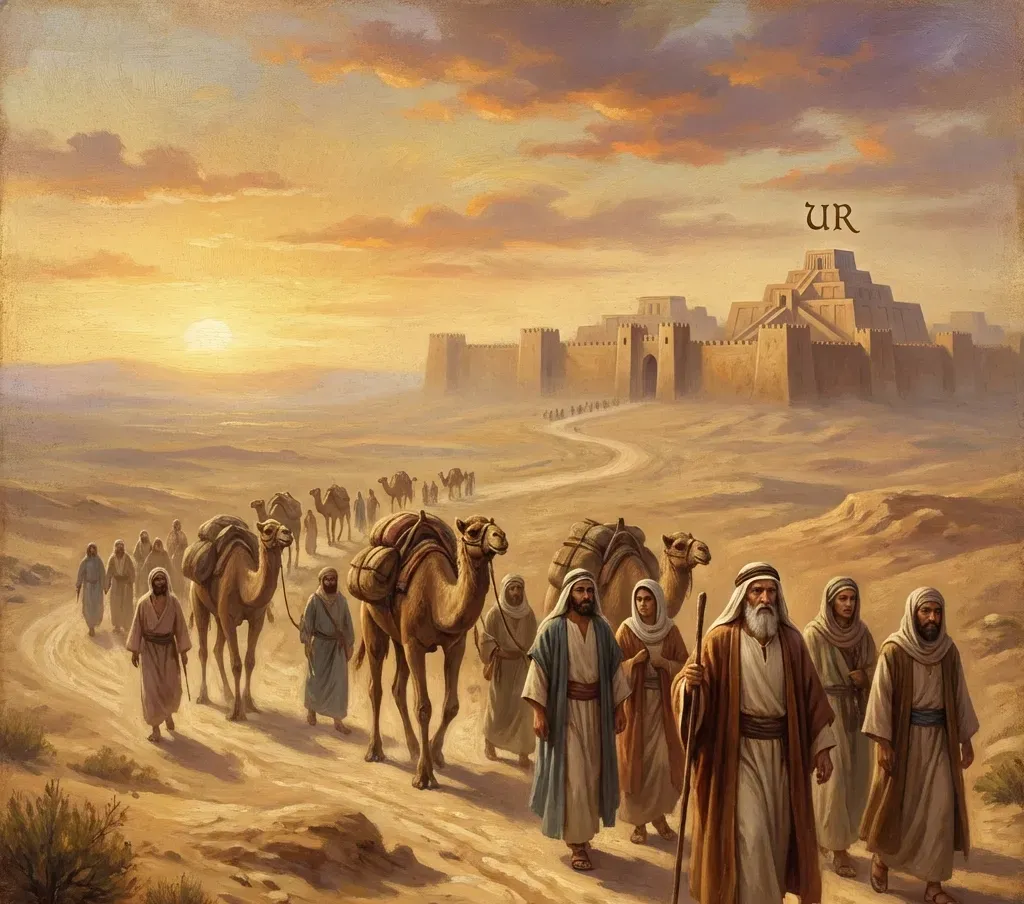
Centuries after the scattering at Babel, idolatry reigned supreme across the ancient Near East. In the vibrant, bustling metropolis of Ur of the Chaldees (located in modern-day southern Iraq), civilization flourished. Multi-story private homes lined paved thoroughfares; merchants traded gold, lapis lazuli, and textiles; and scribes inscribed complex financial ledgers on cuneiform tablets. Dominating the city skyline stood the colossal, multi-tiered Ziggurat dedicated to Nanna, the pagan moon god. In this sophisticated yet spiritually suffocating culture lived a wealthy, settled nobleman named Abram (later Abraham).
1. The Summons of Radical Surrender: Lekh-Lekha
 "Go forth from your country, your people and your father's household..."
Abram was seventy-five years old, established, and affluent. Yet his home carried a profound, culturally humiliating tragedy: his beloved wife, Sarai, was barren. In the ancient world, barrenness was viewed as divine displeasure and social oblivion. Abram seemed destined to live out his sunset years in Ur, dying childless and forgotten among his family’s idols.
Then, the silent heavens ruptured. The One True God—Yahweh—appeared to Abram with a staggering, life-altering imperial mandate:
"Get out of your country, from your family and from your father’s house, to a land that I will show you." (Genesis 12:1)
In the Hebrew text, the command is Lekh-Lekha—literally, "Go forth for yourself!" Notice the concentric circles of severance God required:
- "Your Country": Abandon your civic rights, imperial citizenship, and homeland security.
- "Your Family": Sever ties with your wider tribal clan and mutual protection network.
- "Your Father's House": Renounce your ancestral inheritance, familial status, and household idols.
Where was he to go? God provided no geographical coordinate, no roadmap, and no travel brochure. He simply commanded: "To a land that I will show you." Biblical faith is not blind intellectual assent; it is radical relational trust. Abram was called to tether his entire existence not to a visible territory, but to an invisible, covenant-keeping Person.
2. The Sevenfold Abrahamic Covenant: A Blueprint of Redemption
Alongside the demanding commandment, Yahweh uttered a magnificent, unconditional sevenfold promise that would become the backbone of redemptive history (Genesis 12:2-3):
- "I will make you a great nation": Given to an elderly man with a barren septuagenarian wife.
- "I will bless you": Divine supernatural favor across every dimension of life.
- "I will make your name great": At Babel, humans sought to manufacture their own "name" through pride; here, God promises to bestow true greatness through grace.
- "And you shall be a blessing": Abram was blessed not to be a reservoir, but a conduit.
- "I will bless those who bless you": Divine alliance with Abraham’s friends.
- "And I will curse him who curses you": God pledges to defend His chosen covenant line.
- "And in you all the families of the earth shall be blessed": The supreme climax of the covenant.
The Apostle Paul unlocks the mystery of this seventh clause in Galatians 3:8, declaring: "And the Scripture, foreseeing that God would justify the Gentiles by faith, preached the gospel to Abraham beforehand, saying, 'In you all the nations shall be blessed.'" Through the physical lineage of Abraham, God would bring forth Jesus of Nazareth, the singular Seed who would shatter the curse of the Fall and purchase redemption for people from every tongue, tribe, and nation!
3. The Pilgrimage of Faith and the Altars of Canaan
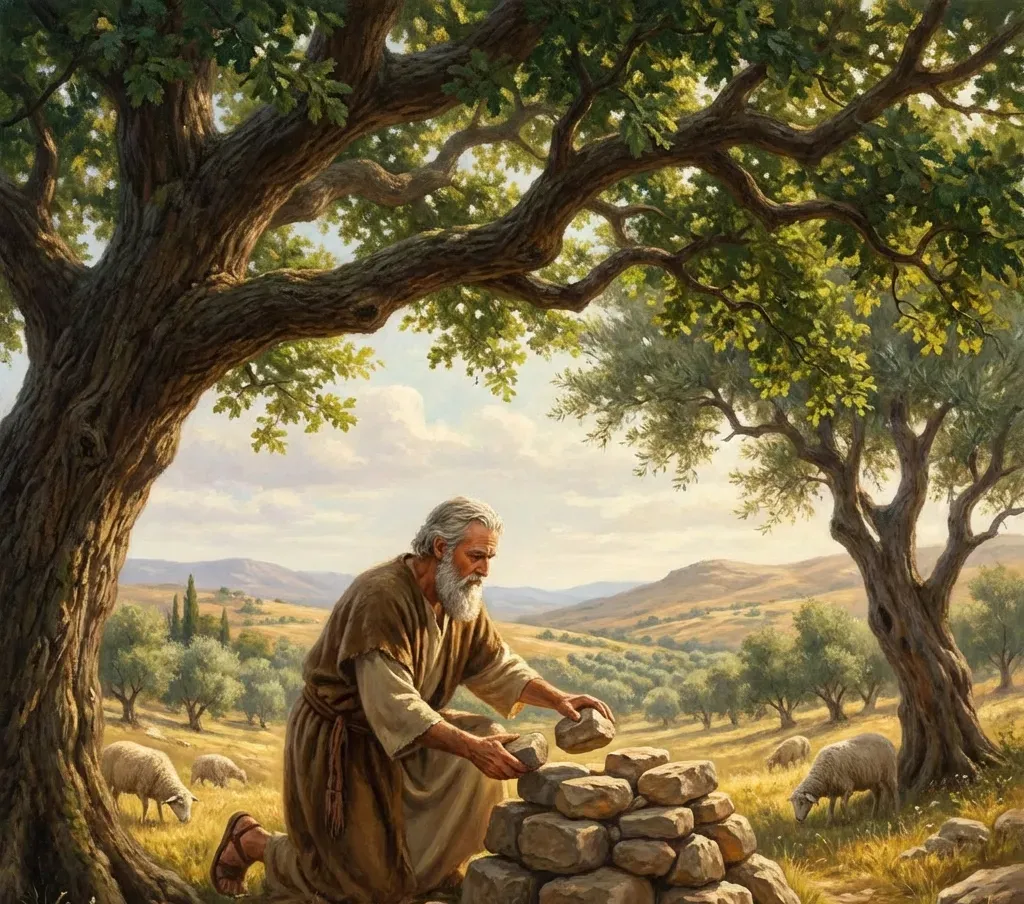 In a land dominated by pagan shrines, Abram builds stone altars to confess the Living God.
Genesis 12:4 records the magnificent simplicity of biblical obedience: "So Abram departed as the Lord had spoken to him." He did not debate, stall, or negotiate. Packing up his tents, his livestock, his barren wife Sarai, and his orphaned nephew Lot, Abram embarked upon an arduous journey of hundreds of miles through dangerous desert trade corridors, crossing the Euphrates toward an unknown destination (Hebrews 11:8).
When Abram finally arrived in Canaan, it was neither empty nor welcoming. Moses notes with realism: "And the Canaanites were then in the land" (Genesis 12:6). Fierce, warlike Amorite tribes occupied the hilltops, practicing fertility rites and child sacrifice. Abram was a homeless foreigner living in fragile tents. Yet at Shechem, beside the great oak of Moreh, the Lord appeared to him again, saying: "To your offspring I will give this land."
Abram did not possess a single square foot of soil. Yet in profound defiance of local paganism, he built an altar to the Lord. Moving southward toward Bethel and Ai, he pitched his tent and built another altar, openly invoking the name of Yahweh. In an idolatrous world, Abram consecrated the Promised Land through public worship, staking an unshakeable claim of faith upon God’s unchanging word.
4. The Crisis of Childlessness: Counting the Desert Stars
A decade elapsed. Abram walked faithfully, rescued his nephew Lot from warring Mesopotamian kings, and paid tithes to Melchizedek, the mysterious King of Salem (Genesis 14:18-20). Yet despite military triumphs and immense material prosperity, one piercing ache remained unhealed: the promised child had not arrived.
In Genesis 15, God spoke in a vision: "Do not be afraid, Abram. I am your shield, your exceedingly great reward." But Abram opened his wounded heart in reverent lament: "Lord God, what will You give me, seeing I go childless, and the heir of my house is Eliezer of Damascus?" (Genesis 15:2).
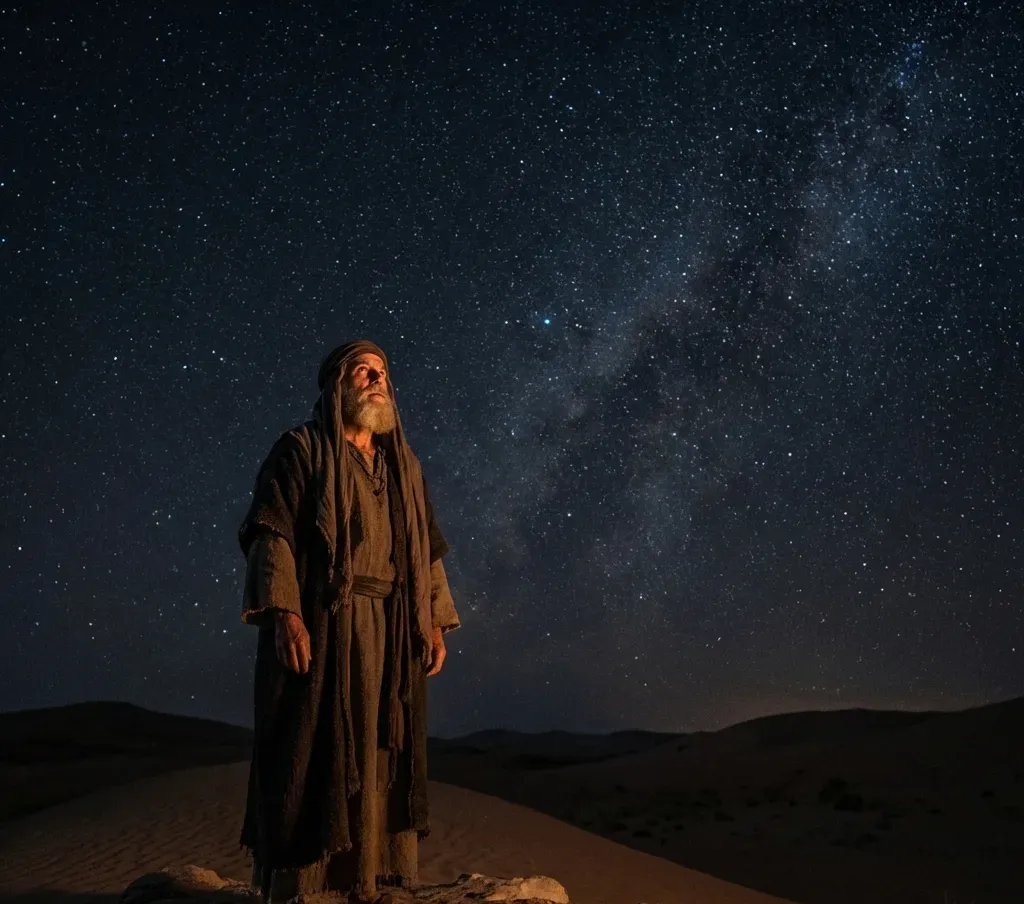
God did not scold Abram for his honesty. Instead, He gently took the aging patriarch by the hand and led him out into the crystal-clear desert night. Far away from city lights, the celestial canopy blazed with millions of burning stellar diamonds.
"Look now toward heaven, and count the stars if you are able to number them," God whispered. "So shall your descendants be."
Abram looked up into the infinite celestial expanse. Then he looked at his own eighty-five-year-old body, and remembered Sarai's barrenness. Humanly, medically, and biologically, it was impossible. Yet Abram looked beyond the physical impossibility to the sovereign Creator who calls into being that which does not exist (Romans 4:17).
5. Justification by Faith Alone: The Foundation of Salvation
At that moment, the Holy Spirit penned the most critical theological verse in the entire Old Testament:
"And he believed in the Lord, and He accounted it to him for righteousness." (Genesis 15:6)
The Hebrew verb for "believed" is He'emin, sharing its root with Amen ("so be it"). Abram rested his entire soul upon the absolute integrity and truthfulness of God’s word. And God took Abram’s faith and chashav—imputed, credited, or deposited it into Abram’s spiritual ledger as Tzedakah (pure, unblemished righteousness).
Abram was not declared righteous because he had achieved moral perfection, or because he kept the Ten Commandments (which would not be delivered for another five centuries), or because he was circumcised (which occurred decades later). He was justified by grace alone through faith alone!
This is the beating heart of the Christian Gospel. Two thousand years later, the Apostle Paul built the foundational bedrock of Romans 4 and Galatians 3 upon this exact verse: whoever places their trust in the crucified and resurrected Christ is clothed in the perfect righteousness of God, just as Abraham was under the starlit desert sky. Galatians 3:29 proclaims: "And if you are Christ’s, then you are Abraham’s seed, and heirs according to the promise." We become the true sons and daughters of Abraham not by bloodline, but by sharing the same courageous, justifying faith in the God who makes all things new.
Biblical Keywords & Theological Roots
Go forth for yourself / leave completely; an emphatic, radical command requiring total severance from past securities.
Blessing, empowerment to prosper and bring redemptive flourishing; God's active favor on Abraham's lineage.
Believed, trusted steadfastly, rested firmly upon; etymological root of 'Amen', indicating total reliant surrender on Yahweh's promise.
Righteousness, right legal and covenant standing before God, imputed through faith rather than earned through works.
Ancient Near Eastern & Archaeological Context
Abraham was called out of Ur of the Chaldees, an advanced Sumerian metropolis excavated extensively by Sir Leonard Woolley in the 1920s. Woolley discovered that Ur was a lavish commercial trade hub featuring sophisticated multi-story private brick homes, extensive public archives, advanced metallurgy, mathematical schools, and the monumental stepped Ziggurat of Ur dedicated to the moon god Nanna (Sin) and his consort Ningal. Joshua 24:2 confirms that Abraham's family lived beyond the Euphrates and served other gods.
In the legal and social framework of the ancient Near East, an individual without land, tribal clan protection, or heirs was legally defenseless and socially vulnerable. Leaving Ur to become a Ger (resident alien/sojourner) living in fragile goat-hair tents among hostile Canaanite tribes was an act of extreme social vulnerability and extraordinary faith. By abandoning worldly wealth and astrological idolatry in Ur, Abraham traded visible, earthly luxury for the invisible, eternal promise of Yahweh Elohim.
Practical Discipleship & Spiritual Application
- Obeying When the Destination is Unrevealed: Biblical faith does not require an exhaustive geographical map; it requires knowing the God who calls. We follow Christ faithfully even when the next step leads into unfamiliar territory.
- Resting in Justification by Faith Alone: Abraham was justified in Genesis 15:6 decades before he was circumcised and long before the Mosaic Law was given. We are saved not by our flawless religious performance, but by trusting entirely in the finished work of Christ.
- Staking Claims of Worship in Hostile Culture: Wherever Abraham pitched his tent, he built an altar and called on the name of Yahweh. We are called to be courageous witnesses for Christ, unashamedly living for God in a secular culture.
- Living as Conduits of Blessing to Others: God blessed Abraham so that he would become a blessing to all families of the earth. We are blessed by God not to hoard divine grace, but to pour out Christ's love to a broken, hurting world.
⚡ Fast Facts
- The Radical Renunciation (Lekh-Lekha): Abraham was summoned to surrender his past, ancestral inheritance, and civil protection to follow an unseen God.
- The Sevenfold Abrahamic Covenant: Genesis 12:2-3 promises nationhood, personal blessing, a renowned name, divine protection, and universal redemption through his seed.
- The Great Turning Point (Genesis 15:6): Abraham 'believed (he'emin) Yahweh, and He credited it to him as righteousness (tzedakah)'—the Old Testament foundation for Paul's doctrine of justification by faith.
- Altars of Witness: In a land teeming with violent Canaanite paganism, Abraham repeatedly erected stone altars to Yahweh, openly confessing the One True God.
❓ Frequently Asked Questions (FAQs)
Abraham had to abandon his country (civic security), his relatives (tribal safety network), and his father's household (ancestral inheritance and pagan ancestral gods) to journey as a nomadic alien into an unspecified land that God would progressively reveal.
The Apostle Paul clarifies in Galatians 3:8, 16 that this was the Gospel preached in advance. The singular 'Seed' promised to Abraham is Jesus Christ, whose atoning sacrifice brings redemption and the Holy Spirit to all Gentile nations who believe.
Because against all biological impossibility (his own age of eighty-five and Sarah’s barren womb), Abraham trusted in the resurrecting power and faithfulness of God to fulfill His word, establishing the pattern for how all sinners are justified before God.