Decades of nomadic wandering, perilous famine, Egyptian detours, and painful domestic conflict had tested Abraham's pilgrim walk with Yahweh. Through it all, the anchor of his soul had been the miraculous covenant promise: that from his aged body and Sarah's barren womb would emerge an heir whose seed would number the stars and bless all the families of the earth. When Isaac was finally born, laughter flooded the patriarchal tents of Beersheba. Isaac was the physical manifestation of God's supernatural fidelity, the joy of Abraham's twilight years, and the sole legal vessel of covenant destiny. Then, in the quiet darkness of an ordinary night, the ultimate test arrived.
1. The Summons into the Dark Night of Faith
The divine voice broke the silence of Beersheba with chilling directness: 'Abraham!' Without hesitation, the patriarch answered with the timeless Hebrew response of total availability: 'Hineni'—'Here am I.' But the instruction that followed pierced the deepest chambers of his soul like a two-edged sword:
'Take now your son, your only son Isaac, whom you love, and go to the land of Moriah, and offer him there as a burnt offering on one of the mountains of which I shall tell you.' (Genesis 22:2).
Every word of the command escalated in psychological and emotional weight. Not merely a servant or a flock animal, but your son; not Ishmael who had been sent away, but your only son; the son of laughter, Isaac; the one whom you love. Here, for the first time in the biblical canon, the word 'love' (Hebrew: Ahav) appears. It is not introduced in the context of romantic affection or brotherly camaraderie, but in the context of a father offering up his beloved, solitary son.
The request seemed to annihilate both natural paternal love and theological coherence. If Isaac died on an altar without children, God's eternal covenant promises would perish with him. Yet the inspired record reveals zero record of debate, protest, or delay. Abraham did not argue as he had over Sodom; he did not awaken Sarah to seek emotional counsel. Early the next morning, in the cool gray dawn, Abraham rose, saddled his donkey, split the dense acacia wood for the burnt offering, took two trusted servants and Isaac his son, and set out toward the rugged limestone heights of Moriah.
2. The Silent Three-Day Journey
The journey from Beersheba to the region of Moriah spanned roughly fifty miles through the rugged central ridge of Canaan—a grueling trek of three full days. For seventy-two agonizing hours, Abraham walked in profound, solitary contemplation. In the legal reality of the patriarch's heart, Isaac was already dead from the moment God spoke the command. Every step of the donkey's hooves, every crackle of the evening campfire, was a quiet crucifixion of Abraham's flesh.
How did Abraham endure this crushing trial? The New Testament lifts the veil on the patriarch's theological reasoning in Hebrews 11:17-19. Abraham did not abandon his belief in the covenant; rather, his theology expanded to embrace the impossible. He reasoned that because God was fundamentally faithful, and because God had explicitly promised, 'Through Isaac your seed shall be called', God was fully able—and indeed obligated by His own holy character—to resurrect Isaac from the ashes of the burnt offering. Abraham's faith had graduated from believing God could create life in a barren womb to believing God could conquer biological death itself.
On the third day, Abraham lifted his eyes and saw the place afar off. Turning to his two young servants, the patriarch issued a monumental declaration pregnant with prophetic certainty: 'Stay here with the donkey; the lad and I will go yonder and worship, and we will come back to you.' (Genesis 22:5). Note the plural verb: we will go, and we will return. Even as he gripped the knife and the fire, Abraham was utterly convinced that both father and son would walk back down that mountain together.
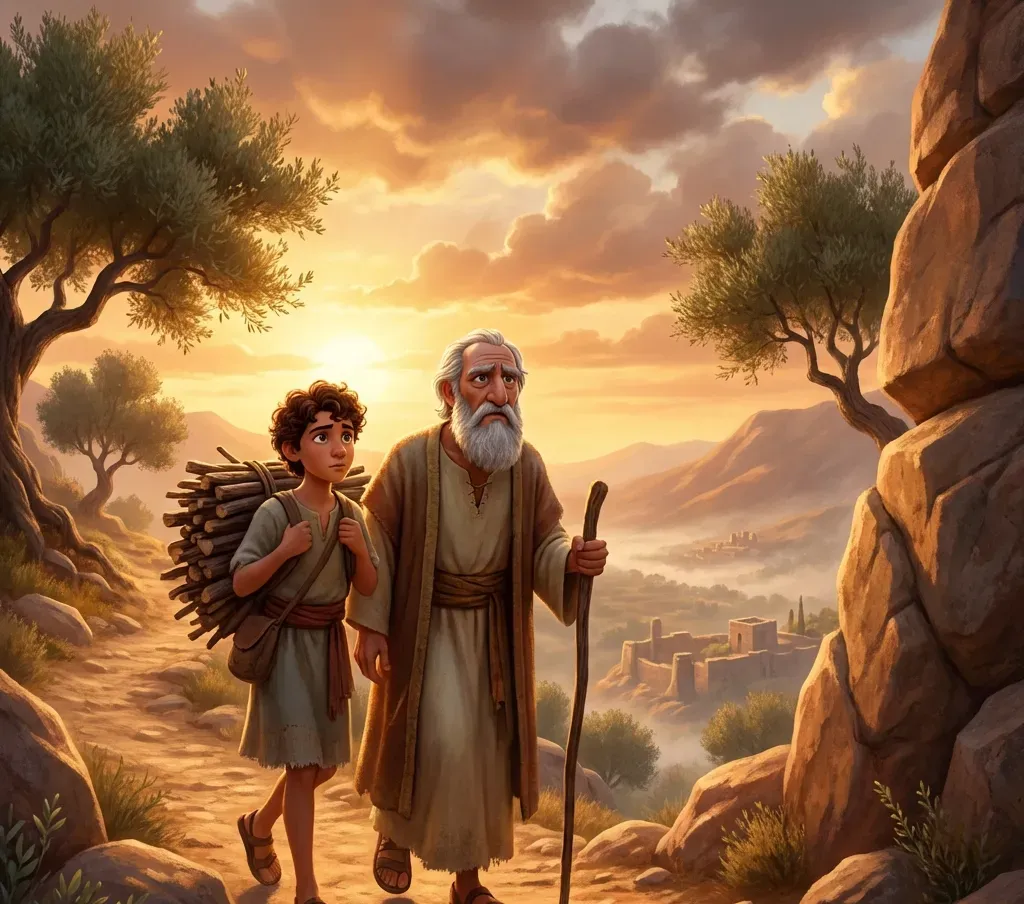
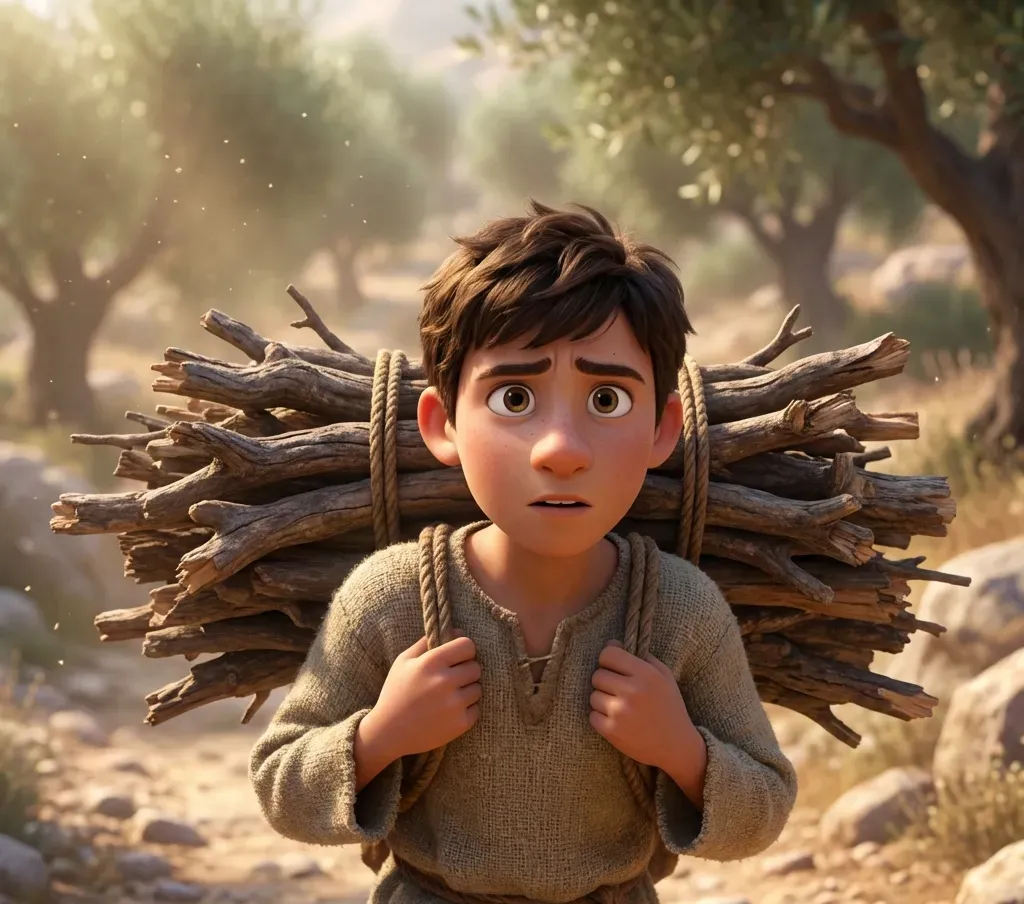 Isaac carried the heavy wood of the burnt offering upon his shoulders, climbing the slopes of Moriah in humble submission.
3. The Ascent of Moriah and the Piercing Question
Abraham took the split wood of the burnt offering and laid it upon the shoulders of Isaac his son. In his own aged hands, Abraham carried the blazing brazier of fire and the heavy bronze knife. Together, the two walked up the steep mountain slope side by side.
In this poignant moment, the typological parallels to the Gospel blaze with dazzling brilliance. Just as Isaac carried the wooden instruments of his own sacrifice up the ridge of Moriah, two thousand years later, the ultimate Beloved Son of the Father would bear the heavy wooden beam of His cross through the gates of Jerusalem, ascending the very same ridge toward Golgotha.
As they ascended, the silence between father and son was broken by Isaac's tender voice: 'My father!' Abraham replied, 'Hineni, beni'—'Here am I, my son.' Isaac looked around at the steep rocky terrain and asked the most piercing question in patriarchal history: 'Look, the fire and the wood, but where is the lamb for a burnt offering?' (Genesis 22:7).
The question must have struck Abraham's heart like an iron spear. Yet, holding back tears of agonizing love, the patriarch spoke words of immense prophetic depth: 'Elohim yir'eh-llo hasseh le'olah, beni'—'God will provide for Himself the lamb for a burnt offering, my son.' (Genesis 22:8). Abraham did not say 'God will provide a lamb for us', but 'God will provide for Himself the lamb.' The sacrifice belonged to God; the provision would originate from God. And so the two of them walked on together, bound by mutual trust and unwavering obedience.
4. The Akedah: Bound Upon the Altar
When they reached the designated summit, Abraham built an altar of unhewn fieldstones, carefully arranging the split wood in order. At this juncture, the narrative confronts us with the extraordinary character of Isaac. Popular children's illustrations often depict Isaac as a helpless young boy unaware of his peril. But biblical and historical reality tells a vastly different story. Isaac was a strong, robust young man—capable of carrying an immense load of dense wood up a steep mountain—while Abraham was well over one hundred years old.
Isaac could easily have overpowered his frail father and fled down the mountain. Instead, when Abraham gently revealed the terrifying divine command, Isaac willingly submitted. He surrendered his youth, his future, and his breath. In Jewish theology, this voluntary submission is revered as the Akedah ('The Binding'). Isaac offered his wrists to be bound with cords; he allowed himself to be placed upon the altar atop the wood. Like a lamb led to the slaughter, he opened not his mouth.
The altar was complete. The wood was arranged. The son of promise lay bound upon the stone, staring up into the vast expanse of the Judean sky. Abraham reached out his trembling hand, took the sacrificial knife, and raised it into the blinding sunlight, aiming for the throat of his beloved child.
5. The Angelic Halt and the Ram in the Thicket
In that fractional second between the raising of the blade and its descent, the heavens exploded with thunderous urgency:
'Abraham! Abraham!'
For the third time, the patriarch cried out: 'Hineni!'—'Here am I!' And the Angel of the LORD commanded:
'Do not lay your hand on the lad, or do anything to him; for now I know that you fear God, since you have not withheld your son, your only son, from Me.' (Genesis 22:11-12).
The test was complete. Abraham had held nothing back. In the court of heaven and before the witnesses of human history, it was definitively established that Abraham did not love the blessing more than the Blesser. He did not worship the covenant gift; he worshiped the Sovereign Giver.
Abraham dropped the blade and lifted his eyes. There, behind him in the dense brush, a mature male ram was caught by its horns in a thorny thicket. The ram had not been visible when they ascended; it had been sovereignly guided by divine providence up the opposing slope to arrive at the exact summit at the exact microsecond. Abraham hurried over, gently untied the bound wrists of his weeping son, and together they seized the ram. In place of Isaac, the ram's blood flowed upon the stone altar, its smoke ascending to heaven as a sweet-smelling savor of divine substitution.
6. Jehovah Jireh and the Sworn Oath of the Covenant
Overwhelmed with awe and gratitude, Abraham commemorated the sacred mountain with an enduring name that has comforted believers across millennia: Yahweh Yireh (Jehovah Jireh)—meaning 'The LORD will provide', or more literally, 'On the mount of the LORD it shall be seen.'
Then the Angel of the LORD called to Abraham a second time out of heaven and spoke words that shook the foundations of the earth:
'By Myself I have sworn, says the LORD, because you have done this thing, and have not withheld your son, your only son—blessing I will bless you, and multiplying I will multiply your descendants as the stars of the heaven and as the sand which is on the seashore; and your descendants shall possess the gate of their enemies. In your seed all the nations of the earth shall be blessed, because you have obeyed My voice.' (Genesis 22:16-18).
Because God could swear by no one greater, He swore by Himself (Hebrews 6:13-14). Abraham's obedience did not create the covenant, but it ratified it with an eternal, unshakeable divine oath. The promises were now sealed in blood and sworn upon the very life of God.
Theological Summary:
- The Nature of Genuine Faith: Faith is not passive intellectual agreement; it is radical obedience that withholds nothing from God. James 2:21-22 declares that Abraham's faith was perfected and justified by works when he offered Isaac upon the altar.
- The Principle of Substitutionary Atonement: The ram caught in the thicket is the foundational Old Testament portrait of substitution (vicarious atonement). The innocent dies so that the condemned son of promise may go free.
- Prophetic Typography of Calvary: Mount Moriah was the divine dress rehearsal for Golgotha. What God spared Abraham from having to endure, God did not spare Himself: 'He who did not spare His own Son, but delivered Him up for us all, how shall He not with Him also freely give us all things?' (Romans 8:32).
- The Certainty of Divine Provision: Jehovah Jireh is not an abstract slogan for financial abundance; it is God's covenant pledge to provide the ultimate sacrifice for human redemption at the summit of our obedience.
Biblical Keywords & Theological Roots
To test, prove, try, or assay precious metal; signifies refining and validating genuine character, not tempting toward sin.
The binding of hands and feet; specifically designating the voluntary binding of Isaac upon the wood of the altar.
The LORD will provide / The LORD will be seen; compound covenant name revealing God's proactive provision at the place of total obedience.
Unique, solitary, only begotten, or singularly precious; expressing the unique covenant status of Isaac as the sole heir of promise.
'Here am I'; expressing total readiness, undivided presence, and unhesitating surrender to the voice of God.
Ancient Near Eastern & Archaeological Context
In the Ancient Near East of the second millennium BC, child sacrifice was an entrenched, terrifying religious reality among Canaanite, Phoenician, and Ammonite tribes. Deities such as Molech and Chemosh demanded the firstborn offspring of their devotees through fire as the ultimate appeasement of wrath and guarantee of fertility. To ancient minds, a god who asked for your son was not an anomaly; it was the supreme test of whether human love for a deity surpassed natural parental affection.
Genesis 22 enters this brutal cultural landscape to execute an unprecedented, permanent theological revolution. When Yahweh commands Abraham to bring Isaac to Mount Moriah, the patriarch—steeped in Mesopotamian and Canaanite surroundings—understands the standard expectations of devotion. However, the climax of the narrative utterly shatters pagan theology: Yahweh's angel dramatically halts the descending blade, proclaiming an absolute divine prohibition against human sacrifice. Unlike the bloodthirsty Canaanite idols that devoured human infants, the God of Israel provides the sacrifice Himself. Mount Moriah later became the sacred threshing floor of Araunah, where King Solomon built the Temple of Jerusalem (2 Chronicles 3:1), establishing the centralized system of animal substitution that pointed directly to the ultimate sacrifice of the Lamb of God on Calvary.
Practical Discipleship & Spiritual Application
- Surrendering Your 'Isaac' to the Lord: An 'Isaac' represents anything good, precious, and miraculous that God has granted us, which can subtly become an idol taking God's supreme place in our heart. True discipleship means opening our hands and releasing even our greatest treasures back to the Giver.
- Cultivating the 'Hineni' Lifestyle: Three times in Genesis 22 (to God, to his son Isaac, and to the Angel of the Lord), Abraham answered with 'Hineni' ('Here am I'). A mature walk of faith is marked by undivided attention, unhesitating surrender, and immediate readiness to obey God's voice without arguing.
- Walking by Faith, Not Sight, on the Three-Day Journey: For three agonizing days of travel, Abraham walked in silence, looking not at the impossible circumstances, but resting upon God's character. When our path is dark, we must trust God's promises even when we cannot trace His unseen hand.
- Resting in Jehovah Jireh at the Summit of Obedience: God did not reveal the ram at the bottom of the mountain; the divine provision appeared only after Abraham climbed to the very summit, built the altar, and raised the knife. God reveals His supernatural provision at the exact point of our radical obedience.
⚡ Fast Facts
- The First Mention of Love: Genesis 22:2 contains the very first occurrence of the word 'love' (Hebrew: 'Ahav') in the entire Bible, framing the sacrificial love of a father for his only unique son.
- The Akedah Tradition: In Jewish theology, this foundational event is known as the 'Akedah' (the Binding), symbolizing ultimate martyrdom, covenant devotion, and unconditional obedience to God.
- Sacred Geography of Moriah: Mount Moriah was not a random wilderness hill; it is the exact ridge where King Solomon later constructed the Temple (2 Chronicles 3:1) and where Jesus Christ was crucified outside Jerusalem's walls.
- Isaac's Mature Willingness: Isaac was not an oblivious small child; historically and linguistically, he was a robust young man (likely in his late teens or twenties) who willingly submitted to his elderly father, carrying the heavy altar wood upon his own shoulders.
❓ Frequently Asked Questions (FAQs)
No. The opening verse explicitly clarifies that 'God tested Abraham' (Genesis 22:1). Child sacrifice was an abominable Canaanite pagan practice strictly forbidden throughout Scripture (Leviticus 18:21, Jeremiah 19:5). God was not demanding human blood; He was revealing the supreme devotion of Abraham's heart, proving that Abraham loved the Giver even more than the miraculous gift of his promised son.
Hebrews 11:17-19 reveals Abraham's unwavering theological conviction: 'By faith Abraham, when God tested him, offered Isaac as a sacrifice... Abraham reasoned that God could even raise the dead.' Abraham's faith had matured so completely that he believed God would physically resurrect Isaac from the ashes on the altar to keep His unbreakable covenant promise.
The parallels are extraordinary: (1) Isaac was the beloved 'only son' (Yachid); Jesus is the 'only begotten Son' (Monogenes). (2) Isaac carried the wood of his execution up the mountain; Jesus carried the wooden cross up Golgotha. (3) The journey took three days during which Isaac was dead in Abraham's mind; Jesus rose on the third day. (4) A ram was substituted in Isaac's place; Jesus is the Lamb of God who died as our divine substitute.