In the political cauldron of first-century Judea, Roman occupation was maintained by the ruthless might of the iron legion. In response, an underground network of fierce Jewish freedom fighters emerged, willing to slit throats, burn villas, and wage guerrilla warfare to liberate Zion. They were known as the Zealots. Among the twelve men chosen by Jesus of Nazareth sat a former member of this radical militant faction: Simon the Zealot (designated in Matthew and Mark as Simon the Cananite, from the Aramaic *Qan'an*, meaning 'the Zealous One'). His discipleship is the ultimate testament to the revolutionary power of the Prince of Peace, who disarmed an assassin's heart and transformed a political terrorist into an apostle of reconciliation.
1. The Crucible of the Zealot Movement
To understand Simon, one must understand the volcanic political landscape of first-century Galilee. In AD 6, when the Roman legate Publius Sulpicius Quirinius ordered an empire-wide census for property taxation, a charismatic firebrand named Judas of Gamala (the Galilean) launched a bloody rebellion. Their theological slogan was unyielding: "God alone is our Master and Lord; to pay tribute to Caesar is idolatry and treason against the God of Israel!"
The Roman governor Varus crushed the revolt with sickening brutality, lining the roads of Galilee with two thousand crucified Jewish rebels. Yet the movement did not die; it went underground. They called themselves Kanna'im (Zealots), fashioning themselves after Phinehas, who drove a javelin through transgressors to turn away divine wrath (Numbers 25), and Judas Maccabeus, who cleansed the Temple with the sword.
Their extreme wing was the Sicarii (from the Latin *sica*, a curved dagger). In crowded festival markets in Jerusalem, they pressed against Roman centurions and Jewish collaborators, plunging daggers into their kidneys before melting into the terrified crowds.
Simon grew up in this toxic atmosphere of rage, blood-vengeance, and revolutionary violence. He was a man who believed the Kingdom of God would arrive through the edge of an iron blade.
2. Disarmed by the Prince of Peace (Matthew 10:4)
What drew this dagger-wielding rebel to Jesus of Nazareth? Initially, Simon may have observed Jesus' cleansing of the Temple courts or His fearless denunciations of corrupt religious aristocrats, assuming Jesus was the military Messiah who would summon heavenly legions to shatter the Roman garrison at Fortress Antonia.
Yet as Simon walked with Jesus, his entire worldview was radically dismantled. Standing on the mountain overlooking the Sea of Galilee, Simon heard the revolutionary Manifesto of the Kingdom:
"You have heard that it was said, 'You shall love your neighbor and hate your enemy.' But I say to you, love your enemies, bless those who curse you, do good to those who hate you, and pray for those who spitefully use you and persecute you." (Matthew 5:43–44)
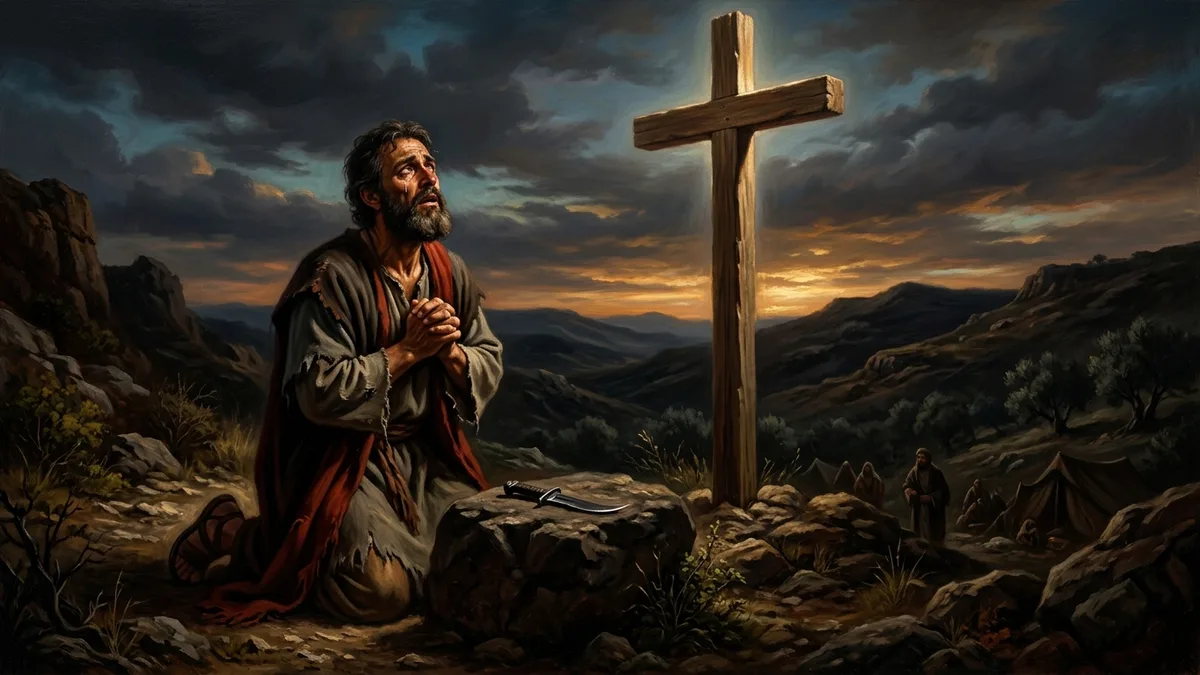
For a Zealot, loving a Roman legionary was the ultimate heresy. Yet in Christ, Simon encountered a power infinitely greater than political insurrection: the power of sacrificial Agape love. Simon discovered that his ultimate enemy was not Caesar, Pilate, or Herod; his true enemy was the serpent of sin and rebellion coiled within the human heart. Laying down his dagger, Simon surrendered his fierce passion to the King who conquers through the Cross.
 The Miracle of Reconciliation: The broken bread and chalice of communion, commemorating how Jesus united Simon the anti-Roman Zealot and Matthew the pro-Roman tax collector at one table.
3. The Table of Impossible Unity: Simon and Matthew
Consider the composition of the Twelve Apostles: Jesus called Matthew (Levi), who had served as a tax collector for Rome, and He called Simon the Zealot, whose life oath was to assassinate Roman collaborators.
In any secular political party, labor guild, or philosophical academy, placing these two men in the same room would have resulted in immediate bloodshed. Matthew was the traitor; Simon was the patriot. Matthew collected the coins; Simon sharpened the knife.
Yet through three years of walking with Jesus, sharing meals, washing one another's feet, and receiving the indwelling Holy Spirit at Pentecost, the former terrorist and the former tax collector became brothers. They did not achieve unity through political compromise or partisan truce; they achieved unity because both were broken at the foot of Calvary and washed in the same redeeming blood. The Church of Jesus Christ was birthed as a living proof that the Gospel dismantles every human wall of division.
4. Apostolic Labors Across North Africa and Mesopotamia
Following the Day of Pentecost, Simon's fierce zeal was channeled into global evangelization. While historical records from this era are fragmented, ancient church traditions preserved in the *Apostolic Constitutions*, the writings of Isidore of Seville, and the Ethiopian *Synaxarium* trace Simon's extensive missionary journeys.
Leaving Judea, Simon carried the Gospel westward along the southern Mediterranean coastline into Egypt, Cyrenaica (Libya), and Mauretania (modern Morocco). Preaching with unyielding fire, he established house churches among North African Berber communities.
Some early British church chronicles (such as Dorotheus of Tyre and Nicephorus Callistus) even suggest that Simon sailed across the English Channel to Roman Britain, preaching in the tin-mining settlements of Cornwall before returning to the Mediterranean.
5. The Final Mission to Persia and Martyrdom by the Saw
Around AD 65, Simon journeyed eastward to join his fellow apostle Thaddaeus (Jude) in the vast Parthian (Persian) Empire. Traveling through Babylon, Mesopotamia, and Media, the two apostles proclaimed the Gospel with miraculous signs, converting Persian nobles and turning thousands away from Zoroastrian fire-worship.
Arriving in the city of Suanir (in modern-day Iran), their preaching provoked violent opposition from two prominent pagan sorcerers named Zaroes and Arphaxat. When the local magistrates demanded that the apostles worship statues of the sun and moon, Simon boldly declared:
"Your idols are deaf and dumb. In the Name of Jesus Christ, let the demons within them speak!"
Ancient martyrologies record that demons shrieked from the idols before the statues shattered into dust upon the temple floor.
Infuriated by the destruction of their temple, the pagan mob seized Simon and Jude. Refusing to renounce his Lord, Simon was tied to a wooden frame and subjected to an execution of horrifying brutality: according to ancient Syrian and Western traditions, he was sawn in half with an iron woodcutter's saw.
Simon the Zealot, who had once dreamed of shedding Roman blood for an earthly Jerusalem, gladly shed his own blood for the celestial King who had redeemed his soul. He laid down the rebel's sword and received the martyr's palm of everlasting victory.
Biblical Keywords & Theological Roots
A Zealot, an uncompromising partisan passionately devoted to a cause; a political insurgent.
Zealous, jealous for God's covenant honor, fiercely resistant to idolatry.
Peace, tranquility, harmony, reconciliation; the state of quiet security purchased by Christ.
A double-edged iron sword; the weapon of carnal revolution renounced at the feet of Jesus.
To saw asunder, to cut in two with an iron saw; traditional method of Simon's martyrdom.
Ancient Near Eastern & Archaeological Context
First-century Judea was a boiling cauldron of insurrection. In AD 6, the Roman legate Quirinius ordered an empire-wide property registration for taxation, sparking the Zealot revolt in Gamala and Sepphoris under Judas the Galilean. Roman legions ruthlessly crushed the rebellion, crucifying two thousand Jewish rebels along the highways of Galilee. From this trauma emerged the underground Zealot movement, characterized by fanatical religious nationalism and violent guerrilla tactics. Growing up in Galilee amidst these crucificial horrors, Simon joined the movement with burning hatred toward Rome. His recruitment into Jesus' twelve disciples was a political earthquake: Jesus chose a man whose previous vocation was violent insurrection, transforming his burning zeal into apostolic love.
Practical Discipleship & Spiritual Application
- Christ Trumps All Political Affiliations: Simon was a radical nationalist; Matthew was an imperial collaborator. Jesus brought them under one cross, proving that allegiance to Christ transcends all political parties.
- Rechanneling Passion: God does not want lukewarm, passive followers. He took Simon's fiery intensity and redirected it from killing enemies to dying for them.
- The Only Kingdom That Cannot Be Shaken: Earthly empires rise, oppress, and crumble into dust. Simon laid down his sword because he found a heavenly Kingdom that will endure for all eternity.
- The Weapon of Love: True spiritual warfare is not fought with carnal daggers, legislative coercion, or worldly politics, but with prayer, the Word of God, and radical, sacrificial love.
Support Independent Biblical Research
Did this study bless you? Help support our independent bilingual research and interactive visual Bible tools.
⚡ Fast Facts
- Cananite vs. Canaanite: In Matthew 10:4 and Mark 3:18, he is called 'Simon the Cananite'—not referring to the ancient Canaanite race, but derived from the Aramaic 'Qan'ana' (zealous), which Luke accurately translates into Greek as 'Zelotes' (Luke 6:15).
- The Zealot Movement: The Zealots were founded by Judas the Galilean in AD 6 during the census of Quirinius, advocating armed guerrilla warfare and refusing to pay taxes to Rome under the rallying cry: 'No King but God!'
- The Table of Grace: In Jesus' apostolic band, Simon the anti-Roman revolutionary sat at the same table and broke bread with Matthew the pro-Roman tax collector—a living miracle of divine reconciliation.
- Sawn Asunder for Christ: Church tradition recorded by Isidore of Seville and the Golden Legend records that Simon preached in Egypt, North Africa, and Persia, where he was martyred by being sawn in half alongside Apostle Thaddaeus.
❓ Frequently Asked Questions (FAQs)
The Zealots were a radical, militantly nationalistic Jewish faction that emerged in resistance to Roman imperial taxation and pagan occupation. Drawing inspiration from Phinehas (Numbers 25) and the Maccabean warriors, they believed that paying taxes to Caesar was high treason against Yahweh. Their extreme wing, the *Sicarii* (dagger-men), carried concealed daggers beneath their cloaks, assassinating Roman officials and Jewish collaborators in crowded festivals.
Jesus did not extinguish Simon's fierce zeal; He radicalized it in a higher direction. Simon discovered that humanity's ultimate oppressor was not the Roman Empire, but the kingdom of darkness, sin, and death. Jesus taught him that the Kingdom of God advances not by the bloodshed of enemies, but by the shed blood of the Savior and the sacrificial love of His followers.
According to historical accounts preserved by Moses of Chorene, Isidore of Seville, and Eastern Orthodox synaxaria, Simon preached through Egypt, Cyrene, Mauretania (North Africa), and Mesopotamia, before partnering with Apostle Thaddaeus (Jude) in Persia (modern-day Iran), where both suffered martyrdom under Zoroastrian pagan priests.