The narrative of the siege of Samaria in Second Kings chapters 6 and 7 stands as one of the most astonishing historical dramas of human despair and supernatural deliverance in biblical history. When an entire nation was reduced to the absolute horrors of starvation and cannibalism under a brutal foreign blockade, Yahweh intervened without an army, without a battle, and without human glory. Through the desperate deduction of four outcast lepers, God turned an apocalyptic famine into an overnight deluge of abundance, vindicating His prophetic word and humiliating secular unbelief.
The nightmare began when King Ben-Hadad II of Aram mobilized his entire imperial army and laid siege to Samaria, the hilltop capital of the Northern Kingdom of Israel. Encircling the city's double casemate walls, the Syrian army severed all access to external springs, agricultural fields, and supply routes. Months dragged into a merciless war of attrition. As grain granaries emptied, a catastrophic famine consumed the city.
Economic inflation soared to madness. Scripture records that a severed, unclean donkey's head—containing virtually no edible meat—sold for eighty shekels of silver, equivalent to nearly two years of an ordinary laborer's wages! A quarter kab (about a pint) of dove's dung—a colloquialism for bitter wild starvation bulbs or literal bird droppings used for cooking salts—fetched five silver shekels. The social fabric of Samaria disintegrated into animalistic survival.
The Mother's Cry and the King's Sackcloth
The horrifying depth of the crisis was unveiled as King Jehoram walked along the city ramparts inspecting the defenses. A desperate woman cried out to him: "Help, my lord, O king!"
The cynical monarch replied in bitter helplessness: "If Yahweh does not help you, where can I get help for you? From the threshing floor or from the winepress?" Then he asked what was troubling her.
Her answer chilled the king's blood with unspeakable horror:
"This woman said to me, 'Give your son, that we may eat him today, and we will eat my son tomorrow.' So we boiled my son, and ate him. And I said to her on the next day, 'Give your son, that we may eat him'; but she has hidden her son!"
The horrifying prophecy of Deuteronomy 28:53—that in the desperation of siege warfare parents would eat the fruit of their own wombs—had come to pass in the capital of Israel. When the king heard her words, he tore his royal robes in grief and rage. As he passed by on the wall, the watching citizens gasped: beneath his royal garments, the king was wearing coarse, scratchy sackcloth against his flesh.
Yet his penitence was twisted by bitter resentment. Instead of repenting of his family's Baal worship, the king blamed the prophet of God. Clenching his fists, Jehoram swore an oath: "God do so to me and more also, if the head of Elisha the son of Shaphat remains on him today!" And he dispatched an executioner to sever Elisha's head.
The Audacious Twenty-Four Hour Prophecy
Down in the city, Elisha was sitting in his house surrounded by the elders of Samaria. Before the royal assassin even arrived at the door, Elisha's prophetic spirit perceived the murder plot. He said to the elders: "Do you see how this son of a murderer has sent someone to take away my head? Look, when the messenger comes, shut the door, and hold him fast at the door. Is not the sound of his master's feet behind him?"
As they held the door, the king arrived with his premier royal officer, upon whose arm the monarch leaned. In bitter defeat, the king declared: "Surely this calamity is from Yahweh; why should I wait for Yahweh any longer?"
Standing in the doorway, Elisha delivered one of the most audacious, breathtaking prophetic decrees in human history:
"Hear the word of Yahweh! Thus says Yahweh: 'Tomorrow about this time a seah of fine flour shall be sold for a shekel, and two seahs of barley for a shekel, at the gate of Samaria!'"
To human logic, the prophecy was absurd. Samaria was starving to death; within twenty-four hours, the prophet claimed, premium milled wheat and barley would flood the city gate at bargain-basement prices! The royal officer scoffed in cynical, sneering derision:
"Look, if Yahweh should make windows in heaven (אֲרֻבּוֹת בַּשָּׁמַיִם - Arubbot ba-Shamayim), could this thing be?"
Elisha looked the arrogant aristocrat in the eye and pronounced a chilling judicial verdict: "In fact, you shall see it with your own eyes, but you shall not eat of it!"
The Four Lepers and the Logic of Faith
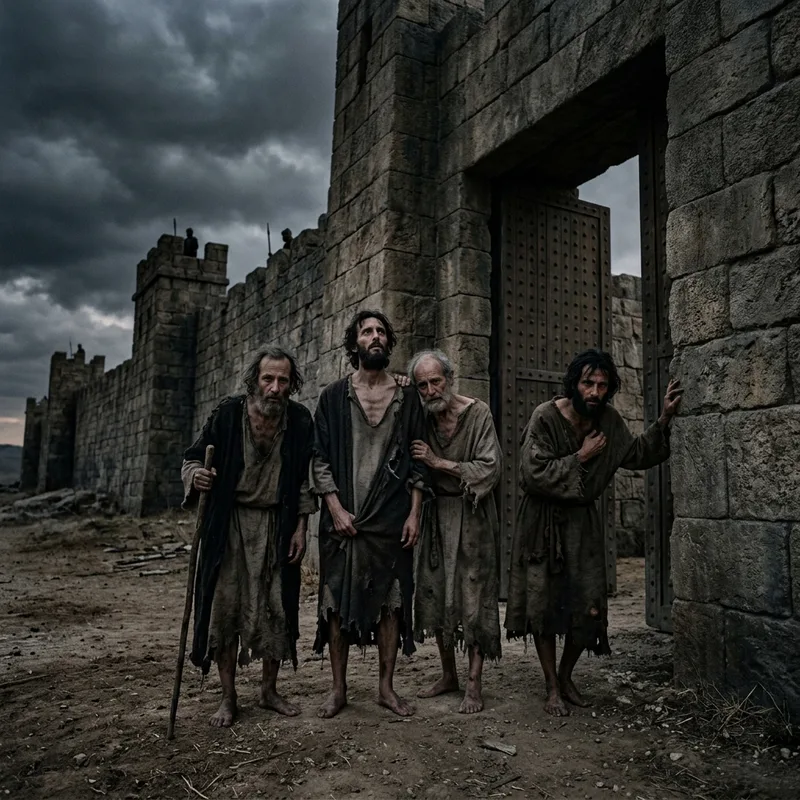
While the royals debated in the citadel, four starving men afflicted with leprosy (מְצֹרָעִים - Metzora'im) sat huddled outside the entrance of the city gate. Ostracized by society and forbidden from entering the city, their rations had ceased completely. As dusk fell across the valley, they looked at one another and engaged in profound, life-changing reasoning:
"Why do we sit here until we die? If we say, 'We will enter the city,' the famine is in the city, and we shall die there. And if we sit here, we die also. Now therefore, come, let us surrender to the army of the Syrians. If they keep us alive, we shall live; and if they kill us, we shall only die!"
It was the ultimate theology of desperation. They had nothing to lose. Rising to their feet at twilight, their ragged cloaks flapping in the evening breeze, the four limping outcasts shuffled down the rocky slope toward the Syrian camp.
The Phantom Army and the Abandoned Camp
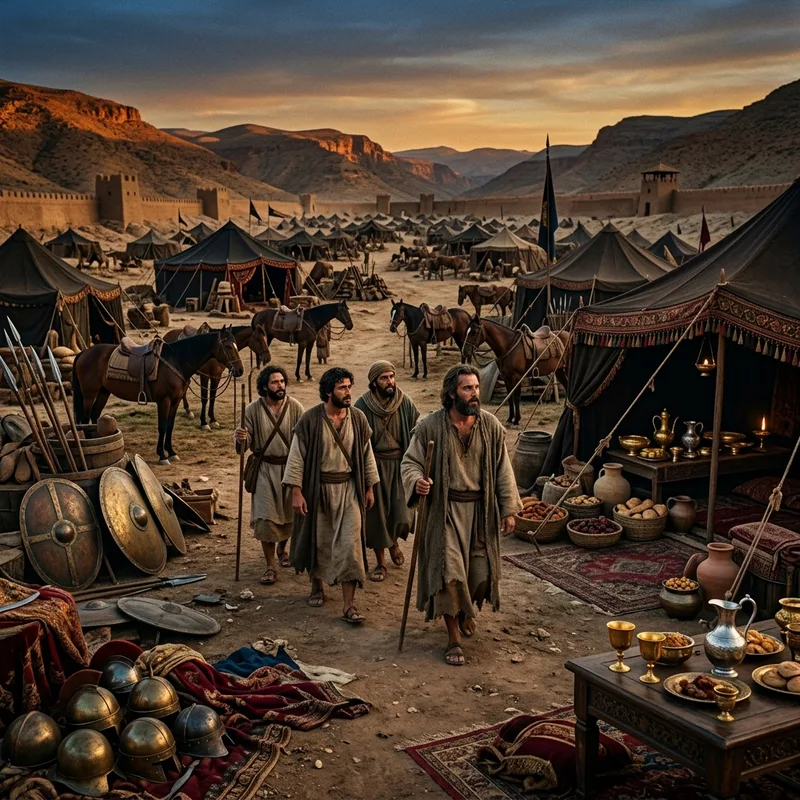
Approaching the perimeter of the enemy camp, the lepers braced themselves for the challenge of Syrian sentries. But there were no sentries. The watchfires flickered in the wind. Reaching the outermost tents, they called out. Silence. They peered inside. Empty!
Unknown to the lepers, Yahweh had orchestrated an astonishing acoustic miracle. In the twilight stillness, the Lord caused the entire Aramean army to hear קוֹל מַחֲנֶה גָדוֹל—the thunderous roar of a colossal army! The cosmic sound of countless war chariots, pounding cavalry hooves, and marching legions reverberated through the hills. Terrified Syrian generals shouted: "Look, the king of Israel has hired against us the kings of the Hittites and the kings of the Egyptians to attack us!"
Seized by blind, uncontrollable panic, the entire Aramean army fled for their lives into the gathering darkness. They did not even untie their horses or donkeys! Leaving their lavish pavilions standing, their tables laden with hot food, and their chests brimming with silver, gold, and royal garments, the Syrians ran on foot toward the Jordan River.
The four lepers stepped into an abandoned wonderland of luxury. Entering one tent, they gorged themselves on roasted meats, fresh bread, and fine wine. Then they seized silver, gold, and costly robes, carrying them off and burying them in the dirt. Entering a second tent, they plundered more treasure and hid it.
Conviction on a Day of Good News
Suddenly, in the midst of their looting, a holy conviction struck their consciences. Stopping in their tracks, they said to one another:
יוֹם בְּשׂוֹרָה הוּא וַאֲנַחְנוּ מַחְשִׁים
"We are not doing right! This day is a day of good news, and we are keeping silent! If we wait until morning light, punishment will overtake us. Now therefore, come, let us go and tell the king's household!"
They realized that hoarding life while an entire city starved was an unforgivable crime. Shuffling back up the steep hill to the city walls in the dead of night, they shouted to the gatekeepers: "We went to the Syrian camp, and behold, there was not a soul there, not even a human voice—only horses tied, donkeys tied, and the tents left just as they were!"
The gatekeepers sent the report echoing through the sleeping city to the royal palace. King Jehoram arose in the middle of the night, paranoid and skeptical: "I will tell you what the Syrians have done to us! They know that we are hungry; therefore they have gone out of the camp to hide in the field, saying, 'When they come out of the city, we shall catch them alive, and get into the city!'"
One of his servants wisely advised: "Please let several men take five of the remaining horses... let us send and see!" Two chariots with horses were dispatched along the escape highway. Following the trail all the way down to the Jordan River, the scouts found the entire road littered with garments, weapons, and baggage that the panicked Syrians had cast away in their flight. The miracle was real!
The Trampled Officer and the Gate of Abundance
When the scouts returned to Samaria and confirmed the news, the gates were flung wide open! A starving, desperate mob of tens of thousands of citizens surged out of the city like a broken dam, flooding across the valley to plunder the Syrian camp. Tents were torn down, chests burst open, and massive stockpiles of wheat, barley, and oil were carried back into the city.
By afternoon, scripture records with awe-inspiring accuracy: סְאָה סֹלֶת בְּשֶׁקֶל—a seah of fine flour was sold for a shekel, and two seahs of barley for a shekel, exactly according to the word of Yahweh!
And what of the cynical royal officer who had scoffed that even if God opened windows in heaven, this could never be? The king had appointed him to maintain order at the city gate. As the frenzied, starving multitude rushed through the narrow portal, the officer was knocked off his feet, trampled beneath the rushing boots of the crowd, and crushed to death in the dust. He saw the miraculous abundance with his own eyes, exactly as Elisha had prophesied, but died without tasting a single morsel. The Word of Yahweh remained infallible: His promises bring life to the humble, but His judgment crushes secular cynicism forever.
Biblical Keywords & Theological Roots
A day of good news / joyful tidings. The foundational Hebrew phrase uttered by the four lepers (2 Kings 7:9), rooted in 'basar' (to announce glad tidings), which serves as the direct linguistic ancestor of the New Testament 'Gospel' (*Euangelion*).
A seah of fine flour. A dry measurement equivalent to approximately 7.3 liters (one peck) of high-grade milled wheat, promised by Elisha to sell for a single silver shekel at the city gate (2 Kings 7:1).
Windows / floodgates in heaven. The ancient cosmological metaphor for heavenly sluice gates pouring out torrential rain or divine abundance, used sarcastically by the cynical royal officer (2 Kings 7:2, 19).
The sound of a great army. The supernatural acoustic illusion orchestrated by Yahweh that caused the entire Aramean army to hear non-existent chariots, cavalry, and allied kings, triggering their panicked flight (2 Kings 7:6).
Lepers / ostracized skin-diseased persons. Individuals banished outside the camp under Leviticus 13:46, whose desperate decision to surrender became God's instrument for saving the nation (2 Kings 7:3).
Ancient Near Eastern & Archaeological Context
The devastating siege of Samaria recorded in 2 Kings 6–7 reflects the brutal warfare tactics of the ancient Near East during the ninth century BC. Ancient siege warfare (*Mator*) aimed at psychological and physiological attrition: encircling a fortified hilltop capital like Omride Samaria cut off external water springs and agricultural supply lines, deliberately starving the population into cannibalism and unconditional surrender (a horrific covenant curse prophesied in Leviticus 26:29 and Deuteronomy 28:52–57). Archaeological excavations at Samaria (Sebaste) reveal the formidable nature of King Omri and Ahab's double casemate walls, which successfully resisted direct infantry assaults but made the city entirely dependent upon external supply lines. An 'eighty-shekel donkey head' represented approximately two pounds of silver—equivalent to nearly a year's wages for an ancient laborer—spent on unclean, inedible carrion meat (Leviticus 11:3–4). The 'dove's dung' (*Dir-yonim*) is interpreted by most Levant botanists as either wild star-of-Bethlehem bulb roots (*Ornithogalum umbellatum*), a bitter survival famine weed, or literal avian droppings used as mineral cooking salts. The four lepers sat outside the city gate in compliance with the quarantine laws of Leviticus 13:46 and Numbers 5:2–3. The psychological panic that struck the Aramean army stemmed from their terror of northern Hittite neo-kingdoms (such as Carchemish and Hamath) and Egyptian Twenty-Second Dynasty pharaohs (Libyan dynasty), whom Damascus feared Jehoram had hired with royal mercenaries. The 'windows of heaven' (*Arubbot ba-Shamayim*) is ancient cosmological language echoing the Genesis floodgates (Genesis 7:11) and Malachi's covenant blessings (Malachi 3:10), used here by the royal officer in cynical, blasphemous derision.
Practical Discipleship & Spiritual Application
- Do Not Sit in Despair and Die: The four lepers reasoned with profound spiritual logic: 'Why do we sit here until we die?' If you are trapped in guilt, addiction, depression, or spiritual famine, refuse to remain passive. Take a step of faith toward Jesus Christ; in Him is infinite mercy and life.
- Beware of Cynical Rationalism: The royal officer evaluated God's promises through human limitations and died in the dust. Never put God in the small box of your intellect. When God speaks a promise, trust that His arm is not shortened that it cannot save.
- Break the Silence of Hoarding Grace: When you discover the riches of the gospel—forgiveness, peace, and eternal life—do not keep silent! Today is a day of good news. Share your testimony, invite your neighbors to church, and proclaim the living Christ to a spiritually starving world.
- Trust God's Overnight Transformation: Samaria went from boiling babies in despair to plundering enemy tents in luxury within twenty-four hours. Your darkest midnight is not the end of your story; joy comes in the morning when Yahweh arises to scatter your enemies.
Support Independent Biblical Research
Did this study bless you? Help support our independent bilingual research and interactive visual Bible tools.
⚡ Fast Facts
- The inflation rate during the siege of Samaria was astronomical: an unclean donkey's head sold for 80 silver shekels (roughly $1,500 modern equivalent), and a handful of dove's dung (famine bulb roots) cost 5 shekels.
- The four lepers' deduction in 2 Kings 7:3–4 ('Why do we sit here until we die?') is considered by theologians as one of the finest scriptural illustrations of saving faith, where stepping toward God holds the only hope of life.
- The Aramean flight was an acoustic supernatural miracle: no physical foreign army ever arrived, yet God caused the sound of massive phantom chariots and cavalry to panic an entire veteran army.
- Elisha's prophecy of economic price collapse was fulfilled with mathematical precision in less than twenty-four hours: a seah of fine flour was sold for one shekel, and two seahs of barley for one shekel.
❓ Frequently Asked Questions (FAQs)
What was the 'dove's dung' that sold for five shekels of silver?
Scholars and biblical botanists debate whether 'dove's dung' (*Dir-yonim*) was literal avian excrement collected from city walls to extract mineral salts for cooking, or more likely a popular Levant colloquialism for the wild, bitter edible bulbs of the Star of Bethlehem plant (*Ornithogalum umbellatum*), which starving citizens dug up in extreme famine.
Why did Yahweh choose four outcast lepers to discover the deliverance?
In Mosaic law, lepers were the ultimate outcasts, quarantined outside the gate and declared ceremonially unclean. By using men who were physically rotting, socially despised, and on the brink of death, God demonstrated that salvation is completely His doing, leaving no room for human military pride or royal self-congratulation. God's glory shines brightest through vessels of zero worldly value.
Why did the royal officer die such a tragic death?
The officer's sin was not passive hesitation, but arrogant, public cynicism against the Word of the Lord through His prophet. By mocking God's ability to provide, the officer insulted the divine character. His punishment was a precise poetic retribution: God allowed him to live long enough to see the flour and barley with his own eyes, validating the prophecy, but he was trampled by the starving crowd before tasting a single morsel.