The sixth chapter of Second Kings unveils one of the most magnificent disclosures of the unseen spiritual world in all of sacred scripture. In a season of international conflict, espionage, and military terror, Yahweh pulled back the veil of the physical universe through the prophet Elisha, demonstrating that the living God exercises absolute sovereignty over the physical laws of nature, the covert councils of hostile empires, and the celestial armies of heaven.
The chapter begins within the humble community of the prophetic guild. The school of the sons of the prophets was flourishing under Elisha's spiritual leadership. Their living quarters had become hopelessly overcrowded. Approaching their master, the disciples said: "See now, the place where we dwell with you is too small for us. Please let us go to the Jordan, and let each man take a beam from there, and let us make there a place where we may dwell." Elisha granted permission, and at their earnest plea, he agreed to accompany them to the Jordan River valley.
The Miracle of the Floating Axe Head
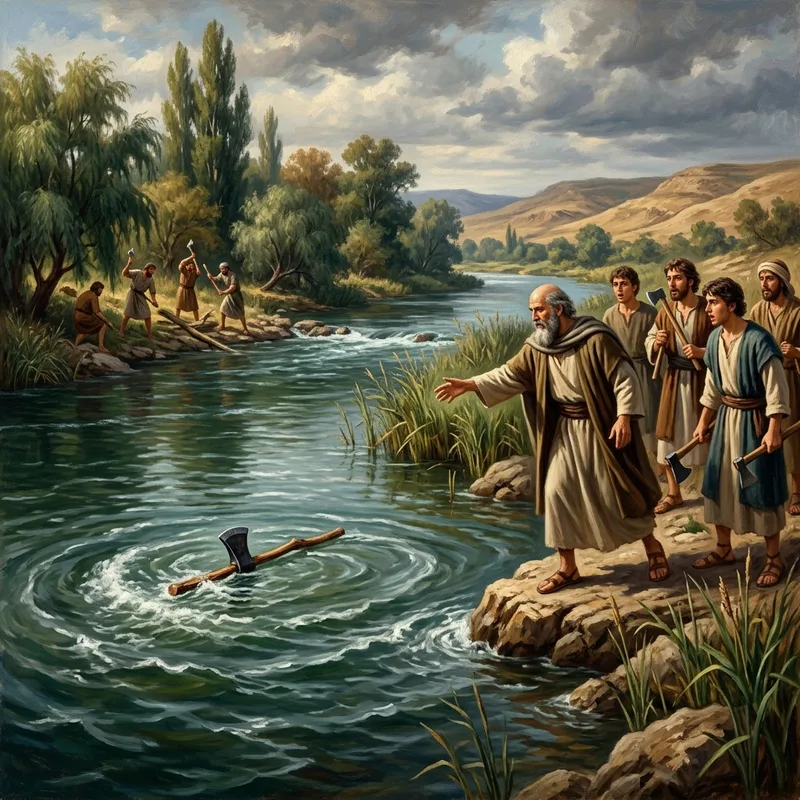
Arriving at the thickets along the muddy banks of the Jordan, the young men began felling trees. As one disciple swung his heavy axe with full force, the wooden handle fractured or slipped, and the iron axe head went flying through the air, plunging into the deep, turbulent waters of the river. The young man cried out in sheer panic and despair:
"Alas, master! For it was borrowed (שָׁאוּל - Sha'ul)!"
In the ninth century BC, iron tools were extraordinarily costly commodities. The impoverished student could never hope to repay its value, leaving him liable under Mosaic debt laws to be seized into debt slavery. Hearing his agonized cry, Elisha asked calmly: "Where did it fall?"
The young man pointed to the spot in the swirling current. Elisha cut a simple wooden stick from a nearby branch and cast it into the water at the exact location. Instantly, an astonishing suspension of the laws of physics occurred: the dense, heavy iron defied gravity and floated to the surface (צָף הַבַּרְזֶל - Tzaf ha-Barzel), bobbing like a piece of cork on the water! Elisha instructed him: "Pick it up for yourself." Reaching out his hand, the overjoyed disciple retrieved his tool. God demonstrated that He cares intimately about the everyday anxieties, debts, and humble crises of His faithful children.
Prophetic Intelligence and the Encircled City
The scene rapidly shifts from domestic pastoral care to international geopolitical warfare. King Ben-Hadad II of Aram-Damascus launched a campaign of calculated military incursions against Israel. Meeting secretly with his generals, the Aramean king would plan strategic ambushes: "My camp will be in such and such a place."
Yet, every time the Syrian trap was laid, Elisha sent an urgent dispatch to King Jehoram of Israel: "Beware that you do not pass this place, for the Syrians are coming down there!" The King of Israel would send scouts to verify the warning, evade the trap, and save his army repeatedly. Frustrated and enraged, the King of Syria summoned his council, demanding: "Will you not show me which of us is for the king of Israel?" He was convinced a traitor occupied his inner cabinet.
One of his elite officers stepped forward and revealed the startling truth:
"None, my lord, O king; but Elisha, the prophet who is in Israel, tells the king of Israel the words that you speak in your bedchamber!"
Determined to eliminate the prophetic surveillance, the Syrian king commanded: "Go and see where he is, that I may send and seize him!" Word returned: "Behold, he is in Dothan." Deploying a formidable combined-arms force, the Syrian king sent a massive detachment of cavalry and iron war chariots. Marching under cover of darkness, the Aramean army surrounded the hilltop mound of Dothan, sealing off all avenues of escape.
The Unseen Army and Chariots of Fire
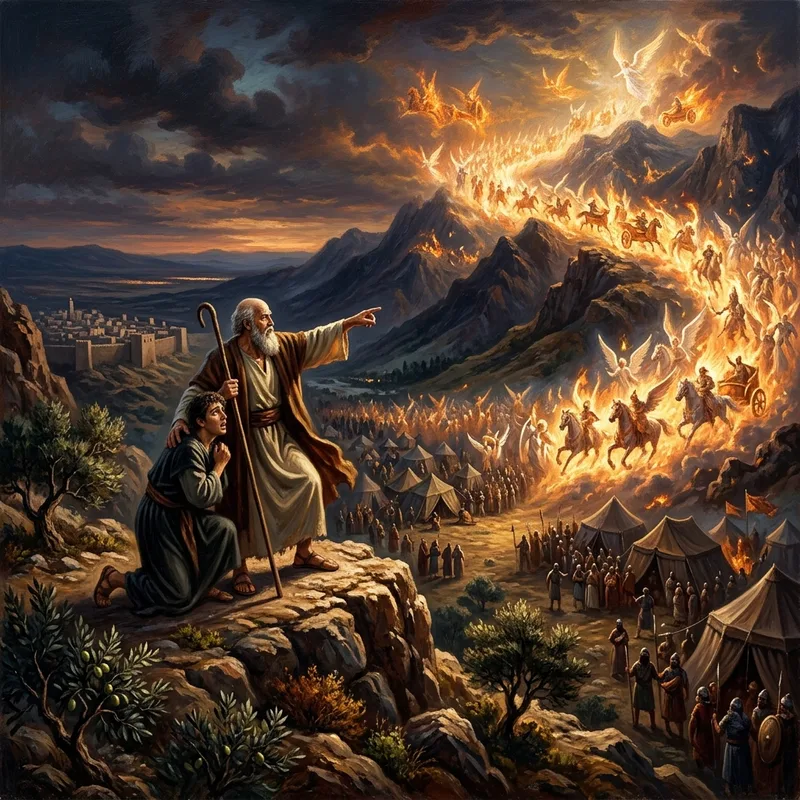
At dawn, Elisha's young servant stepped out of the house into the cool morning air. Looking across the slopes, his blood ran cold with terror. Encircling the entire city was a bristling ring of iron chariots, war horses, and armed Syrian soldiers. Trembling violently, the young man rushed back inside to Elisha, crying out in sheer hopelessness:
"Alas, my master! What shall we do?"
Elisha sat completely untroubled, resting in serene covenant authority. He looked at his terrified attendant and uttered an immortal promise that has echoed down the centuries to every embattled believer:
אַל־תִּירָא כִּי רַבִּים אֲשֶׁר אִתָּנוּ מֵאֲשֶׁר אוֹתָם
"Do not fear, for those who are with us are more than those who are with them!"
Then Elisha prayed a simple, sublime prayer of spiritual illumination: "Yahweh, I pray, open his eyes that he may see (פְּקַח־נָא אֶת־עֵינָיו וְיִרְאֶה)!"
Instantly, the scales fell from the young man's eyes, and the veil of the physical universe was torn away. Looking beyond the Syrian cavalry, he saw that the entire mountain was ablaze with supernatural radiance: סוּסִים וְרֶכֶב אֵשׁ—horses and chariots of fire filled the heights all around Elisha! The heavenly host of the Lord of Hosts had established an impenetrable fiery garrison around the prophet. The Syrian army was utterly outmatched and completely surrounded.
The March of the Blinded Army
As the Syrian troops began advancing down the hillside toward the house to capture Elisha, the prophet prayed again to Yahweh: "Strike this people, I pray, with blindness (סַנְוֵרִים - Sanverim)!" God answered immediately, striking the entire Aramean force with cognitive delusion and sensory confusion. Their physical eyes were functional, but their minds could no longer recognize their surroundings or identify their target.
Walking boldly out to meet the disoriented enemy commanders, Elisha said to them: "This is not the way, nor is this the city. Follow me, and I will bring you to the man whom you seek." In stunned docility, the entire enemy army fell into line behind the solitary prophet. Elisha led them on a twelve-mile march southward across the hill country, bringing them directly through the city gates into the fortified citadel of Samaria—the capital of Israel!
Once they were sealed inside the royal fortress, surrounded by the Israelite garrison, Elisha prayed: "Yahweh, open the eyes of these men, that they may see!" Yahweh opened their eyes, and they looked around in horror. They were trapped inside the fortified stronghold of their mortal enemies!
The Feast of Mercy and Victory Without Bloodshed
King Jehoram of Israel rushed to the scene. Seeing his enemies helpless and unarmed before him, his eyes gleamed with bloodlust. Trembling with excitement, the king asked Elisha twice: "My father, shall I strike them down? Shall I strike them down?"
Elisha answered with thunderous prophetic indignation: "You shall not strike them! Would you strike those whom you have taken captive with your sword and your bow? Set bread and water before them, that they may eat and drink and go back to their master!"
Obeying the prophet, the King of Israel prepared an extraordinary, lavish covenant feast (כֵּרָה גְדוֹלָה - Kerah Gedolah) for the captured Syrian army. The terrified soldiers, who had anticipated torture and execution, were seated at tables laden with fresh bread, roasted meats, and wine. When they had eaten and drank their fill, the king released them, and they returned home to Damascus completely unharmed.
The radical mercy of God achieved what centuries of warfare could never accomplish. Scripture concludes with quiet triumph: "So the bands of Syrian raiders came no more into the land of Israel." Radical love and covenant hospitality disarmed an entire empire, proving that the weapons of our warfare are not carnal, but mighty in God to pull down every stronghold.
Biblical Keywords & Theological Roots
The iron floated. The extraordinary Hebrew verbal phrase describing the supernatural suspension of gravitational density as the heavy iron axe head buoyed to the surface of the Jordan (2 Kings 6:6).
Borrowed / asked on loan. Denoting an item acquired temporarily under legal covenant obligation (Exodus 22:14), emphasizing the young disciple's distress over potential debt bondage (2 Kings 6:5).
Open his eyes, please! The intercessory petition of Elisha asking Yahweh to unveil his servant's spiritual perception to behold the unseen angelic army (2 Kings 6:17).
Sudden blindness, sensory confusion, cognitive delusion. A rare term denoting supernatural mental blindness that incapacitated the Syrian troops without blinding their physical retinas (2 Kings 6:18).
A great feast / lavish covenant banquet. A formal, celebratory feast prepared by the King of Israel for the captured Aramean invaders at Elisha's command, transforming prisoners of war into covenant guests (2 Kings 6:23).
Ancient Near Eastern & Archaeological Context
The events of 2 Kings 6 transpired during the prolonged border conflicts between King Ben-Hadad II of Aram-Damascus and King Jehoram of Israel (circa 848–845 BC). Iron tools in the early iron age Levant (Iron Age IIA/B) were extraordinarily precious economic commodities. Blacksmithing technology was labor-intensive, and iron imported from Anatolia or Transjordan was expensive, explaining why a young theological student was forced to borrow an axe head (*Barzel*) and why its loss into the muddy, perennial torrent of the Jordan represented financial and legal ruin (debt servitude under Exodus 22:14). Dothan was a strategically positioned fortified mound (Tell Dothan) located ten miles north of Samaria along the ancient caravan highway (the Dothan Plain) connecting the Jezreel Valley to the central hill country—the very site where Joseph had been cast into a cistern centuries earlier (Genesis 37:17). The Syrian assault utilized mobile combined-arms forces consisting of royal horse cavalry and two-wheeled iron-plated chariots, designed for blitzkrieg encirclement. The term *Sanverim*, used only twice in the Hebrew Bible (here and Genesis 19:11 at Sodom), denotes not anatomical ocular blindness, but cognitive blinding, sensory delusion, or hypnotic confusion, allowing Elisha to personally lead an armed enemy vanguard twelve miles southward directly into the fortified capital of Samaria without resistance. Elisha's insistence on covenant hospitality (*Kerah Gedolah*) rather than battlefield slaughter adhered to the highest ethical mandates of ancient Near Eastern guest-friendship and Deuteronomy's holy war ethics, achieving through radical grace what military arms could never accomplish: a comprehensive cessation of Syrian raids.
Practical Discipleship & Spiritual Application
- Trust God with Your Borrowed, Everyday Problems: The God of the universe cares when you lose a tool, face an unexpected bill, or encounter an embarrassing domestic crisis. Cast your mundane anxieties upon Him; the same God who floats heavy iron in deep rivers can lift the crushing burdens of your life.
- Pray for Spiritual Sight in Seasons of Fear: When circumstances surround you like the Syrian army at Dothan, refuse to surrender to panic. Cry out: 'Lord, open my eyes that I may see!' The invisible promises of God and His angelic hosts are vastly superior to any earthly crisis you face.
- Recognize the Invisible Firewall Around You: You are never at the mercy of the enemy's secret plots or worldly opposition. Psalm 34:7 assures us that the Angel of Yahweh encamps around the faithful. Walk with the holy confidence of a believer who knows that 'those with us are more than those with them.'
- Overcome Your Enemies with Radical Love: When God hands your detractors or enemies into your hands, resist the worldly temptation to seek revenge. Heap coals of kindness upon their heads through forgiveness, generosity, and blessing. Radical grace disarms hostility far more permanently than retaliation.
Support Independent Biblical Research
Did this study bless you? Help support our independent bilingual research and interactive visual Bible tools.
⚡ Fast Facts
- The miracle of the floating iron axe head (2 Kings 6:1–7) is one of the Bible's most dramatic instances of a prophet suspending fundamental laws of physics through divine intervention.
- Tell Dothan, the site of the Syrian siege, is the exact geographic location where Joseph was betrayed by his brothers and sold to Midianite traders nearly a millennium earlier (Genesis 37:17).
- The phrase 'those who are with us are more than those who are with them' was echoed by King Hezekiah centuries later when Sennacherib besieged Jerusalem (2 Chronicles 32:7) and inspired the Apostle John's epistle: 'He who is in you is greater than he who is in the world' (1 John 4:4).
- The cognitive blindness (*Sanverim*) that struck the Syrian army is linguistically identical to the blindness that struck the wicked mob outside Lot's door in Sodom (Genesis 19:11).
❓ Frequently Asked Questions (FAQs)
Why was losing a borrowed iron axe head such a catastrophic disaster for the young prophet?
In ninth-century BC Israel, iron metallurgy was still relatively rare and expensive compared to bronze. An iron axe head represented a substantial capital investment, completely unaffordable for an impoverished member of the prophetic guild. Under Mosaic law (Exodus 22:14), a borrower was legally liable for any borrowed property lost or damaged in his possession. Unable to repay the owner, the young disciple faced the grim prospect of debt slavery for himself or his children.
What was the nature of the 'horses and chariots of fire' surrounding Elisha?
The horses and chariots of fire were the visible manifestation of the celestial army of the Lord of Hosts (*Yahweh Tseba'ot*). Similar to the fiery escort that translated Elijah into heaven (2 Kings 2:11), these heavenly war chariots revealed that the spiritual realm interpenetrates the physical world. God deployed an impenetrable celestial firewall around His servant, demonstrating that no earthly cavalry can contend against the armies of heaven.
Why did Elisha instruct the King of Israel to feed the captured Syrian army instead of killing them?
Elisha's command to provide a great feast (*Kerah Gedolah*) was a radical act of covenant diplomacy and prophetic wisdom. In ancient Near Eastern culture, sharing bread and water constituted a sacred covenant of peace that bound the participants in mutual non-aggression. By transforming prisoners of war into honored guests, Elisha demonstrated Yahweh's overwhelming moral superiority, breaking the cycle of bloodshed and causing Syrian raiding parties to cease immediately.