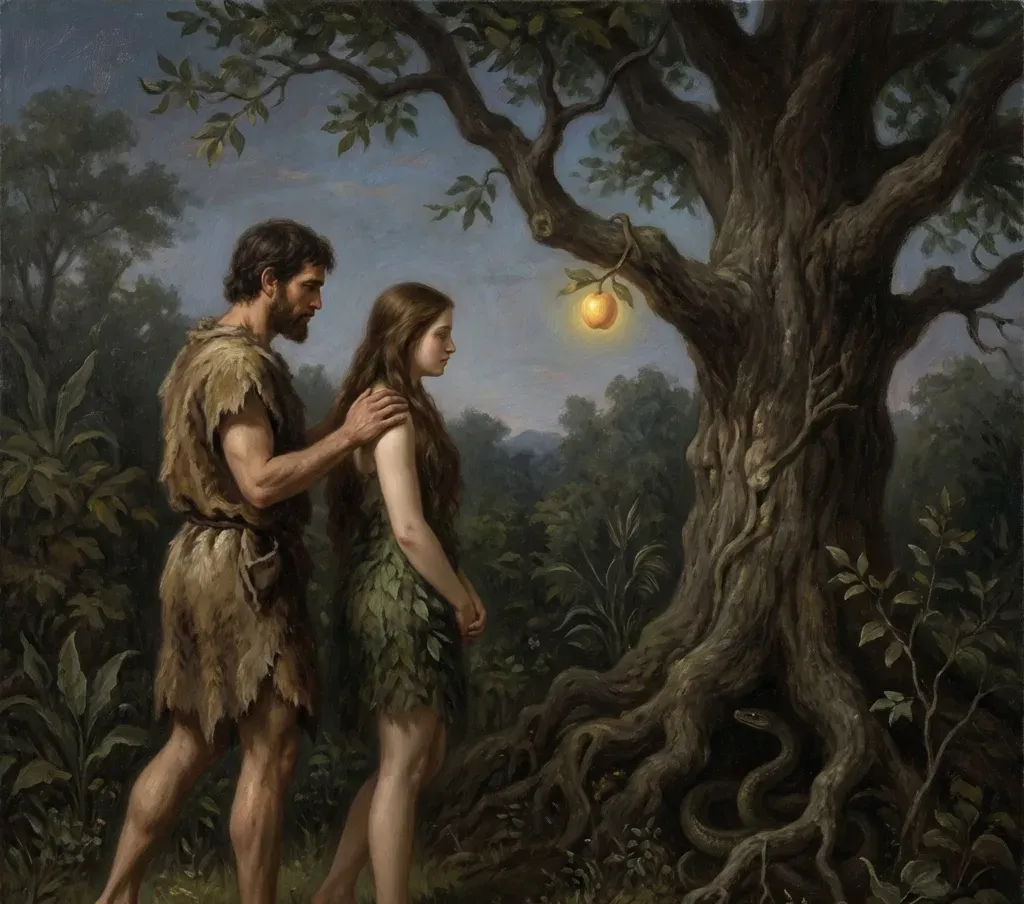
The palace corridors of Jerusalem ran crimson with innocent royal blood. Athaliah, daughter of King Ahab and Jezebel of Israel, had received word that her son, King Ahaziah of Judah, had been slain by Jehu in the northern valley of Jezreel. Rather than donning widow's sackcloth or mourning her offspring, the venomous Queen Mother seized the catastrophic moment to realize her most demonic ambition: the total, systemic eradication of the entire royal seed (Zera ha-Mamlakhah) of the House of David. If every son, grandson, and nephew of the royal line perished under her assassin squads, she would seize the throne of David for herself, sever the messianic branch promised by Yahweh, and transform Jerusalem into a southern stronghold of Phoenician Baal worship. The unconditional covenant God made with King David in 2 Samuel 7—that his throne would endure forever before the Lord—hung by the thinnest human thread in biblical history.
The Treacherous Purge and the Bravery of Jehosheba
As Athaliah's ruthless executioners swept through the royal nurseries, harem quarters, and bedchambers of the citadel, cold-blooded shrieks pierced the night. Every prince carrying Davidic blood was cornered and butchered. Yet amidst the unfathomable terror, one courageous woman stood in the breach. Princess Jehosheba (spelled Jehoshabeath in Chronicles), daughter of the deceased King Jehoram and half-sister of the slain Ahaziah, moved with lightning speed and holy defiance. She was uniquely positioned within the providence of God: she was the lawful royal princess, yet also the devoted wife of High Priest Jehoiada, connecting the royal crown to the sacred altar.
Slipping into the royal bedchambers while the assassins were slaughtering the older princes, Jehosheba snatched the infant Prince Joash—scarcely one year old—along with his faithful wet nurse. She hid them in an inner bedchamber (Chadar ha-Mittot), a storeroom used for storing sleeping mattresses and bedding, concealed behind heavy tapestries. When the death squads swept the wing, the infant made no sound. Under the cover of darkness, Jehosheba smuggled the boy across the palace grounds and through the guarded gates into the labyrinthine residential precincts of Solomon's Temple, where her husband Jehoiada presided as High Priest.
For six agonizing years, while Athaliah ruled over the terrified land from the palace throne, strutting in royal purple and establishing the profane worship of Tyrian Baal in the holy city, the rightful king of Judah was nurtured in absolute secrecy within the courts of the Lord. Joash grew up to the solemn sound of morning and evening sacrifices, the chanting of Levitical choirs, and the sacred recitation of the Torah taught to him by the venerable Jehoiada. Every breath the child drew was an invisible divine strike against the usurper queen. God had preserved a living lamp for David in the very house consecrated to His glorious name.
High Priest Jehoiada's Strategic Masterplan
In the seventh year of Athaliah's tyranny, High Priest Jehoiada determined that the hour of divine reckoning had arrived. The venerable priest was nearly a century old, rich in spiritual wisdom, political courage, and military acumen. He knew that an uncoordinated insurrection would lead to slaughter; a precision operation rooted in solemn covenant was essential. Jehoiada summoned the commanders of hundreds—the Carites (royal mercenaries and elite palace guard) and the Temple guards—bringing them secretly into the temple of the Lord.
Behind the massive cedar doors of the sanctuary, Jehoiada made a formal, binding covenant (berit) with these battle-hardened centurions, swearing them to secrecy under the most terrible oaths of Yahweh. Only after their loyalty was absolute did the High Priest draw aside the curtain and present to their astonished eyes a seven-year-old boy: "Behold, the king's son! He shall reign, as the Lord said concerning the sons of David!" The grizzled commanders gasped; they had believed the line of David was utterly dead. Tears filled their eyes as they gazed upon the living heir of David and Solomon, preserved by the hand of the Almighty.
Jehoiada then laid out a brilliant tactical plan timed to the Sabbath rotation. Under normal temple protocol, the division of priests and Levites going off duty on the Sabbath swapped places with the division coming on duty. Jehoiada ordered both divisions to remain assembled together, tripling the armed presence in the temple courts without arousing suspicion in the adjacent royal palace. One-third of the guard was assigned to the royal palace gate (the Foundation Gate), one-third to the Gate of Sur, and the remaining armed contingents were stationed in a tight perimeter enclosing the young king.
The Consecrated Relics of David and the Ring of Steel
There was, however, a critical challenge: the Levitical guards were forbidden by ritual law from bringing ordinary profane military hardware into the inner court of the temple. How could an army assemble within the sacred sanctuary fully armed? Jehoiada solved this dilemma with magnificent theological and historic brilliance. Stored within the temple treasury were the consecrated spears, lances, and large shields that had belonged to King David himself—trophies of his glorious victories over the Philistines, Syrians, and Ammonites, dedicated to Yahweh two centuries earlier.
Jehoiada opened the sacred armory and distributed the consecrated weapons of King David to the centurions, Levites, and royal captains. The symbolism was electrifying: the guards who would restore the Davidic dynasty were physically holding the very weapons forged and wielded by King David! Standing shoulder to shoulder, spearpoint to spearpoint, the armed men formed an impenetrable ring of steel spanning from the south side of the temple to the north side, surrounding the great bronze altar and guarding every approach to the sanctuary.
The Coronation beside the Sacred Pillar
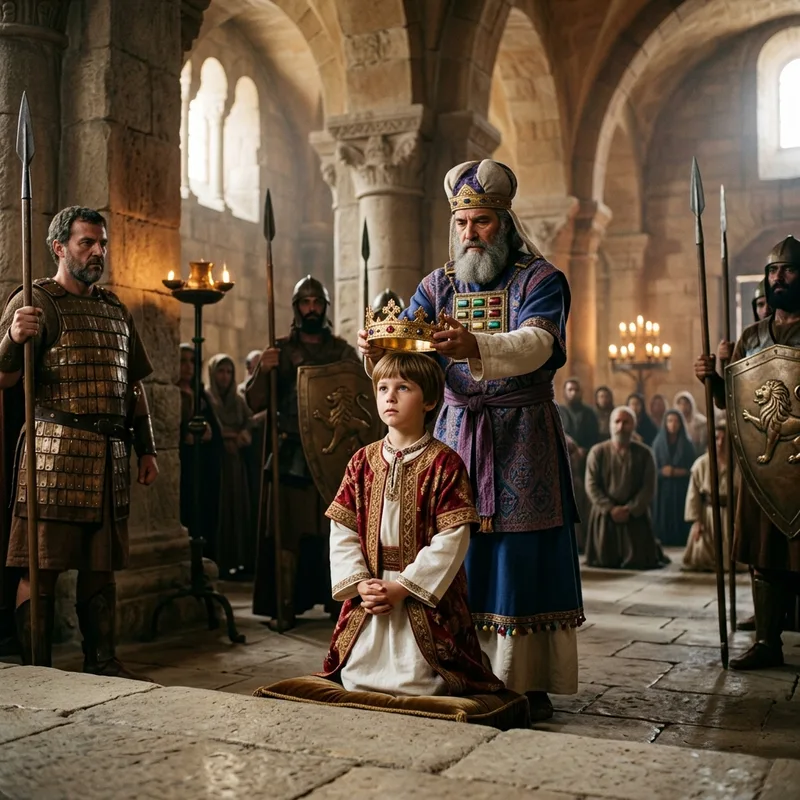
When the perimeter was secured and every guard stood with drawn weapon, Jehoiada brought young Prince Joash out into the court of the Lord. The boy was led to the monumental entrance beside the sacred bronze pillar (identified with either Jachin or Boaz), the traditional station where Davidic kings stood on solemn state occasions. Before the assembled multitude of priests, elders, and Temple guards, Jehoiada and his sons placed the golden royal diadem (Nezer) upon the seven-year-old boy's head.
Next, Jehoiada placed into the child's hands the Testimony (Edut)—the sacred scroll containing the Law of Moses, according to the royal mandate of Deuteronomy 17:18–20, which commanded that every king of Israel must keep a copy of the Torah and read it all the days of his life. Then Jehoiada took the horn of consecrated olive oil and poured it over Joash's head, anointing him as Yahweh's chosen king. The armed assembly erupted into thundering applause. They clapped their hands, blew silver trumpets, played harps and lyres, and shouted at the top of their lungs: "Yechi ha-Melekh! Long live the king!" The roar of celebration resonated like thunder across the Ophel ridge and reverberated into the royal palace.
"Treason! Treason!" — The Fall of Athaliah
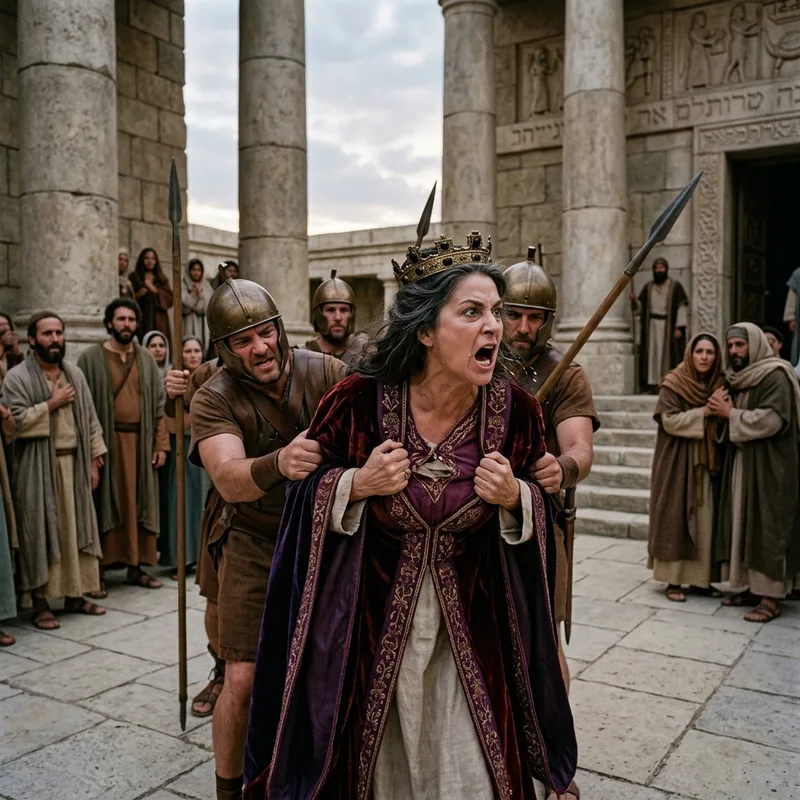
In the royal apartments adjacent to the temple, Queen Athaliah was startled by the unprecedented roar of shouting, trumpets, and ecstatic celebration. Suspicious and furious, she rushed unguarded toward the temple of Yahweh. Crossing the threshold into the temple court, her eyes beheld a scene that turned her blood to ice: there, standing beside the royal pillar according to the ancient custom, was a living boy adorned with the royal diadem, flanked by armed centurions and trumpeters, while the entire populace rejoiced and blew horns.
Realizing in an instant that her six-year reign of terror had crumbled and the seed of David lived, Athaliah tore her royal garments in hysterical frenzy and shrieked into the air: "Qesher! Qesher! Treason! Treason!" She who had murdered an entire royal family, usurped the throne, and drenched Jerusalem in innocent blood dared to accuse the righteous of conspiracy! But High Priest Jehoiada was in absolute command. He commanded the centurions: "Bring her out between the ranks! Kill with the sword anyone who follows her! But let her not be put to death in the house of the Lord!"
The guards seized Athaliah, leading her through the temple gates along the horses' entryway toward the royal stables. There, outside the holy sanctuary at the Horse Gate (Shaar ha-Susim), the wicked queen met the righteous retribution of God. The bloodthirsty usurper who had lived by the sword fell by the sword, bringing an end to the dark Omride curse that had plagued the throne of Judah.
Covenant Renewal and the Purging of Baal
With Athaliah removed, Jehoiada seized the holy momentum to execute a comprehensive spiritual reformation. He did not immediately begin festivities; he first established a threefold covenant (berit). Jehoiada mediated a solemn covenant between Yahweh, the young king, and all the people, pledging that they would belong exclusively to the Lord as His holy nation. A second covenant was established between the king and his subjects, establishing a righteous monarchy governed by justice and the fear of God.
The ignited people marched immediately from the temple of Yahweh to the profane temple of Baal that Athaliah had built in Jerusalem. In a display of righteous holy zeal, the assembly tore down the idolatrous shrine, smashed its altars into dust, shattered its detestable carved images, and executed Mattan, the chief pagan priest of Baal, right before his desecrated altars. Jehoiada stationed trusted officers and gatekeepers at the gates of the temple of the Lord so that no unclean person or idolatrous influence could enter the sacred house.
Finally, the centurions, the Carite bodyguards, and all the dignitaries escorted the young boy king Joash down from the temple of the Lord, through the Gate of the Guard, and into the royal palace. With the entire nation cheering and the city rejoicing in peace, seven-year-old Joash was seated upon the royal throne of the kings of Judah. Jerusalem had rested from bloodshed, the line of David was victoriously restored, and the covenant promise of the coming Messiah was preserved intact for all eternity.
Biblical Keywords & Theological Roots
Ancient Near Eastern & Archaeological Context
The near-annihilation of the Davidic dynasty under Athaliah (c. 841–835 BC) represents one of the most precarious genealogical crises in biblical history. Athaliah was the daughter of King Ahab of Israel and Phoenician princess Jezebel. Her marriage to King Jehoram of Judah was an ill-fated political alliance orchestrated by Jehoshaphat, which infected Judah's court with the virulent cult of Tyrian Melqart (Baal). In ancient Near Eastern monarchies, the Queen Mother (Hebrew: Gebirah) exercised formidable administrative and cultic authority; Athaliah capitalized on this power following the assassination of her son Ahaziah by Jehu. Solomon's Temple architecture played a decisive tactical role: the monumental bronze pillars (Jachin and Boaz) at the portico served as the traditional constitutional station where Judean monarchs stood during coronation ceremonies. The Temple armory housed the consecrated shields and spears dedicated by King David two centuries earlier (2 Samuel 8:7–11), allowing the Levites to arm themselves within sacred precincts without violating cultic purity laws prohibiting secular weapons in the inner court. The execution of Athaliah at the Horse Gate (Shaar ha-Susim) near the royal palace and the slaughter of Mattan the Baal priest before his altars followed ancient covenant lawsuit procedures, purging the city of treason and spiritual apostasy.
Practical Discipleship & Spiritual Application
- Guard the Sacred Calling in Hidden Seasons: Joash spent six silent years concealed within the temple chambers before being unveiled as king. When your spiritual calling or promise appears hidden and cultural forces seem overwhelmingly hostile, remain deeply anchored in God's presence; the Lord faithfully nurtures in secret what He will manifest in His appointed hour.
- Stand Courageously Against Cultural Apostasy: Princess Jehosheba dared to defy an all-powerful, murderous queen to preserve what was sacred to Yahweh. Believers are summoned to steadfast, nonviolent moral courage when prevailing culture demands total conformity to godless ideologies.
- Anchor All Leadership and Governance in God's Word: Joash was crowned alongside the Testimony (the scroll of the covenant Law). Leadership severed from Scripture degenerates into pride, tyranny, and moral failure; every vocational and familial responsibility must be governed by the unchanging counsel of God's Word.
- Cleanse Personal and Corporate Altars of Compromise: The revival under Jehoiada was incomplete until the altars and idols of Baal were pulverized to dust. Genuine spiritual renewal demands the uncompromising dismantling of modern idols—greed, entertainment addiction, and worldly compromise—competing with Christ in our hearts.
Support Independent Biblical Research
Did this study bless you? Help support our independent bilingual research and interactive visual Bible tools.
⚡ Fast Facts
- Joash was only one year old when his aunt Jehosheba rescued him from Athaliah's bloody palace massacre.
- The infant prince was concealed in the residential chambers of Solomon's Temple for six full years before his public unveiling.
- High Priest Jehoiada armed the Levitical guards with the actual spears and shields dedicated by King David two centuries earlier.
- Joash was crowned at age seven beside the bronze pillar of the Temple, holding the royal diadem and the scroll of the Law.
❓ Frequently Asked Questions (FAQs)
Why did Athaliah attempt to murder all of her own grandchildren and royal heirs?
Athaliah, daughter of Ahab and Jezebel, was driven by ruthless political ambition and fanatical devotion to Tyrian Baal. Following the assassination of her son King Ahaziah, she sought to eliminate every legitimate Davidic heir to seize absolute power for herself, eradicate the worship of Yahweh in Judah, and absorb Judah into the northern Omride sphere of Phoenician paganism.
What was the legal and spiritual significance of placing both the diadem and the Testimony on Joash?
The royal diadem (Nezer) represented legitimate political sovereignty and royal authority, while the Testimony (Edut) was the scroll of the Mosaic Law. In accordance with Deuteronomy 17:18–20, an authentic Davidic king was not an absolute tyrant above the law, but a servant-monarch bound by sacred covenant to study, obey, and govern under the supreme authority of God's Word.
How does the preservation and coronation of Joash point typologically to Jesus Christ?
Joash prefigures Christ in multiple ways: he was the sole surviving seed of David preserved from a genocidal tyrant (mirroring infant Jesus preserved from King Herod's slaughter in Bethlehem); he was hidden in the temple before being revealed as king; and he overthrew the reign of the usurper to establish righteous worship, foreshadowing Christ's ultimate victory over Satan and His eternal coronation upon the throne of David.