Approximately a decade after Daniel had interpreted King Nebuchadnezzar's forgotten dream in Daniel 2—unveiling a colossal statue with a head of gold, chest of silver, thighs of bronze, and legs of iron representing the succession of mortal empires that would crumble before the unshakeable kingdom of God—the monarch's initial humility dissolved into blinding imperial arrogance. Unwilling to accept the divine verdict that Babylon was merely the golden head and would eventually be replaced by an inferior power, Nebuchadnezzar engaged in an act of monumental geopolitical defiance against the God of heaven. He resolved to construct a colossal image made entirely of gold from head to foot, arrogantly proclaiming that his reign, his dynasty, and his empire would endure forever.
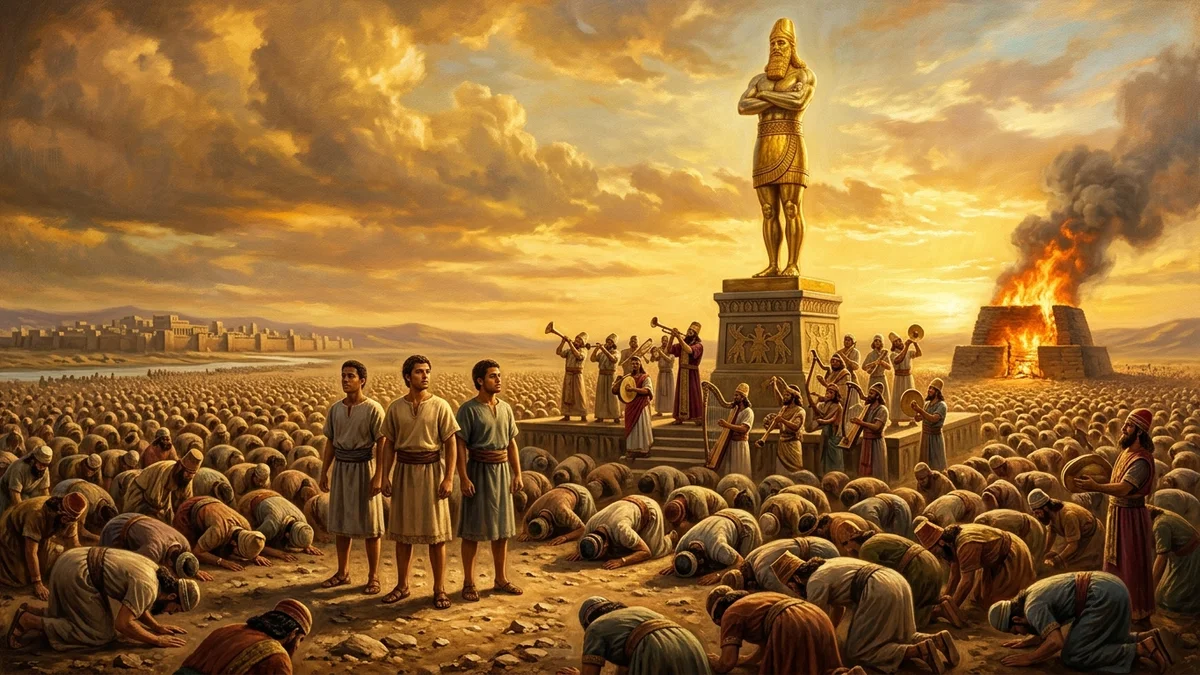
The site chosen for this imperial spectacle was the Plain of Dura (*Biq'at Dura*), an expansive alluvial plateau twelve miles southeast of Babylon (excavated in modern Iraq as the mounds of *Tolul Dura*). The dimensions of the monument were staggering: towering sixty cubits high (approximately ninety feet or nine stories tall) and six cubits wide (nine feet across), the gilded colossus caught the blinding desert sun, radiating a dazzling, hypnotic glare across the Mesopotamian flatlands. Supported by a massive brick pedestal, the statue stood as an unyielding symbol of totalitarian state power, pagan idolatry, and mandatory ideological conformity.
The Imperial Concourse and the Herald's Ultimatum
To inaugurate the monument, Nebuchadnezzar summoned the entire administrative, military, and judicial apparatus of the Neo-Babylonian Empire. Scripture meticulously records the official hierarchy: satraps (*achashdarpanin*), administrators (*signayin*), governors (*pachavat*), counselors (*adargazrayin*), treasurers (*gedavrayin*), judges (*detavrayin*), magistrates (*tiftayin*), and all the regional provincial officials. Hundreds of dignitaries, clad in embroidered silk, gold necklaces, and ceremonial vestments, assembled before the golden monolith.
Suddenly, the imperial herald stepped forward and bellowed with deafening authority across the silent multitude: לְכוֹן אָמְרִין עַמְמַיָּא אֻמַּיָּא וְלִשָּׁנַיָּא—"To you it is commanded, O peoples, nations, and languages: at the time you hear the sound of the horn, flute, harp, lyre, and psaltery, in symphony with all kinds of music, you shall fall down and worship the gold image that King Nebuchadnezzar has set up! And whoever does not fall down and worship shall be cast immediately into the midst of a burning fiery furnace!" (Daniel 3:4–6).
The ultimatum was absolute. There was no room for religious exemption, philosophical debate, or conscientious objection. The industrial kilns of Babylon—massive domed structures (*attun nura*) used for firing millions of architectural bricks for the city's walls and ziggurats—were roaring nearby, fed with sulfur, pitch, and dry timber, their open chimneys belching black smoke into the desert sky. When the immense court orchestra struck its thunderous opening crescendo, terror paralyzed the concourse: thousands of princes, generals, and governors fell face down onto the dusty ground, their foreheads pressed against the earth in abject submission.
Three Solitary Silhouettes: The Refusal to Bow
Yet across that vast sea of prostrated human bodies, three solitary figures remained standing bolt upright. They were Shadrach (Hananiah), Meshach (Mishael), and Abednego (Azariah)—the three young Jewish exiles whom Nebuchadnezzar had appointed over the administration of the province of Babylon. In an age of total compromise, their vertical posture was a catastrophic scandal. To bow would have been so simple: they could have justified it as mere civic obedience, argued that their hearts remained true to Yahweh, or cited the sheer physical agony of being incinerated alive. But their theology was anchored in the absolute covenant commandment of Mount Sinai: "You shall have no other gods before Me; you shall not make for yourself a carved image... you shall not bow down to them nor serve them" (Exodus 20:3–5). Between the wrath of a mortal emperor and the holiness of the Living God, there was no choice.
Certain jealous Chaldean astrologers (*Guvrin Kasdayin*), bitter that foreign Jewish captives held administrative supremacy over them, immediately rushed to Nebuchadnezzar with malicious accusations: "There are certain Jews whom you have set over the affairs of the province of Babylon... these men, O king, have not paid due regard to you. They do not serve your gods or worship the gold image which you have set up!" (Daniel 3:12).
Scripture records that Nebuchadnezzar was consumed with rage and fury (*birgaz va-chamah*). The absolute monarch, accustomed to trembling subservience from every conquered nation, could not tolerate the defiance of three young officials. Summoned before the royal throne, the king offered them a calculated second chance: "Now if you are ready... fall down and worship the image; but if you do not worship, you shall be cast immediately into the midst of a burning fiery furnace. And who is the god who will deliver you from my hands?" (Daniel 3:15). In his blinding pride, Nebuchadnezzar threw down the gauntlet not merely against three youths, but against the Almighty Creator of the cosmos.
The Sublime Confession: 'Even If He Does Not'
Without a moment's hesitation, without trembling or conferring in private, the three young men looked into the eyes of the most terrifying despot on earth and delivered one of the most sublime confessions of faith in human history: לָא חַשְׁחִין אֲנַחְנָא עַל־דְּנָה פִּתְגָם לַהֲתָבוּתָךְ—"O Nebuchadnezzar, we have no need to answer you in this matter. If that is the case, our God whom we serve is able to deliver us from the burning fiery furnace, and He will deliver us from your hand, O king. But if not, let it be known to you, O king, that we do not serve your gods, nor will we worship the gold image which you have set up!" (Daniel 3:16–18).
Here was faith stripped of all commercial bargaining, all selfish entitlement, and all conditional expectations. They knew that Yahweh possessed the sovereign omnipotence to quench the violent flames; yet even if the mysterious counsel of divine providence ordained that their flesh should be reduced to ashes, their loyalty to God remained unconditional. They loved the Lord more than life itself.
Seven Times Hotter: The Furnace of Fury
Nebuchadnezzar's countenance distorted with demonic fury. His aristocratic composure shattered into unrestrained savagery. He ordered the furnace heated seven times hotter than its normal operating temperature (*shiv'ah al di chazeh*). Elite soldiers from the royal guard bound Shadrach, Meshach, and Abednego tightly in their coats, trousers, turbans, and outer garments. Dragged up the stone ramp to the furnace's upper feed opening, the heat radiating from the mouth of the kiln was so catastrophic that the superheated thermal blast instantly incinerated the valiant soldiers who threw them in!
Tumbling through the roaring column of white-hot fire, the three bound Hebrew youths fell deep into the belly of the furnace. In the eyes of Nebuchadnezzar and the watching concourse, the execution was finished. No biological organism could survive such thermal intensity for three seconds.
The Fourth Figure in the Fire: The Unseen Companion
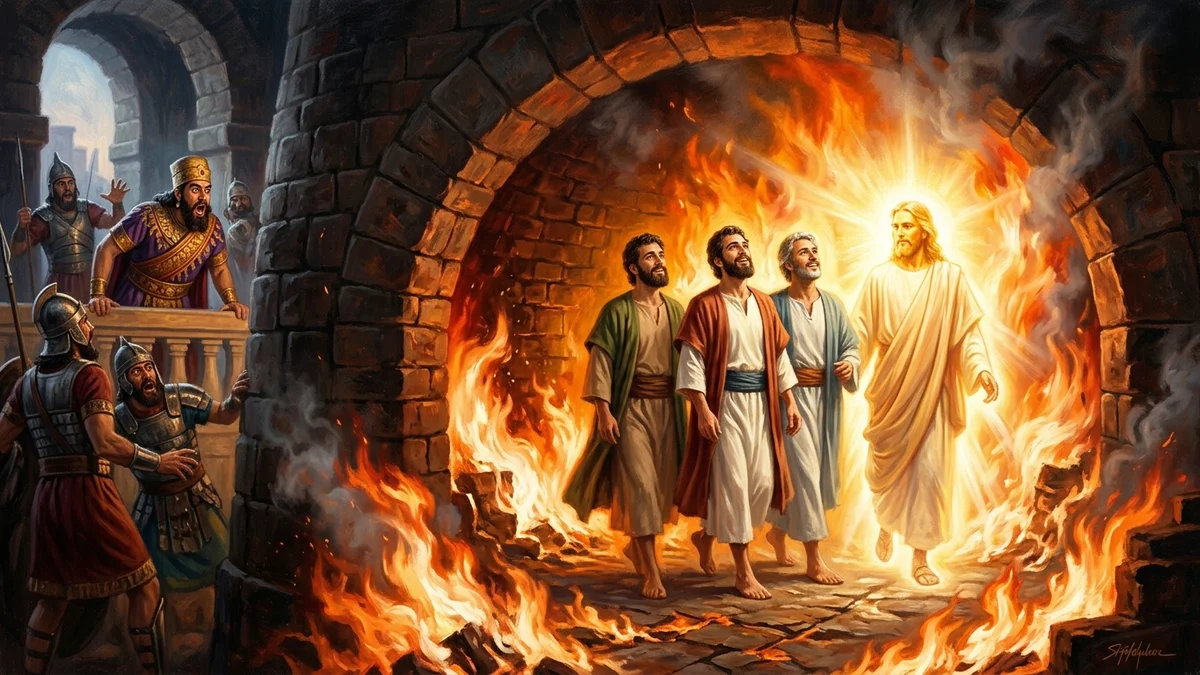
As the monarch leaned forward on his throne to gloat over the smoking ashes, his eyes suddenly widened in paralyzing terror. Scripture records: "Then King Nebuchadnezzar was astonished; and he rose in haste and spoke, saying to his counselors: 'Did we not cast three men bound into the midst of the fire?' They answered and said to the king, 'True, O king.' 'Look!' he answered, 'I see four men loose, walking in the midst of the fire; and they are not hurt, and the form of the fourth is like the Son of God!'" (Daniel 3:24–25).
The Aramaic phrase דָּמֵה לְבַר־אֱלָהִין (Dameh le-Var-Elahin)—"like a son of the gods"—burst from the pagan emperor's lips in involuntary awe. Inside the roaring inferno, the physical laws of nature had been suspended by the Creator. The only items consumed by the flames were the hemp ropes that had bound their hands and feet! Liberated from their shackles, Shadrach, Meshach, and Abednego were leisurely strolling through the white-hot coals, fellowshipping in joyous intimacy with their heavenly Protector!
This was no ordinary angel. Christian theology has historically recognized this breathtaking intervention as a Christophany—a pre-incarnate manifestation of the eternal Son of God, Jesus Christ, stepping down from the heavenly throne into the Babylonian kiln to stand beside His faithful witnesses. God had not kept them from the fire; He had joined them in the fire!
The Miraculous Emergence and the Universal Decree
Trembling and pale, Nebuchadnezzar approached the lower draft opening of the kiln, crying aloud: "Shadrach, Meshach, and Abednego, servants of the Most High God, come out, and come here!" (Daniel 3:26). Stepping forth from the furnace into the bright sunlight of the Plain of Dura, the three young men were instantly surrounded by satraps, prefects, governors, and the king's counselors. A thorough physical examination revealed a miracle of staggering proportions:
- The fire had no power over their physical bodies: not a single blister or burn marred their skin.
- Not a single hair of their heads was singed.
- Their delicate garments—coats, trousers, and turbans—were undamaged and uncharred.
- Most astonishing of all: "the smell of fire was not on them" (Daniel 3:27).
Overwhelmed by the majesty of the God of Israel, the proudest monarch on earth issued an imperial decree across his global empire: בְּרִיךְ אֱלָהֲהוֹן דִּי־שַׁדְרַךְ מֵישַׁךְ וַעֲבֵד נְגוֹ—"Blessed be the God of Shadrach, Meshach, and Abednego, who sent His Angel and delivered His servants who trusted in Him, and have frustrated the king's word, and yielded their bodies, that they should not serve nor worship any god except their own God! Therefore I make a decree that any people, nation, or language which speaks anything amiss against the God of Shadrach, Meshach, and Abednego shall be cut in pieces, and their houses shall be made an ash heap; because there is no other God who can deliver like this!" (Daniel 3:28–29).
The Furnace of Affliction and the Believer's Victory
The fiery furnace of Dura remains an immortal beacon of comfort for every persecuted disciple throughout the ages. The Apostle Peter reminded the suffering early church: "Beloved, do not think it strange concerning the fiery trial which is to try you, as though some strange thing happened to you; but rejoice to the extent that you partake of Christ's sufferings" (1 Peter 4:12–13). When worldly systems threaten cancellation, economic ruin, or bodily harm for refusing to bow to modern idols of secularism, moral compromise, and state idolatry, the God of the fourth man stands ready.
The flames of adversity cannot consume the child of God; they serve only to burn away the chains of worldly fear, liberating us to walk in deeper communion with Christ. For He who promised in Isaiah 43:2—"When you walk through the fire, you shall not be burned, nor shall the flame scorch you"—is the same yesterday, today, and forever. Dare to stand, dare to refuse the golden idols of the age, and rest secure in the knowledge that in every furnace of life, the Son of God walks beside you!
Biblical Keywords & Theological Roots
Ancient Near Eastern & Archaeological Context
Excavations by French archaeologist Jules Oppert in the 1850s at the mound of *Tolul Dura*, twelve miles southeast of Babylon, uncovered a massive baked-brick pedestal measuring 45 feet square and 20 feet high, perfectly matching the structural base required for Nebuchadnezzar's sixty-cubit colossal monument. Royal inscriptions from the reign of Nebuchadnezzar describe the gilding of public monuments with hundreds of talents of refined gold. Furthermore, industrial lime and brick kilns (*attun nura*)—massive subterranean chambers fed with timber, bitumen, and pitch with open top shafts and side draft vents—were ubiquitous around Babylon for the massive brick construction of the Ishtar Gate and city walls, confirming the execution method attested in ancient Babylonian penal codes.
Practical Discipleship & Spiritual Application
- Stand firm when everyone else bows: when cultural pressure, corporate corruption, or peer conformity demands compromise, dare to stand alone for Christ.
- Cultivate an 'even if' faith: trust God in sickness, financial struggle, or trial, declaring that whether He heals now or brings you home to glory, you will never deny Him.
- Look for Christ in your fiery trials: when suffering intensifies, realize that Jesus is closest to you in the furnace of affliction.
- Trust that your testimony in persecution will silence critics and glorify God: Nebuchadnezzar, the most powerful tyrant on earth, was forced to praise Yahweh because three teenagers refused to bend.
Support Independent Biblical Research
Did this study bless you? Help support our independent bilingual research and interactive visual Bible tools.
⚡ Fast Facts
- The colossal statue stood 60 cubits high (approx. 90 feet / 27 meters) and 6 cubits wide (9 feet / 2.7 meters), with a 10:1 height-to-width ratio typical of monumental ancient steles.
- The royal orchestra included six specific ancient instruments: the horn (*qarna*), pipe (*mashroqita*), zither (*qathros*), lyre (*sabbeka*), harp (*psanterin*), and pipes (*sumponya*).
- Daniel was notably absent from the gathering at Dura, likely away on high-level administrative diplomacy in an outlying province of the empire.
- Nebuchadnezzar's fury was so intense that he personally watched the execution, leading to his instant shock when he saw four men walking in the flames.
❓ Frequently Asked Questions (FAQs)
Why did Nebuchadnezzar make an image of solid gold after the dream in Daniel 2?
In Daniel 2, God revealed that Nebuchadnezzar was only the 'head of gold', to be succeeded by inferior kingdoms of silver, bronze, and iron. Driven by wounded pride and imperial rebellion, Nebuchadnezzar constructed an image entirely of gold from head to toe, effectively declaring to the world that his Babylonian empire would never fall, never be replaced, and would reign eternally.
Who was the 'Fourth Man' in the fiery furnace?
Nebuchadnezzar described Him in Aramaic as *Dameh le-Var-Elahin* ('like a son of the gods'). While pagan theology perceived a divine angelic messenger, historic Christian orthodoxy recognizes this as a Christophany—a pre-incarnate appearance of the Second Person of the Trinity, the Lord Jesus Christ, physically manifesting to fellowship with and shield His faithful servants.
Why wasn't Daniel thrown into the fiery furnace alongside his three friends?
Scripture does not state Daniel's exact location, but as the chief governor over the whole province of Babylon and prefect over all the wise men (Daniel 2:48), Daniel was likely traveling on royal business in distant imperial territories (such as Elam or Media) during the dedication ceremony. His unwavering faithfulness throughout the book demonstrates that had he been present, he would have stood with his brethren.