Following King Saul's dramatic early triumph over Nahash the Ammonite at Jabesh-Gilead, the young monarchy appeared firmly established. Saul reigned two years over Israel, consolidating a standing professional guard of three thousand elite warriors—stationing two thousand with himself at Michmash and Bethel, and one thousand with his courageous son Jonathan at Gibeah of Benjamin. Yet beneath the surface of royal consolidation, an unbearable geopolitical crisis simmered: the Philistines maintained fortified military garrisons deep within the highlands of Benjamin, enforcing an iron metallurgical monopoly that kept Israel completely disarmed. Desiring to break this imperial stranglehold, young prince Jonathan executed a daring raid, striking the Philistine garrison stationed at Geba. The news swept across the Shephelah like wildfire: the Hebrews had openly defied their oppressors.
The Philistine retaliation was swift, massive, and terrifying. Mobilizing an overwhelming expeditionary force, the Philistines assembled at Michmash, directly east of Beth-Aven: thirty thousand iron-scythed war chariots, six thousand elite cavalrymen, and foot soldiers as numerous as the sand on the seashore (1 Samuel 13:5). When the Israelite peasantry saw the colossal mechanized army camping across the deep gorge of the Michmash pass, utter panic broke out. The Hebrew soldiers deserted en masse, scattering into dark limestone caves, thick thorn thickets, deep crevices, subterranean cisterns, and rocky tombs; some even fled across the Jordan River into the remote plains of Gad and Gilead. Saul retreated to the historic staging ground of Gilgal in the Jordan Valley, surrounded by a terrified, trembling remnant of only six hundred men.
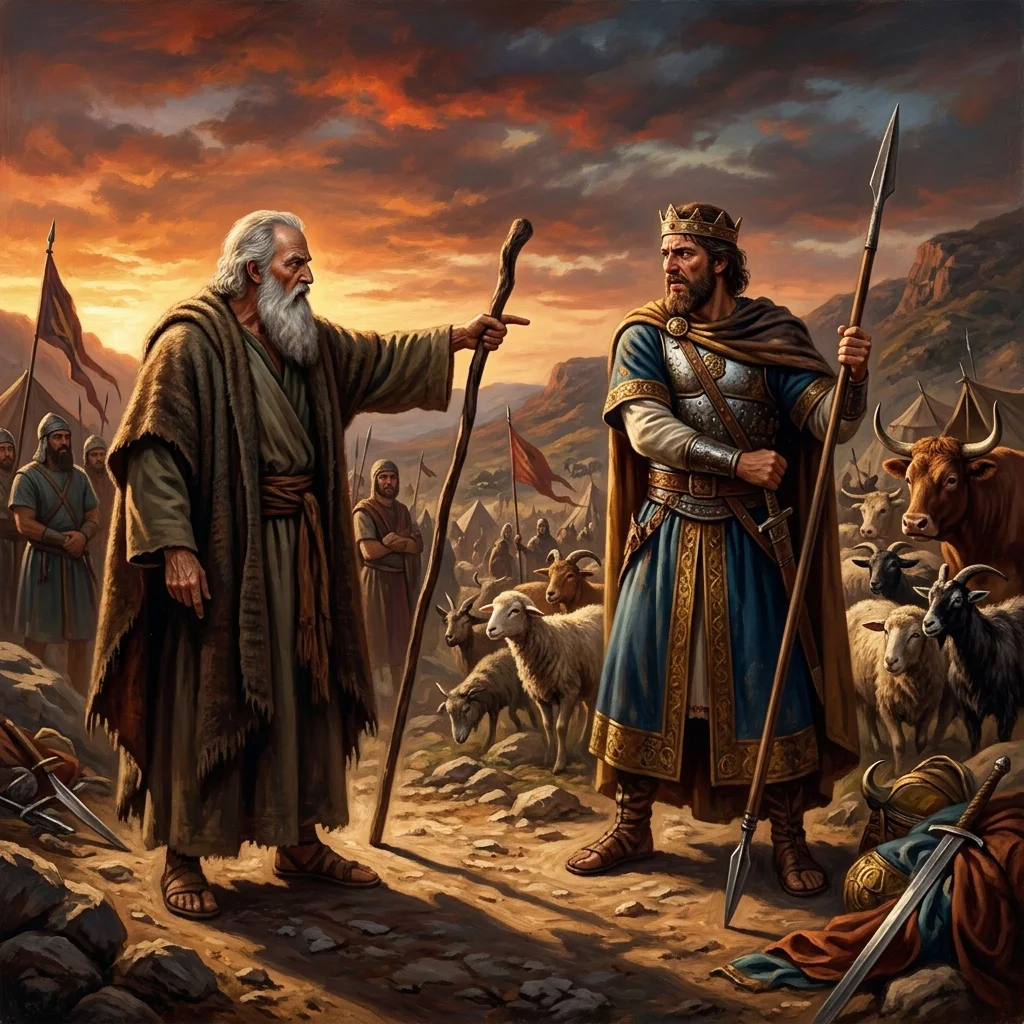
At Gilgal, Saul faced an agonizing spiritual test. Prior to the crisis, the prophet Samuel had given Saul an explicit divine command: "You shall go down before me to Gilgal; and surely I will come down to you to offer burnt offerings and make sacrifices of peace offerings. Seven days you shall wait, till I come to you and show you what you should do" (1 Samuel 10:8). For seven grueling days, Saul waited as the hours ticked away. Across the hills, the Philistine raiding parties were plundering the land in three strike columns; at Gilgal, Saul's demoralized soldiers were melting away by the hour. On the seventh day, with the morning sun climbing and Samuel yet absent, Saul's faith collapsed into carnal panic.
Believing that military victory could not be secured without religious ritual, Saul presumed to cross the sacred boundary between king and priest. Under the Mosaic covenant, only consecrated descendants of Aaron were authorized to offer blood upon Yahweh's altar; kings were strictly forbidden from functioning as sacerdotal clerics. Overcome by impatience, Saul commanded his attendants: "Bring a burnt offering and peace offerings here to me!" And Saul presumptuously offered the burnt offering upon the altar with his own hands. The smoke of the illicit sacrifice had scarcely cleared when Samuel walked into the camp. Saul hurried out to greet him, attempting to present a pious front. But the aged prophet's eyes blazed with holy indignation: "What have you done?" (1 Samuel 13:11).
Saul immediately began rationalizing his disobedience: "When I saw that the people were scattered from me, and that you did not come within the days appointed, and that the Philistines gathered together at Michmash, then I said, 'The Philistines will now come down on me at Gilgal, and I have not made supplication to Yahweh.' Therefore I felt compelled, and offered a burnt offering!" Notice Saul's self-deceit: he blamed the fleeing troops, blamed Samuel's delay, blamed the advancing Philistines, and framed his sin as an act of pious necessity. But Samuel cut through the excuses with thunderous clarity: "You have done foolishly! You have not kept the commandment of Yahweh your God, which He commanded you. For now Yahweh would have established your kingdom over Israel forever. But now your kingdom shall not continue. Yahweh has sought for Himself a man after His own heart, and Yahweh has commanded him to be commander over His people, because you have not kept what Yahweh commanded you!" (1 Samuel 13:13-14).
Though God granted a miraculous deliverance at Michmash through the audacious personal faith of Jonathan and his armor-bearer, Saul's inner character continued to rot with insecurity, rash vows, and pride. The final, definitive moral crucible arrived several years later when Samuel approached Saul with a direct, unambiguous commission from Yahweh of Hosts: "Yahweh sent me to anoint you king over His people... Now go and strike Amalek, and utterly destroy all that they have, and do not spare them. But kill both man and woman, infant and nursing child, ox and sheep, camel and donkey!" (1 Samuel 15:1-3). This command placed Amalek under the solemn ban of sacred devotion (*herem*). Four hundred years earlier, when Israel had emerged exhausted from Egyptian slavery, the Amalekites had launched a cowardly, unprovoked ambush at Rephidim, butchering the weary stragglers at the rear of the column (Deuteronomy 25:17-19). God had sworn that their memory would be blotted out. Saul was not sent on a war of territorial plunder or personal vengeance, but as Yahweh's consecrated judicial executor.
Saul mobilized two hundred thousand infantrymen of Israel and ten thousand men of Judah at Telaim. Marching into the Negev, he laid ambush in the valley, warning the friendly Kenites to depart lest they be swept away. Saul struck the Amalekites in a sweeping campaign from Havilah all the way to Shur on the Egyptian border. Yet in the hour of victory, Saul and his army committed fatal covenant treason: they spared Agag, the king of the Amalekites, alive as a royal trophy, and spared the very best of the sheep, the oxen, the fatlings, the lambs, and all that was good, refusing to utterly destroy them. Only the despised and worthless animals did they put to the sword.
That night, the word of Yahweh came to Samuel in deep grief: "I greatly regret that I have set up Saul as king, for he has turned back from following Me, and has not performed My commandments!" (1 Samuel 15:11). The heartbroken prophet spent the entire night crying out to Yahweh in weeping intercession. Rising early the next morning, Samuel learned that Saul had gone to Carmel to erect a stone monument to his own glory, and had proceeded down to Gilgal.
When Samuel arrived, Saul greeted him with astonishing arrogance: "Blessed are you of Yahweh! I have performed the commandment of Yahweh!" But the prophet silenced the king's self-congratulation with a devastating, sarcastic inquiry: "What then is this bleating of the sheep in my ears, and the lowing of the oxen which I hear?" Caught red-handed, Saul instantly shifted the blame: "They have brought them from the Amalekites; for the people spared the best of the sheep and the oxen, to sacrifice to Yahweh your God; and the rest we have utterly destroyed!" Saul hid his greed beneath the sanctimonious guise of worship: 'the people' took them, and they did it 'to sacrifice to YOUR God!'
Samuel commanded: "Be quiet! And I will tell you what Yahweh said to me last night... When you were little in your own eyes, were you not head of the tribes of Israel? Did not Yahweh anoint you king over Israel?... Why then did you not obey the voice of Yahweh? Why did you swoop down on the spoil, and do evil in the sight of Yahweh?" When Saul stubbornly insisted that he had obeyed, Samuel uttered the immortal manifesto of biblical faith: "Has Yahweh as great delight in burnt offerings and sacrifices, as in obeying the voice of Yahweh? Behold, to obey is better than sacrifice, and to heed than the fat of rams. For rebellion is as the sin of witchcraft, and stubbornness is as iniquity and idolatry. Because you have rejected the word of Yahweh, He also has rejected you from being king!" (1 Samuel 15:22-23).
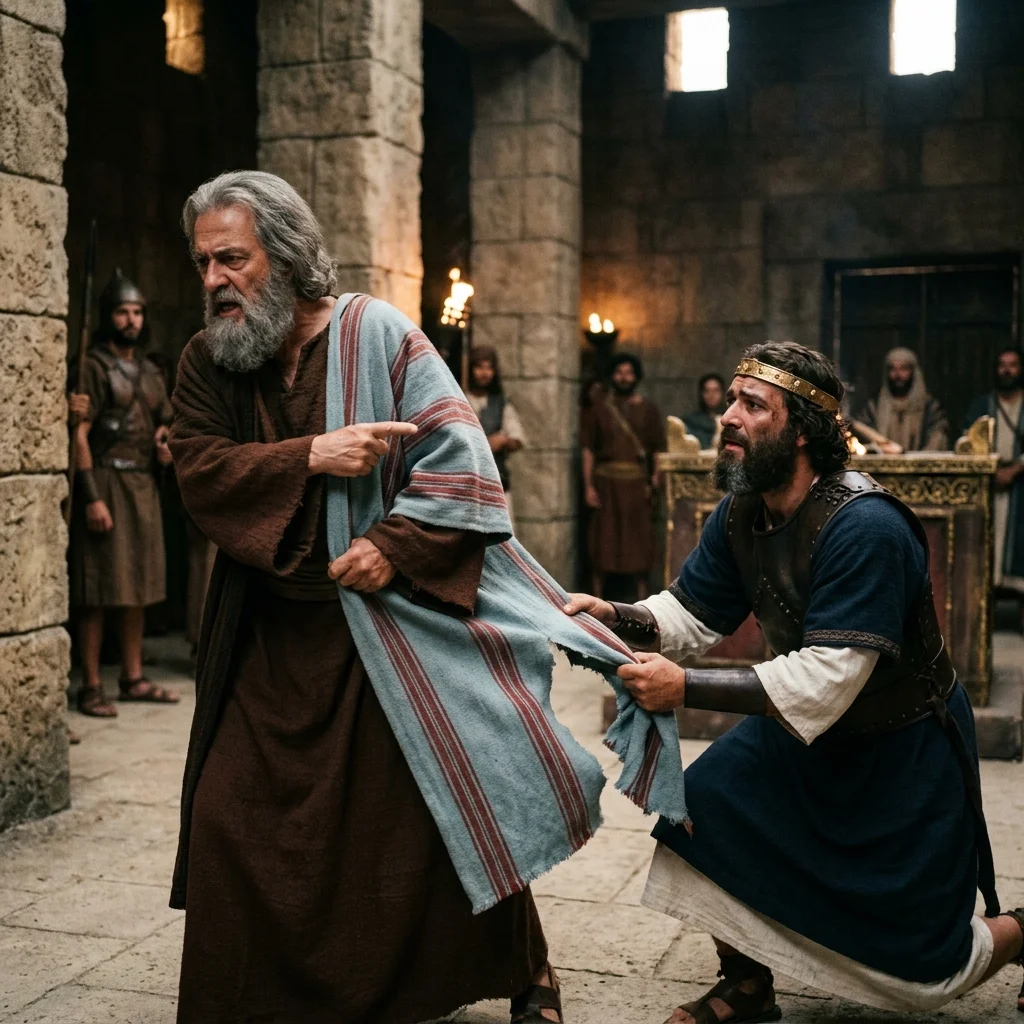
Terrified of public disgrace, Saul confessed: "I have sinned... because I feared the people and obeyed their voice. Now therefore, please pardon my sin, and return with me, that I may worship Yahweh." But Samuel replied: "I will not return with you, for you have rejected the word of Yahweh, and Yahweh has rejected you from being king over Israel!" As Samuel turned to walk away, Saul lunged forward in desperation and grabbed the hem of the prophet's robe (*me'il*), and the garment tore in his hand. Samuel turned, fixed his eyes upon the weeping king, and pronounced the irrevocable decree: "Yahweh has torn the kingdom of Israel from you today, and has given it to a neighbor of yours, who is better than you! And also the Strength of Israel will not lie nor relent. For He is not a man, that He should relent!" (1 Samuel 15:28-29).
Though Samuel consented to honor Saul before the elders one last time during public worship, the prophet called for King Agag. The Amalekite monarch walked delicately toward him, flattering himself: "Surely the bitterness of death is past." But Samuel declared: "As your sword has made women childless, so shall your mother be childless among women!" And there at Gilgal, the aged prophet hacked Agag in pieces before Yahweh. Samuel departed to Ramah, mourning deeply for Saul; and Samuel went no more to see Saul until the day of his death. The tragic reign of Saul had forfeited its spiritual mandate, clearing the path for the shepherd boy of Bethlehem who would truly be a man after God's own heart!
Biblical Keywords & Theological Roots
To hear intelligently, listen attentively, obey. In Hebrew, hearing and obeying are inseparable: true 'shama' results in immediate active compliance with divine commands.
Sacrificial slaughter, offering, animal victim. External ritual worship that becomes an abomination when severed from inward covenant integrity and heartfelt obedience.
Divination, witchcraft, sorcery, illicit occult manipulation. Samuel equates spiritual rebellion (*meri*) with the demonic sin of divination.
Household idols, pagan figurines, carved family deities consulted for divination. Used by Samuel to demonstrate that self-willed stubbornness is equivalent to idolatry.
To tear, rend violently, rip apart. The violent tearing of Samuel's prophetic robe symbolizing the irreversible tearing away of the kingdom from Saul's dynasty.
Ancient Near Eastern & Archaeological Context
The events of 1 Samuel 13–15 represent the tragic turning point of the Early Iron Age monarchy (circa 1040–1025 BC). Geographically, the Philistine threat had paralyzed the central ridge of Benjamin: the Philistines fortified the Michmash Pass (Wadi Suweinit), a steep gorge separating Geba from Michmash. Archaeologically, excavations at Khirbet Qeiyafa and Tell en-Nasbeh (Mizpah) reveal the strategic importance of fortified frontier checkpoints. The text highlights a severe technological disparity: the Philistines maintained an iron-working cartel, banning Hebrew blacksmiths and forcing Israelites to descend to the Philistine plains even to sharpen plows, mattocks, and axes with silver payments (*pim* weight, an authentic 8-gram Iron Age measure discovered in excavations) (1 Samuel 13:19-21). Saul's second crisis involved the Amalekites—ruthless nomadic pastoralists of the Negev and Sinai deserts who had ambushed vulnerable Israelite stragglers at Rephidim after the Exodus (Exodus 17:8-16; Deuteronomy 25:17-19). Ancient Near Eastern warfare recognized the institution of *herem* (the sacred ban), where all spoils of an unprovoked aggressor were devoted to God for destruction rather than personal enrichment. Saul's decision to spare Agag and take prime livestock transformed a solemn divine judicial execution into a typical mercenary plunder raid, violating covenant law.
Practical Discipleship & Spiritual Application
- Never Substitute Religious Activity for Moral Obedience: Attending worship, singing on praise teams, or giving tithes cannot compensate for persistent unrepentant sin in your private life. God desires your surrendered heart and daily obedience far above external religious performance.
- Beware of Rationalizing Compromise: Saul convinced himself that sparing the best livestock was noble because it was 'for sacrifice to the Lord.' Beware of baptizing personal disobedience in spiritual excuses. Obey God completely without altering His instructions.
- Wait Patiently on God's Timing in Crisis: Saul's downfall at Gilgal began with impatience when his troops scattered. When pressure mounts, deadlines loom, and resources dwindle, do not take matters into your own hands; wait faithfully for Yahweh's deliverance.
- Fear God More Than Human Opinion: Saul admitted to Samuel: 'I have sinned, for I have transgressed the commandment of Yahweh... because I feared the people and obeyed their voice' (1 Samuel 15:24). People-pleasing is the graveyard of spiritual integrity. Walk boldly in the fear of the Lord alone.
⚡ Fast Facts
- The Philistine army assembled at Michmash was massive: 30,000 chariots, 6,000 horsemen, and foot soldiers as numerous as the sand on the seashore (1 Samuel 13:5).
- Because the Philistines outlawed blacksmiths, on the day of battle at Michmash, only King Saul and his son Jonathan possessed swords or spears in all Israel (1 Samuel 13:19-22).
- Archaeological excavations in Israel have uncovered ancient stone weights inscribed with the Hebrew word 'Pim' (about 8 grams / two-thirds of a shekel), exactly confirming 1 Samuel 13:21.
- Samuel himself executed King Agag of the Amalekites at Gilgal, hewing him in pieces before Yahweh with the words: 'As your sword has made women childless, so shall your mother be childless among women' (1 Samuel 15:33).
❓ Frequently Asked Questions (FAQs)
Saul's action at Gilgal (1 Samuel 13:8-14) was not merely a minor liturgical technicality; it was a profound violation of the constitutional separation of powers in Israel's covenant theocracy. Under the Mosaic Law, kings were strictly forbidden from functioning as sacerdotal priests; only consecrated descendants of Aaron could offer burnt offerings on Yahweh's altar. By taking the holy fire into his own hands when his troops began scattering, Saul demonstrated that he viewed religious ritual as a manipulative military technique rather than holy communion with a sovereign God. Saul acted out of panic, unbelief, and pride, placing military expediency above God's explicit commandment. Samuel immediately delivered the tragic verdict: because Saul had not kept what Yahweh commanded, his royal dynasty would not be established, and God had sought out 'a man after His own heart' (1 Samuel 13:14).
The command to place Amalek under the sacred ban (*herem* - 1 Samuel 15:2-3) was not an arbitrary act of vengeance, but the execution of a solemn judicial decree pronounced by Yahweh four centuries earlier. When Israel emerged exhausted from Egypt, the Amalekites launched an unprovoked, predatory rear-guard ambush at Rephidim, slaughtering the weary, elderly, and vulnerable stragglers (Exodus 17:8-16; Deuteronomy 25:17-19). Scripture notes that Amalek 'did not fear God' and represented pure antisemitic malice aimed at annihilating God's covenant people. In Deuteronomy 25:19, God swore that when Israel had rest, they must blot out the remembrance of Amalek. Centuries of unrepentant predatory violence across the Negev had filled their cup of iniquity. Saul was commissioned not for personal military glory or looting, but as Yahweh's judicial executioner.
In 1 Samuel 15:11, Yahweh says, 'I greatly regret that I have set up Saul as king,' while verse 29 states, 'The Strength of Israel will not lie nor repent; for He is not a man, that He should repent.' Far from a biblical contradiction, this illustrates the difference between divine relational grief and divine sovereign decree. When God 'regretted' (*nacham*) making Saul king, it expressed His genuine emotional sorrow and holy grief over Saul's moral apostasy—God's unchanging holiness naturally reacts with sorrow when a man turns from light to darkness. Conversely, verse 29 affirms God's immutable integrity (*Netzach Yisrael*): unlike fickle humans who change their minds based on shifting whims or deceit, God's righteous verdict stripping the kingship from Saul's dynasty was irrevocable and final.