In the rugged borderlands of the Shephelah, where the fertile maritime plains of Philistia rise to meet the limestone foothills of Judah, the two great geopolitical powers of the late eleventh century BC gathered for decisive warfare. The Philistine coalition marshaled their formidable forces between Socoh and Azekah, encamping at Ephes-dammim; directly across the strategic valley, King Saul and the men of Israel drew up in battle array. The two armies occupied opposing mountain ridges, separated by the wide, dry gully of the Valley of Elah (Wadi es-Sunt)—a natural amphitheater lined with ancient terebinth trees and dry riverbed limestone gravel.
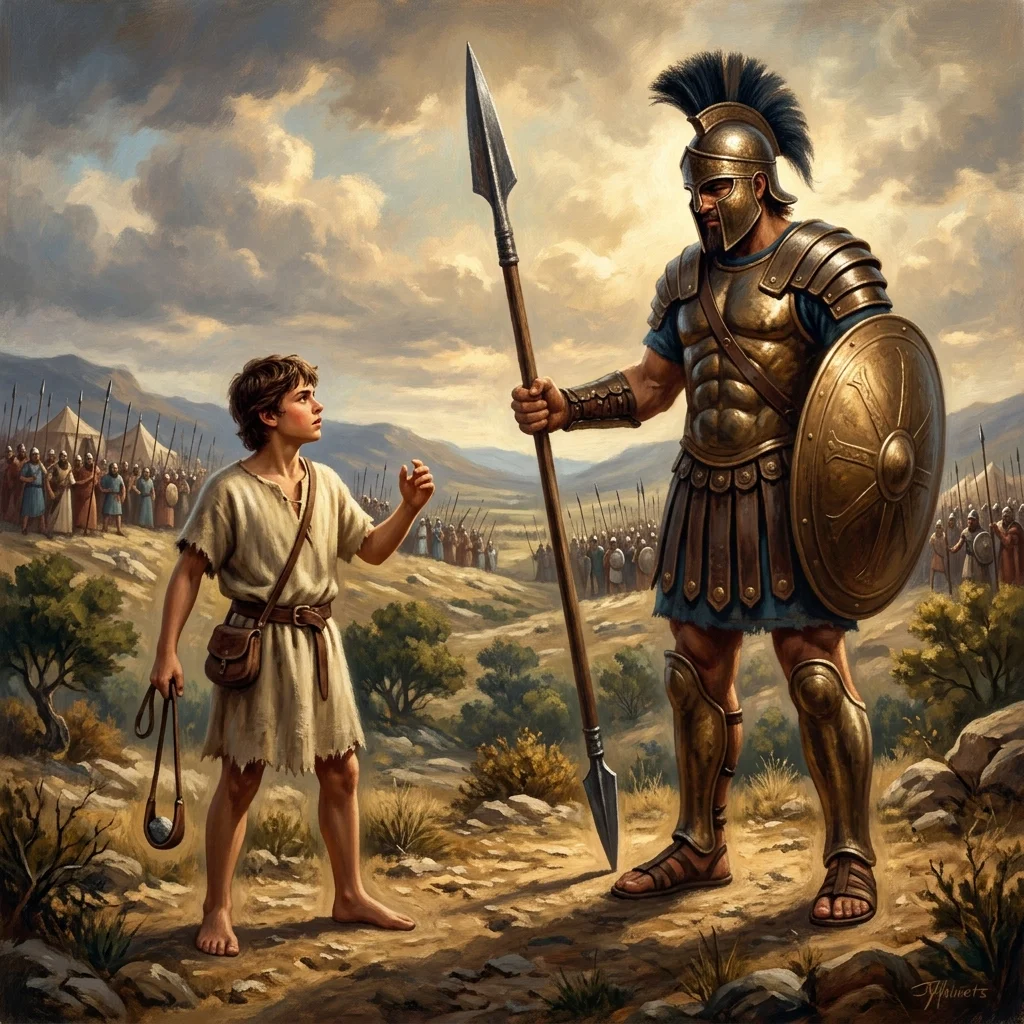
For forty agonizing days, a terrifying ritual paralyzed the armies of Israel. Twice each day, at dawn and at dusk, a colossal champion (*ish ha-benayim*—the intermediary warrior who stood between the lines) strode out from the Philistine camp into the valley floor. His name was Goliath of Gath. He was an intimidating physical behemoth: towering six cubits and a span (nearly ten feet tall), his presence defied human imagination. Goliath was encased from head to foot in gleaming defensive bronze: a massive bronze helmet adorned his head; a coat of scale armor (*shiryon qaskassim*) weighing five thousand shekels (approximately 125 pounds) encased his chest; bronze greaves shielded his shins; and a bronze scimitar hung across his broad shoulders. The heavy shaft of his spear was like a weaver's wooden beam, tipped with an iron spearhead weighing six hundred shekels (fifteen pounds); before him marched an armor-bearer carrying a body-length tower shield (*tzenah*).
Standing upon the rocky valley floor, Goliath roared his blasphemous challenge across the echoing canyon: "Why have you come out to line up for battle? Am I not a Philistine, and you the servants of Saul? Choose a man for yourselves, and let him come down to me! If he is able to fight with me and kill me, then we will be your servants. But if I prevail against him and kill him, then you shall be our servants and serve us!" Then the giant bellowed: "I defy the armies of Israel this day; give me a man, that we may fight together!" (1 Samuel 17:8-10). When Saul and all Israel heard the words of the Philistine, their hearts melted like wax; they were dismayed and greatly afraid, cowering inside their defensive fortifications.
Meanwhile, in the quiet pastures of Bethlehem twenty miles to the east, an elderly Ephrathite named Jesse had eight sons. The three eldest—Eliab, Abinadab, and Shammah—were serving in Saul's infantry at the front lines. But David, the youngest son, shuttled back and forth between tending his father's sheep in Bethlehem and serving periodically as a harpist to soothe Saul's tormented spirit. After forty days of stalemate, Jesse called young David: "Take now for your brothers an ephah of this dried grain and these ten loaves, and run to your brothers at the camp. And carry these ten cheeses to the captain of their thousand, and see how your brothers fare, and bring back news of them" (1 Samuel 17:17-18).
Rising early the next morning, David left the flock with a trusted keeper, loaded the provisions, and hurried toward the Valley of Elah. He reached the perimeter of the military camp (*ma'galah*) just as the Israelite army was shouting the war cry and marching out to the battle ranks. Leaving his supplies in the care of the baggage keeper, David sprinted to the front line to greet his brothers. As he was conversing with them, the terrifying champion Goliath strode out from the Philistine ranks and bellowed his usual daily defiance. As the giant's roar rolled across the rocks, the soldiers of Israel broke formation and fled in terror.
Listening to the men whispering about King Saul's lavish reward—great riches, the king's daughter in marriage, and total tax exemption for the victor's family—David's spirit burned with righteous fury. He turned to the soldiers beside him: "What shall be done for the man who kills this Philistine and takes away the reproach from Israel? For who is this uncircumcised Philistine, that he should defy the armies of the living God?" (1 Samuel 17:26). Hearing David's inquiry, his eldest brother Eliab exploded with condescending anger: "Why did you come down here? And with whom have you left those few sheep in the wilderness? I know your pride and the insolence of your heart, for you have come down to see the battle!" But David replied with calm resolve: "What have I done now? Is there not a cause?"
David's bold words quickly circulated through the camp until they reached King Saul, who summoned the boy. Standing before the distraught monarch, the teenage shepherd uttered astonishing words: "Let no man's heart fail because of him; your servant will go and fight with this Philistine!" Saul looked at the boy and sighed: "You are not able to go against this Philistine to fight with him; for you are a youth, and he a man of war from his youth."
Then David revealed the secret furnace in which his faith had been forged: "Your servant used to keep his father's sheep, and when a lion or a bear came and took a lamb out of the flock, I went out after it and struck it, and delivered the lamb from its mouth; and when it arose against me, I caught it by its beard, and struck and killed it. Your servant has killed both lion and bear; and this uncircumcised Philistine will be like one of them, seeing he has defied the armies of the living God!" David drove home the supreme theological truth: "Yahweh, who delivered me from the paw of the lion and from the paw of the bear, He will deliver me from the hand of this Philistine!" (1 Samuel 17:34-37). Convinced by his raw conviction, Saul said: "Go, and Yahweh be with you!"
Saul attempted to clothe David in his own royal armor: strapping a bronze helmet on his head and fastening his coat of mail. David buckled Saul's heavy sword over his garments and tried to walk, but he could not move freely. "I cannot walk with these," David told Saul, "for I have not tested them." So David took them off. Stripping away the heavy armor of human pride, David picked up his simple wooden shepherd's staff. He walked down into the dry brook at the bottom of the valley, chose five smooth limestone stones (*chalaqim*), put them into his shepherd's pouch, took his woven woolen sling (*qela*) in his hand, and stepped out into the open ground toward the giant.
When Goliath looked and saw David approaching, he disdained him with mocking laughter, for David was only a ruddy, handsome youth. "Am I a dog," the giant bellowed, "that you come to me with sticks?" And the Philistine cursed David by his gods, snarling: "Come to me, and I will give your flesh to the birds of the air and the beasts of the field!"
David did not flinch. His voice rang out across the valley with prophetic power: "You come to me with a sword, with a spear, and with a javelin. But I come to you in the name of Yahweh of Hosts, the God of the armies of Israel, whom you have defied! This day Yahweh will deliver you into my hand, and I will strike you and take your head from you; and this day I will give the carcasses of the camp of the Philistines to the birds of the air and the wild beasts of the earth, that all the earth may know that there is a God in Israel! Then all this assembly shall know that Yahweh does not save with sword and spear; for the battle is Yahweh's, and He will give you into our hands!" (1 Samuel 17:45-47).
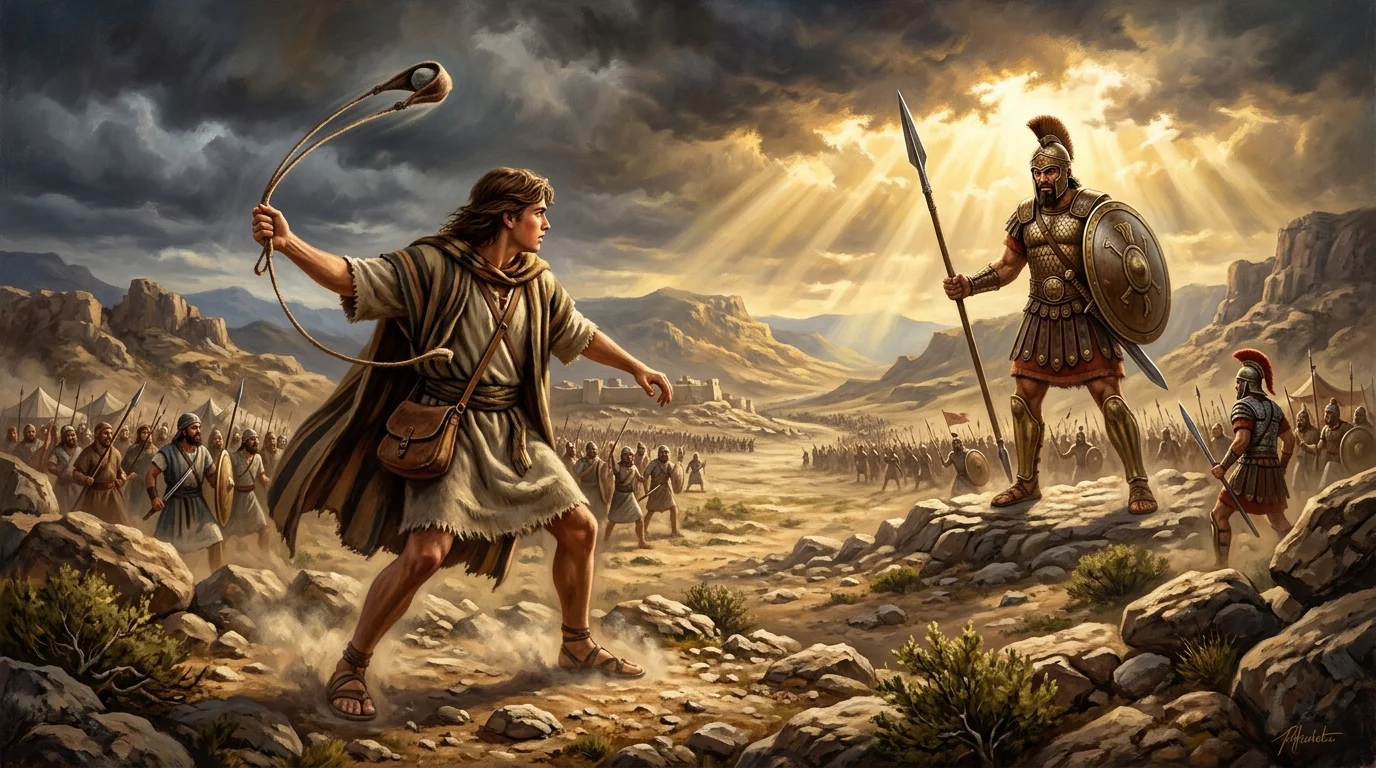
Enraged, the massive giant arose and lumbered forward to crush the boy. David did not wait; he ran quickly toward the battle line to meet the Philistine. Reaching his hand into his shepherd's bag, David drew out a single smooth stone. He fitted it into the leather pouch of his sling, whirled the cords overhead with blinding velocity, and released the stone. Propelled with supersonic ballistic force, the smooth limestone missile hissed through the air and struck Goliath directly in the forehead! The stone sank deep into the giant's skull, shattering the frontal bone. Instantly paralyzed, the towering champion toppled forward, crashing face-down onto the earth like a fallen cedar.
David sprinted forward and stood over the fallen behemoth. Because there was no sword in David's hand, he grabbed Goliath's massive hilt, drew the giant's own sword from its sheath, killed him, and severed his head in full view of both armies. When the Philistines saw that their invincible champion was dead, utter pandemonium erupted: the entire Philistine army broke ranks and fled in chaotic terror down the valley! The men of Israel and Judah arose with a thunderous war shout and pursued the fleeing enemies all the way along the road of Shaaraim to the gates of Gath and Ekron, slaughtering them in their flight.
David returned from the slaughter bearing the grisly head of Goliath. Saul watched the young hero in awe, turning to his general Abner: "Whose son is this youth?" When David approached the king holding the giant's head in his hand, Saul asked: "Whose son are you, young man?" David humbly replied: "I am the son of your servant Jesse the Bethlehemite." That day in the Valley of Elah, faith conquered intimidation, demonstrating forever that no giant can stand before the sovereign power of the living God!
Biblical Keywords & Theological Roots
Goliath; meaning 'Splendor' or 'Exile / Uncovered'. The Philistine champion (*ish ha-benayim* - man between the two ranks) from Gath who terrorized Israel.
A sling, woven sling of wool, cord, or leather. In ancient warfare, a lethal ballistic weapon capable of launching stones at devastating speed with pinpoint accuracy.
Smooth, polished, frictionless. Specifically the five water-smoothed limestone stones David selected from the dry bed of the brook (*nachal*) in the Valley of Elah.
Array, row, battle line, ranks of mobilized troops in formation. Referring to the armies of Israel which Goliath blasphemed, and which David defended in Yahweh's name.
Body armor, coat of mail, corselet of bronze scales. Goliath wore a coat of bronze scales weighing 5,000 shekels (approx 125 lbs) designed to repel arrows and spears.
Ancient Near Eastern & Archaeological Context
The epic confrontation of 1 Samuel 17 is situated in the Shephelah buffer zone during the late 11th century BC (circa 1025 BC). The Valley of Elah (Wadi es-Sunt, named after its abundant terebinth and acacia trees) served as the primary strategic corridor connecting the Philistine coastal plains (near Gath / Tell es-Safi) with the Judean highlands (leading directly to Bethlehem and Jerusalem). Excavations at Khirbet Qeiyafa, directed by Yosef Garfinkel and Saar Ganor, uncovered a heavily fortified early 10th-century Judean garrison city overlooking the exact battle site, complete with two gates (*Shaaraim*, confirming 1 Samuel 17:52), olive presses, and an ostracon inscribed in proto-Canaanite/Hebrew. Goliath's imposing armaments reflect the sophisticated bronze/iron metallurgy of the Aegean Sea Peoples: a bronze helmet (*kova nechoshet*), flexible scale armor (*shiryon qaskassim*) weighing approximately 125 pounds (5,000 shekels), bronze greaves (*mitchah*), a bronze scimitar (*kidon*), and an iron spearhead weighing over 15 pounds (600 shekels) carried behind a full-body shield-bearer (*noseh hatzenah*). David's weapon was not an improvised child's toy, but a lethal ancient Near Eastern slinger's weapon: a woven wool or leather pocket with cords capable of accelerating dense limestone river stones to velocities exceeding 100 miles per hour, striking with the kinetic energy of a modern handgun projectile.
Practical Discipleship & Spiritual Application
- Confront Intimidation with the Name of Yahweh: When spiritual giants of fear, sickness, addiction, or financial impossibility threaten your life, do not retreat into panic. Stand firmly upon the promises of Scripture and confess the all-powerful name of Jesus Christ: the battle belongs to the Lord!
- Never Neglect the Secret Place of Preparation: David's courage in the Valley of Elah was forged while faithfully killing the lion and the bear when nobody was watching. Faithfully shepherd the small responsibilities God has given you today; your hidden faithfulness is qualifying you for future divine promotion.
- Cast Off Borrowed Armor: Do not try to live out another person's calling, personality, or leadership style. God did not make you to fight in Saul's cumbersome armor; He has uniquely gifted you. Walk in authentic humility, utilizing the spiritual gifts the Holy Spirit has entrusted to you.
- Cut Off the Giant's Head Completely: David did not merely knock Goliath unconscious; he drew the giant's own sword and cut off his head, ensuring the threat would never rise again. When dealing with besetting sin in your life, show no mercy; make no provision for the flesh, but mortify it radically through the power of the Holy Spirit.
⚡ Fast Facts
- Goliath's height was described as 'six cubits and a span' (approx 9 feet 9 inches in the Masoretic Text), while the Dead Sea Scrolls (4QSamb) and Septuagint record 'four cubits and a span' (approx 6 feet 9 inches), still towering over ordinary soldiers.
- Goliath's iron spearhead weighed 600 shekels (approx 15 pounds / 6.8 kg), and his bronze scale coat weighed 5,000 shekels (approx 125 pounds / 57 kg) (1 Samuel 17:5, 7).
- David selected exactly five smooth stones from the dry wadi—traditionally understood because Goliath had four giant relatives in Gath (Ishbi-Benob, Saph, Lahmi, and a twelve-fingered giant, 2 Samuel 21:16-22).
- David cut off Goliath's head with the giant's own massive sword, later depositing the head in Jerusalem and storing the armor in his personal tent (1 Samuel 17:51, 54).
❓ Frequently Asked Questions (FAQs)
While skeptics sometimes suggest David feared missing with his first shot, ancient slinger mechanics and biblical history offer profound insights. First, an experienced ancient slinger always carried several stones in his shepherd's bag as standard ammunition for rapid reload during tactical skirmishing. Second, and most compellingly, Scripture reveals that Goliath was not an isolated anomaly; 2 Samuel 21:16-22 and 1 Chronicles 20:4-8 document that Goliath had four other giant sons or kinsmen in Gath: Ishbi-Benob, Saph (Sippai), Lahmi the brother of Goliath, and an unnamed six-fingered giant. David was not merely prepared to kill Goliath; with audacious covenant confidence, he was prepared to take on Goliath and all four of his giant brothers if they stepped forward to avenge him!
Ancient ballistics and anatomical mechanics explain this miraculous yet physically devastating strike. In ancient warfare, a slinger (*qala*) was not an amateur, but an elite artilleryman. Using a woven woolen or leather sling rotated overhead, a skilled slinger could propel dense limestone river stones (weighing 2 to 3 ounces) at speeds between 100 and 150 miles per hour. Kinetic energy calculations show that such a projectile strikes with force comparable to a modern .44 Magnum handgun bullet. Furthermore, ancient Aegean/Philistine helmets typically featured a nasal bar and cheek guards, leaving a critical triangular opening exposing the forehead and eyes. Guided by the sovereign hand of God, David's stone struck Goliath with pinpoint accuracy in the unprotected frontal bone of the forehead, fracturing the skull and driving bone fragments into the frontal lobe of his brain, knocking the giant unconscious and causing him to collapse face-down.
David's declaration reveals the foundational secret of biblical faith: past deliverances are collateral for present crises. While shepherding his father's flocks in the wilderness of Judea, David had encountered apex predators—the Syrian brown bear and Asiatic lion—which threatened his father's lambs. Rather than fleeing, David chased them down, struck them, and rescued the prey; when the beast turned on him, he grabbed it by its beard and killed it. David understood that it was not his youthful muscle that saved him, but Yahweh's covenant faithfulness. When confronted by Goliath, David did not see an invincible nine-foot warrior; he saw an 'uncircumcised Philistine' who was no different than the lion or the bear, because Goliath had dared to defy the armies of the living God.