For forty agonizing years, the dark, suffocating grip of Philistine domination paralyzed the land of Israel. Armed with advanced metallurgical iron weapons and an organized Aegean military machine, the five royal lords of the Philistine Pentapolis ruled the coastal plains and pushed deep into the Judean foothills. Israel was disarmed, subjugated, and demoralized. Yet even before this dark oppression began, the grace of God had already prepared a supernatural deliverer. To the barren wife of Manoah, a Danite from the rugged hill town of Zorah, the Angel of Yahweh appeared in blazing splendor, announcing the miraculous conception of a son. This child was to be consecrated under the strictest lifelong Nazirite vow (*Nazir*) from his mother's womb: no fermented wine or strong drink, no unclean food, and no razor was ever to touch his head. He was named Samson (*Shimshon*)—'little sun' or 'radiant champion'—for he was destined to begin the deliverance of Israel.
As the boy grew, the blessing of Yahweh rested upon him, and the Spirit of the Lord (*Ruach Yahweh*) began to stir him with supernatural energy in the camp of Dan, between Zorah and Eshtaol. Samson possessed a terrifying, unmatched physical endowment—not because he possessed gigantic bodybuilder muscles, but because the Holy Spirit would suddenly rush upon him in explosive power. Walking through the vineyards of Timnah, a roaring young lion charged at him from the thickets; without a spear or knife, Samson tore the beast apart with his bare hands as one would tear a young goat! Later, when three thousand frightened men of Judah bound him with two new ropes and handed him over to the Philistines at Lehi, the Spirit of Yahweh came mightily upon him; the ropes melted off his arms like charred flax. Seizing the fresh, heavy jawbone of a donkey from the dirt, Samson single-handedly slaughtered a thousand armored Philistine warriors, chanting in triumphant Hebrew verse: "With the jawbone of a donkey, heaps upon heaps, with the jawbone of a donkey I have slain a thousand men!" (Judges 15:16).
For twenty years, Samson judged Israel, standing as an invincible, terrifying one-man army against Philistine hegemony. When trapped inside the fortified Philistine metropolis of Gaza, surrounded by armed guards waiting to assassinate him at dawn, Samson arose at midnight, ripped the colossal bronze-plated city gates, posts, and heavy bar right out of the stone bedrock, hoisted them onto his shoulders, and carried them forty miles uphill to the summit overlooking Hebron! The Philistine empire was utterly helpless before his supernatural prowess.
Yet the mighty warrior who could conquer lions and shatter armies could not conquer his own undisciplined passions. Samson's fatal spiritual blind spot was his unchecked sensual vulnerability. In the fertile Valley of Sorek (*Nachal Sorek*)—the porous frontier where Danite vineyards met Philistine cities—Samson fell infatuated with a woman named Delilah. Seeing their golden opportunity, the five royal lords of the Philistines (*seranim*) secretly approached Delilah, offering an astronomical bribe: eleven hundred pieces of silver from each lord, totaling an unprecedented royal fortune of five thousand five hundred shekels of silver! Delilah became the lethal mercenary instrument of Samson's downfall.
With insidious seduction, Delilah began plying Samson with sweet, poisoned inquiries: "Please tell me where your great strength lies, and with what you may be bound to afflict you?" (Judges 16:6). Instead of fleeing the snare, Samson foolishly trifled with temptation, playing dangerous games on the edge of the abyss. Three times he deceived her: first claiming he could be subdued if bound with seven fresh, undried bowstrings; second, with brand new, unused ropes; and third, by weaving the seven long braided locks of his hair into the fabric of a weaver's loom and fastening it with a pin. Each time, as Philistine assassins waited in the inner chamber, Delilah shrieked: "The Philistines are upon you, Samson!" And each time, Samson snapped the bindings like threads, mocking her treachery.
Yet Delilah was relentless. Day after day, she pressed him with tears, emotional guilt, and manipulative affection: "How can you say, 'I love you,' when your heart is not with me? You have mocked me these three times, and have not told me where your great strength lies!" (Judges 16:15). Scripture records the tragic psychological weariness that broke the champion's soul: "And it came to pass, when she pestered him daily with her words and pressed him, so that his soul was vexed to death, that he told her all his heart!"
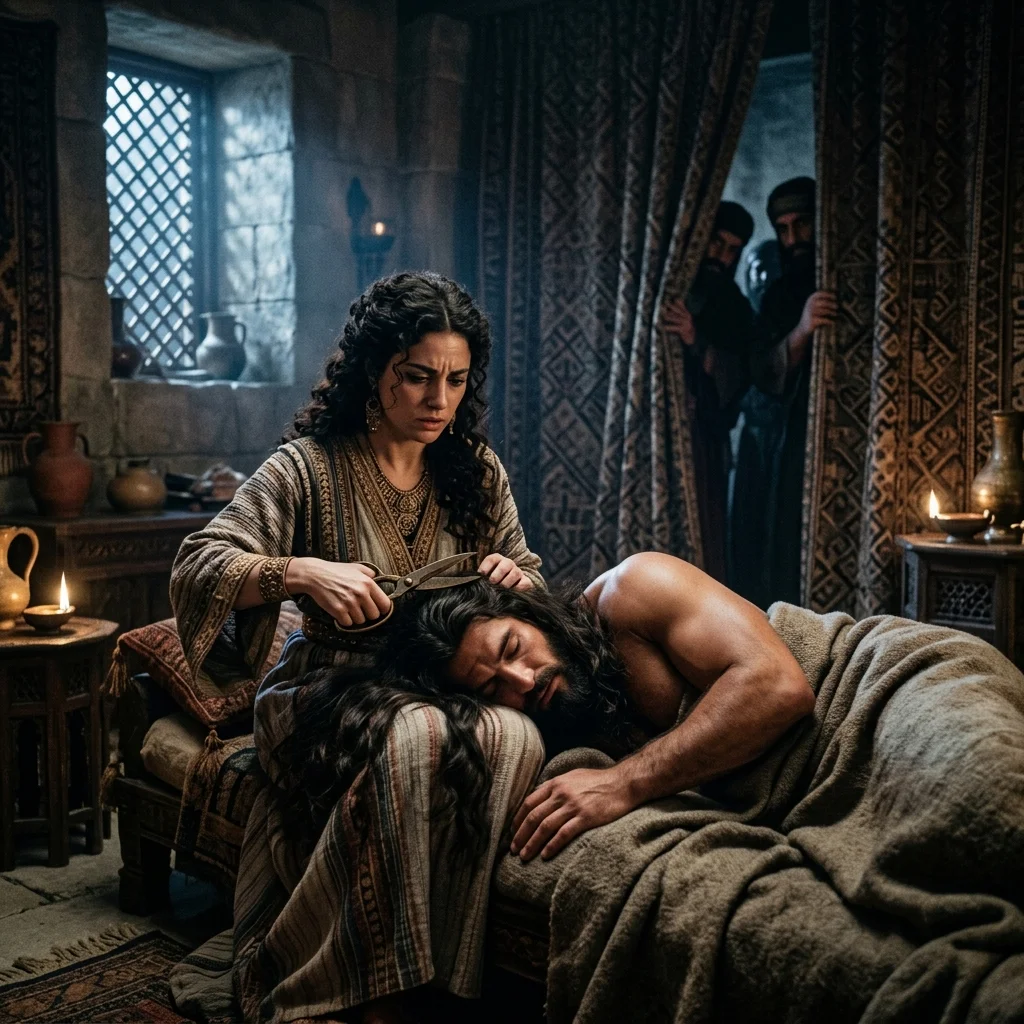
Looking into her deceptive eyes, Samson surrendered the sacred sanctuary of his covenant calling: "No razor has ever come upon my head, for I have been a Nazirite to God from my mother's womb. If I am shaven, then my strength will leave me, and I shall become weak, and be like any other man" (Judges 16:17). Recognizing that he had finally unveiled the innermost secret of his soul, Delilah summoned the Philistine lords with the silver in their hands. Lulling Samson to sleep with his head resting upon her lap, she signaled a barber, who silently shaved away the seven sacred locks of his consecration. Then she cried out: "The Philistines are upon you, Samson!"
Samson awakened from his slumber, shaking himself and saying, "I will go out as before, at other times, and shake myself free!" But he uttered those words in catastrophic spiritual delusion: "He did not know that Yahweh had departed from him!" (Judges 16:20). The power had never been in the dead protein of his hair; it was in the living presence of Yahweh, which he had so casually cast into the lap of a pagan harlot. The Philistine warriors seized him; with savage cruelty, they gouged out his eyes, dragged him in chains down to Gaza, bound him with heavy bronze fetters (*nechushtayim*), and forced the former judge of Israel to turn the heavy stone mill (*tochen*) like an ox in the dark dungeon.
Yet in the subterranean misery of Gaza's dungeon, while the blind giant wept in bitter repentance and turned the grinding stone, God was not finished. Scripture records one of the most sublime sentences of restorative grace in the entire Bible: "However, the hair of his head began to grow again (*tzemach*) after it had been shaved!" (Judges 16:22). As the dark strands grew, Samson's heart returned to the covenant God of his fathers. His physical eyesight was gone forever, but his spiritual vision was clearer than it had ever been in his days of pride.
Months later, the five Philistine lords declared a massive national festival in Gaza to celebrate their greatest victory. Thousands of Philistines packed the colossal multi-tiered temple of Dagon, their fish-grain agricultural deity. Sacrificing hundreds of animals and drinking heavily, the drunken lords cried out: "Our god has delivered into our hands our enemy Samson, the destroyer of our land, who multiplied our dead!" As the revelry peaked, they demanded: "Call for Samson, that he may perform for us!"
Brought up from the foul dungeon, the blind, scarred giant was led by a young boy into the roaring, amphitheater-like sanctuary. Over three thousand Philistine lords, princes, military officers, and women crowded the roof and balconies, heaping vulgar mockeries, spitting, and hurling debris at the fallen champion of Yahweh. Samson endured the humiliation in solemn, focused silence. Turning to the young lad holding his hand, he whispered: "Let me feel the pillars which support the temple, so that I may lean against them."
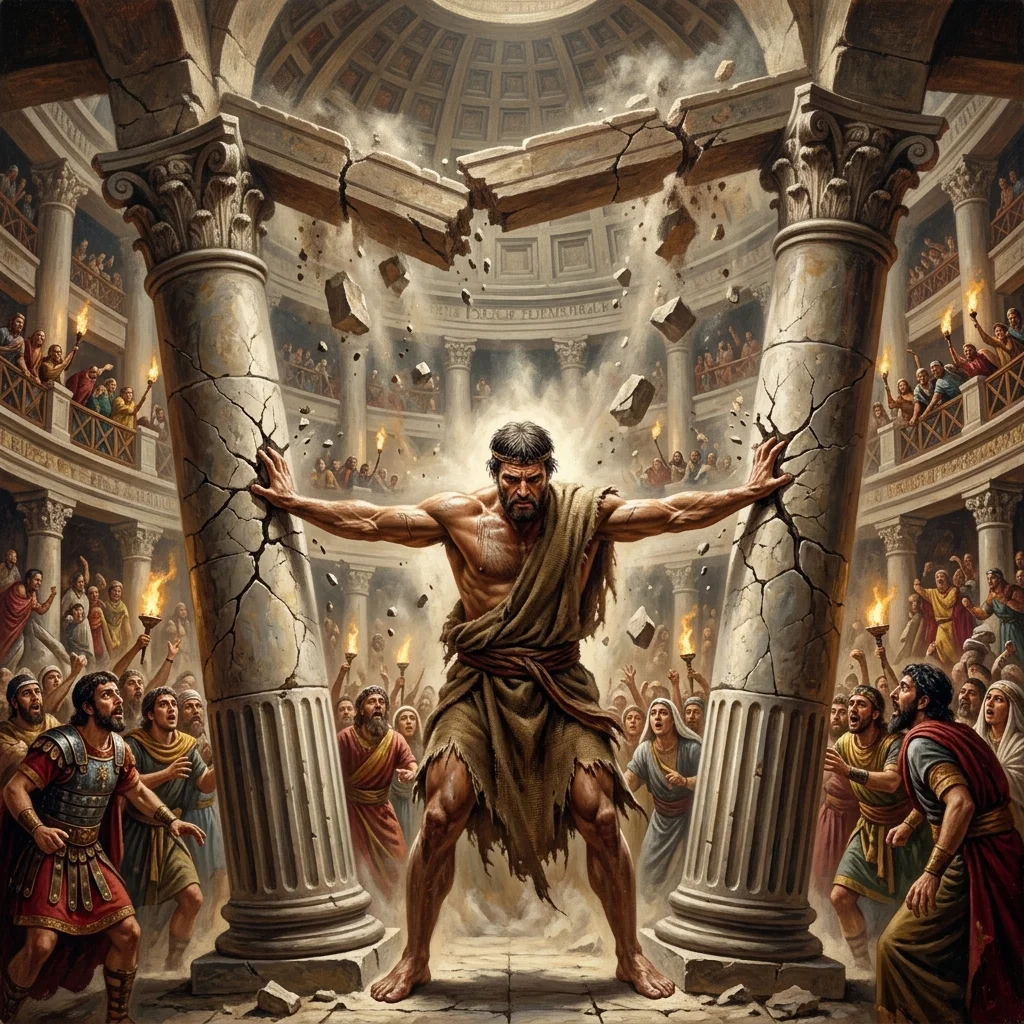
The boy guided Samson's scarred hands to the two central load-bearing cedar pillars (*ammudim*) that held up the entire superstructure of the temple. Standing between them, Samson stretched out his massive arms, bracing his right hand against one column and his left against the other. In that sacred, final heartbeat of his life, the former champion did not boast in his own strength. Bowing his head, he poured out his soul in desperate, intercessory faith: "O Lord Yahweh, remember me, I pray! Strengthen me, I pray, just this once, O God, that I may with one blow take vengeance on the Philistines for my two eyes!" (Judges 16:28).
The Spirit of Yahweh answered from heaven! The same supernatural surge that had torn the lion and broken the ropes rushed through Samson's veins with apocalyptic intensity. Crying out with his final breath, "Let me die with the Philistines!", Samson bowed with all his divine might! He pushed the two cedar pillars with irresistible force. The round stone plinths cracked; the pillars buckled and sheared away from the foundation. With a deafening, catastrophic roar that shook all Gaza, the massive roof, stone balconies, and thousands of spectators collapsed inward into a terrifying mountain of rubble!
In that single, sacrificial act of dying faith, Samson destroyed the entire political, military, and religious leadership of the Philistine empire. Scripture records the breathtaking epitaph: "So the dead that he killed at his death were more than he had killed in his life" (Judges 16:30). His brothers and all his father's household came down, carried his body out of the ruins, and buried him with profound honor between Zorah and Eshtaol in the tomb of his father Manoah. Samson's life stands as a sobering warning of the peril of compromise, but an eternal monument to the triumph of grace: in brokenness, surrender, and sacrificial faith, God turns our deepest failures into glorious redemptive victory!
Biblical Keywords & Theological Roots
Consecrated, separated, dedicated under a holy vow. A devotee set apart unto Yahweh by strict abstinences: no wine/grape products, no corpse contact, and no razor upon the head.
Samson; derived from 'shemesh' (sun) with the diminutive/intensive suffix '-on', meaning 'Sun-like, little sun, radiant champion'. Foretelling his brilliant but tragic blazing trajectory.
To sprout, spring up, grow, bud forth. Used in Judges 16:22 of Samson's hair regrowing in the dark dungeon, serving as an agricultural metaphor for resurrected covenant grace.
Pillars, upright architectural support columns. Specifically the two central load-bearing cedar pillars of Dagon's temple in Gaza that Samson dislodged through supernatural strength.
Vengeance, retributive justice, divine vindication. Samson's final prayer requested divine vindication against the Philistines for blaspheming Yahweh and gouging out his eyes.
Ancient Near Eastern & Archaeological Context
The historical and archaeological setting of Samson's narrative in Judges 13–16 reflects the acute border friction of the Early Iron Age (circa 1150–1075 BC) between the Shephelah (the Judean/Danite foothills around Zorah and Eshtaol) and the coastal Philistine Pentapolis (Gaza, Ashkelon, Ashdod, Ekron, and Gath). The Philistines, Aegean Sea Peoples arriving in the Levant around 1175 BC, exercised strict technological, political, and metallurgical hegemony over Israel (1 Samuel 13:19-20). The Valley of Sorek (*Nachal Sorek*), where Delilah resided, served as the porous border frontier where Hebrew agrarian settlements intersected with sophisticated Philistine urban centers. The bribe offered to Delilah—eleven hundred pieces of silver from each of the five Philistine lords, totaling an astronomical 5,500 shekels of silver—represented a staggering royal fortune (an average laborer earned about ten shekels a year), underscoring the existential desperation of the Philistine hegemony to eliminate Samson. Furthermore, archaeological excavations at Philistine sites like Tel Qasile (excavated by Amihai Mazar) and Tel Miqne/Ekron (Trude Dothan) have unearthed ancient Philistine temples featuring architectural floor plans identical to the narrative: two central cedar-wood columns resting closely together upon rounded stone bases, precisely separated by roughly six to seven feet, supporting a massive wooden portico and roof that could collapse if the central columns were violently dislodged.
Practical Discipleship & Spiritual Application
- Guard the Secret of Your Spiritual Anointing: Samson treated his holy consecration casually, playing games with temptation until he was stripped of his strength. Guard your personal devotion, prayer life, and biblical boundaries with vigilant tenacity; do not flirt with compromise.
- Recognize the Deceptive Slippery Slope of Sin: Samson did not lose his eyes and freedom in one sudden catastrophe; it was the culmination of unrepentant, repeated steps of compromise (Timnah, Gaza's harlot, Sorek). Stop compromise at the first whisper before it binds and blinds you.
- Take Heart When Suffering the Pain of Failure: If past moral failure or backsliding has left you grinding in the prison of regret, remember that 'the hair began to grow again.' Turn to God with brokenhearted humility; His redeeming blood can restore and use you for His glory.
- Finish Strong by Surrendering Self-Will: Samson's greatest victory occurred when he finally ceased relying on his own physical prowess and cried out to Yahweh with unconditional surrender: 'Remember me, O Lord God, strengthen me just this once!' True spiritual power is perfected in weakness.
⚡ Fast Facts
- Samson judged Israel for twenty years during the height of the Philistine oppression (Judges 15:20; 16:31).
- The five Philistine lords offered Delilah 1,100 pieces of silver each, totaling 5,500 pieces of silver—an exorbitant royal fortune equal to centuries of wages.
- Three times Delilah attempted to bind Samson: with seven fresh bowstrings, new unused ropes, and weaving his seven locks into a loom, before he finally revealed his secret.
- More Philistines were slain by Samson in his sacrificial death at the temple of Dagon (over 3,000 rulers, nobles, and civilians) than he had killed during his entire lifetime (Judges 16:30).
❓ Frequently Asked Questions (FAQs)
Samson's inclusion in Hebrews 11:32 among Gideon, Barak, David, and Samuel often puzzles readers due to his blatant sensual impulsiveness and moral compromises. However, the author of Hebrews does not canonize Samson's character flaws, but honors his foundational, desperate faith in Yahweh as the sole source of deliverance. Throughout his life, Samson recognized that his supernatural power was not biological, but a spiritual endowment from the Spirit of the Lord. In his final moments in Gaza—blinded, humiliated, and stripped of human pride—Samson exhibited pure, unadulterated faith. He turned away from self-reliance, acknowledged his utter helplessness, and trusted entirely in Yahweh's mercy and power to vindicate God's holy name against the blasphemous cult of Dagon.
Excavations at Philistine cultic sites, most notably Tel Qasile in modern Tel Aviv (excavated by archaeologist Amihai Mazar) and Tel Miqne (biblical Ekron), have revealed the exact architectural blueprint described in Judges 16:26-30. Unlike typical Canaanite or Egyptian temples with vast rows of masonry pillars, Philistine temples featured a distinctive open-air sanctuary hall supported by two central load-bearing wooden columns made of massive cedar logs. These two pillars rested upon circular stone pillar plinths sunk into the earth and were positioned remarkably close together—approximately six to seven feet apart—so that a tall, broad-shouldered man could easily reach out his hands and touch both simultaneously. The entire wooden roof structure, supporting thousands of spectators, relied upon these two central fulcrums; pushing them off their stone bases would inevitably collapse the entire superstructure.
Samson's death was not despairing self-murder (suicide), but a heroic, sacrificial act of war in the line of duty as Israel's judge. Under Mosaic law and biblical theology, suicide is the self-centered termination of life in hopelessness. In contrast, Samson offered his life as a targeted military operation to eradicate the ruling echelon of Israel's oppressors who were actively mocking the living God. His cry, 'Let me die with the Philistines!' was an acknowledgement that eliminating the enemy lords gathered upon the roof would cost him his own physical life, exactly like a soldier throwing himself upon a live grenade to neutralize the enemy and save his nation. God authenticated his petition by supernaturally infusing him with divine strength one last time, honoring his sacrificial death to achieve national deliverance.