For seven agonizing years, the land of Israel groaned beneath an inescapable plague of devastation. Because the children of Israel had once again forsaken Yahweh to embrace the local Canaanite Baals, the Lord delivered them into the merciless hand of Midian. Every spring during harvest season, when the wheat and barley ripened across the fertile expanse of the Jezreel Valley, the horizon blackened with an unprecedented nightmare: the combined hordes of the Midianites, the Amalekites, and the nomadic tribes of the East crossed the Jordan like a relentless swarm of locusts. Mounted upon tens of thousands of domesticated dromedary camels—the terrifying new mechanized cavalry of the desert—they pitched their black goat-hair tents across the valleys, stripping fields bare, slaughtering sheep, cattle, and donkeys, and leaving Israel in utter famine as far south as Gaza. Paralyzed with fear, the impoverished Hebrews fled their villages, huddling in damp mountain ravines, inaccessible caves, and craggy fortresses.
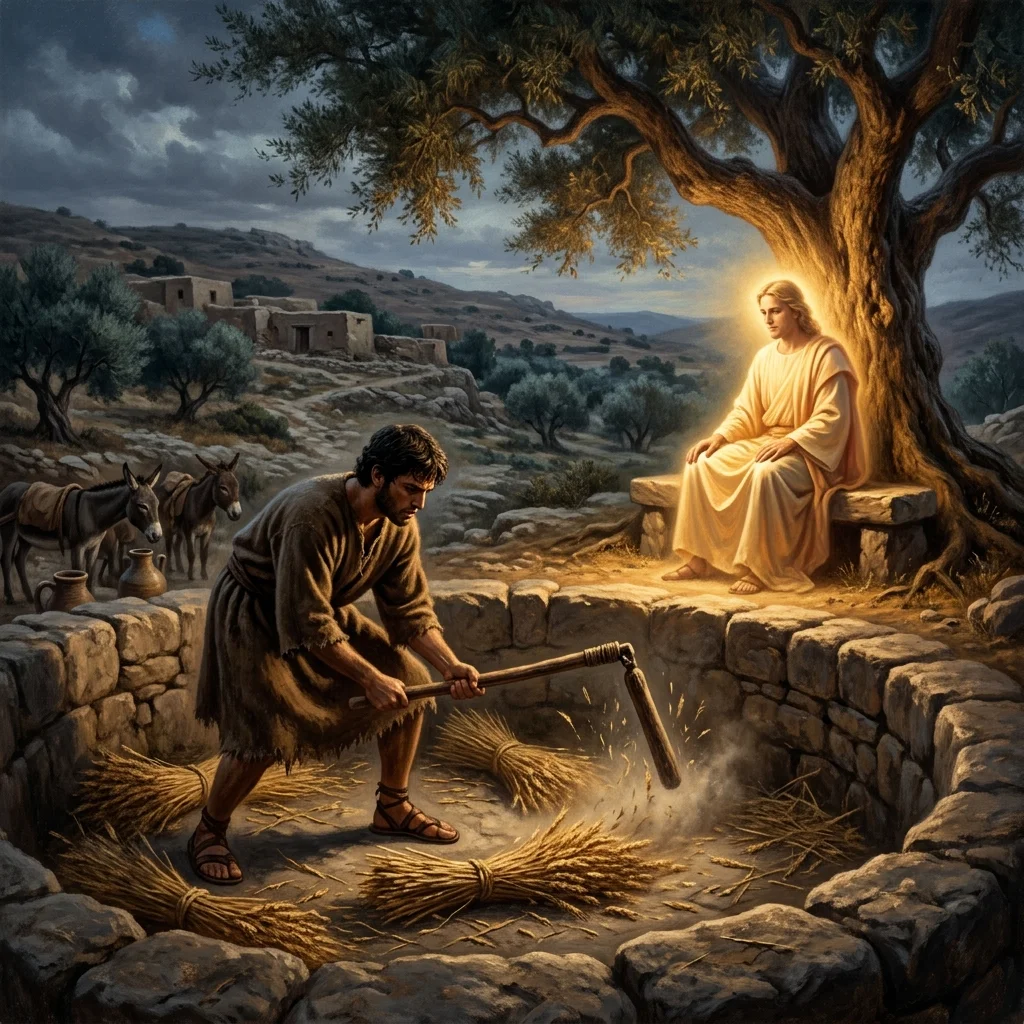
Deep inside a subterranean rock-hewn winepress (*gath*) beneath the ancient terebinth oak at Ophrah, a young farmer named Gideon, son of Joash the Abiezrite, was desperately beating out a small sheaf of wheat with a wooden flail. In ordinary times, threshing was conducted upon an elevated, wind-swept hilltop threshing floor (*goren*), where the evening breeze could separate the flying chaff from the golden grain. But in those days of terror, working in the open was a death sentence; the dust of a threshing floor would instantly summon swarms of camel-raiders. Hidden within the sunken pit of the winepress, drenched in sweat and suffocating beneath the airborne chaff, Gideon's heart burned with bitter confusion.
Suddenly, Gideon looked up to find a mysterious traveler seated beneath the oak. In a voice resonant with majestic peace, the Angel of Yahweh spoke: "Yahweh is with you, you mighty man of valor (gibbor ha-chayil)!" (Judges 6:12). Gideon blurted out the raw, unvarnished agony of his soul: "O my Lord, if Yahweh is with us, why then has all this happened to us? And where are all His miracles which our fathers told us about, saying, 'Did not Yahweh bring us up from Egypt?' But now Yahweh has forsaken us and delivered us into the hands of the Midianites!" (Judges 6:13).
Yahweh did not rebuke Gideon's honest anguish; instead, He turned to him with sovereign authority: "Go in this might of yours, and you shall save Israel from the hand of the Midianites! Have I not sent you?" Gideon recoiled, protesting his utter insignificance: his clan was the weakest in the tribe of Manasseh, and he was the least in his father's house. But God replied with the definitive promise that anchors every divine mission: "Surely I will be with you, and you shall defeat the Midianites as one man!" (Judges 6:16). When Gideon prepared an offering of young goat meat and unleavened cakes upon a rock, the Angel touched it with the tip of his staff; fire supernaturally erupted from the granite, consuming the sacrifice, and the Angel vanished from sight. Shaken to his core, Gideon erected an altar, naming it *Yahweh-Shalom*—The Lord is Peace.
That very night, God issued Gideon his premier battlefield commission—and it began not on the frontiers of Canaan, but in his own backyard: "Tear down the altar of Baal that your father has, and cut down the wooden Asherah pole that is beside it; and build an altar to Yahweh your God on top of this rock!" (Judges 6:25-26). Fearing his family and the townspeople by day, Gideon took ten servants under cover of midnight darkness, felled the pagan timber, demolished the stone altar of Baal, and offered a seven-year-old bull upon the new altar of Yahweh. When the furious citizens awakened and demanded Gideon's execution, his father Joash wisely retorted: "Will you plead for Baal? If he is a god, let him plead for himself, because someone has torn down his altar!" Thus Gideon was renamed *Jerubbaal*—'Let Baal plead against him.'
Soon, the seasonal crisis arrived. A coalition of one hundred and thirty-five thousand Midianites, Amalekites, and desert tribes crossed the Jordan and camped in the Valley of Jezreel near the Hill of Moreh. Clothed by the Spirit of Yahweh (*Ruach Yahweh*), Gideon sounded the ram's horn (*shofar*). Thirty-two thousand Hebrew volunteers from Manasseh, Asher, Zebulun, and Naphtali rallied to his banner. Yet Gideon's heart trembled before the sheer magnitude of the host. Seeking absolute assurance, he laid a fleece of wool (*gizath ha-tsemer*) upon the threshing floor: the first morning, the fleece was saturated with dew while the surrounding soil remained bone-dry; the second morning, by divine inversion, the fleece remained dry while the earth was soaked with dew. God had spoken.
Marching his thirty-two thousand men to the Spring of Harod (*Ein Jalod*) at the northern base of Mount Gilboa, Gideon prepared for battle. But Yahweh stunned his commander with a radical counter-strategy: "The people who are with you are too many for Me to give the Midianites into their hands, lest Israel claim glory for itself against Me, saying, 'My own hand has saved me!' Proclaim in the hearing of the people: 'Whoever is fearful and afraid, let him turn and depart!'" (Judges 7:2-3). To Gideon's dismay, twenty-two thousand men turned and walked away! Only ten thousand remained.
Then Yahweh said: "The people are still too many! Bring them down to the water, and I will test them for you there." At the spring, God observed how the men drank. Nine thousand seven hundred soldiers carelessly dropped their weapons, fell to their knees, and plunged their faces directly into the water. But three hundred men remained upright on one knee, cupping water in their hands and lapping it like a vigilant dog, their eyes scanning the hills and weapons in hand. Yahweh declared: "By the three hundred men who lapped I will save you, and deliver the Midianites into your hand. Let all the other people go!" (Judges 7:7). Human calculation was reduced to utter foolishness: three hundred lightly armed infantry against one hundred and thirty-five thousand desert warriors!
That night, God commanded Gideon to sneak down to the perimeter of the enemy encampment with his servant Purah. In the shadow of a tent, Gideon overheard a Midianite soldier recounting a nightmare: a round loaf of coarse barley bread (*tselil lechem se'orim*) had tumbled into the camp, striking a royal pavilion and collapsing it flat. His companion answered in terror: "This is nothing else but the sword of Gideon son of Joash! Into his hand God has delivered Midian and the whole camp!" Overwhelmed with worship, Gideon bowed upon the desert sand, slipped back to his lines, and shouted to his men: "Arise, for Yahweh has delivered the camp of Midian into your hand!"
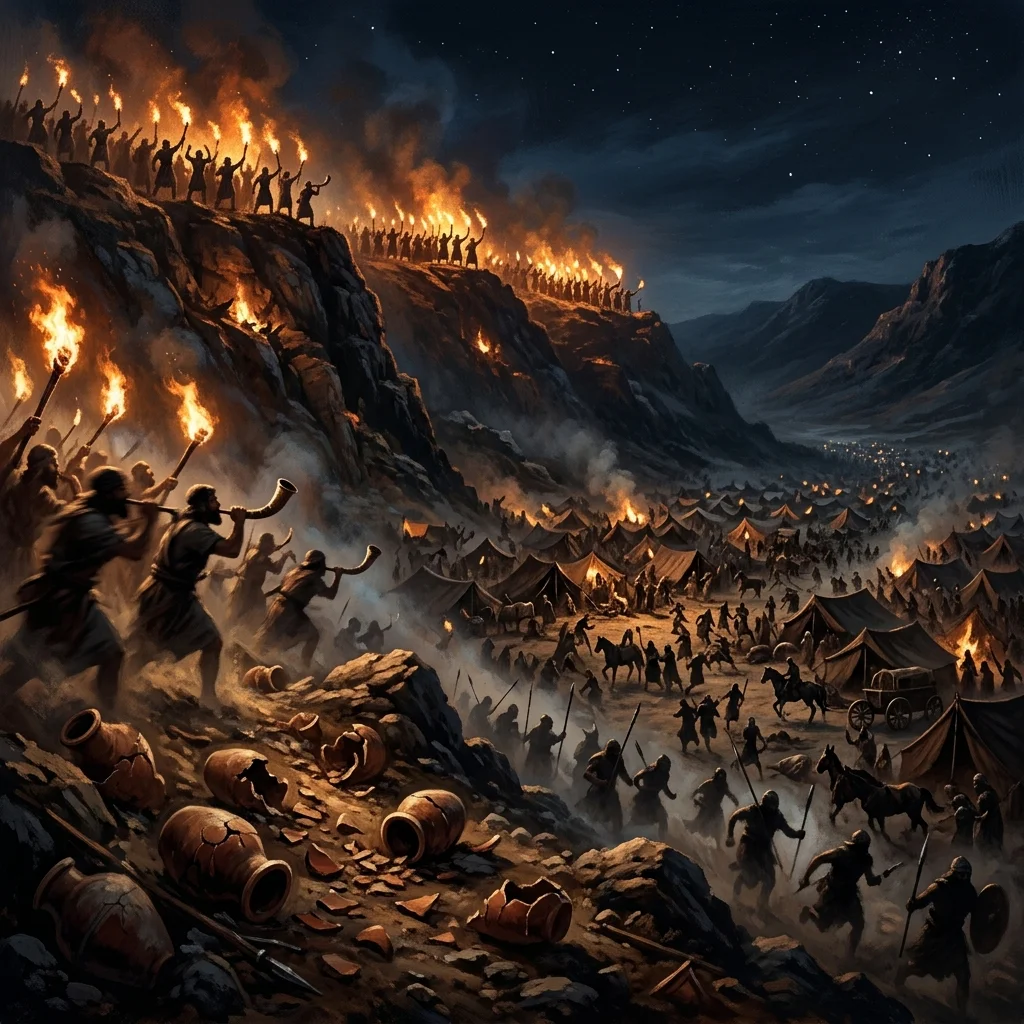
Gideon divided the three hundred into three companies of one hundred. He placed three weapons in every man's hands—weapons that defied all human military logic: a ram's horn (*shofar*), an empty clay pitcher (*kad*), and a burning torch (*lappid*) hidden inside the pitcher. Under cover of the middle watch, around ten o'clock at night, the three companies crept silently along the ridges, completely encircling the vast, sleeping Midianite camp sprawling in the valley floor.
At Gideon's signal, the silence of the desert was shattered by an explosion of sound and light! Three hundred men blew their ram's horns in deafening unison; three hundred clay jars were smashed to pieces with a concussive roar, and three hundred blazing torches burst into the black night sky! Holding their flaming torches aloft in their left hands and their shofars in their right, the warriors shouted with all their might: "The sword of Yahweh and of Gideon (Cherev l'Yahweh ul'Gideon)!"
The psychological shock was catastrophic. Awakened from deep sleep by shattering pottery, blazing fire on every surrounding ridge, and three hundred trumpets echoing like an army of hundreds of thousands, sheer pandemonium seized the Midianite encampment! In the pitch darkness and blinding smoke, the terrified nomads turned their swords against their own comrades, slaughtering one another in wild frenzy! Tens of thousands perished in the panic, while the surviving remnants fled eastward toward the Jordan. Gideon summoned the men of Ephraim to seize the Jordan fords, capturing the Midianite princes Oreb and Zeeb, and pursuing the kings Zebah and Zalmunna to final destruction.
Through three hundred broken vessels and the breath of a ram's horn, Yahweh broke the seven-year yoke of Midianite terror. Gideon's victory stands as an eternal monument of redemptive truth: God does not deliver by numbers, technology, or human might. When His people surrender their fears, allow their self-sufficiency to be shattered like clay, and hold forth the blazing light of His presence, heaven unleashes irresistible victory!
Biblical Keywords & Theological Roots
Mighty warrior of valor, champion of strength and virtue. Spoken by the Angel of Yahweh to Gideon to impute divine strength contrary to Gideon's outward fear.
Winepress; a rock-hewn vat used for treading grapes. Gideon used this subterranean basin to secretly beat out wheat away from the sight of Midianite raiders.
Fleece of wool; freshly shorn wool laid upon the threshing floor as a double miraculous test of morning dew, confirming God's covenant commissioning.
Pitchers and torches; earthen clay jars concealing burning wooden resin torches, shattered simultaneously to create sudden psychological and visual panic.
The sword of Yahweh and of Gideon! The electrifying battle cry shouted by the 300 warriors, invoking Yahweh's heavenly warfare alongside human obedience.
Ancient Near Eastern & Archaeological Context
The historical backdrop of Judges 6–8 corresponds to the Early Iron Age (circa 1175–1100 BC), marked by the catastrophic advent of large-scale nomadic camel pastoralism in the Ancient Near East. For the first time in military history, Bedouin confederacies of Midianites, Amalekites, and 'sons of the East' (*Benei Qedem*) utilized newly domesticated dromedary camels (*gemallim*) as long-range desert cavalry. Swarming across the Jordan Rift Valley during harvest seasons, they operated ruthless scorched-earth *razzia* raids, penetrating westward as far as Gaza. Archaeological surveys in the Jezreel Valley confirm massive disruption of sedentary agricultural settlements during this era, forcing Hebrews into mountain ravines and defensible caves. Gideon threshing wheat inside a sunken rock-cut winepress (*gath*) at Ophrah—rather than upon a breezy, elevated hilltop threshing floor (*goren*)—vividly reflects this suffocating economic terror, as an open threshing floor would instantly attract camel marauders. The Spring of Harod (*Ein Jalod*), bursting from a cave beneath the northern precipice of Mount Gilboa, provided the precise tactical staging ground for testing troop alertness in full view of the Midianite encampment sprawling across the Hill of Moreh.
Practical Discipleship & Spiritual Application
- Embrace Your Identity in God's Eyes: Do not define your calling by your background, financial limitations, or feelings of inadequacy. When God looks at you in Christ, He sees a victorious overcomer equipped for His kingdom purposes.
- Tear Down Personal and Domestic Idols: Public victory requires private integrity. Identify any cultural compromises, hidden addictions, or false securities in your household and courageously dismantle them before stepping into spiritual warfare.
- Trust God When Resources Are Subtracted: When doors close, finances tighten, or human support walks away, do not panic. God frequently subtracts human crutches to demonstrate that your breakthrough is orchestrated entirely by His sovereign grace.
- Allow the Earthen Vessel to Be Broken: The radiant light of Christ cannot shine through an unbroken, self-sufficient ego. Surrender your pride and self-reliance, allowing God to break the outer shell so His resurrection power can illuminate a dark world.
⚡ Fast Facts
- Gideon was from the poorest clan in the tribe of Manasseh, and he was the least in his father's house (Judges 6:15).
- The Midianite, Amalekite, and Eastern coalition was described as 'numerous as locusts,' with camels without number like the sand on the seashore (Judges 7:12).
- At the Spring of Harod, twenty-two thousand men returned home because of fear, and ninety-seven hundred were dismissed for kneeling carelessly to drink, leaving only three hundred (Judges 7:3-7).
- Gideon's army of three hundred men defeated a combined enemy host of one hundred and thirty-five thousand warriors without drawing a single sword inside the camp (Judges 8:10).
❓ Frequently Asked Questions (FAQs)
The water test at the Spring of Harod served a profound dual purpose: tactical alertness and theological dependence. The vast majority of the soldiers (9,700 men) threw themselves carelessly upon their knees, burying their faces directly into the spring water to quench their thirst. In doing so, they cast aside their weapons, lowered their eyes, and left themselves completely vulnerable to a surprise cavalry assault from the Hill of Moreh. In stark contrast, the three hundred men remained standing or kneeling on one knee, cupping the water with their hands and lapping it like a dog while keeping their heads erect, eyes scanning the horizon, and weapons ready. Tactically, they demonstrated disciplined situational awareness. Theologically, reducing the force from 32,000 to 300 eliminated any possibility of human self-glorification, proving that victory belongs entirely to Yahweh.
On the eve of battle, God sent Gideon down to eavesdrop on the Midianite camp, where an enemy sentry was recounting a bizarre nightmare: a humble round loaf of barley bread (*tselil lechem se'orim*) came tumbling down from the mountains into the camp, striking a royal tent with such violent force that it collapsed completely flat! In the Ancient Near East, wheat was the prized grain of wealthy landowners, whereas coarse barley was the staple food of impoverished peasants and animal fodder. The rolling barley loaf was an unmistakable prophetic symbol of Gideon's destitute, agricultural Hebrew force—underestimated, humble, and poor—crushing the luxurious nomadic tents of the haughty desert kings. The sentry's instantaneous interpretation ('This is nothing else but the sword of Gideon son of Joash!') proved that God had already placed supernatural terror and demoralization into the hearts of the enemy.
Gideon's fleece test (Judges 6:36-40) is frequently cited as a template for discernment, yet Scripture portrays it not as a spiritual ideal, but as an example of gracious condescension toward weak, struggling faith. God had already spoken directly to Gideon through the Angel of Yahweh and provided supernatural fire from the rock. Gideon did not lack divine revelation; he lacked emotional confidence to execute it. In His boundless mercy, God accommodated Gideon's hesitation by altering the natural laws of dew twice. In the New Covenant era, believers are not instructed to 'put out fleeces' or demand arbitrary physical omens. Instead, we are indwelt by the Holy Spirit, equipped with the completed, inspired Word of God (2 Timothy 3:16-17), and guided by prayer, pastoral wisdom, and spiritual discernment rather than conditional signs.