During the dark, tumultuous era when the judges ruled in Israel—a lawless epoch marked by cycles of idolatry, foreign oppression, and spiritual decay when every man did what was right in his own eyes—a devastating famine struck the central hill country of Judah. The fertile terraces of Bethlehem, whose very name meant the 'House of Bread' (*Beit-Lechem*), dried up into cracked, barren dust. Desperate to survive, an Ephrathite man of noble lineage named Elimelech made a fateful decision: he took his wife Naomi and their two sickly sons, Mahlon ('Pining') and Chilion ('Failing'), and departed from the covenant land of promise to sojourn in the pagan plains of Moab across the Jordan Rift Valley.
The sojourn proved catastrophic. In Moab, Elimelech died, leaving Naomi alone with her two sons. The young men subsequently violated ancient cultural boundaries by marrying Moabite women—one named Orpah, the other named Ruth. Ten silent, sorrowful years passed beneath the foreign skies of Moab, yet the unions produced no children. Then, tragedy struck again: both Mahlon and Chilion died, leaving three destitute, childless widows in an unforgiving ancient world where widowhood without male protection meant destitution, starvation, or enslavement.
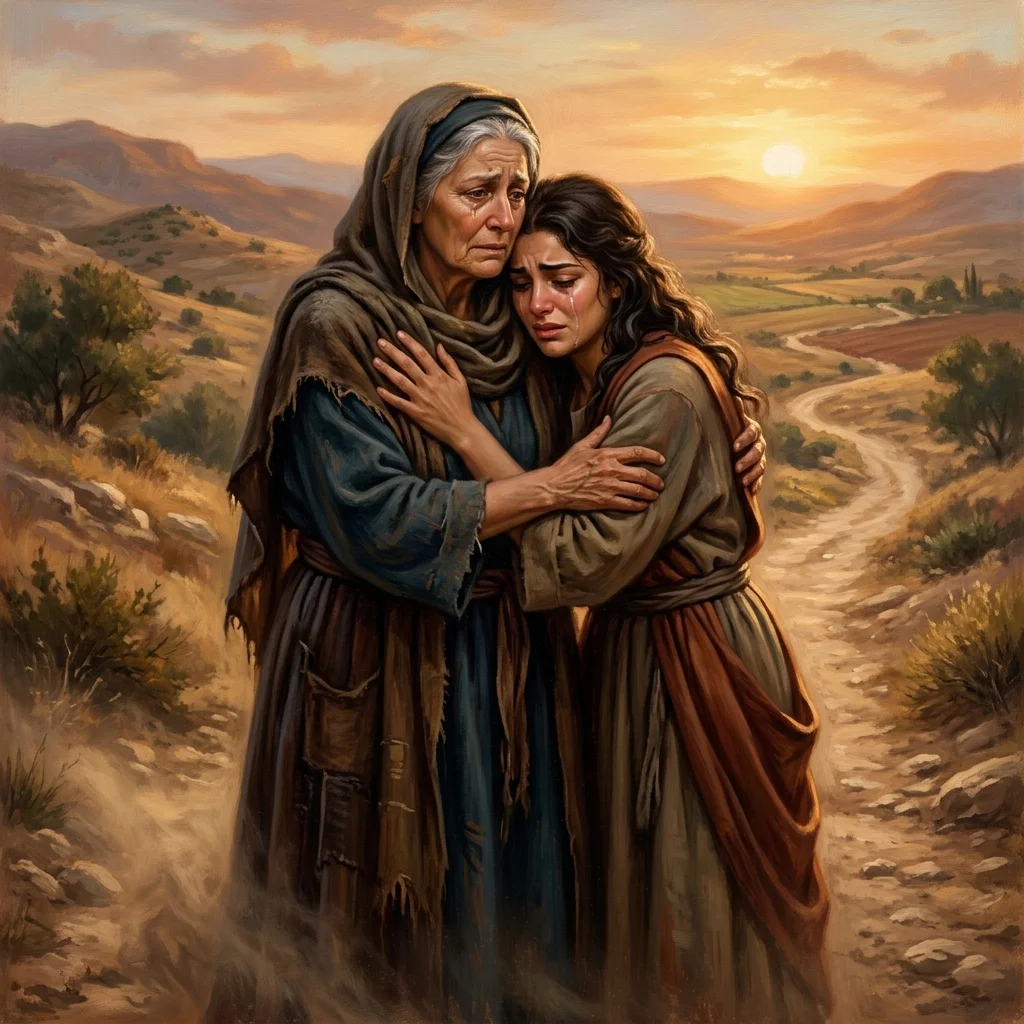
Word arrived that Yahweh had visited His people in Judah by giving them bread. Brokenhearted and financially ruined, Naomi prepared to return to Bethlehem. Her two daughters-in-law set out on the dusty desert road beside her. But as they neared the border of Moab, Naomi stopped, pleading with them to return to their mothers' homes: "Go, return each to her mother's house. Yahweh deal kindly (chesed) with you, as you have dealt with the dead and with me... Turn back, my daughters; why will you go with me? Are there still sons in my womb, that they may be your husbands?" (Ruth 1:8, 11). Weeping bitterly, Orpah kissed her mother-in-law, turned around, and returned to her people and her idols.
Ruth, however, clung (*dabaq*) to Naomi with immovable tenacity. When Naomi urged her to follow Orpah back to Chemosh and Moab, Ruth looked into the hollow, tear-stained eyes of the older woman and uttered what has become universally recognized as one of the most magnificent confessions of covenant loyalty and spiritual surrender in human literature:
"Entreat me not to leave you, or to turn back from following after you; for wherever you go, I will go; and wherever you lodge, I will lodge; your people shall be my people, and your God, my God! Where you die, I will die, and there will I be buried. Yahweh do so to me, and more also, if anything but death parts you and me!" (Ruth 1:16-17). Ruth was not simply expressing sentimental filial affection; she was making an irrevocable monotheistic conversion. She was swearing by the sacred covenant name *Yahweh*, legally renouncing her ancestral gods, her homeland, and her people to embrace the living God of Israel and a life of poverty beside a broken widow.
When the two exhausted women finally climbed the steep Judean ridges and entered Bethlehem, the entire town was stirred. The local women gathered, whispering in disbelief: "Is this Naomi?" But Naomi answered with raw, agonizing grief: "Do not call me Naomi ('Pleasant'); call me Mara ('Bitter'), for the Almighty has dealt very bitterly with me! I went out full, and Yahweh has brought me home again empty!" (Ruth 1:20-21). Yet beneath her bitter lament, the sacred text whispers an exquisite note of divine timing: they arrived in Bethlehem at the very beginning of the spring barley harvest (*qatsir se'orim*).
To keep her mother-in-law from starving, Ruth resolved to take advantage of the Mosaic gleaning laws (Leviticus 19:9-10), which commanded farmers not to harvest the margins of their fields, but to leave dropped ears of grain for the poor, the fatherless, and the resident alien. In a sentence infused with glorious theological irony, Scripture records: "And she happened to come to the part of the field belonging to Boaz, who was of the family of Elimelech" (Ruth 2:3). In the providence of God, there are no accidents!
Boaz arrived from Bethlehem, greeting his reapers with the warm covenant benediction: "Yahweh be with you!" and they replied, "Yahweh bless you!" Noticing the young foreign woman quietly gathering ears behind the harvesters, Boaz inquired of his foreman: "Whose young woman is this?" The servant recounted her extraordinary devotion: she was the Moabite daughter-in-law who had returned with Naomi, working diligently from dawn until afternoon with scarcely a rest.
Stepping forward with noble dignity, Boaz addressed Ruth with deep tenderness: "Listen, my daughter, do not go to glean in another field, nor go from here, but stay close by my young women... Have I not commanded the young men not to touch you? And when you are thirsty, go to the vessels and drink what the young men have drawn." Overwhelmed by such unexpected kindness, Ruth fell prostrate to the earth: "Why have I found favor in your eyes, that you should take notice of me, since I am a foreigner?" (Ruth 2:10).
Boaz answered with profound reverence: "It has been fully reported to me, all that you have done for your mother-in-law since the death of your husband, and how you have left your father and your mother and the land of your birth, and have come to a people whom you did not know before. Yahweh repay your work, and a full reward be given you by Yahweh God of Israel, under whose wings (kanaf) you have come to take refuge!" (Ruth 2:11-12). Boaz secretly instructed his reapers to let fall handfuls of barley deliberately on purpose for her. That evening, Ruth threshed out an entire ephah of barley—nearly thirty pounds of grain—and carried it home along with roasted grain from Boaz's table.
When Naomi saw the mountain of grain, she gasped: "Where have you gleaned today?" When Ruth replied, "The man's name with whom I worked today is Boaz," Naomi's bitter heart melted with surging hope: "Blessed be he of Yahweh, who has not forsaken His kindness (chesed) to the living and the dead! This man is a close relative of ours, one of our kinsman-redeemers (go'el)!" (Ruth 2:19-20).
Under Mosaic jurisprudence, a kinsman-redeemer (*go'el*) was a close male relative who possessed the legal right and moral obligation to redeem alienated family property and marry a deceased relative's childless widow through levirate marriage to perpetuate the family lineage (Leviticus 25:25; Deuteronomy 25:5-10). At the end of the barley and wheat harvests, Naomi gave Ruth precise, daring instructions for the nocturnal threshing floor (*goren*). After winnowing the grain in the cool evening breeze, Boaz would eat, drink, and sleep beside the heap of barley to guard the harvest.
Ruth washed, anointed herself with fragrant oil, put on her finest mantle, and descended to the threshing floor under cover of midnight darkness. When Boaz was asleep, she crept softly, uncovered his feet, and lay down. At midnight, the man was startled, rolling over to find a woman lying at his feet: "Who are you?" he whispered into the darkness. Ruth answered with breathtaking clarity and bold faith: "I am Ruth, your maidservant. Take your maidservant under your wing (spread your garment skirt, kanaf, over me), for you are a kinsman-redeemer (go'el)!" (Ruth 3:9). Ruth was not seeking casual romance; she was formally invoking covenant redemption!
Boaz was deeply moved by her virtue: "Blessed are you of Yahweh, my daughter! For you have shown more kindness at the end than at the beginning, in that you did not go after young men, whether poor or rich. And now, my daughter, do not fear. I will do for you all that you request, for all the people of my town know that you are a virtuous woman (eshet chayil)!" (Ruth 3:10-11). Yet Boaz, ever a man of impeccable legal integrity, explained that there was a closer relative who had the first right of redemption. If that relative refused, Boaz swore: "As Yahweh lives, I will redeem you!"
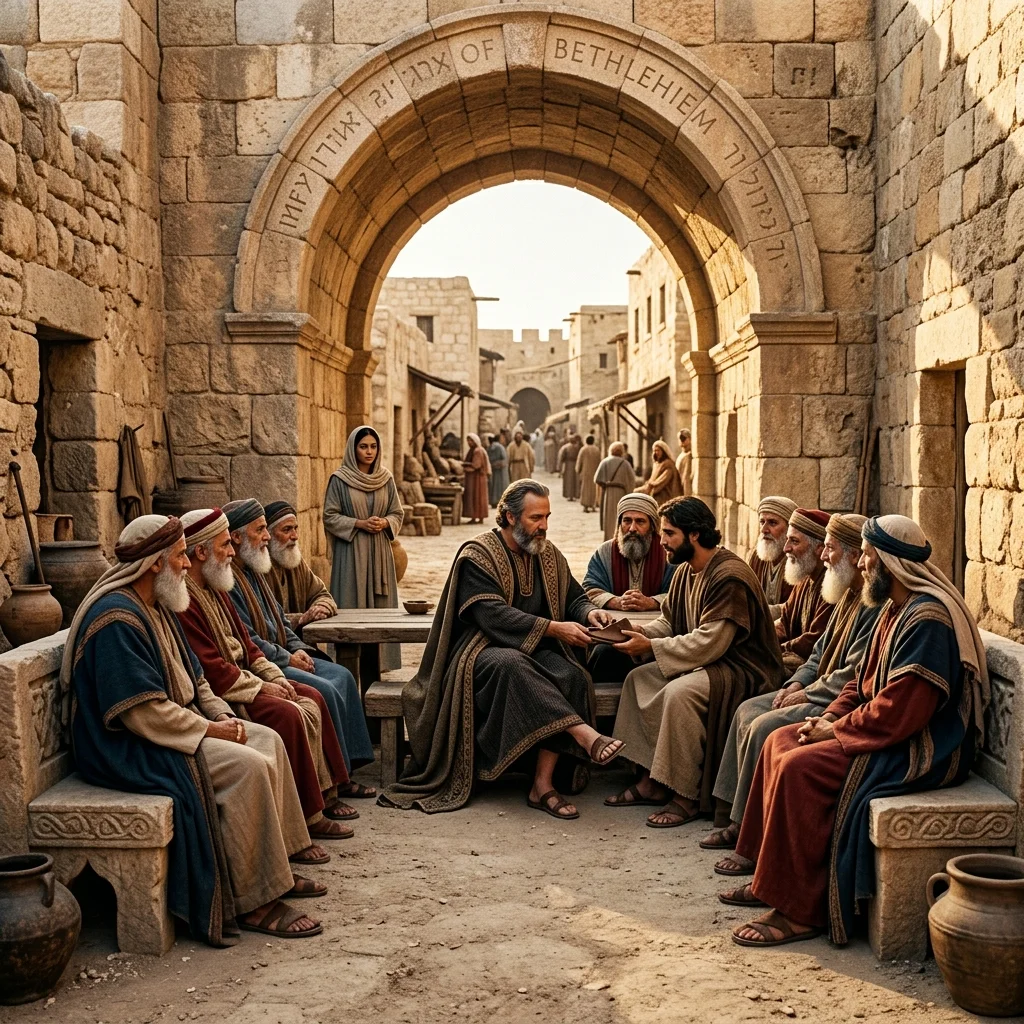
The next morning, Boaz went up to the city gate (*sha'ar*)—the civic court of Bethlehem—and summoned ten elders of the town as legal witnesses. When the closer kinsman walked by, Boaz presented the case: Naomi was selling the parcel of land that belonged to their brother Elimelech. The closer relative readily agreed: "I will redeem it!" But Boaz delivered the decisive legal stipulation: "On the day you buy the field from the hand of Naomi, you must also acquire Ruth the Moabitess, the wife of the dead, to perpetuate the name of the dead through his inheritance!" (Ruth 4:5). Terrified that marrying a poor foreign widow would jeopardize his own estate and dilute his children's inheritance, the closer kinsman declined: "I cannot redeem it for myself, lest I ruin my own inheritance. You take my right of redemption for yourself!"
To ratify the transaction in the presence of the elders and all the people, the closer relative drew off his sandal (*chalitzah*) and handed it to Boaz—the ancient legal symbol confirming the transfer of redemption rights. Boaz turned to the elders with radiant joy: "You are witnesses this day that I have bought all that was Elimelech's... Moreover, Ruth the Moabitess, the widow of Mahlon, I have acquired as my wife, to perpetuate the name of the dead through his inheritance... You are witnesses this day!" And the elders cried out in blessing: "We are witnesses! Yahweh make the woman who is coming to your house like Rachel and Leah, the two who built the house of Israel; and may you prosper in Ephrathah and be famous in Bethlehem!" (Ruth 4:9-11).
So Boaz took Ruth, and she became his wife. Yahweh blessed her womb, and she gave birth to a son. The women of Bethlehem gathered around Naomi, rejoicing: "Blessed be Yahweh, who has not left you this day without a close relative; and may his name be famous in Israel! And may he be to you a restorer of life and a nourisher of your old age; for your daughter-in-law, who loves you, who is better to you than seven sons, has borne him!" Naomi took the baby and laid him in her bosom, nursing him with tears of joyful restoration. They named the child Obed ('Servant/Worshipper').
The sacred book concludes with an astonishing genealogical crescendo: Obed became the father of Jesse, Jesse became the father of David, the shepherd king of Israel—and through the line of David, fourteen centuries later, Jesus the Messiah, the ultimate Kinsman-Redeemer of the world, was born in that very same town of Bethlehem! In the quiet fields of Bethlehem, God demonstrated that His redeeming *chesed* reaches beyond race, nationality, and human despair to craft eternal salvation!
Biblical Keywords & Theological Roots
Lovingkindness, steadfast covenant loyalty, merciful devotion. An active, enduring love that goes far beyond legal requirements to rescue and bless another.
Kinsman-Redeemer; a close relative who has the legal right and moral obligation to repurchase sold land, redeem enslaved kin, and avenge wrongful death.
Wing, corner of a garment, mantle. Spreading the garment skirt over someone was the ancient Near Eastern symbol of marriage proposal and covenant protection under Yahweh's wings.
To cling, cleave, adhere firmly, hold fast with unyielding devotion. Used in Ruth 1:14 of Ruth clinging to Naomi, echoing Genesis 2:24 of marriage union.
City gate; the monumental public entryway where city elders gathered, trials were conducted, and binding commercial and legal contracts were ratified.
Ancient Near Eastern & Archaeological Context
The narrative of Ruth takes place 'in the days when the judges ruled' (Ruth 1:1), circa 1150–1100 BC, providing a luminous domestic contrast to the systemic bloodshed and moral collapse portrayed in the Book of Judges. Bethlehem-Judah ('House of Bread') suffered recurrent severe droughts due to its location on the eastern Judean rain shadow bordering the wilderness. Crossing the Jordan into the high plateau of Moab provided lush pastureland, but Moab was historically an ancestral enemy born of Lot's incestuous union (Genesis 19:37) and barred from the congregation of Yahweh to the tenth generation (Deuteronomy 23:3). Ruth's story revolves around two ancient Israelite legal codes: (1) The Poor Gleaning Laws (Leviticus 19:9-10; Deuteronomy 24:19), requiring farmers not to reap the corners of fields or retrieve dropped sheaves, leaving them for the alien, fatherless, and widow; and (2) The Kinsman-Redeemer (*Go'el*) and Levirate Marriage Laws (Leviticus 25:25-28; Deuteronomy 25:5-10). The *go'el* was obligated to buy back alienated family land and marry the childless widow to raise up offspring in the deceased brother's name. The legal convening of ten elders (*zeqenim*) at the city gate (*sha'ar*) and the public removal of the sandal (*chalitzah*) represented the binding transfer of property and levirate obligations in Ancient Near Eastern jurisprudence.
Practical Discipleship & Spiritual Application
- Demonstrate Radical Loyalty in Seasons of Loss: Ruth did not abandon Naomi when all earthly security vanished. True Christian character is revealed not when circumstances are prosperous, but when we choose sacrificial loyalty (*chesed*) toward those in pain.
- Trust God's Invisible Hand in Ordinary Daily Steps: Ruth did not wait for a miraculous thunderclap; she simply went out to glean barley to feed her mother-in-law. Faithfully perform your daily responsibilities, trusting that God supernaturally orders your 'accidental' steps.
- Rest Securely Beneath the Wings of Christ: When Ruth asked Boaz to spread his garment (*kanaf*) over her, she was claiming shelter under the wings of the Lord God of Israel. Cast yourself at the feet of Jesus, our ultimate Redeemer, who covers our shame and sin with His robe of righteousness.
- Rejoice in God's Power to Overturn Bitterness into Joy: Naomi cried out in despair: 'Do not call me Naomi (Pleasant); call me Mara (Bitter), for the Almighty has dealt very bitterly with me!' Yet by the story's end, Naomi was cradling baby Obed in her lap. Never judge God's unfinished work by your present season of grief.
⚡ Fast Facts
- The name 'Bethlehem' means 'House of Bread,' yet a severe famine drove Elimelech's family away into the pagan fields of Moab (Ruth 1:1-2).
- Ruth gathered an entire ephah of barley (roughly 22 liters or 30 pounds) on her very first day of gleaning in Boaz's field (Ruth 2:17).
- The legal transaction at the gate of Bethlehem involved a formal ritual where the nearer redeemer removed his sandal (*chalitzah*) and gave it to Boaz to seal the transfer of redemption rights (Ruth 4:7-8).
- Ruth is one of only five women explicitly listed in the royal genealogy of Jesus Christ in Matthew 1:5, alongside Tamar, Rahab, Bathsheba, and Mary.
❓ Frequently Asked Questions (FAQs)
Moab originated from an incestuous union between Lot and his eldest daughter following the destruction of Sodom (Genesis 19:37). During the wilderness wandering, the King of Moab hired Balaam to curse Israel, and Moabite women seduced Hebrew men into the catastrophic sexual and idolatrous heresy of Baal-Peor (Numbers 25). Consequently, Deuteronomy 23:3 laid down a severe exclusionary statute: 'An Ammonite or Moabite shall not enter the assembly of Yahweh; even to the tenth generation none of his descendants shall enter the assembly of Yahweh forever.' For a Hebrew landowner of noble birth like Boaz to marry a Moabite widow seemed, on the surface, legally scandalous. However, Ruth had made an absolute spiritual renunciation of Moab's gods (*Chemosh*) and embraced Yahweh with covenant loyalty (*chesed*). Her story demonstrates that genuine saving faith supersedes ancestral curses, and sovereign grace welcomes the repentant outsider into the very core of God's covenant family.
In the Ancient Near East, the threshing floor (*goren*) during harvest festivals was often associated with festive drinking, celebration, and nocturnal prostitution. However, Naomi's instructions to Ruth were not a scheme of immoral seduction, but a precise, bold legal appeal rooted in Israelite jurisprudence. By washing, anointing herself, and dressing in her best mantle, Ruth signaled the termination of her formal widowhood mourning. When she uncovered Boaz's feet and lay down, she adopted the humble posture of a maidservant petitioning a master. When Boaz awakened in shock at midnight, Ruth boldly stated her request: 'Spread your garment skirt (*kanaf*) over your maidservant, for you are a kinsman-redeemer (*go'el*)' (Ruth 3:9). In ancient Semitic culture, spreading the corner of one's cloak over a woman was the solemn, formal idiom for proposing marriage (seen also in Ezekiel 16:8 of God marrying Israel). Boaz immediately praised her moral virtue (*eshet chayil*), protecting her reputation and refusing to take advantage of her vulnerability.
Under the Mosaic Law (Leviticus 25 and Deuteronomy 25), an individual could not simply volunteer to be a redeemer; he had to satisfy three strict statutory requirements: (1) He must be a close blood relative (*qaroav*): Boaz was an influential kinsman of Elimelech's family clan. (2) He must possess the financial capacity to redeem (*chayil*): Boaz was a man of great wealth and resources capable of repurchasing Elimelech's impoverished parcel of land without jeopardizing his own estate. (3) He must be entirely willing to redeem: while a closer unnamed kinsman refused to redeem Ruth because marrying her would dilute his own inheritance, Boaz joyfully consented to pay the full price, buy back the land, and marry Ruth to perpetuate the name of the deceased. In this threefold perfection, Boaz points directly to Jesus Christ, who became our blood brother in flesh, possessed the infinite spiritual wealth of sinless righteousness, and willingly laid down His life on the cross to redeem us.