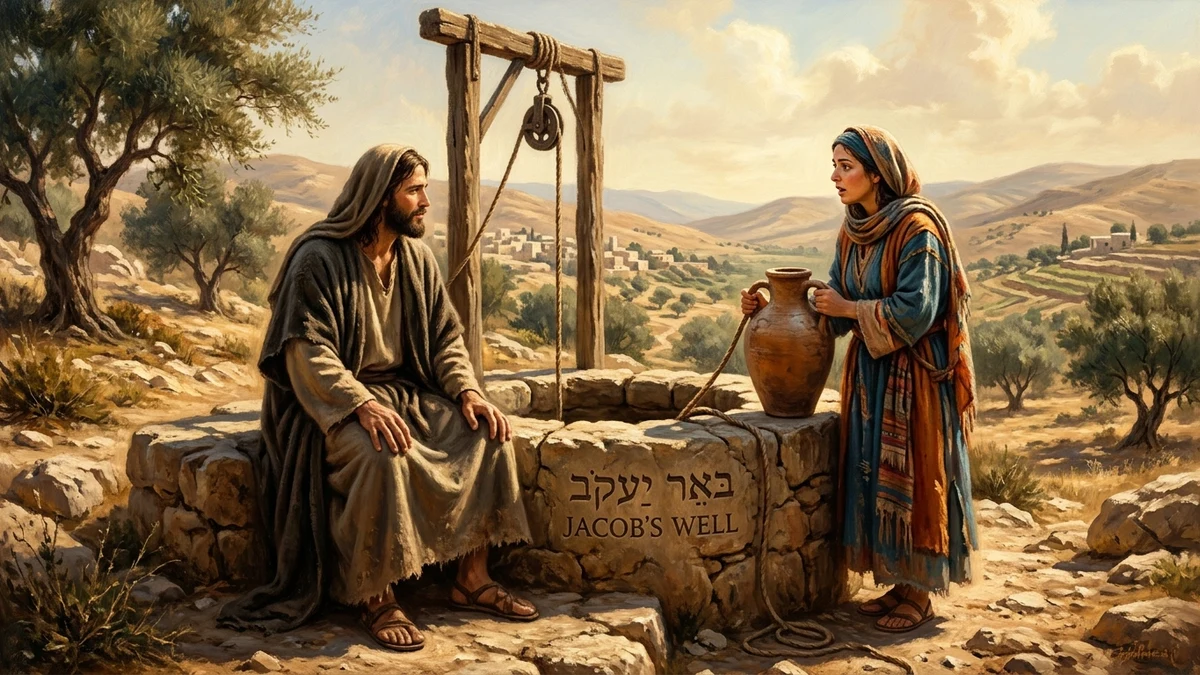
The midday sun hung mercilessly over the dusty limestone ridges of Samaria, baking the ancient terraces of Mount Gerizim into shimmering heat waves. Travelers along the central highway through the hill country had long sought shade, yet along the rocky footpath approaching the village of Sychar walked a solitary figure. Wearied from the arduous climb from the Jordan Valley, His sandals coated with white desert dust, Jesus of Nazareth sat down by the rim of a deep, stone-carved cistern: the ancestral well of patriarch Jacob. On that scorching afternoon, heaven orchestrated an encounter that would shatter centuries of ethnic hostility, dismantle religious hypocrisy, and release an unending river of Living Water to the broken outcasts of the world.
1. The Divine Necessity Through Unfriendly Soil
The fourth chapter of John opens with a profound theological declaration that defies conventional first-century geography: "He needed to go through Samaria" (John 4:4). To the contemporary Jewish mind, this statement was scandalous. Judea lay to the south, Galilee to the north, and Samaria directly in the center. Strict Pharisaic travelers routinely doubled their journey, crossing eastward over the Jordan River into the sweltering heat of Perea, marching northward, and crossing back across the Jordan just to avoid setting foot on Samaritan soil.
The hatred between Jews and Samaritans was ancient, visceral, and bitter. Following the Assyrian conquest of the Northern Kingdom of Israel in 722 BC, pagan populations were relocated into the scorched cities of Samaria, intermarrying with the remnant Israelites. The Samaritans embraced a syncretistic faith, accepting only the five books of Moses and constructing a rival temple atop Mount Gerizim. When Jewish king John Hyrcanus demolished that rival sanctuary in 128 BC, the wound became an unbridgeable chasm. Rabbinic tradition codified the prejudice: "The daughters of the Samaritans are deemed menstruants from their cradle", decreeing their food and drinking vessels perpetually unclean.
Yet Jesus operated under a higher sovereign compass. His necessity was not dictated by topography or convenience, but by divine purpose. A broken, thirsty soul was walking toward Jacob’s well, and the Shepherd of Israel had an eternal appointment to keep.
2. The Outcast at High Noon
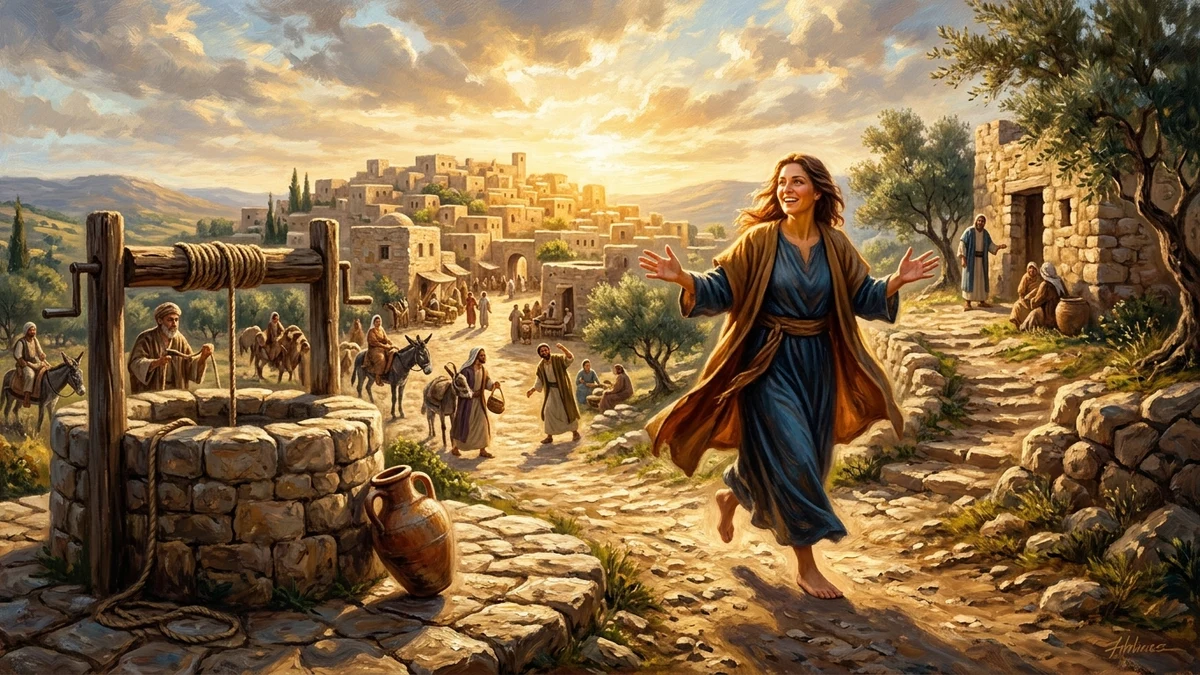
It was the sixth hour—twelve o'clock noon—when the sun was at its blazing zenith. In ancient Near Eastern village life, drawing water was an exclusively communal, female routine conducted during the cool breath of dawn or twilight. Women gathered in laughter and conversation, balancing heavy earthen water jars upon their shoulders.
Yet walking down the winding footpath from Sychar came a woman completely alone. She carried her heavy clay jar under the scorching heat, not because she desired the midday sun, but because she feared the piercing eyes, cold whispers, and cruel laughter of the village women. Her life was an open ledger of sorrow and scandal. Five times she had stood beneath a marriage canopy; five times the covenant had dissolved through death, betrayal, or cruel divorce. Now, resigned to survival, she was living with a man who was not her husband. She was a moral outcast among an already despised race.
Arriving at the stone wellhead, she froze. A Jewish man was seated upon the rim. His Galilean mantle marked His heritage. Expecting the familiar contempt—the averted eyes, the hitched-up garments, the cold sneer of disgust—she lowered her gaze, preparing to drop her leather bucket into the hundred-foot darkness.
3. The Request That Shattered Three Walls
Before she could fasten her rope, the Silence was broken by a gentle, resonant voice:
"Give Me a drink." (John 4:7).
The words struck her like thunder. In three simple syllables, Jesus dismantled three fortified barriers of ancient culture:
- The Racial Barrier: A Jew was requesting to drink from a Samaritan vessel, which the oral law strictly declared to be ritually defiled.
- The Gender Barrier: Rabbinic precepts sternly warned: "Let no man speak with a woman in public, not even his own wife, lest he incur hell."
- The Moral Barrier: The sinless Son of God was initiating intimate conversation with a publicly shamed sinner without a whisper of disgust.
Stunned and disarmed, the woman blurted out: "How is it that You, being a Jew, ask a drink from me, a Samaritan woman?"
Jesus did not enter into an ethnic argument. Instead, He lifted her gaze from the dusty wellhead to the boundless reservoirs of heaven:
"If you knew the gift of God, and who it is who says to you, 'Give Me a drink,' you would have asked Him, and He would have given you living water." (John 4:10).
4. From Stagnant Cisterns to Springing Wells
Still anchored in the physical realm, the woman challenged Him: "Sir, You have nothing to draw with, and the well is deep. Where then do You get that living water? Are You greater than our father Jacob, who gave us the well?" Jacob’s well was renowned; over a hundred feet deep, it collected runoff and seepage through limestone strata. It required backbreaking labor to hoist a single gallon.
Jesus answered with eternal clarity:
"Whoever drinks of this water will thirst again, but whoever drinks of the water that I shall give him will never thirst. But the water that I shall give him will become in him a fountain of water springing up into everlasting life." (John 4:13–14).
Earthly wells—whether career, romance, wealth, or human approval—can only satisfy transient thirst. The moment the vessel is emptied, the agonizing drought returns. But Christ offered a supernatural artesian spring (pege hydatos hallomenou)—an internal fountain continually leaping, surging, and overflowing with divine life.
Longing for relief from her daily shame, she pleaded: "Sir, give me this water, that I may not thirst, nor come here to draw!"
5. The Sword of Truth and True Worship
Jesus knew that Living Water cannot fill a vessel that refuses to be emptied of its sin. With pinpoint surgical precision, He aimed directly at her hidden wound:
"Go, call your husband, and come here."
Her heart stopped. She tried to deflect with a technical truth: "I have no husband."
Jesus looked into her eyes with pure divine omniscience, devoid of malice yet ablaze with truth: "You have well said, 'I have no husband,' for you have had five husbands, and the one whom you now have is not your husband; in that you spoke truly."
She was stripped bare before the gaze of heaven. Yet there was no stone in His hand, no condemnation in His voice. Convicted to the core, she perceived His prophetic office: "Sir, I perceive that You are a prophet!" Then, attempting to pivot away from her painful personal history, she raised the age-old theological debate: "Our fathers worshiped on this mountain (Mount Gerizim), and you Jews say that in Jerusalem is the place where one ought to worship."
Jesus elevated the dialogue to its supreme pinnacle:
"Woman, believe Me, the hour is coming when you will neither on this mountain, nor in Jerusalem, worship the Father... But the hour is coming, and now is, when the true worshipers will worship the Father in spirit and truth; for the Father is seeking such to worship Him. God is Spirit, and those who worship Him must worship in spirit and truth." (John 4:21–24).
True worship is not a geographical shrine, an architectural monument, or an outward ritual. God is immaterial, omnipresent Spirit (Pneuma ho Theos). True communion requires the inward regeneration of the human spirit aligned with the absolute truth of divine revelation in Christ.
6. "I Am He" & The Awakening of Sychar
Overwhelmed by His wisdom, the woman whispered the deepest longing of her beaten soul: "I know that Messiah is coming (who is called Christ). When He comes, He will tell us all things."
Then, in the scorching silence of the Samarian hills, Jesus spoke the words He had withheld from Jerusalem's proud Sanhedrin:
"I who speak to you am He." (Ego eimi, ho lalon soi).
It was the divine Name of the burning bush—the eternal Yahweh—standing before an adulterous Samaritan woman! At that moment, the disciples returned with food, marvelling that He talked with a woman, yet daring not to question Him.
The woman did something magnificent: she left her waterpot (John 4:28). The very vessel that represented her domestic burden, her social shame, and her physical thirst was forgotten in the dust. She ran as fast as her feet could carry her into the crowded gates of Sychar, crying out to the elders, the merchants, and the neighbors:
"Come, see a Man who told me all things that I ever did! Could this be the Christ?"
Her transformed life became an irresistible magnet. The entire village surged out of the gates, marching across the barley fields toward the well. Seeing the crowds dressed in white linen walking through the green crops, Jesus turned to His disciples: "Lift up your eyes and look at the fields, for they are already white for harvest!"
For two full days, Jesus remained in Samaria teaching the people. Many more believed because of His own word, confessing to the woman: "Now we believe, not just because of what you said, for we ourselves have heard Him and we know that this is indeed the Christ, the Savior of the world!"
Biblical Keywords & Theological Roots
Living water; dynamic, flowing spring water carrying life, symbolic of the regenerative and sanctifying indwelling of the Holy Spirit.
To have dealings with, associate familiarly, or use vessels in common; denotes the rigid social and ritual quarantine between Jews and Samaritans.
God is Spirit; theological affirmation that God is not confined to physical matter, geographical temples, or material shrines.
I am; the supreme divine covenant name revealed at the burning bush (Exodus 3:14), claimed explicitly by Jesus to declare His absolute Messianic deity.
Ancient Near Eastern & Archaeological Context
First-century Samaria was located directly between Judea in the south and Galilee in the north. Although traveling through Samaria was the most direct route taking only three days, strict Judean pilgrims routinely walked an arduous six-day detour across the Jordan River through Perea to avoid stepping foot on Samaritan soil or drinking from Samaritan vessels, which rabbinic oral law (Mishnah Niddah 4:1) declared perpetually defiled. Jacob's Well stood near the ancient ruins of Shechem beneath the twin peaks of Mount Gerizim (the mountain of blessings, where the Samaritans maintained their holy site) and Mount Ebal (the mountain of curses). Women customarily gathered to draw water in social groups in the cool of early morning or twilight. A woman arriving alone at the sixth hour (noon) demonstrated profound social ostracism, avoiding the piercing whispers of the village matriarchs due to her irregular marital history.
Support Independent Biblical Research
Did this study bless you? Help support our independent bilingual research and interactive visual Bible tools.
⚡ Fast Facts
- Jews traditionally detoured around Samaria through the Jordan Valley to avoid ceremonial contamination from Samaritans
- Jacob's Well (Bir Ya'qub) is over 100 feet deep, fed by subterranean percolation rather than a direct underground spring
- The sixth hour corresponds to Roman noon (12:00 PM), the hottest hour when outcast women drew water in isolation
- Jesus' declaration 'I who speak to you am He' (Ego eimi) is His clearest recorded Messianic self-identification in the Gospels
❓ Frequently Asked Questions (FAQs)
The enmity dated back to the Assyrian conquest of the Northern Kingdom of Israel in 722 BC, when pagan foreigners were resettled in Samaria and intermarried with the remaining Israelites (2 Kings 17). Jews viewed Samaritans as theological heretics and racial half-breeds who rejected all Old Testament scriptures except the Samaritan Pentateuch and built a rival temple on Mount Gerizim, which Jewish Hasmonean king John Hyrcanus destroyed in 128 BC.
In the physical realm, living water referred to flowing, fresh artesian water from an active spring, contrasted with dead, stagnant rainwater in a limestone cistern. Spiritually, Jesus uses it as a metaphor for the Holy Spirit and regenerative divine grace (John 7:37–39; Jeremiah 2:13) that cleanses the inner soul, satisfies the spiritual thirst of humanity, and becomes an eternal fountain within the believer.
Worship in spirit means engaging God not through external ceremonial rituals, outward relics, or geographical shrines (such as Jerusalem or Mount Gerizim), but through the inward regeneration of the human spirit empowered by the Holy Spirit. Worship in truth means approaching God in accordance with His true revelation in Jesus Christ, without falsehood, theological distortion, or religious hypocrisy.