The road from the sunlit hills of Cana down to the bustling fishing ports of Capernaum was a steep, rocky descent that tore at the hooves of horses and tested the stamina of the hardiest travelers. Yet on an anxious afternoon in Galilee, an imperial chariot tore across the limestone ridges with reckless urgency. Inside sat a nobleman of Herod’s royal court, his robes stained with sweat and dust, his aristocratic composure shattered by grief. Twenty miles away, beside the blue waters of Lake Gennesaret, his young son lay burning with a virulent fever, his shallow breaths rattling in his chest. In this moment of utter helplessness, earthly power, royal wealth, and political influence collapsed into dust. The nobleman was riding for the life of his child, seeking the only One whose voice held dominion over the grave.
1. The Emptiness of Earthly Aristocracy
The Gospel of John introduces this unforgettable narrative with surgical historical precision: "So Jesus came again to Cana of Galilee where He had made the water wine. And there was a certain nobleman whose son was sick at Capernaum" (John 4:46).
The title applied to this man in the Greek text is basilikos—a royal courtier, an aristocrat intimately attached to the royal household of Tetrarch Herod Antipas. This man moved in the corridors of power in Tiberias and Sepphoris. He commanded servants, wore garments of dyed Tyrian purple, and dined at banquets of imperial splendor. He had access to the finest physicians in the eastern Mediterranean, men trained in Alexandria and Antioch who carried jars of costly balms and medicinal herbs.
Yet when malignant fever invaded his Capernaum villa, all his gold was useless. The physicians shook their heads in despair; the potions failed; the boy’s fever surged past the threshold of survival. The boy was slipping into the icy grip of death. Hearing that the young Prophet who had turned water into wine had returned from Judea to Cana, the father made a desperate choice. Casting aside his aristocratic pride, he mounted his horse and rode twenty grueling miles uphill into the mountains of Galilee.
2. The Cry of a Breaking Father
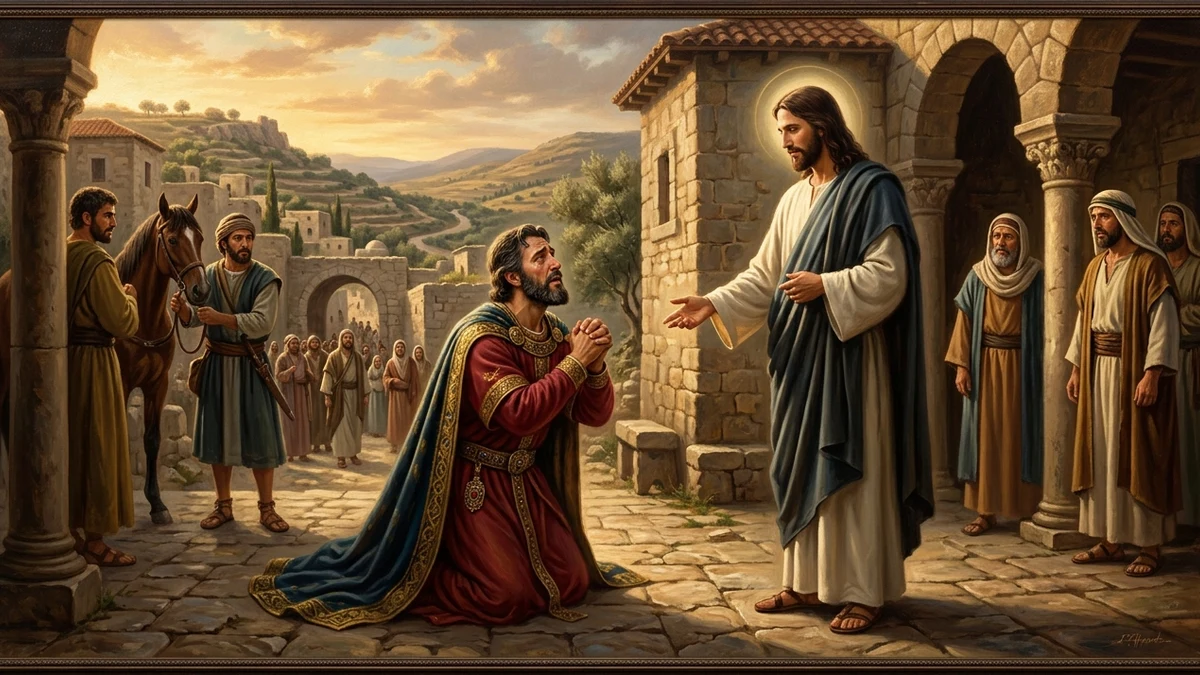
Arriving in Cana coated in dust and exhausted from the steep ascent, the nobleman found Jesus surrounded by curious crowds. In the ancient world, high-ranking royal officials commanded commoners to come to them; they did not bow before itinerant peasant teachers.
Yet love obliterates protocol. Pushing through the onlookers, the nobleman cast himself down before the Galilean Rabbi:
"He implored Him to come down and heal his son, for he was at the point of death." (John 4:47).
Notice the verb: "implored" (Greek: erota)—an imperfect tense indicating repeated, desperate, broken begging. He did not issue a royal summons; he wept. He begged Jesus to mount a steed and make the eight-hour descent down to Capernaum before the boy drew his final breath. In the father’s mind, Jesus was a localized wonder-worker who needed to be physically present in the sickroom, to touch the child's forehead, to rebuke the sickness at the bedside.
3. The Test of Superficial Faith
Instead of immediately mounting a horse and rushing to Capernaum, Jesus spoke words that sounded like a stinging rebuke:
"Unless you people see signs and wonders, you will by no means believe." (John 4:48).
The pronoun "you people" (Greek: idete) is plural. Jesus was not attacking the grieving father; He was addressing the sensation-hungry crowds of Galilee who treated His miracles like theatrical entertainment. Many followed Him not out of repentance or love for God, but to witness supernatural fireworks. They demanded signs before they would trust His word.
A lesser man, offended by the Rabbi's delay and public reprimand, might have turned back in royal indignation. But the nobleman had moved beyond human pride. He did not argue theology; he did not defend his motives. With raw, unvarnished agony, he pressed his single plea:
"Sir, come down before my child dies!" (John 4:49).
The Greek phrase is deeply tender: to paidion mou—"my little boy." The father’s heart was bleeding. He believed that if Jesus did not physically cross the threshold of his Capernaum home within hours, all hope was extinguished forever.
4. The Word That Defies Distance
Looking upon the trembling, weeping father, Christ’s eyes filled with divine majesty and sovereign grace. He would not travel to Capernaum. He would not ride a horse down the mountain. He would do something infinitely greater—He would elevate this father's faith from the crutch of visible sight to the rock of the unassisted Word.
Standing in the dusty courtyard of Cana, Jesus issued an absolute royal decree:
"Go your way; your son lives." (Poreuou; ho huios sou ze - John 4:50).
No incense was burned; no ritual prayers were chanted; no physical talisman was given. There was only the sovereign, creative Logos of the Son of God spoken into the thin mountain air. Twenty miles away, across valleys, ravines, and stone outcroppings, that Word traveled with the speed of light.
Then occurred the supreme turning point of the entire narrative: "So the man believed the word that Jesus spoke to him, and he went his way." (John 4:50).
Think of the radical faith required in that moment! The nobleman had no confirmation, no telegraph, no visible proof. His child was either alive or dead twenty miles away. Yet he ceased begging. He did not insist that Jesus accompany him. He surrendered his panic, turned his horse around, and walked in the peace of God.
5. The Seventh Hour at Capernaum
So deep was the nobleman’s newly anchored peace that he did not frantically gallop his horse through the dangerous mountain passes at night. He lodged along the way, resting in the promise of Christ.
The following morning, as he was descending the final ridge overlooking the sparkling blue expanse of the Sea of Galilee, a cloud of dust appeared on the road ahead. Servants from his Capernaum estate were sprinting toward him, their faces radiant with joy!
Before he could utter a word, they shouted the magnificent news: "Your son lives!" (John 4:51).
His heart pounding with awe, the father asked them the precise hour when the boy began to improve:
"Yesterday at the seventh hour the fever left him." (John 4:52).
Notice their language: the fever did not gradually recede through normal biological recovery; "the fever left him"—it vanished instantaneously, as if driven out by a sovereign command!
The nobleman stopped his horse. The seventh hour was 1:00 PM yesterday afternoon—the exact moment when the sun stood high over Cana, when Jesus had looked into his weeping eyes and declared: "Go your way; your son lives!"
6. A Household Swept into Salvation
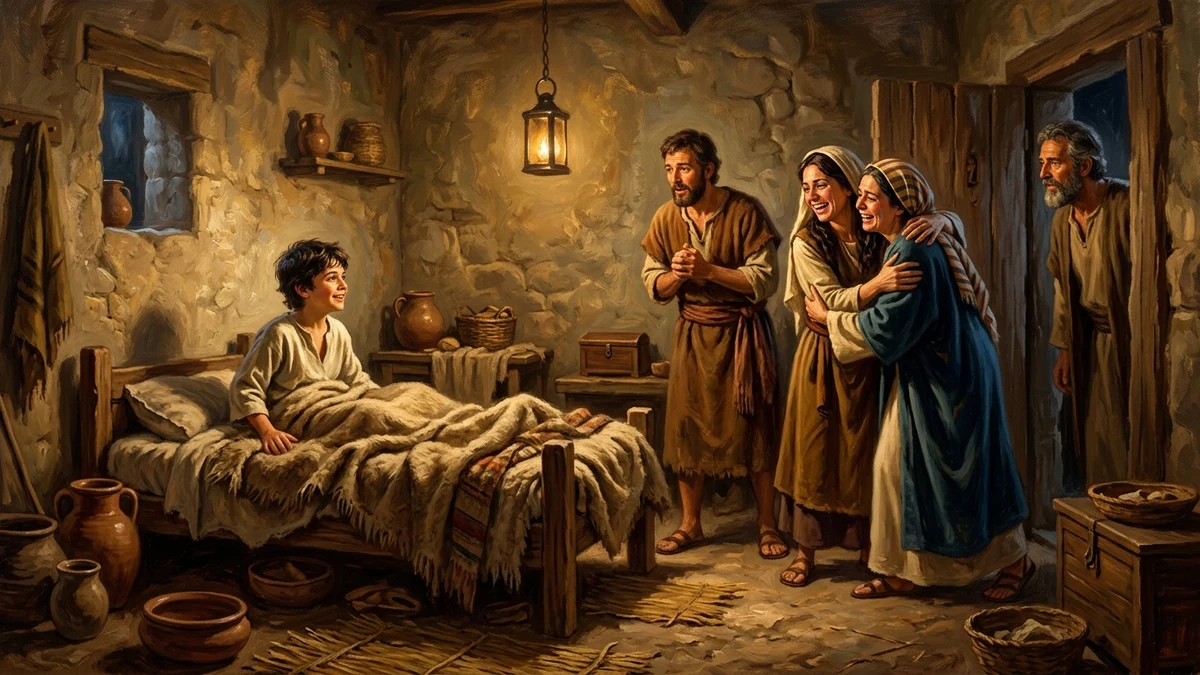
The conclusion of the story is the crown of the second sign: "So the father knew that it was at the same hour in which Jesus said to him, 'Your son lives.' And he himself believed, and his whole household." (John 4:53).
The miracle in the child’s body unlocked an eternal miracle in the family's soul. When the father entered his home, embraced his healthy, vibrant boy, and recounted the majesty of the Prophet of Nazareth, his wife, his children, and all his domestic servants surrendered their lives to Jesus Christ as the true King of Israel.
John concludes: "This again is the second sign Jesus did when He had come out of Judea into Galilee" (John 4:54). By healing across twenty miles of rugged terrain, Jesus established that His power knows no boundaries of space, geography, or distance. For two thousand years, this second sign remains an unshakeable anchor for every praying soul: no matter how distant your loved one may be, they are never beyond the reach of the spoken Word of Jesus Christ!
Biblical Keywords & Theological Roots
Royal officer, courtier, or king's man; a high-ranking civic or military dignitary attached to the court of Herod Antipas.
Believed the word; active conviction and reliance upon the authoritative spoken utterance of Jesus without physical verification.
Second sign; a miraculous act pointing beyond itself to unveil the divine identity, authority, and glory of Christ.
Come down; imperative plea reflecting the steep 1,500-foot descent from Cana in the hills down to Capernaum on the Sea of Galilee.
Ancient Near Eastern & Archaeological Context
Cana of Galilee sat elevated in the hill country approximately 700 feet above sea level, whereas Capernaum sat on the northwestern shore of the Sea of Galilee at nearly 700 feet below sea level. Traveling between the two cities meant navigating a steep, rocky descent of nearly 1,500 vertical feet over a distance of twenty to twenty-five miles—a grueling journey requiring at least seven to eight hours of hard riding on horseback. The nobleman (Greek: 'basilikos') was an elite officer of Herod Antipas, the Roman client tetrarch of Galilee and Perea who later executed John the Baptist. For an imperial aristocrat clothed in royal purple to publicly prostrate himself before an itinerant Galilean carpenter demonstrated the sheer desperation of a father confronting the imminent death of his beloved child. The seventh hour in Jewish and Roman calculation was 1:00 PM, when the Mediterranean midday heat peaked and malignant marsh fevers (endemic to the swampy northern delta of the Sea of Galilee) reached their most fatal crises.
Support Independent Biblical Research
Did this study bless you? Help support our independent bilingual research and interactive visual Bible tools.
⚡ Fast Facts
- The Greek term 'basilikos' denotes an aristocratic royal officer, likely serving Tetrarch Herod Antipas
- The distance between Cana in the Galilean hill country and lakeside Capernaum was roughly 20 to 25 mountainous miles
- The seventh hour in Roman time reckoning corresponded to 1:00 PM, the hottest part of the day when fevers normally spiked
- John designates this miracle as Jesus' 'second sign' (deuteron semeion) performed in Galilee, demonstrating authority over distance
❓ Frequently Asked Questions (FAQs)
Jesus was not rejecting the hurting father, but diagnosing a prevalent spiritual disease in Galilee. Many followed Christ merely as an entertainer or miracle worker seeking sensory spectacles rather than surrendering to Him as Lord and Savior. By confronting this, Jesus called the nobleman to elevate his faith from demanding visible sensations to trusting Christ's spoken Word alone.
The nobleman's faith develops through three distinct stages: first, 'crisis faith' driven by desperation that brought him to Jesus; second, 'trusting faith' that took Jesus at His naked word without demanding that He physically travel to Capernaum; and third, 'confirmed, contagious faith' that worshiped Jesus as Messiah and led his entire household into salvation.
Long-distance healing demonstrates that Jesus Christ is not a localized healer bound by geography, physical proximity, touch, or incantations. His sovereign Logos transcends time and space, proving His divine omnipresence and omnipotence as the Creator of the universe whose word upholds all things (Hebrews 1:3; Psalm 107:20).