Jesus and Nicodemus by Night: Born Again & The Love of God
The Midnight Encounter in Jerusalem, the Mystery of the Spirit, the Uplifted Bronze Serpent, and the Eternal Promise of John 3:16
The Passover festival of A.D. 27 had engulfed Jerusalem in theological tumult. Only days earlier, a young Galilean prophet named Jesus of Nazareth had strode into the Court of the Gentiles, overturned the money changers' tables with a whip of cords, and declared the temple to be His Father's house. While the crowds buzzed with astonished speculation and the chief priests bristled with wounded pride, one man among the religious aristocracy found himself utterly captivated. His name was Nicodemus (Greek: Nikodēmos, meaning "conqueror of the people"), an esteemed Pharisee and sitting magistrate on the Great Sanhedrin—the august council of seventy elders that governed Judea's civil and sacred affairs.
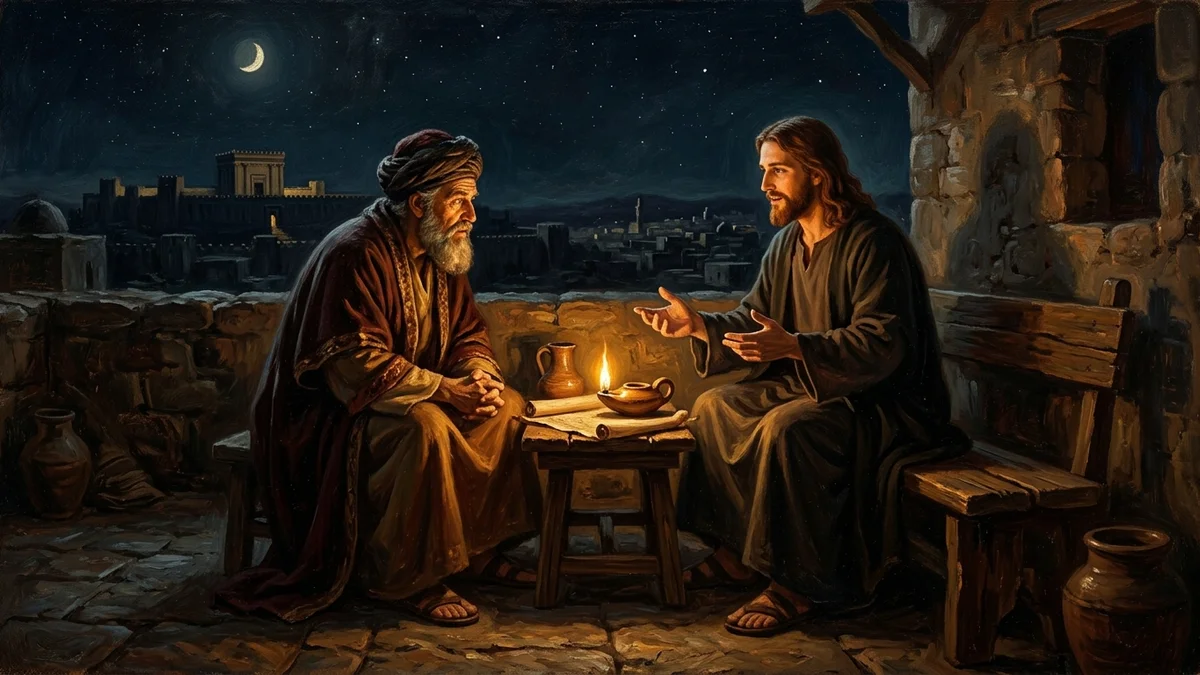
Tormented by conviction, yet guarded by social caution, Nicodemus refused to dismiss the miracles he had witnessed. He knew the prophecies of Daniel, Isaiah, and Malachi. The signs wrought by this Nazarene were neither demonic illusions nor cheap illusions; they bore the authentic stamp of heaven. Under the concealing mantle of midnight, wrapped in his scholarly mantle, Nicodemus slipped through the darkened, terraced alleys of Jerusalem to seek a private audience with Jesus.
1. The Midnight Inquirer: Courteous Flattery Meets Sovereign Truth
Stepping into the humble lodging illuminated by the soft flicker of an oil lamp, the aristocratic ruler opened the conversation with deferential rabbinic etiquette:
"Rabbi, we know that You are a teacher come from God; for no one can do these signs that You do unless God is with him." (John 3:2).
Nicodemus spoke not merely for himself but for a silent minority within the ruling council ("we know"). He was offering Jesus an olive branch—an elite academic validation. In the eyes of the Jerusalem establishment, granting a young artisan-turned-prophet the title of "divinely sent teacher" was a breathtaking concession.
Yet Jesus refused to negotiate within the confines of human compliments. He did not seek academic accreditation from the Sanhedrin, nor did He desire to be numbered among the great philosophical scribes of Judea. Cutting straight through the polite preamble, Christ pierced to the absolute core of the human condition with solemn covenantal authority:
"Most assuredly, I say to you, unless one is born again, he cannot see the kingdom of God." (John 3:3).
The Hebrew phrase rendered in Greek as Amēn, amēn legō soi ("Truly, truly, I say to you") marked an infallible divine decree. Jesus did not say that Nicodemus needed moral improvement, more rigorous Torah study, or refined philanthropic charity. He declared that even the most righteous, learned, and revered magistrate on earth was spiritually blind and completely barred from the kingdom of God without an ontological recreation.
2. The Linguistic Mystery of 'Anōthen': Born from Above
Nicodemus recoiled in utter bewilderment. As a descendant of Abraham and a strict Pharisee, he believed that his physical lineage and ceremonial obedience guaranteed his citizenship in the Messianic kingdom. In his confusion, the aging scholar took Jesus' words with wooden literalism:
"How can a man be born when he is old? Can he enter a second time into his mother's womb and be born?" (John 3:4).
Here, the theological brilliance of the Apostle John's original Greek text shines forth. Jesus had used the word ἄνωθεν (anōthen, Strong's G509). In Koine Greek, anōthen possesses a profound dual meaning: it signifies both "again / a second time" and "from above / from a heavenly source." Nicodemus heard only the temporal meaning ("a second physical birth"), which sounded biologically preposterous. But Jesus intended the heavenly meaning: a supernatural regeneration originating from God above!
Patiently, the Master unfolded the mystery:
"Most assuredly, I say to you, unless one is born of water and the Spirit, he cannot enter the kingdom of God. That which is born of the flesh is flesh, and that which is born of the Spirit is spirit." (John 3:5–6).
When Jesus spoke of being "born of water and the Spirit," He was not introducing an obscure ritual; He was calling Nicodemus back to the cornerstone promise of the New Covenant in Ezekiel 36:25–27: "Then I will sprinkle clean water on you, and you shall be clean; I will cleanse you from all your filthiness... I will give you a new heart and put a new spirit within you... I will put My Spirit within you and cause you to walk in My statutes."
Human reproduction yields only fallen human nature ("flesh is flesh"). No amount of cultural cultivation, rabbinic prestige, or ascetic discipline can transform the corrupt flesh of Adam into the holy nature required for God's presence. Only the supernatural washing of the Holy Spirit can impart the divine life of eternity.
3. The Sovereign Mystery of the Wind (Pneuma)
Noticing the furrowed brow of the Israelite teacher, Jesus pointed toward the invisible forces of the natural world:
"Do not marvel that I said to you, 'You must be born again.' The wind blows where it wishes, and you hear the sound of it, but cannot tell where it comes from and where it goes. So is everyone who is born of the Spirit." (John 3:7–8).
In both biblical Hebrew (ruach) and Greek (πνεῦμα - pneuma, Strong's G4151), the same word encompasses "wind," "breath," and "spirit." The wind is invisible, sovereign, and unstoppable. Man cannot command the northern gale, nor can he predict where the evening breeze will settle. Yet while the wind itself remains unseen, its dramatic effects—rustling olive leaves, bending cedar branches, cooling the parched skin—are undeniably real.
In identical fashion operates the Holy Spirit in regeneration. Spiritual rebirth cannot be engineered through human liturgies, ecclesiastical councils, or psychological willpower. The Holy Spirit moves with sovereign freedom, breathing supernatural resurrection life into dead souls according to the divine will.
Completely stripped of his intellectual self-assurance, the venerable member of the Sanhedrin could only whisper in awe:
"How can these things be?" (John 3:9).
Jesus offered a gentle yet devastating appraisal of institutional religion: "Are you the teacher of Israel, and do not know these things?" (John 3:10). The definite article in Greek (ho didaskalos tou Israēl) signified that Nicodemus was not merely one teacher among many, but held the national chair of orthodoxy. Yet, for all his mastery of the 613 Levitical precepts, he was illiterate concerning the internal, supernatural heartbeat of biblical redemption.
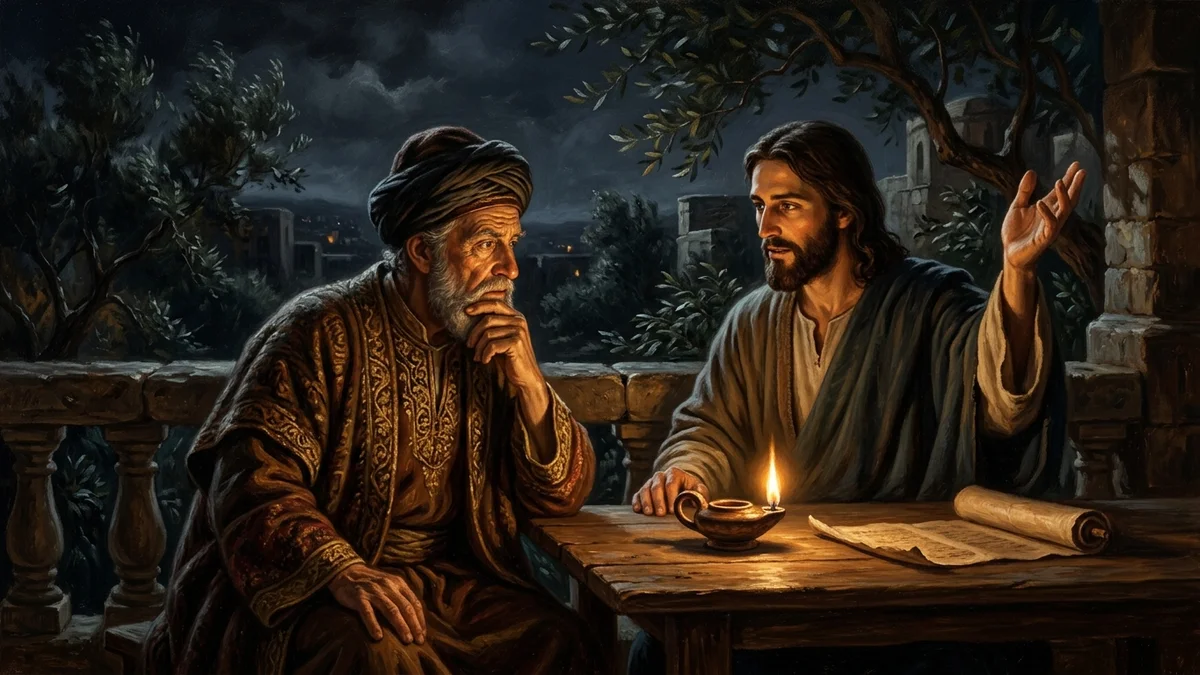 In the quiet midnight shadows of Jerusalem, Jesus explains the mystery of the Spirit and the typology of Moses' bronze serpent to the contemplative Sanhedrin ruler Nicodemus.
4. The Typology of the Wilderness: The Son of Man Lifted Up
To explain how this radical spiritual regeneration would be purchased and applied, Jesus led Nicodemus back fourteen centuries into the scorching sands of the Sinai wilderness:
"And as Moses lifted up the serpent in the wilderness, even so must the Son of Man be lifted up, that whoever believes in Him should not perish but have eternal life." (John 3:14–15).
This startling typological analogy referenced the harrowing narrative of Numbers 21:4–9. Rebel Israel had grumbled against God and Moses, despising the heavenly manna. In divine discipline, the Lord sent venomous serpents (*seraphim*) whose bites burned like fire through the encampment, leaving thousands writhing in agonized death. When the people repented, Yahweh did not immediately banish the vipers. Instead, He commanded Moses to fashion a replica of the very instrument of their judgment: a serpent forged of shining bronze, mounted high upon a wooden standard where all could behold it.
The divine prescription was astonishingly counterintuitive. The dying Israelite was not instructed to manufacture an antidote, perform ceremonial washings, or offer costly animal sacrifices. He had only to direct his failing eyes toward the lifted bronze serpent on the pole. Those who looked in obedient faith were instantly cured; those who refused the gaze perished in the dust.
Jesus declared that this historic crisis was a divine blueprint of His own impending cross! The Greek verb for "lifted up" (ὑψωθῆναι - hypsōthēnai, Strong's G5312) carries a magnificent Johannine double meaning: it refers both to the physical elevation of Christ upon the Roman timber of execution and His subsequent exaltation to the right hand of the Majesty on high!
The bronze serpent bore the visual form of the deadly snake, yet possessed no venom. In the same way, Jesus Christ appeared in the likeness of sinful flesh (Romans 8:3), yet without sin (2 Corinthians 5:21). Upon the cross of Golgotha, He would become the curse for us (Galatians 3:13), absorbing the deadly venom of the ancient serpent Satan and the righteous wrath of God against human transgression. Just as the bitten Israelites lived by looking upon the pole, every sinner dying of the venom of sin who looks upon the crucified and risen Christ in penitent faith receives instant, irreversible spiritual deliverance.
5. The Golden Verse: The Eternal Dimensions of Divine Love
Then, in words that have echoed across millennia as the supreme summary of human redemption, the Son of God unveiled the infinite motivation behind heaven's sacrifice:
"For God so loved the world that He gave His only begotten Son, that whoever believes in Him should not perish but have everlasting life." (John 3:16).
Every clause of John 3:16 is an ocean of unfathomable grace:
- The Fountain of Salvation: "For God so loved..." The Greek verb used is ἀγαπάω (agapaō, Strong's G25), denoting not a fleeting emotional impulse, but an unconditional, self-sacrificing, covenantal commitment of the will.
- The Scope of Salvation: "...the world" (κόσμος - kosmos, Strong's G2889). In 1st-century Jewish thought, rabbis taught that God loved Israel alone while looking upon the Gentile nations with wrath. Jesus demolished this nationalistic pride. God's redeeming love encompassed the entire rebellious, alienated, fallen human cosmos.
- The Sacrifice of Salvation: "...that He gave His only begotten Son." The word μονογενής (monogenēs, Strong's G3439) does not imply origin or creation; it signifies "unique, one-of-a-kind, irreplaceable." Abraham offered Isaac on Mount Moriah as a prophetic shadow (Genesis 22); God the Father gave His eternal, beloved, co-equal Son to be bruised for our iniquities.
- The Condition of Salvation: "...that whoever believes in Him..." Salvation is radically democratic and universally accessible. It is not limited to descendants of Abraham, scholars of the Sanhedrin, or ascetics of Qumran. "Whoever" (Greek: pas ho pisteuōn)—the thief on the cross, the broken tax collector, the weary Pharisee, the modern seeker—who entrusts their whole life to Christ is welcomed.
- The Deliverance of Salvation: "...should not perish..." (mē apolētai). Deliverance from eternal condemnation, the lake of fire, and spiritual destruction.
- The Gift of Salvation: "...but have everlasting life" (zōēn aiōnion). Not merely quantitative endless existence, but the qualitative, uncreated life of God Himself pulsating within the redeemed human heart.
Jesus immediately reinforced this declaration of mercy:
"For God did not send His Son into the world to condemn the world, but that the world through Him might be saved." (John 3:17).
The Messiah had not arrived as a fierce conquering warlord to execute immediate vengeance upon Roman legions or errant Pharisees. His primary advent was an emissary mission of boundless redemption.
6. The Great Verdict: The Crisis of Light and Darkness
Yet, this ocean of grace brings with it an unavoidable moral dividing line. Christ explained the judicial crisis (*krisis*) confronting humanity:
"He who believes in Him is not condemned; but he who does not believe is condemned already, because he has not believed in the name of the only begotten Son of God. And this is the condemnation, that the light has come into the world, and men loved darkness rather than light, because their deeds were evil." (John 3:18–19).
Man does not stand neutral before God awaiting a future court verdict; without Christ, humanity already sits under the verdict of condemnation inherited from Adam. The ultimate reason men reject Jesus is not lack of historical evidence or philosophical deficiency; it is moral hostility. The brilliant, pure light of Christ (to phōs) exposes the secret self-idolatry, lust, greed, and hypocrisy harbored in the dark recesses of human hearts.
"For everyone practicing evil hates the light and does not come to the light, lest his deeds should be exposed. But he who does the truth comes to the light, that his deeds may be clearly seen, that they have been done in God." (John 3:20–21).
To "do the truth" means stepping out from behind the masks of religious respectability and self-justification, allowing the searing, healing light of Christ to search and cleanse the innermost soul.
7. The Transformation of Nicodemus: From Shadows to Golgotha
The Gospel narrative does not record Nicodemus' immediate verbal reply that night. He stepped out of the upper room and walked back through the quiet streets into the temple precincts, forever haunted and transformed by the words of the Galilean Prophet. The seed of the living Word had been sown deep within his aristocratic soul.
Over the subsequent three years, the Gospel of John traces the gradual, courageous blossoming of Nicodemus' faith:
First, during the Feast of Tabernacles (John 7:50–52), when the Sanhedrin mobilized temple officers to arrest Jesus and bitterly denounced Him, it was Nicodemus who boldly rose to challenge his fellow judges: "Does our law judge a man before it hears him and knows what he is doing?" He stood as a lone voice of justice against the murderous tide of his own peers.
Finally, at the catastrophic climax of Good Friday, when Jesus hung dead upon the cross and His terrified disciples had scattered in the shadows, Nicodemus stepped entirely into the brilliant light of day (John 19:38–42). Alongside Joseph of Arimathea, he approached the Roman governor Pontius Pilate to beg for the body of the crucified King.
With open defiance of the Sanhedrin, Nicodemus brought an astonishing, royal tribute: a mixture of myrrh and aloes weighing about a hundred Roman pounds (nearly seventy-five pounds or thirty-four kilograms)—a quantity reserved exclusively for the burial of emperors and kings! Tenderly washing the dried blood from the pierced hands, feet, and brow of Jesus, Nicodemus wrapped the holy body in fine linen with sweet spices and laid Him in a virgin rock tomb.
The man who had once crept to Jesus under the cowardly cloak of midnight had been born from above. Gazing upon the Son of Man lifted up on the cross, the elite ruler of Israel found the eternal love of God, surrendered his earthly prestige, and entered the everlasting kingdom of the King of Kings.
Biblical Keywords & Theological Roots
From above, from a higher place, from heaven, or anew / again; carrying a vital double meaning in John 3:3 of heavenly divine origin and spiritual rebirth.
Spirit, breath, or wind; signifying invisible sovereign divine power and the third Person of the Trinity who regenerates human hearts.
Only begotten, unique, one-of-a-kind, sole representative of a family; expressing Christ's peerless, eternal, divine Sonship.
To love unconditionally, sacrificially, and covenantally; a deliberate choice of divine benevolence giving up what is most precious for the unworthy.
Ancient Near Eastern & Archaeological Context
During the reign of Tiberius Caesar and the Judean governorship of Pontius Pilate (c. A.D. 27), the religious and civil government of Jerusalem was administered by the Great Sanhedrin (Beth Din HaGadol). Comprising 70 aristocratic Sadducean chief priests, elders, and leading Pharisaic scribes, this supreme council convened in the Hall of Hewn Stones within the temple courts. Nicodemus was one of their most eminent teachers, bearing the title 'ho didaskalos tou Israēl' (the teacher of Israel). In first-century Rabbinic Judaism, scholars debated whether circumcision and genealogical descent from Abraham were sufficient for entrance into Olam Ha-Ba (the World to Come). Jesus shattered this assumption by declaring that biological heritage and ceremonial fidelity were entirely inadequate; every person, including the supreme teacher of Israel, must experience sovereign supernatural regeneration through the Holy Spirit.
Support Independent Biblical Research
Did this study bless you? Help support our independent bilingual research and interactive visual Bible tools.
⚡ Fast Facts
- Nicodemus was not merely a local rabbi but an 'archōn' (ruler) and member of the Great Sanhedrin—the supreme tribunal of 70 Jewish elders presiding over religious and civil jurisprudence in Jerusalem
- The Greek term 'anōthen' (ἄνωθεν) carries a deliberate double meaning: it signifies both 'born again / a second time' and 'born from above / of heavenly origin'
- Jesus referred to Numbers 21:4–9, where Moses mounted a bronze serpent on a pole; looking upon the lifted serpent spared bitten Israelites from deadly venom, foreshadowing Christ bearing sin on the cross
- Later in John's Gospel, Nicodemus openly defied his peers: he defended Jesus' legal rights before the Sanhedrin (John 7:50–51) and donated an exorbitant royal gift of 100 Roman pounds of myrrh and aloes for Jesus' burial (John 19:39)
❓ Frequently Asked Questions (FAQs)
Historically, Nicodemus was a prominent aristocratic member of the Sanhedrin whose public reputation and official standing would have been imperiled by an open association with the controversial Galilean prophet who had just cleansed the temple courts. Additionally, Jewish rabbinic tradition considered the quiet, uninterrupted hours of the night as the ideal environment for deep theological contemplation and Torah study. Spiritually, the Gospel of John uses 'night' as a rich theological motif representing spiritual darkness and searching before encountering Christ, the True Light (John 1:5; 3:19; 13:30).
Rather than referring to Christian baptism or physical amniotic fluid, Jesus was speaking to a master of the Old Testament Scriptures using the prophetic imagery of Ezekiel 36:25–27. In that passage, Yahweh promised that under the New Covenant, He would sprinkle clean water upon His people to wash away ritual filthiness and place His Holy Spirit within their hearts to give them a new nature. To enter God's kingdom, human pedigree, circumcision, and moral strivings are insufficient; one must undergo divine spiritual purification and supernatural regeneration imparted by the Holy Spirit.
In Numbers 21, the Israelites sinned against God and were afflicted with lethal venom from fiery serpents. God commanded Moses to fashion a bronze serpent—fashioned in the visual likeness of the curse yet possessing no poison—and lift it high on a timber pole. Anyone who looked upon it in obedient faith was instantly saved from physical death. In the same way, Jesus was made in the likeness of sinful flesh (Romans 8:3) and lifted up (*hypsōthēnai*) upon the timber of the cross to bear the curse of sin (Galatians 3:13). Whoever looks upon the crucified and risen Christ in penitent faith is rescued from eternal spiritual death and granted everlasting life.