Abraham had reached a serene and venerable old age, richly blessed by Yahweh in all things. Yet, amid the peace of Beersheba, an urgent spiritual responsibility weighed heavily upon the aged patriarch's soul. Sarah was buried in the cave of Machpelah, and Isaac—the sole heir of the miraculous covenant promise—remained unwed at forty years of age. Surrounded by Canaanite clans immersed in idolatry, moral degradation, and child sacrifice, Abraham knew that allowing Isaac to take a local pagan wife would poison the spiritual wellspring of the covenant. A sacred mission had to be launched to secure a bride from his ancestral kin who feared the living God.
1. The Solemn Oath beneath the Patriarchal Thigh
Abraham summoned the oldest and most trusted steward of his household—the man who managed all his vast possessions (historically identified as Eliezer of Damascus). The patriarch commanded him to perform an ancient, inviolable covenant ritual:
'Please, put your hand under my thigh, and I will make you swear by the LORD, the God of heaven and the God of the earth, that you will not take a wife for my son from the daughters of the Canaanites, among whom I dwell; but you shall go to my country and to my family, and take a wife for my son Isaac.' (Genesis 24:2-4).
In ancient Semitic tradition, placing a hand beneath the patriarch's thigh invoked the sacred source of life and the future seed through whom the Messianic promise would flow. The servant, acutely aware of geopolitical and logistical realities, asked a practical question: What if the woman refuses to leave her homeland and follow me across five hundred miles of desert into this foreign land? Must I take Isaac back to the land from which you came?
Abraham's response was swift and uncompromising: 'Beware that you do not take my son back there!' (Genesis 24:6). To send Isaac back to Mesopotamia would be an act of apostasy, reversing the divine exodus out of Ur and abandoning the Promised Land. Abraham proclaimed with unshakeable prophetic confidence: 'The LORD God of heaven, who took me from my father's house... He will send His angel before you, and you shall take a wife for my son from there.' If the woman refused, the servant would be released from his oath. But Isaac was never to leave the land of promise.
2. The Desert Caravan and the Prayer at the Well
The servant equipped a magnificent royal caravan of ten camels, laden with choice treasures, delicate gold and silver jewelry, costly garments, and dried provisions from his master's estate. Embarking northward across the Jordan Rift, traversing the Syrian desert, the expedition journeyed roughly five hundred grueling miles until they arrived at the outskirts of the City of Nahor in northwestern Mesopotamia (Aram-Naharaim).
It was evening—the time when the heat of the day broke and the young women of the city customarily ventured out to draw water from the communal cistern. The servant knelt his weary camels outside the town beside the well. Fully aware that the fate of the covenant lineage rested upon his shoulders, the servant did not rely on worldly charm or human calculation. He bowed his head and poured out a model prayer of faith:
'O LORD God of my master Abraham, please give me success this day, and show kindness (Hesed) to my master Abraham. Behold, here I stand by the well of water, and the daughters of the men of the city are coming out to draw water. Now let it be that the young woman to whom I say, "Please let down your pitcher that I may drink," and she says, "Drink, and I will also give your camels a drink"—let her be the one You have appointed for Your servant Isaac. And by this I will know that You have shown kindness to my master.' (Genesis 24:12-14).
This fleece was brilliant in its theological and practical wisdom. It did not seek an arbitrary magic sign, but tested moral character, work ethic, and selfless hospitality. A single thirsty camel coming off a desert journey can drink up to twenty-five gallons of water in a few minutes. To water ten camels required drawing over two hundred gallons of water by hand in a heavy earthenware jug from a subterranean spring, ascending and descending stone steps dozens of times. The woman who would voluntarily undertake this backbreaking labor for an unknown foreigner was a woman of extraordinary vitality, humility, and sacrificial kindness.
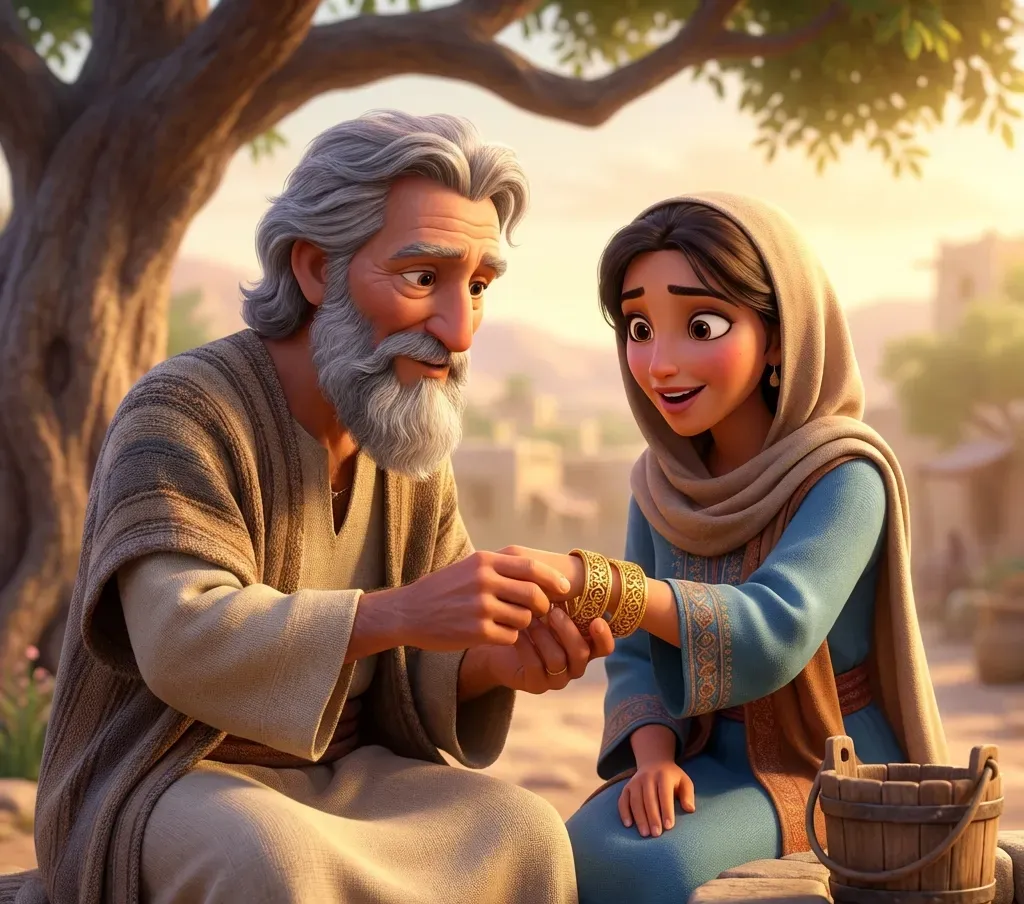 Rebekah watered all ten camels with joyful generosity; in awe, the servant bestowed golden nose rings and bracelets upon her wrists.
3. Rebekah at the Well: Extravagant Generosity
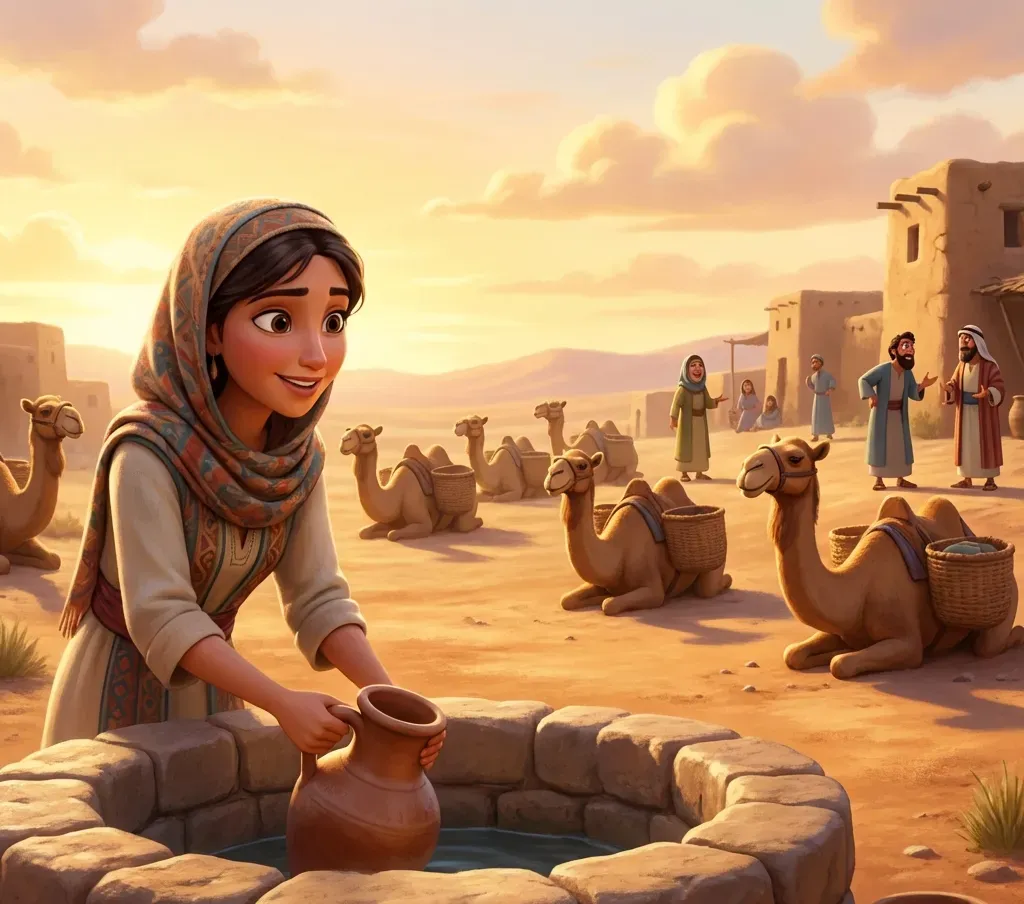
Before the servant had even finished speaking in his heart, providence unfolded with breathtaking precision. A radiant young maiden stepped toward the well, bearing a heavy clay pitcher gracefully upon her shoulder. The narrator notes that she was exceedingly beautiful, a virgin whom no man had known. She descended into the spring, filled her jar, and came up.
The servant ran to meet her and said, 'Please let me drink a little water from your pitcher.' She immediately lowered her pitcher onto her hand and said with gentle courtesy, 'Drink, my lord.' As soon as he had finished drinking, without a moment's hesitation, she looked at the panting herd and spoke the exact words of the servant's prayer: 'I will draw water for your camels also, until they have finished drinking.'
She quickly emptied her jar into the watering trough, ran back to the well again and again, drawing bucket after bucket until all ten massive camels were completely satisfied. The servant stood in absolute silence, watching her with breathless wonder, discerning whether the Lord had made his journey prosperous (Hitzliach) or not.
When the camels had finished drinking, the man took out a heavy gold nose ring weighing half a shekel and two ornate gold bracelets weighing ten shekels for her wrists. He asked, 'Whose daughter are you? Is there room in your father's house for us to lodge?' When she revealed that she was the daughter of Bethuel, son of Milcah, the wife of Nahor—Abraham's own biological brother—the servant bowed his head to the earth and worshiped Yahweh, weeping in gratitude: 'Blessed be the LORD God of my master Abraham, who has not forsaken His mercy and His truth toward my master! As for me, being on the way, the LORD led me to the house of my master's brethren!' (Genesis 24:27).
4. The Negotiations and the Bold Decision: 'I Will Go'
Rebekah ran home to her mother's household and recounted the astonishing events. Her brother Laban, captivated by the sight of the gold jewelry sparkling upon his sister's wrists, rushed out to the well and greeted the traveler with lavish Eastern hospitality: 'Come in, O blessed of the LORD! Why do you stand outside? For I have prepared the house, and a place for the camels.'
Food was set before the travelers, but the servant refused to eat a single morsel until he had declared his business: 'I will not eat until I have told my errand.' With eloquence inspired by the Holy Spirit, he recounted Abraham's vast wealth, the miraculous birth of Isaac in Sarah's old age, the solemn oath under the patriarch's thigh, his specific prayer at the communal well, and Rebekah's immediate, word-for-word fulfillment.
Laban and Bethuel were utterly silenced by the unmistakable hand of God: 'The thing comes from the LORD; we cannot speak to you either bad or good. Here is Rebekah before you; take her and go, and let her be the wife of your master's son, as the LORD has spoken.' The servant brought out treasures of silver, gold, and costly garments, bestowing them upon Rebekah, her mother, and her brother.
The following morning, the servant requested immediate departure to return to his master. But Laban and Rebekah's mother hesitated, seeking to delay her departure for at least ten days. The servant implored them: 'Do not hinder me, since the LORD has prospered my way.' Recognizing that the ultimate decision belonged to the bride, they called Rebekah and asked the defining question: 'Will you go with this man?'
Without a trace of fear, doubt, or delay, the young woman replied with magnificent, resolute faith: 'Elekh'—'I will go.' She was willing to sever ties with her childhood home, leave her family behind, and traverse five hundred miles of hazardous desert to marry a man she had never laid eyes on, anchored solely by the Word of the Lord.
5. Eventide in the Negev: The Meeting of Bride and Bridegroom
Weeks of dusty caravan travel drew to a close as the entourage approached the southern Negev, near the desert well of Beer-Lahai-Roi ('The Well of the Living One Who Sees Me'). The sun was sinking behind the western dunes, bathing the arid landscape in amber and crimson light.
Isaac had gone out into the open field to meditate (Hebrew: Lasuach—to pray, ponder, and seek the face of God) at eventide. As he lifted his eyes, he beheld the distant silhouettes of camels approaching along the horizon. Simultaneously, Rebekah lifted her eyes and saw Isaac walking through the fields. She dismounted from her camel and asked the servant, 'Who is this man walking in the field to meet us?' The servant answered, 'It is my master.'
Rebekah took her veil and covered herself with humble modesty and reverent beauty. The servant recounted to Isaac all the marvelous works that Yahweh had accomplished. Isaac led Rebekah into the tent of his late mother Sarah. He took Rebekah, and she became his covenant wife, and he loved her deeply. And the sacred text concludes with quiet emotional beauty: 'So Isaac was comforted after his mother's death.'
Theological Summary:
- The Sovereignty of Divine Providence: Genesis 24 demonstrates that God orchestrates human history through unseen, meticulous providential alignment. God answers prayer before it is fully formed upon human lips (Isaiah 65:24).
- Typology of the Holy Spirit and the Bride of Christ: The unnamed servant represents the Holy Spirit sent from the Father to seek a spotless Bride (the Church) for the Beloved Son (Jesus). The Spirit bestows the spiritual gifts of the Father upon the Bride and safely escorts her through the desert of this world to meet the Bridegroom.
- Faith as Surrender and Departure: Rebekah's courageous declaration 'I will go' mirrors Abraham's original departure from Ur. Genuine faith requires an unhesitating departure from worldly ties to enter covenant intimacy with God.
- Sanctity of Covenant Marriage: Marriage in Scripture is an unbreakable covenant ordained to reflect Christ and His Church (Ephesians 5:31-32). Isaac and Rebekah's union was grounded in prayer, purity, mutual love, and divine purpose.
Biblical Keywords & Theological Roots
Steadfast love, lovingkindness, unmerited covenant loyalty, or persistent mercy; central theme of Genesis 24 describing God's covenant fidelity to Abraham.
Truth, faithfulness, firmness, reliability, and stability; often paired with Hesed to emphasize God's absolute trustworthiness.
To cause to prosper, grant divine breakthrough, or make a journey successful under God's sovereign oversight.
A solemn sacred oath, sworn pledge, or covenant ratification binding parties before the living God.
To comfort, console, ease sorrow, or bring deep emotional peace after grief; describing Isaac's consolation in Rebekah.
Ancient Near Eastern & Archaeological Context
In the second millennium BC, marriage in the ancient Near East was not an individualistic romantic pursuit, but a comprehensive covenant alliance between families, legal clans, and future generations. The selection of a bride dictated inheritance rights, religious continuity, and social preservation. Abraham's residence in the Negev of southern Canaan positioned him in proximity to Canaanite clans. However, to preserve the spiritual purity of the Abrahamic covenant line—uncontaminated by Canaanite polytheism and child-sacrifice cults—Abraham dispatched his chief steward to his ancestral homeland in Paddan-Aram (northwestern Mesopotamia, around the ancient city of Haran, roughly 500 miles away).
Caravan travel across the Fertile Crescent was perilous, expensive, and logistically demanding. The steward commanded an aristocratic entourage of ten camels laden with costly textiles, silver, gold jewelry, and culinary delicacies. In ancient arid landscapes, the community well (*be'er*) was the legal and social nerve center of pastoral life. Women customarily gathered at dusk to draw water for household needs. The arrival of ten camels—which could consume between 200 to 250 gallons of water after long transit—constituted a massive physical demand. The steward's fleece strategically tested whether a prospective matriarch possessed the exceptional stamina, hospitality (*theoxeny*), and generous spirit required to manage the massive pastoral wealth and domestic responsibilities of the patriarchal estate.
Practical Discipleship & Spiritual Application
- Trusting God's Unseen Guidance in Life Decisions: The servant prayed specifically, watched expectantly, and surrendered the outcome entirely to God. When making major life decisions—careers, relationships, or marriages—we must seek God's providential guidance rather than leaning on carnal impulses.
- The Radiance of Extravagant, Cheerful Service: Rebekah did not merely fulfill the bare minimum; when asked for a sip of water, she voluntarily offered to draw water for all ten camels until they finished drinking. God's favor rests upon those who go the extra mile with cheerful, humble generosity.
- The Courage to Leave the Familiar for the Kingdom: When faced with a life-altering choice, Rebekah declared, 'I will go.' True faith requires the courageous willingness to step out of comfortable, familiar worldly surroundings to embrace God's higher covenant calling.
- God's Redemptive Comfort in Seasons of Loss: Genesis 24 concludes by noting that Isaac brought Rebekah into Sarah's tent, loved her, and was comforted after his mother's death. God tenderly weaves new joy, companionship, and healing into our lives after seasons of profound grief.
⚡ Fast Facts
- The Longest Chapter in Genesis: Genesis 24 contains 67 verses, making it the longest single narrative chapter in the book of Genesis, underscoring the vital theological importance of preserving the holy covenant lineage.
- The Unnamed Servant's Typology: Abraham's trusted steward (traditionally Eliezer of Damascus) is never explicitly named in the entire 67 verses; he is simply 'the servant', serving as a magnificent biblical type of the Holy Spirit who draws no attention to Himself, but seeks and adorns the Bride of Christ.
- Heroic Labor at the Well: Watering ten thirsty camels after a trans-desert trek is an enormous feat; a single thirsty camel can drink up to 25 gallons of water in minutes, meaning Rebekah voluntarily drew up to 200–250 gallons of water by hand in heavy earthenware pitchers!
- The Covenant Oath under the Thigh: Placing the hand beneath the patriarch's thigh was an ancient, solemn covenant ritual invoking the source of patriarchal vitality and the future seed through whom the Messianic promise would flow.
❓ Frequently Asked Questions (FAQs)
The prohibition was not racial or ethnic, but profoundly religious and spiritual. The Canaanites were entrenched in violent pagan polytheism, child sacrifice to Molech, and corrupt ritual practices. A Canaanite wife would inevitably introduce idolatry and syncretism into the covenant household, compromising the holy lineage through which the redemptive knowledge of the true God and the promised Messiah was ordained to come.
The servant's fleece—asking that the chosen woman offer water not only to him, but also to all ten camels—was brilliant. It did not merely seek a supernatural coincidence; it actively tested moral character. A woman who would voluntarily undertake the backbreaking labor of drawing hundreds of gallons of water for a foreign stranger's herd demonstrated extraordinary hospitality, boundless energy, sacrificial humility, and a servant's heart worthy of matriarchal leadership.
When asked by her family whether she would depart immediately with the servant without having seen Isaac, Rebekah responded with unhesitating faith: 'I will go' (Elekh). Typologically, she represents the Church—the Bride of Christ—who hears the testimony of the Holy Spirit, receives the earnest gifts of grace, and willingly leaves behind her earthly kindred by faith to journey through the wilderness to meet the Bridegroom she has not yet seen.