During the twilight decades of the era of the Judges—a lawless, fractured period when the moral fabric of Israel had unraveled and every man did what was right in his own eyes—the spiritual condition of the twelve-tribe confederacy had reached catastrophic stagnation. In the rugged hill country of Ephraim, at the central sanctuary city of Shiloh, the sacred Tent of Meeting housing the Ark of the Covenant had fallen into tragic domestic degradation. Eli, the aged High Priest and judge of Israel, was growing physically blind and spiritually desensitized; his two sons, Hophni and Phinehas, operated as ruthless, predatory clerics, treating the sacrifices of Yahweh with contempt by forcibly extorting raw meat from worshippers and committing gross sexual immorality at the very doorway of the Tabernacle. Scripture records the heartbreaking spiritual famine of the epoch: "And the word of Yahweh was rare in those days; there was no widespread revelation" (1 Samuel 3:1).
Yet in the quiet hills of Ramathaim-Zophim, far from the ecclesiastical corruption of the sanctuary, God was orchestrating a quiet miracle through the tears of a broken woman. A godly Levite named Elkanah had two wives: the name of the one was Hannah, and the name of the other was Peninnah. Peninnah had borne sons and daughters, but Hannah was barren, for Yahweh had closed her womb. In the ancient Near East, barrenness was an acute domestic curse, exposing a woman to social stigma, legal vulnerability, and relentless psychological cruelty. Year after year, when Elkanah took his household up to Shiloh to sacrifice to Yahweh of Hosts, the domestic friction exploded. Elkanah loved Hannah with tender affection, giving her a double portion of the sacrificial meat, but Peninnah acted as an unmerciful adversary, provoking Hannah bitterly to irritate her and mock her childlessness. Overwhelmed with sorrow, Hannah could only weep and refuse to eat.
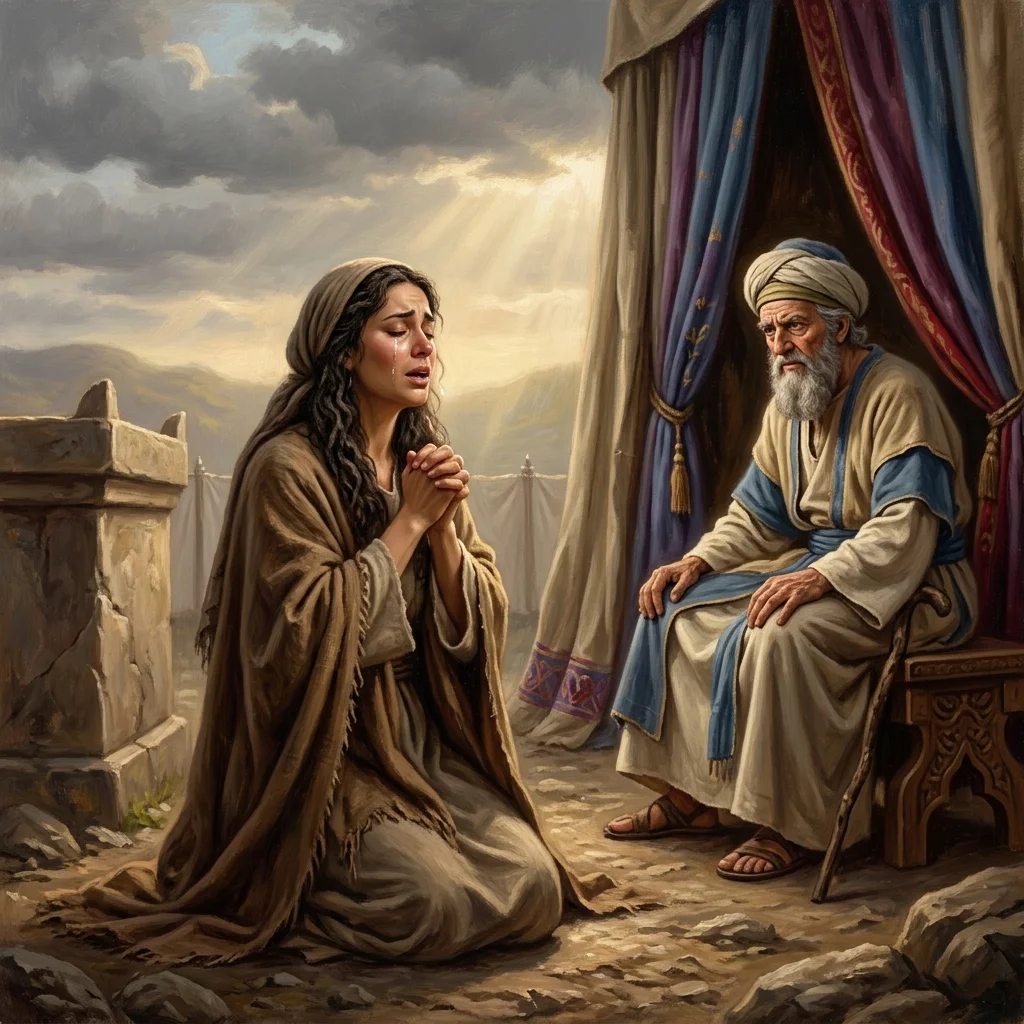
During one such pilgrimage to Shiloh, after the sacrificial feast had concluded, Hannah arose in the quiet of the evening and made her way toward the entrance of the Tabernacle. Her grief was so overwhelming that she could no longer contain it within human decorum. Scripture describes her desperate agony: "And she was in bitterness of soul, and prayed to Yahweh and wept in anguish!" (1 Samuel 1:10). Eli the High Priest was sitting upon his official seat by the doorpost of the sanctuary, watching the solitary worshipper with heavy, half-blind eyes.
Hannah's prayer broke all established liturgical norms. She did not recite loud, rhythmic chants or demand public attention. Instead, she spoke in her heart; her lips moved in silent, convulsive trembling, but no audible sound issued from her throat. In that place of wordless travail, Hannah uttered an extraordinary, life-altering Nazirite vow (*neder*): "O Yahweh of Hosts, if You will indeed look on the affliction of Your maidservant and remember me, and not forget Your maidservant, but will give Your maidservant a male child, then I will give him to Yahweh all the days of his life, and no razor shall come upon his head!" (1 Samuel 1:11).
Watching her lips twitch without sound, Eli concluded she was drunk from the festival wine. Stepping forward with self-righteous indignation, the High Priest rebuked her: "How long will you be drunk? Put your wine away from you!" But Hannah replied with sublime, gentle dignity: "No, my lord, I am a woman of sorrowful spirit. I have drunk neither wine nor intoxicating drink, but have poured out my soul before Yahweh! Do not consider your maidservant a wicked woman, for out of the abundance of my complaint and grief I have spoken until now."
Pierced by her pure integrity, Eli's conscience awakened. The High Priest pronounced a prophetic benediction: "Go in peace, and the God of Israel grant your petition which you have asked of Him!" Hannah answered, "Let your maidservant find favor in your sight." She went her way, ate her food, and her face was no longer sad. The heavy burden of barrenness had been transferred into the hands of the living God.

Elkanah and Hannah returned to their home in Ramah. In the fullness of time, Yahweh remembered Hannah. She conceived and gave birth to a son, naming him Samuel (*Shemu'el*)—proclaiming with radiant gratitude: "Because I have asked him of Yahweh!" When Elkanah went up the following year for the annual sacrifice, Hannah remained in Ramah, nursing the boy, resolving: "Not until the child is weaned; then I will take him, that he may appear before Yahweh and remain there forever."
When the child was weaned—at roughly three years of age—Hannah undertook the monumental journey to Shiloh, bringing three bulls, an ephah of flour, and a skin of wine. Leading the toddler by the hand into the sanctuary, she brought him before Eli. The aged priest looked at the glowing mother, who declared: "O my lord! As your soul lives, my lord, I am the woman who stood by you here, praying to Yahweh. For this child I prayed, and Yahweh has granted me my petition which I asked of Him! Therefore I also have lent him to Yahweh; as long as he lives he shall be lent to Yahweh!" (1 Samuel 1:26-28). And they worshipped Yahweh there.
Then Hannah opened her mouth in one of the most sublime theological canticles in all of Holy Scripture (1 Samuel 2:1-10)—an inspired hymn of praise that served as the direct literary and prophetic model for the Magnificat of the Virgin Mary in Luke 1. Hannah sang of a holy God who reverses human destinies: breaking the bows of the mighty, feeding the hungry, raising the poor out of the dust, and setting them among princes. Prophetically gazing across the centuries, Hannah uttered the very first reference in the Bible to God's 'Anointed King'—the *Mashiach* / Messiah: "He will give strength to His king, and exalt the horn of His anointed!" (1 Samuel 2:10).
Leaving her young child in the care of Eli at Shiloh, Hannah returned to Ramah. Each year, when she came up with Elkanah for the sacrifice, she brought Samuel a little sleeveless robe (*me'il qaton*) that she had lovingly woven with her own hands, marveling as her consecrated boy grew in stature and in favor with Yahweh and men. The Lord blessed Hannah with three more sons and two daughters.
Young Samuel ministered before Yahweh, girded with a sacred linen ephod (*ephod bad*). While Eli's sons brought divine judgment upon their house by desecrating the offerings, Samuel's heart remained spotless, consecrated, and receptive. One fateful night, when Eli was lying down in his quarters and his eyes had grown too dim to see, young Samuel lay sleeping inside the Tabernacle sanctuary near the Ark of God, where the golden seven-branched Menorah (*ner Elohim*) was burning in the quiet hours before dawn.
Suddenly, a voice resonated through the sacred silence: "Samuel!" Thinking it was his aged mentor, the boy leaped up, ran to Eli's bedside, and said: "Here am I (Hineni), for you called me!" Eli answered, "I did not call; lie down again." A second time, the voice called: "Samuel!" Again the obedient boy ran to Eli: "Here am I, for you did call me!" But Eli answered, "I did not call, my son; lie down again." At that time, Samuel did not yet personally know the prophetic voice of Yahweh, nor was the word of Yahweh yet revealed to him.
When the voice called a third time, "Samuel!", the boy ran once more to Eli. Finally, the spiritual perception of the old High Priest was triggered: Eli perceived that Yahweh was calling the child! Eli instructed Samuel: "Go, lie down; and it shall be, if He calls you, that you must say, 'Speak, Yahweh, for Your servant hears!'"
Samuel went and lay down in his place. Then Yahweh came, stood, and called as at other times: "Samuel! Samuel!" The young boy answered with trembling reverence: "Speak, for Your servant hears!"
That night, heaven broke its long silence. Yahweh revealed to Samuel the terrifying judgment about to fall upon the house of Eli because of the unbridled blasphemy of his sons. In the morning, Samuel opened the doors of the house of Yahweh, afraid to tell Eli the vision. But Eli demanded the truth, and Samuel concealed nothing. The aged priest bowed his head: "It is Yahweh. Let Him do what seems good to Him."
Samuel grew, and Yahweh was with him, letting none of his words fall to the ground. From Dan in the far north to Beersheba in the deep south, all Israel recognized that young Samuel had been established as a prophet of Yahweh. The spiritual lamp had not gone out; out of the tears of a praying mother and the obedience of a consecrated child, God raised up the prophet who would anoint King David and herald the dawn of Israel's golden age!
Biblical Keywords & Theological Roots
Samuel; traditionally understood as 'Heard of God' (from 'shama' [to hear] and 'El' [God]) or 'Name of God'. Commemorating Hannah's petition: 'Because I have asked him of Yahweh.'
A solemn vow or sacred promise made voluntarily to God, consecrated by an oath. Hannah vowed to dedicate her son to lifelong Nazirite service without a razor touching his head.
Shiloh; meaning 'Place of rest, tranquility, peace'. The ancient central sanctuary in Ephraim where the Tabernacle and Ark of the Covenant resided throughout the Judges era.
The Lamp of God; referring to the seven-branched golden Menorah burning inside the Holy Place of the Tabernacle, kept fueled through the night until dawn by the priests.
Here am I! An expression of total, unhesitating readiness, complete availability, and humble surrender to the divine voice, spoken by Abraham, Moses, and young Samuel.
Ancient Near Eastern & Archaeological Context
The narrative of 1 Samuel 1–3 dates to the terminal phase of the Judges era (circa 1075–1050 BC), immediately prior to the emergence of the United Monarchy under Saul and David. Shiloh (modern Khirbet Seilun in the Ephraimite hill country) served as the primary religious capital and amphictyonic sanctuary of the twelve-tribe confederacy, where the Ark of the Covenant and the Mosaic Tabernacle had rested since the days of Joshua (Joshua 18:1). Archaeological excavations directed by Israel Finkelstein and the Associates for Biblical Research (ABR) have uncovered massive Middle/Late Bronze fortification terraces at Shiloh, alongside a designated northern platform whose rectangular dimensions align remarkably with the biblical Tabernacle court. Extensive deposits of Early Iron Age ceramic colluvium and faunal remains—predominantly unblemished right-side sheep and goat bones from kosher sacrificial feasting (Leviticus 7:32)—corroborate the biblical portrait of a functioning cultic center. The spiritual degeneration described in the text, where Eli's sons Hophni and Phinehas violently commandeered sacrificial portions and engaged in sexual misconduct at the entrance of the tent of meeting (1 Samuel 2:12-22), highlights an urgent leadership crisis that necessitated the bypassing of the corrupt hereditary priesthood in favor of an independently called prophetic office.
Practical Discipleship & Spiritual Application
- Pour Out Your Heart Instead of Harboring Bitterness: When provoked by life's cruel circumstances or critical people, do not retaliate in anger or retreat into despair. Like Hannah, take your deepest anguish directly to the altar of God and pour out your soul in raw, honest prayer.
- Surrender God's Blessings Back into His Kingdom: When God answers your prayers with financial breakthroughs, children, or career opportunities, beware of idolatrous possessiveness. Faithfully dedicate the fruit of your miracles back to Yahweh's service.
- Remain Pure Amidst Institutional Compromise: Young Samuel ministered faithfully in Shiloh despite the scandalous greed and immorality of Hophni and Phinehas around him. You can remain holy and blameless in a corrupt workplace, culture, or environment when your eyes are fixed solely on God.
- Cultivate the Posture of 'Speak, Lord, for Your Servant Hears': In a noisy world filled with competing distractions, quiet your spirit in the secret place of prayer. Train your heart to listen to the promptings of the Holy Spirit with immediate, childlike obedience: 'Hineni—Here am I!'
⚡ Fast Facts
- Elkanah was an Ephraimite Levite from Ramathaim-Zophim who loved Hannah deeply, giving her a double portion of the sacrificial meat despite her barrenness (1 Samuel 1:1-5).
- Eli the High Priest initially mistook Hannah's silent, weeping, lip-moving prayer for drunken stupor (1 Samuel 1:13-14).
- Samuel's name (*Shemu'el*) commemorates Hannah's petition: 'Because I asked him of Yahweh' (1 Samuel 1:20).
- Hannah's prophetic prayer in 1 Samuel 2:10 contains the very first mention of the word 'Messiah' (*Mashiach* - 'His Anointed') in the entire Hebrew Bible.
❓ Frequently Asked Questions (FAQs)
Eli's astonishing misjudgment of Hannah's prayer (1 Samuel 1:13-14) provides a tragic diagnostic window into the spiritual atrophy of Shiloh. In the ancient world, worship was typically loud, communal, and ritualized; silent, contemplative prayer where only the lips moved in deep inner agony was virtually unheard of in public sanctuaries. Furthermore, the annual pilgrimage festivals at Shiloh were often tainted by gluttony, drunkenness, and carnal revelry—conduct actively indulged by Eli's own corrupt priest-sons, Hophni and Phinehas (1 Samuel 2:12-17). Eli was so accustomed to seeing carnal, drunken women carousing after festival meals that when he witnessed a truly broken, desperate woman pouring out her heart in the Holy Spirit, his spiritually desensitized eyes could only register intoxication. Hannah's gentle, respectful defense ('No, my lord, I am a woman of sorrowful spirit') awakened Eli's conscience, prompting him to pronounce a prophetic blessing.
Young Samuel was clothed in a linen ephod (*ephod bad*), which was the distinctive vestment worn by officiating Levitical priests (and later by King David when dancing before the Ark in 2 Samuel 6:14). Though only a young boy, Samuel was actively serving as an acolyte before the presence of Yahweh, untainted by the corrupt habits of Eli's adult sons. Moreover, Scripture tenderly records that each year, when Hannah and Elkanah came up for the annual sacrifice, his mother brought him a little seamless robe (*me'il qaton*) that she had lovingly woven with her own hands. In ancient Israel, the *me'il* was the garment of dignity, nobility, and prophetic authority (1 Samuel 15:27; 28:14). As Samuel grew physically, Hannah wove a larger robe each year, symbolizing her continuous spiritual investment and anticipating his future mantle as prophet, priest, and judge over all Israel.
The dramatic scene in 1 Samuel 3 illustrates a profound theological principle: God speaks not to ecclesiastical titles, seniority, or hereditary position, but to consecrated, listening hearts. Eli was roughly ninety years old, virtually blind, and complacent in leadership. Though he held the highest religious office in the land and possessed the Urim and Thummim, Eli had failed to discipline his sons when they blasphemed Yahweh and desecrated the Tabernacle. Consequently, the prophetic word had ceased through him. Meanwhile, young Samuel was sleeping in the sanctuary near the Ark of the Covenant, where the seven-branched golden Menorah ('the lamp of God') was burning down in the quiet hours before dawn. By bypassing the slumbering, compromised High Priest to call a receptive child who answered 'Hineni' ('Here am I'), God signaled that the old corrupt priestly dynasty was under judgment and that a fresh prophetic era was being birthed.