The dusty mountain village of Nazareth nestled like an obscure limestone bowl in the southern ridges of lower Galilee. For nearly thirty silent years, the eternal Son of God had lived within its terraced stone alleys, working with adze, mallet, and saw as a humble village carpenter (tekton). He had carried timber up its steep stairways, attended its synagogue school, and watched its generations come and go without performing a single public miracle. But now, after His baptism in the Jordan, His triumph over Satan in the scorched Judean wilderness, and His inaugural signs in Cana and Jerusalem, Jesus returned home. He came not as an anonymous woodworker, but in the blazing, unmeasured power of the Holy Spirit. On a fateful Sabbath morning, in the very room where He had learned His Hebrew alphabet, Christ unfurled the prophetic blueprint of His kingdom and stood face to face with the deadly toxicity of religious familiarity.
1. The Sacred Roll in the Boyhood Synagogue
The Gospel of Luke captures the solemn rhythm of this historic Sabbath: "So He came to Nazareth, where He had been brought up. And as His custom was, He went into the synagogue on the Sabbath day, and stood up to read." (Luke 4:16).
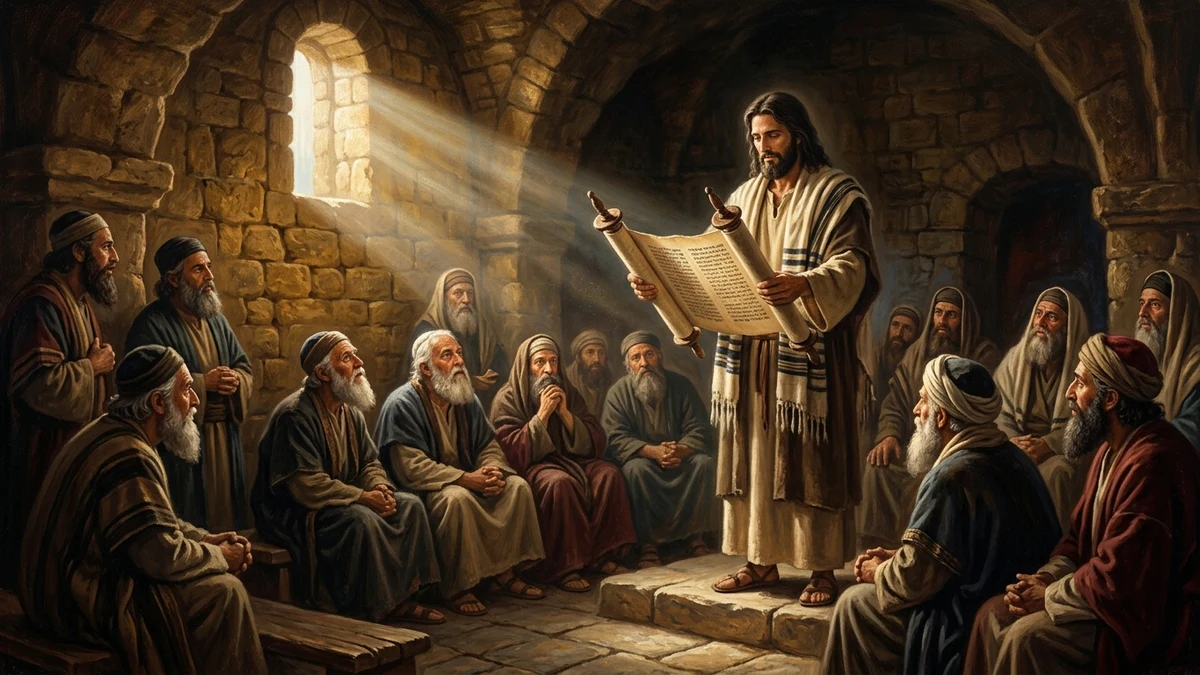
The village elders, carpenters, farmers, and neighbors with whom Jesus had spent three decades filled the benches. Rumors of His supernatural deeds in Capernaum and Judea had raced across the Galilean hill country like wildfire. A palpable, suffocating tension hung over the stone assembly.
The synagogue attendant (chazzan) reverently stepped to the wooden ark, took out the sacred leather scroll of the prophet Isaiah (Sefer Yeshayahu), and handed it into the hands of Jesus. Standing upright out of supreme reverence for the Holy Scriptures, Jesus unrolled the ancient Hebrew parchment column by column until His fingers rested upon the radiant, Messianic crown of Isaiah 61.
2. The Jubilee Manifesto of the Messiah
In the hushed silence of the Nazareth sanctuary, the voice of the Creator broke the air, reading the eternal decree of His mission:
"The Spirit of the Lord is upon Me, because He has anointed Me to preach the gospel to the poor; He has sent Me to heal the brokenhearted, to proclaim liberty to the captives and recovery of sight to the blind, to set at liberty those who are oppressed; to proclaim the acceptable year of the Lord." (Luke 4:18–19).
Every syllable was pregnant with revolutionary power:
- The Anointing (Echrisen me): Declaring Himself the true *Mashiach*—the Prophet, Priest, and King consecrated not with earthly olive oil, but with the boundless power of the Holy Spirit.
- Good News to the Poor (Ptochois): Not merely economic poverty, but the spiritually bankrupt, crushed under guilt, legalism, and despair.
- Liberty to Captives (Aphesin): Striking off the iron chains of demonic bondage, moral addiction, and Satanic captivity.
- Sight to the Blind: Physical vision restored to diseased eyes, and spiritual illumination granted to hearts darkened by sin.
- The Acceptable Year of the Lord: Proclaiming the ultimate prophetic fulfillment of the Levitical Year of Jubilee (Leviticus 25)—the divine Jubilee where all debts are blotted out, all ancestral inheritances restored, and all slaves emancipated forever!
Then, with breathtaking deliberation, Jesus stopped reading in mid-sentence. He did not read the next terrifying clause of Isaiah 61:2: "and the day of vengeance of our God." His first coming was consecrated entirely to sovereign mercy, unmerited grace, and salvation; the awful day of divine wrath was reserved for His return.
3. "Today This Scripture Is Fulfilled"
Jesus rolled up the leather scroll, handed it back to the trembling attendant, and sat down upon the elevated Seat of Moses to deliver His exposition.
The sanctuary was so quiet one could hear the rustle of the linen garments. "And the eyes of all who were in the synagogue were fixed on Him" (Luke 4:20).
Then Christ dropped the ultimate theological thunderbolt of history:
"Today this Scripture is fulfilled in your hearing." (Luke 4:21).
It was a declaration of absolute Messianic authority! He was not merely expounding an ancient text; He was declaring: "I am the Man of whom Isaiah wrote! The seven centuries of waiting are ended. The Anointed One is seated before your eyes!"
Initially, a wave of astonishment swept across the room: "So all bore witness to Him, and marveled at the gracious words which proceeded out of His mouth." But within moments, the deadly poison of familiar pride began to curdle their hearts.
4. The Deadly Snare of Familiarity
Whispers began to ripple along the back benches: "Is not this Joseph's son?" (Luke 4:22).
The human carnal mind cannot fathom the supernatural when masked in the ordinary. To them, Jesus was merely the boy who had grown up down the street, the carpenter who had built their ox yokes, the son of the peasant woman Mary. Their pride recoiled at the thought that their local peer was heaven's King. Furthermore, they felt entitled: if He had worked miraculous wonders in Capernaum, why had He not performed a fireworks display for His hometown patrons?
Perceiving their cynical thoughts, Jesus unmasked their hearts:
"You will surely say this proverb to Me, 'Physician, heal yourself! Whatever we have heard done in Capernaum, do also here in your country.' Assuredly, I say to you, no prophet is accepted in his own country." (Luke 4:23–24).
5. The Gentile Indictment & The Eruption of Wrath
Then Jesus drove a prophetic sword into the heart of their nationalistic arrogance. He cited two historic crises from the Old Testament:
"I tell you truly, many widows were in Israel in the days of Elijah, when the heaven was shut up three years and six months, and there was a great famine throughout all the land; but to none of them was Elijah sent except to Zarephath, in the region of Sidon, to a woman who was a widow. And many lepers were in Israel in the time of Elisha the prophet, and none of them was cleansed except Naaman the Syrian." (Luke 4:25–27).
The indictment was devastating! In the dark apostasy of King Ahab, God bypassed thousands of Hebrew widows to sustain a pagan Phoenician woman in Baal's territory. In the days of Elisha, God bypassed thousands of circumcised Jewish lepers to cleanse Naaman, the commander of Syria’s pagan armies!
The implication was crystal clear: God’s grace is not an ethnic birthright. Unbelief in Nazareth would slam heaven's door shut, while humble faith among the despised Gentiles would receive the fullness of God's salvation!
The synagogue exploded into demonic hysteria:
"So all those in the synagogue, when they heard these things, were filled with wrath!" (Luke 4:28).
6. The Cliff of Mount Precipice & Sovereign Deliverance
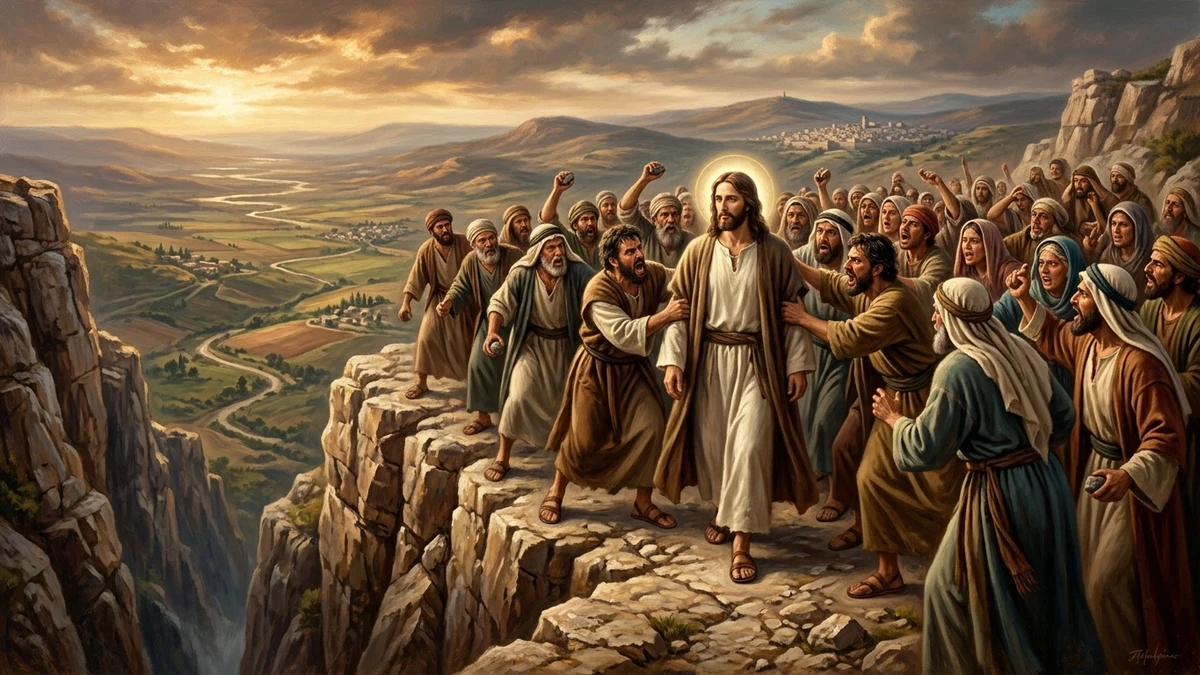
Religious respectability vanished. Benches were overturned. The congregation transformed into a bloodthirsty lynch mob. Screaming curses, they seized Jesus, pinned His arms, and shoved Him through the stone alleys out of the village gates.
They dragged Him southward to the jagged limestone rim of Mount Precipice (Jebel el-Qafzeh). Below them yawned a terrifying drop of over a thousand vertical feet into the rocky gorge of the Jezreel Valley. Their intention was brutal and illegal: under rabbinic halakha, blasphemers were sometimes executed by hurling them headlong off a precipice before finishing them with stones (katakremnisai).
They reached the very edge. The wind whipped His robes. Murderous hands prepared to give the final shove.
Then, in a single heartbeat, the atmosphere shifted.
Jesus turned. The sovereign, uncreated majesty of the King of the Universe flashed through His eyes. A holy, paralyzing dread fell upon the mob. Their hands froze; their shouting died in their throats; their violent momentum collapsed into stunned immobility.
Luke records the event with peerless, magnificent understatement:
"Then passing through the midst of them, He went His way." (Luke 4:30).
Untouchable and serene, Jesus parted the frozen ranks of the mob like the waters of the Red Sea. He did not run. He did not hide. With the majestic calm of the Lord of Hosts, He walked straight through the center of the crowd and descended the mountain. His life could never be stolen by an unruly mob on a Galilean cliff; He would lay down His life willingly, at the appointed hour, upon the altar of Calvary for the sins of the world.
Biblical Keywords & Theological Roots
He has anointed Me; consecration by the Holy Spirit for the prophetic, priestly, and kingly office of the Messiah (Christos).
Release, deliverance, pardon, or liberty; technical Septuagint term for the complete cancellation of debt in the Year of Jubilee.
The acceptable year of the Lord; the ultimate favorable epoch of divine grace, restoration, and covenant redemption inaugurated by Christ.
To throw down headlong from a precipice or steep cliff; an illegal, mob-driven form of execution by hurling off a precipice.
Ancient Near Eastern & Archaeological Context
First-century Nazareth was a secluded agricultural hamlet of approximately two hundred to four hundred residents in lower Galilee, nestled in an elevated basin in the Nazareth Ridge. Because of its obscurity and isolation, it was culturally disdained ('Can anything good come out of Nazareth?' - John 1:46). The village synagogue served not only as a house of prayer and Scripture study on the Sabbath, but as the civic town hall, local court, and primary school during the week. Sabbath services followed a strict liturgical structure: the recitation of the Shema, the Shemoneh Esreh (eighteen benedictions), the Torah reading from Moses, followed by the Haftarah reading from the Prophets. The reader customarily stood out of reverence for the Word of God, and then sat down upon the 'Seat of Moses' (Cathedra) to deliver the exposition. The cliff to which the mob dragged Jesus is traditionally identified with Mount Precipice (Jebel el-Qafzeh), located approximately two miles south of modern Nazareth, which plunges sheer and rocky over 1,200 feet down into the sweeping breadbasket of the Jezreel Valley.
Support Independent Biblical Research
Did this study bless you? Help support our independent bilingual research and interactive visual Bible tools.
⚡ Fast Facts
- In first-century synagogues, reading the Haftarah (prophetic portion) was followed by the reader sitting down to teach
- Jesus stopped reading Isaiah 61:2 mid-sentence right before 'and the day of vengeance of our God', distinguishing His first coming of grace from His second coming of judgment
- The 'acceptable year of the Lord' directly pointed to the Levitical Year of Jubilee (Leviticus 25), when all debts were cancelled and slaves emancipated
- Mount Precipice (Jebel el-Qafzeh) stands south of Nazareth, dropping over 1,200 feet into the Plain of Esdraelon (Jezreel Valley)
❓ Frequently Asked Questions (FAQs)
In Hebrew prophetic literature, the first and second comings of the Messiah were often presented within the same breath. By intentionally rolling up the scroll before reading 'the day of vengeance', Jesus demonstrated dispensational precision. His first advent was dedicated entirely to grace, spiritual liberation, and salvation; the execution of divine vengeance against unrepentant wickedness is reserved for His second advent in glory.
First-century Jews believed that the Messiah would exclusively favor Israel and crush Gentile oppressors. By citing how God bypassed countless starving widows in Israel to feed a pagan Phoenician widow in Zarephath, and passed over thousands of Jewish lepers to heal Naaman, the commanding general of Israel's bitter enemy Syria, Jesus demolished their nationalistic spiritual entitlement, showing that God's covenant grace flows to humble faith rather than racial heritage.
Scripture states simply: 'Then passing through the midst of them, He went His way' (Luke 4:30). This was not a panicked flight, but an exercise of sovereign, divine authority. Whether through an overpowering spiritual majesty that paralyzed the crowd, blinding their eyes, or casting a holy hush of awe over them, Jesus proved that His life could never be taken by an unruly mob; He would lay down His life willingly only when His appointed 'hour' arrived at Calvary.