Following His rejection at Nazareth, Jesus descended the mountains of lower Galilee and established His ministry headquarters in the bustling lakeside city of Capernaum (Kfar Nachum). Nestled along the northwestern shore of the Sea of Galilee, Capernaum was vibrant with life—fishermen casting circular nets from wooden boats, Roman tax collectors exacting tolls along the great imperial highway of the Via Maris, and merchants trading dried fish, olive oil, and grain. Yet beneath the commercial prosperity lay an agonizing undercurrent of human suffering: incurable plagues, burning fevers, and the oppressive terror of demonic torment. On an ordinary Sabbath in this lakeside town, Jesus entered the local black basalt synagogue and unleashed an unprecedented wave of divine authority that swept from the synagogue pulpit into the private home of Peter, and culminated in a twilight revival that shook all Galilee.
1. The Synagogue of Black Basalt & Unprecedented Authority
The Gospel of Mark records the electrifying atmosphere of that Sabbath morning: "Then they went into Capernaum, and immediately on the Sabbath He entered the synagogue and taught. And they were astonished at His teaching, for He taught them as one having authority, and not as the scribes." (Mark 1:21–22).
For generations, the Jewish people had sat through dry, formal rabbinic discourses. The scribes spoke with delegated, secondary authority; they cited ancient traditions, quoting Rabbi Hillel, Rabbi Shammai, and the elders of the past. They offered endlessly debated legal technicalities without a spark of life.
Jesus spoke unlike any human teacher who had ever walked the earth. He did not quote Rabbi so-and-so; He spoke as the Lawgiver Himself! His words resonated with the thunder of Mount Sinai, yet were saturated with intoxicating grace, clarity, and sovereign power (exousia). The truth pierced the hearts of the hearers like a two-edged sword.
2. The Cry of the Demoniac & The Muzzled Spirit
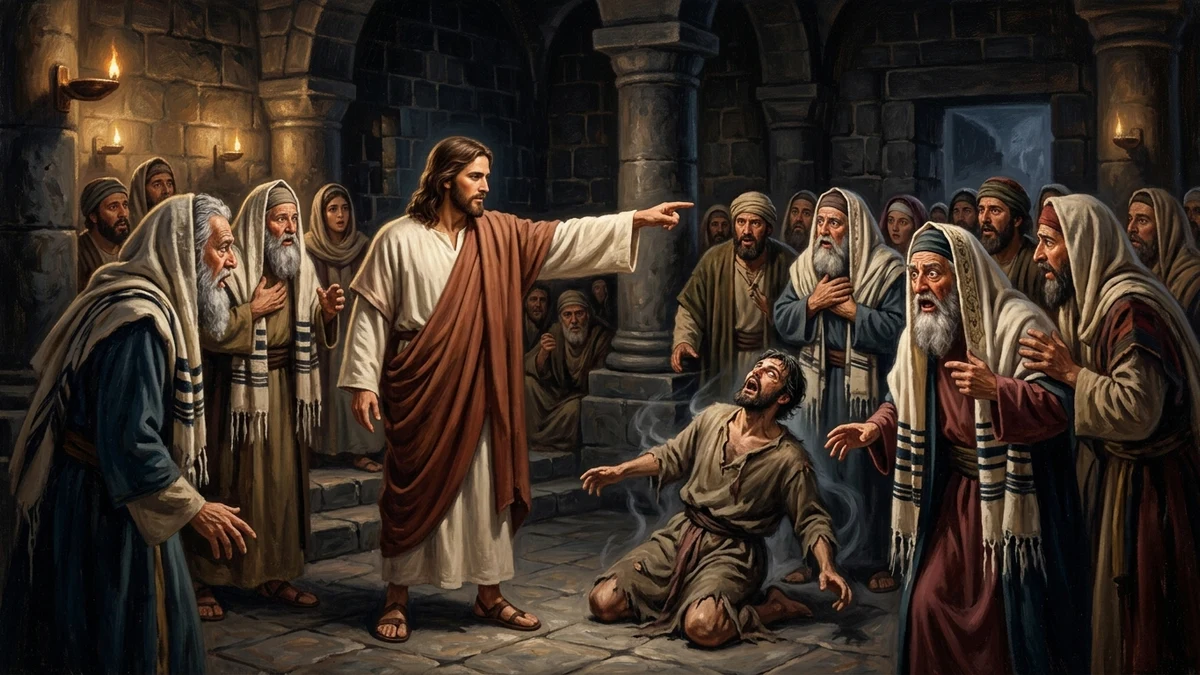
Light always provokes darkness. Suddenly, in the middle of the sacred assembly, a blood-curdling shriek shattered the reverent silence:
"Let us alone! What have we to do with You, Jesus of Nazareth? Did You come to destroy us? I know who You are—the Holy One of God!" (Mark 1:24).
A man possessed by an unclean demonic spirit was thrashing in the aisle. The demon was terrified. The presence of sinless deity scorched the unclean entity. Notice its confession: it knew His earthly origin ("Jesus of Nazareth"), His cosmic mission ("Did You come to destroy us?"), and His divine title ("the Holy One of God").
Jesus refused testimony from hell. He did not engage in theatrical exorcism or chant superstitious incantations. He uttered two razor-sharp commands:
"Be quiet, and come out of him!" (Greek: Phimotheti - "Be muzzled!").
The demon convulsed the man with violent spasms, screamed with a final guttural cry, and was violently expelled! The man lay on the stone pavement unharmed, completely sane, and free.
The synagogue was seized with sheer awe: "What is this? What new doctrine is this? For with authority He commands even the unclean spirits, and they obey Him!" (Mark 1:27).
3. The Sickroom in Peter's Courtyard
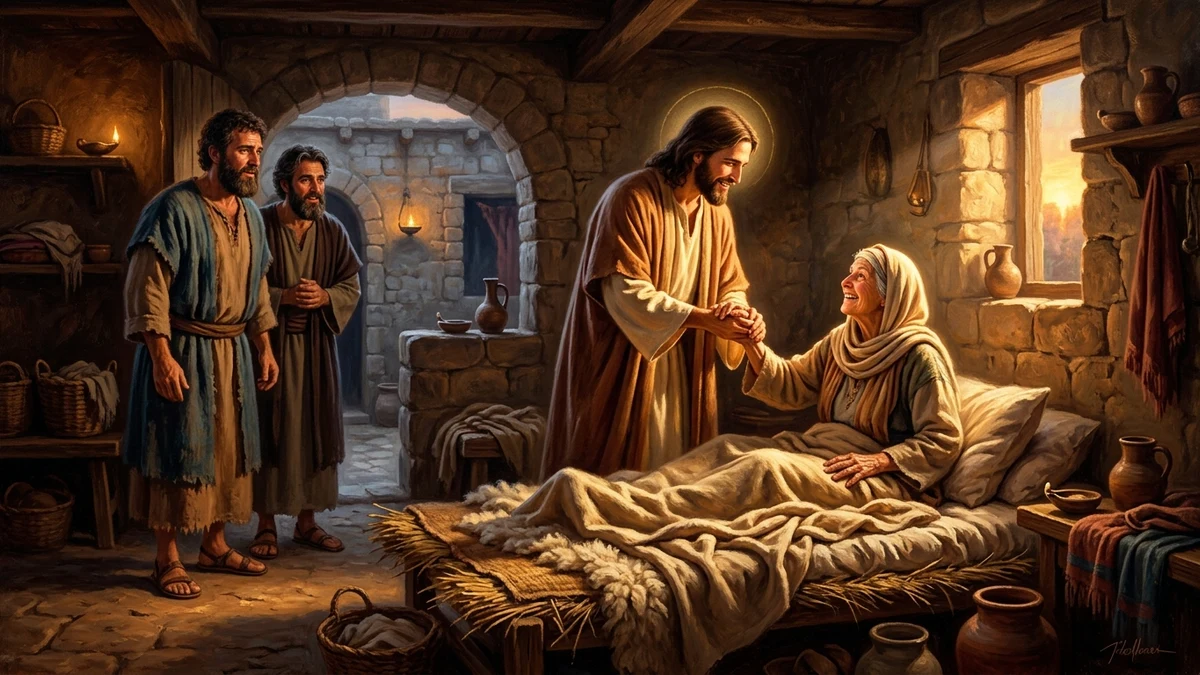
Departing the public synagogue, Jesus, accompanied by James and John, walked the eighty feet across the stone alley into the home of brothers Simon Peter and Andrew.
Inside, the atmosphere was thick with anxiety. Simon’s mother-in-law lay bedridden, battling a malignant fever. Luke, the trained physician, uses the specific medical phrase puretos megas—a "great fever." In the swampy delta north of the Sea of Galilee, mosquito-borne marsh fevers were common and often fatal. Her pulse raced, her skin was burning, and she was slipping into delirium.
They immediately told Jesus about her. The Lord did not hesitate. He entered the cramped, stifling sickroom.
Luke records: "So He stood over her and rebuked the fever." Just as He had rebuked the unclean spirit, He rebuked the diseased biological affliction. Then, with infinite tenderness, Jesus reached out and took her burning hand into His own.
4. The Instantaneous Touch of Wholeness
The moment the hand of the Creator touched the hand of the suffering woman, the fever broke!
In ordinary medical recoveries from severe fevers, a patient remains bedridden for days, emaciated, weak, and trembling through a lengthy convalescence. But Christ’s miracles leave no residual weakness!
Mark records the beautiful sequel: "And immediately the fever left her, and she served them." (Mark 1:31).
Her strength returned in a surging wave of divine energy! She did not merely sit up; she leaped from the bed, arranged her garments, and joyfully moved into the courtyard kitchen to prepare dinner for Jesus and His disciples. Her instantaneous service (diekei) demonstrated the absolute completeness of her restoration. When Jesus touches a life, He transforms sickbeds into sanctuaries of joyful service!
5. The Sunset Wave of Healing at the Door
Throughout that Sabbath afternoon, the news of the exorcism in the synagogue and the restoration of Peter’s mother-in-law swept through every courtyard, alley, and marketplace of Capernaum. Yet because Pharisaic tradition strictly forbade carrying beds or healing non-fatal illnesses on the Sabbath, the people waited in agonizing suspense.
Then, as the fiery orb of the Mediterranean sun sank behind the hills of Galilee, twilight descended. The moment three stars appeared in the evening sky, the Sabbath legally closed.
What followed was one of the most astonishing scenes in the Gospels:
"At evening, when the sun had set, they brought to Him all who were sick and those who were demon-possessed. And the whole city was gathered together at the door." (Mark 1:32–33).
Hundreds of desperate souls converged upon the narrow alley outside Peter’s courtyard. Fathers carried paralyzed sons on stretchers; mothers cradled feverish infants; friends guided the blind and the lame. Screaming demoniacs thrashing in chains were dragged before the porch.
Jesus did not turn them away. He walked out into the dusty street. Luke records: "He laid His hands on every one of them and healed them" (Luke 4:40). He touched the diseased, spoke peace to the tormented, and cast out demons with a word!
Matthew witnesses this scene and quotes the royal prophecy of Isaiah 53:4: "He Himself took our infirmities and bore our sicknesses." Christ was not a detached physician; His heart absorbed the sorrows of humanity, pouring out divine life until every disease was conquered.
6. The Solitary Place in the Wilderness
By midnight, Capernaum had become a city without a sickbed. Weary from the immense outpouring of spiritual power, Jesus finally slept.
Yet long before dawn, while the lake was still wrapped in pitch-black silence (proi ennycha lian), Jesus arose. He slipped quietly past the sleeping disciples, opened the courtyard door, and walked out of the city into the solitary wilderness hills (eremon topon).
There, kneeling beneath the Galilean stars, Jesus poured out His soul in prayer to His Father.
When Simon Peter and the others awoke and found a new crowd clamoring at the door, they searched frantically for Jesus. Finding Him in the quiet hills, Peter cried out: "Everyone is looking for You!"
Peter wanted to capitalize on the sensational popularity, to establish an enduring healing center in Capernaum. But Jesus answered with crystalline clarity:
"Let us go into the next towns, that I may preach there also, because for this purpose I have come forth." (Mark 1:38).
Miracles were the compassionate signposts of His kingdom, but preaching the Gospel of repentance was the supreme purpose of His advent. Grounded in unceasing prayer, Jesus moved forward to conquer all Galilee with the Word of life!
Biblical Keywords & Theological Roots
Inherent authority, sovereign jurisdiction, right, or power; the absolute prerogative of Christ distinct from delegated rabbinic tradition.
Be muzzled / be silenced; a sharp, authoritative command to gag, muzzle, or silence completely like an animal with a muzzle.
Great fever; technical Galenic medical term used by Luke to indicate an acute, life-threatening febrile infection.
Served / ministered; imperfect active verb indicating continuous, energetic table fellowship and hospitality born of total healing.
Ancient Near Eastern & Archaeological Context
Capernaum (Hebrew: Kfar Nachum, meaning 'Village of Nahum' or 'Village of Comfort') was a prosperous fishing and trade settlement situated on the northwestern shoreline of the Sea of Galilee along the major international highway known as the Via Maris (Way of the Sea). Archaeological excavations by the Franciscans beneath the modern white limestone fourth-century synagogue have unearthed the black basalt foundations of the exact first-century synagogue where Jesus taught. Merely eighty feet away stands the excavated 'Insula of Saint Peter'—a complex of basalt courtyard homes surrounding a central courtyard. Excavations have revealed first-century plaster walls covered in early Christian graffiti citing 'Jesus', 'Lord', and 'Peter', confirming it as the traditional house of Simon Peter where Jesus healed Peter's mother-in-law. First-century Sabbath laws under Pharisaic halakha strictly prohibited carrying any burden or healing non-life-threatening ailments on the Sabbath; therefore, the townsfolk waited until three stars appeared in the evening sky (sunset), marking the legal termination of the Sabbath, before carrying their bedridden relatives to Peter's doorway.
Support Independent Biblical Research
Did this study bless you? Help support our independent bilingual research and interactive visual Bible tools.
⚡ Fast Facts
- Capernaum (Kfar Nachum - 'Village of Comfort') became known in Matthew 9:1 as Jesus' 'own city'
- Luke the physician uses the medical term 'puretos megas' (great fever), distinguishing acute life-threatening infection from minor fevers
- Simon Peter was married, as evidenced by his mother-in-law living in his household in Capernaum (and 1 Corinthians 9:5)
- At sunset, Sabbath travel restrictions ended, allowing the entire city to legally carry their sick to Peter's door
❓ Frequently Asked Questions (FAQs)
First-century Jewish scribes and rabbis never taught on their own authority. They invariably cited chains of previous rabbinic traditions (e.g., 'Rabbi Hillel said in the name of Rabbi Shammai who cited Rabbi Gamaliel...'). Jesus, however, taught as the divine Author of the Law Himself, speaking with direct sovereign authority: 'Assuredly, I say to you' (Amen, amen lego hymin), cutting through rabbinic traditions directly to the heart of God.
Although demons accurately shrieked that Jesus was 'the Holy One of God', Christ silenced them (the 'Messianic Secret') because: (1) He refused to accept testimony from the father of lies; (2) premature public proclamation of Messiahship in Roman-occupied Galilee would ignite political zealot rebellions before His spiritual mission was taught; and (3) His true identity was to be revealed through the cross and resurrection, not demonic agitation.
In Matthew 8:17, Matthew quotes Isaiah 53:4: 'He Himself took our infirmities and bore our sicknesses.' While the ultimate fulfillment of the atonement occurred on the cross where Christ bore the guilt and penalty of sin, His earthly healing ministry was an active down payment and manifestation of that atoning work, demonstrating that Christ entered into visceral sympathy with human suffering to deliver mankind from the curse.