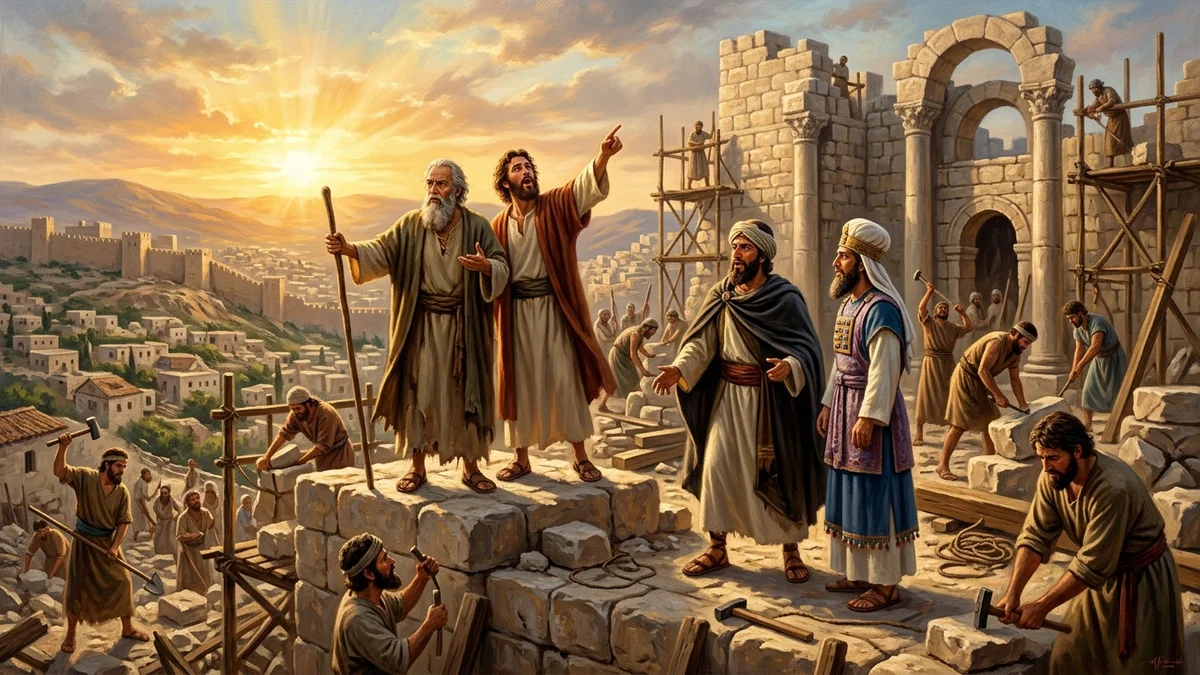
Laying the foundation of God’s house is a moment of sacred triumph, but completing the structure demands enduring spiritual warfare. Following the initial joy of laying the Temple foundation in 536 BC, the returning Jewish remnant encountered fierce, paralyzing intimidation from local adversaries. For sixteen painful years, the Temple of Yahweh sat as an abandoned construction site—weeds grew over the limestone footings, scaffolding rotted in the rain, and the discouraged people retreated into their own selfish pursuits. It took the fiery prophetic preaching of Haggai and Zechariah to break the spirit of lethargy, dismantle human excuses, and prove that God builds His kingdom not by human might or earthly power, but by the supernatural power of the Holy Spirit.
1. Samaritan Sabotage and the Sixteen-Year Halt
When the pagan settlers and syncretistic Samaritans whom the Assyrians had placed in the land heard that the exiles were rebuilding the Temple, they approached Zerubbabel with deceitful flattery: "Let us build with you, for we seek your God as you do." (Ezra 4:2).
Zerubbabel, Joshua, and the heads of fathers' houses recognized the deadly spiritual trap. Compromising with idolatrous neighbors would pollute the covenant purity of Israel once again. They answered firmly: "You may do nothing with us to build a house for our God; but we alone will build to the Lord God of Israel, as King Cyrus the king of Persia has commanded us." (Ezra 4:3).
Rebuffed, the adversaries unmasked their true hatred. They discouraged the people, terrified them from building, and hired professional lobbyists and counselors to frustrate their purpose throughout the reigns of Cyrus and Cambyses. Finally, they penned a malicious, slanderous letter to the Persian throne accusing Jerusalem of being a historically rebellious and seditious city that would refuse to pay taxes if rebuilt. A royal decree was issued ordering the work to cease, and the adversaries enforced it by force of arms. For sixteen years (536–520 BC), the Temple Mount lay silent and barren.
2. The Piercing Rebuke of Prophet Haggai
During those sixteen years of delay, a insidious spiritual sickness infected the remnant. The people rationalized their laziness: "The time has not come, the time that the Lord's house should be built." (Haggai 1:2). They busied themselves building luxurious, paneled cedar houses, cultivating vineyards, and pursuing commercial wealth, while treating God's house as an afterthought.
In 520 BC, the Word of the Lord exploded like thunder through the elderly prophet Haggai:
"Is it time for you yourselves to dwell in your paneled houses, and this temple to lie in ruins? Now therefore, thus says the Lord of hosts: 'Consider your ways!' You have sown much, and bring in little; you eat, but do not have enough; you drink, but you are not filled with drink; you clothe yourselves, but no one is warm; and he who earns wages, earns wages to put into a bag with holes." (Haggai 1:4-6).
Haggai exposed the economic curse that had plagued Judea: drought, ruined harvests, and inflation were God's divine discipline because they had neglected His house. Haggai commanded them: "Go up to the mountains and bring wood and build the temple, that I may take pleasure in it and be glorified!"
Convicted to the bone, Zerubbabel, Joshua, and all the people obeyed the voice of the prophet. Within twenty-four days, the sound of chisels, hammers, and saws rang across Mount Moriah once again!
3. Zechariah's Vision: The Golden Lampstand & Olive Trees
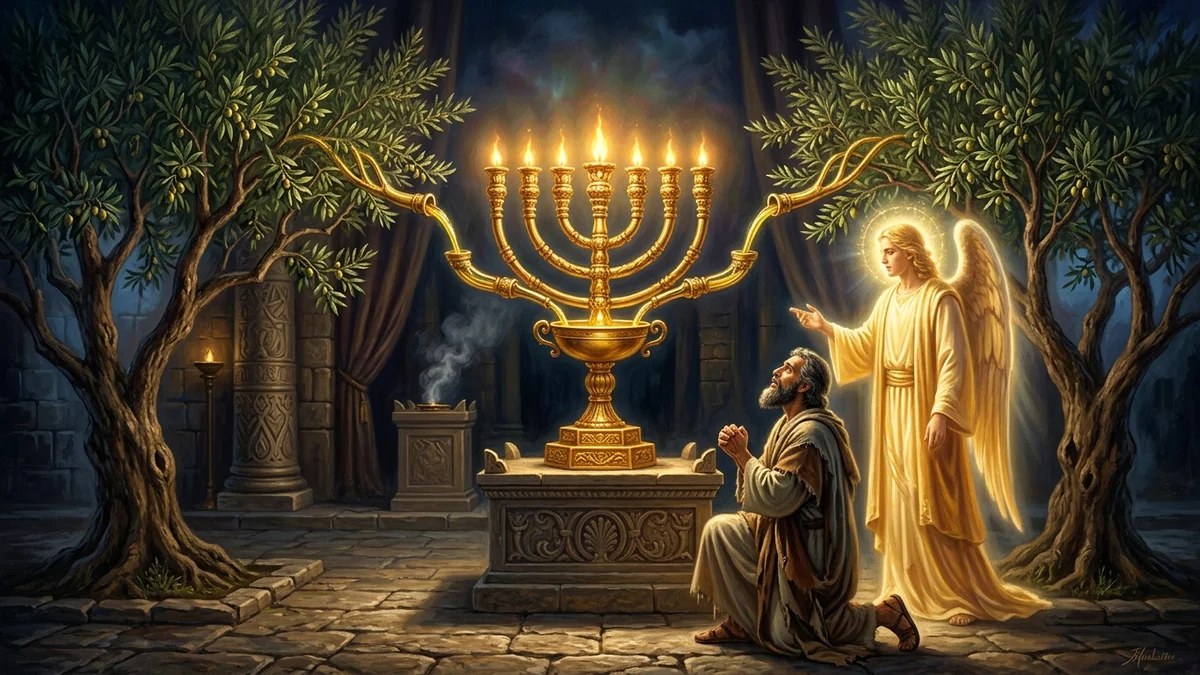 The vision of the solid gold seven-branched Menorah supplied with golden oil from two living olive trees: 'Not by might nor by power, but by My Spirit, says the Lord of hosts.'
Two months after Haggai began preaching, young prophet Zechariah joined him, providing apocalyptic visions to encourage the weary builders. In his fourth night vision, Zechariah saw a magnificent solid gold Menorah with seven lamps and a bowl on top, flanked by two living olive trees whose branches poured golden oil through golden pipes.
When Zechariah asked the meaning, the angel answered with one of the most celebrated declarations in Scripture:
"This is the word of the Lord to Zerubbabel: 'Not by might nor by power, but by My Spirit,' says the Lord of hosts. 'Who are you, O great mountain? Before Zerubbabel you shall become a plain! And he shall bring forth the capstone with shouts of "Grace, grace to it!"' " (Zechariah 4:6-7).
The "great mountain" of Samaritan political opposition, imperial bureaucracy, and poverty would be flattened into a plain, not through human military prowess, but through the limitless power of the Holy Spirit. God promised that the hands of Zerubbabel, which laid the foundation, would also place the final crowning capstone!
4. The Persian Archive Search and King Darius's Decree
When regional Persian governor Tattenai noticed the frenetic rebuilding activity, he arrived in Jerusalem demanding: "Who has commanded you to build this temple?" The Jewish elders boldly cited the original decree of Cyrus.
Tattenai sent a formal inquiry to King Darius I (Darius the Great) in Susa, requesting that the royal archives be searched. Persian archivists combed through the royal library in Babylon without finding it, but continuing the search at the summer fortress of **Ecbatana** in Media, they unearthed an ancient parchment scroll:
It was the original memorandum of Cyrus from 538 BC, explicitly commanding the rebuilding of the Temple in Jerusalem and ordering that the costs be paid from the royal treasury!
King Darius issued a sweeping, unassailable decree to Tattenai: not only must he leave the Jewish builders completely alone, but he was commanded to provide them daily with royal tax revenues from Trans-Euphrates, along with young bulls, rams, and lambs for sacrifices, "that they may offer sacrifices of sweet aroma to the God of heaven, and pray for the life of the king and his sons." (Ezra 6:10). Furthermore, Darius decreed that anyone who altered this edict would be impaled on a timber pulled from his own house!
5. Completion and Joyful Dedication of the Second Temple
With royal protection, imperial funding, and prophetic encouragement, the building progressed with astonishing speed. On the third day of the month of **Adar in the sixth year of King Darius (March 516 BC)**—precisely seventy years after Nebuchadnezzar destroyed Solomon's Temple in 586 BC—the Second Temple was gloriously completed!
The children of Israel, the priests, the Levites, and the rest of the returned captives celebrated the dedication of the house of God with joyful abandonment:
They offered a dedication sacrifice of 100 bulls, 200 rams, 400 lambs, and 12 male goats as a sin offering for all twelve tribes of Israel (Ezra 6:17). The priests and Levites were installed in their service divisions, and the following month, they celebrated a magnificent Passover in holiness and unity, "for the Lord made them joyful, and turned the heart of the king of Assyria toward them, to strengthen their hands in the work of the house of God." (Ezra 6:22).
6. Christological Connections: The Greater Glory of the Latter House
During the rebuilding, Haggai delivered an astonishing messianic prophecy regarding this Second Temple:
"'The glory of this latter temple shall be greater than the former,' says the Lord of hosts. 'And in this place I will give peace,' says the Lord of hosts." (Haggai 2:9).
In physical dimensions and lavish gold, Zerubbabel's Temple paled in comparison to Solomon's wonder. Yet Haggai prophesied its glory would be far greater. How was this fulfilled? Five centuries later, Jesus Christ, God incarnate in human flesh, walked into the courts of this very Second Temple! Solomon’s Temple had the Shekinah cloud; the Second Temple had the living Son of God healing the blind, cleansing the courts, and proclaiming eternal peace!
Spiritual Reflections & Practical Life Application:
- Beware of Spiritual Procrastination: Never say "the time has not come" to obey God. Putting God first in your time, finances, and priorities breaks the spiritual curse of empty labor.
- Not by Might, But by the Spirit: When you face mountainous obstacles in your ministry, career, or family, stop relying on fleshly strength. The Holy Spirit flattens every mountain before faith.
- God Turns Opposition into Provision: The enemy tried to stop the Temple through Persian bureaucracy, but God used that very bureaucracy to fund the Temple from the enemy's taxes! God can make your adversaries pay for your breakthrough.
- Finish What You Started: Zerubbabel laid the cornerstone, endured 16 years of delay, and brought forth the capstone with shouts of grace. Do not quit in the middle of your assignment; finish your race in Christ!
⚡ Fast Facts
- Temple construction was completely stalled for 16 years (536–520 BC) due to enemy threats
- Prophet Haggai confronted their misplaced priorities: living in paneled houses while God's house lay in ruins
- Prophet Zechariah gave the famous promise: 'Not by might nor by power, but by My Spirit' (Zech 4:6)
- The Second Temple was finished on the 3rd of Adar in 516 BC, exactly 70 years after Solomon's Temple was burned
❓ Frequently Asked Questions (FAQs)
Pagan settlers and Samaritans offered to join the project. When Zerubbabel refused compromise, they intimidated the builders, bribed Persian counselors, and wrote slanderous letters accusing the Jews of plotting rebellion, causing the Persian crown to issue an injunction halting construction.
The two olive trees represented the two anointed leaders—Zerubbabel (the royal governor) and Joshua (the high priest)—continually supplied with the oil of the Holy Spirit to accomplish God's work not through human strength or political might, but through supernatural divine power.
Governor Tattenai investigated the renewed construction and wrote to King Darius asking if Cyrus had truly authorized it. Darius searched the royal archives at Ecbatana, found Cyrus's memorandum, and commanded Tattenai not only to leave the Jews alone but to pay for all building costs from royal tribute.