Set within the opulent, perfumed courtyards and mosaic corridors of the winter palace at Susa, the book of Esther is one of the most thrilling masterpieces of literature and divine providence ever penned. Though the name of God is never explicitly mentioned in its ten chapters, His invisible hand orchestrates every sleepless night, every cast of the dice, and every royal decree. In an hour when total annihilation threatened the Jewish race, an orphaned exile maiden stepped into the corridors of global power, demonstrating that ordinary courage anchored in fasting and prayer can overthrow genocidal tyranny and alter world history.
1. The Discarded Queen and the Royal Search
In the third year of his reign, King Ahasuerus (Xerxes I) hosted an extravagant 180-day feast for all the princes, nobles, and military commanders of the 127 provinces stretching from India to Ethiopia, followed by a seven-day banquet in the palace gardens of Susa. Drunk with wine, the king commanded his royal chamberlains to bring Queen Vashti wearing her royal crown to display her beauty before the leering crowd. When Vashti refused to degrade herself, the enraged king deposed her by imperial decree, stripping her of her crown.
A nationwide search was launched to gather the fairest young virgins across the empire into the palace harem at Susa. Among them was an orphaned Jewish maiden named Hadassah (Esther), who had been tenderly raised by her cousin Mordecai, a Benjamite official sitting at the King's Gate. Mordecai instructed Esther not to reveal her Jewish heritage.
After twelve months of beauty preparations with oil of myrrh and sweet perfumes, Esther was brought before King Ahasuerus. The monarch was utterly captivated by her grace, humility, and radiant beauty:
"The king loved Esther more than all the other women, and she obtained grace and favor in his sight more than all the virgins; so he set the royal crown upon her head and made her queen instead of Vashti." (Esther 2:17).
2. Haman’s Pride and the Genocidal Decree
Soon after, Ahasuerus elevated Haman the Agagite (a descendant of the Amalekite royal line) above all the princes of the realm. The king commanded that all royal servants at the King’s Gate must bow and pay homage to Haman. But Mordecai refused to bow before the Amalekite.
Infuriated that a single Jewish man refused to prostrate before him, Haman disdained to lay hands on Mordecai alone. Learning Mordecai’s heritage, Haman resolved to wipe every Jewish man, woman, and child off the face of the earth!
In the first month of the twelfth year of Ahasuerus, Haman cast **Pur (the lot)** to determine the most auspicious day for the slaughter. The lot fell on the 13th day of the twelfth month, **Adar**. Haman approached the king with smooth slander: "There is a certain people scattered and dispersed among the people in all the provinces of your kingdom; their laws are different from all other people’s, and they do not keep the king’s laws. Therefore it is not fitting for the king to let them remain."
Haman offered 10,000 talents of silver into the royal treasury to finance the genocide. The king blindly gave his signet ring to Haman. Letters were sealed and dispatched by couriers on horseback to all 127 provinces, commanding the annihilation of all Jews in a single day and the plundering of their goods.
3. "For Such a Time as This"
When Mordecai learned of the decree, he tore his clothes, put on sackcloth and ashes, and went out into the midst of the city wailing with a bitter cry. Throughout every province, there was great mourning, fasting, weeping, and wailing among the Jews.
Esther sent garments to clothe Mordecai, but he refused. Through the royal chamberlain Hathach, Mordecai sent Esther a copy of the death decree, charging her to go into the king’s presence to plead for her people. Esther replied that anyone entering the inner court without being summoned was subject to instant death, unless the king extended his golden scepter: "And I have not been called to go in to the king these thirty days."
Mordecai delivered an electrifying response that resonated through the corridors of eternity:
"Do not think in your heart that you will escape in the king's palace any more than all the other Jews. For if you remain completely silent at this time, relief and deliverance will arise for the Jews from another place, but you and your father's house will perish. Yet who knows whether you have come to the kingdom for such a time as this?" (Esther 4:13-14).
Esther rose to the spiritual challenge. She sent word to Mordecai: "Go, gather all the Jews who are present in Shushan, and fast for me; neither eat nor drink for three days, night or day. My maids and I will fast likewise. And so I will go to the king, which is against the law; and IF I PERISH, I PERISH!" (Esther 4:16).
4. The Golden Scepter and the Sleepless Night
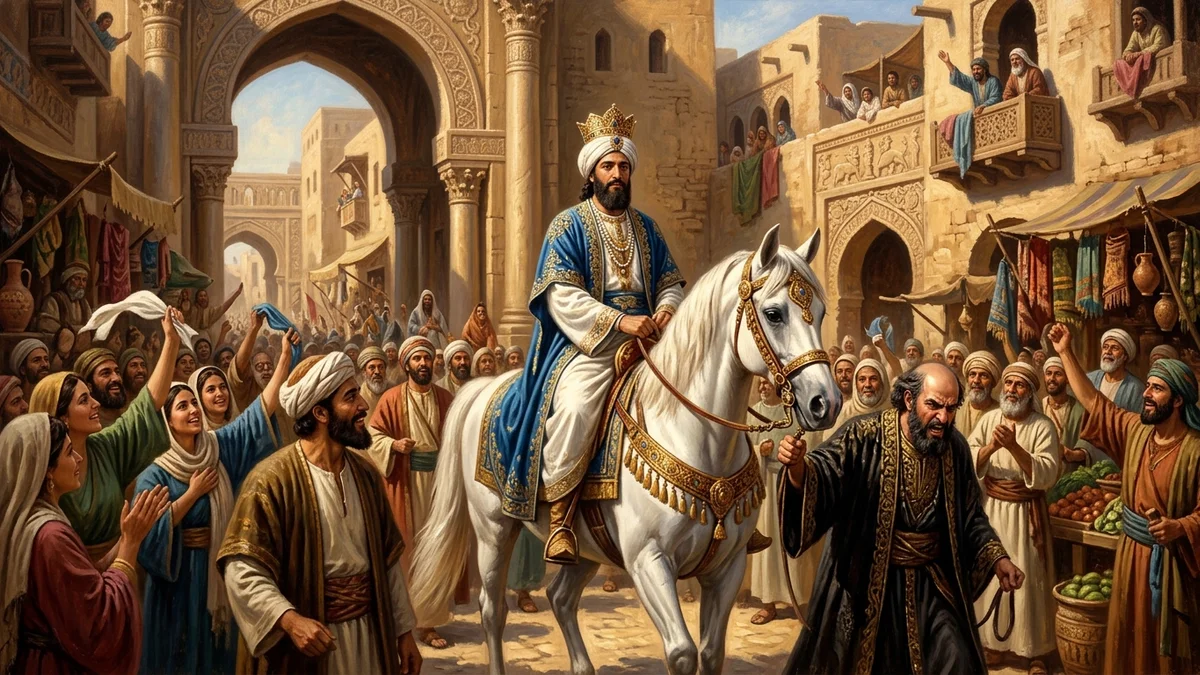 In a stunning reversal of divine providence, a humiliated Haman was forced to lead Mordecai through Susa on the King's stallion, shouting his praises.
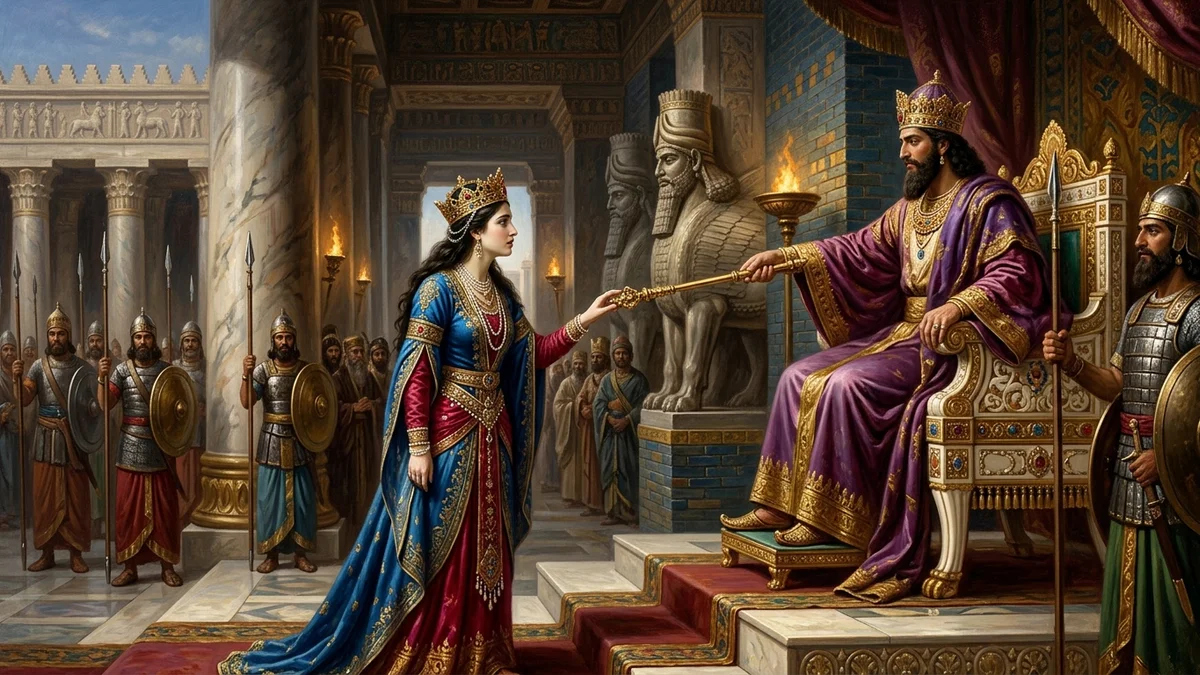
On the third day of fasting, Esther adorned herself in her royal apparel and stood in the inner court of the palace. When King Ahasuerus saw Queen Esther standing before him, his heart melted with divine favor: he extended his golden scepter! Esther stepped forward and touched the tip of the scepter.
"What do you wish, Queen Esther? What is your request? It shall be given to you—up to half the kingdom!" the king proclaimed. Instead of rushing to blurt out her request, Esther operated with supernatural wisdom, inviting the king and Haman to a private banquet of wine that afternoon, and then to a second banquet the following day.
Puffed up with pride, Haman went home boasting of his wealth and royal favor, but confessed that it meant nothing as long as Mordecai sat at the King’s Gate. His wife Zeresh suggested building a colossal gallows fifty cubits (seventy-five feet) high to hang Mordecai the next morning.
That very night, God intervened: the king could not sleep!
Unable to rest, Ahasuerus ordered the book of the chronicles of his reign read to him. The reader happened to open to the account where Mordecai had discovered an assassination plot against the king years earlier. The king asked, "What honor or dignity has been bestowed on Mordecai for this?" The servants answered, "Nothing has been done for him."
Just then, Haman arrived in the outer court to ask permission to hang Mordecai. The king called him in: "What should be done for the man whom the king delights to honor?" Thinking the king meant him, Haman described the ultimate honor: dress him in the king's royal robes, place him on the king's royal stallion with a royal crest, and let a noble prince lead him through the city shouting his glory.
The king commanded: "Hurry, take the robe and the horse, as you have suggested, and do so for Mordecai the Jew who sits within the king's gate! Leave nothing undone of all that you have spoken!"
In agonizing humiliation, Haman was forced to robe Mordecai and lead him through Susa, crying aloud before his mortal enemy: "Thus shall it be done to the man whom the king delights to honor!"
5. The Unmasking at the Banquet and the Deliverance of Purim
That afternoon at the second banquet, the king asked again: "What is your petition, Queen Esther?"
Esther fell to her knees and pleaded: "If I have found favor in your sight, O king, and if it pleases the king, let my life be given me at my petition, and my people at my request. For we have been sold, my people and I, to be destroyed, to be killed, and to be annihilated!"
Furious, the king demanded: "Who is he, and where is he, who would dare presume in his heart to do such a thing?"
Esther pointed her finger: "The adversary and enemy is this wicked Haman!"
Terror seized Haman. When Harbonah, one of the royal eunuchs, informed the king that Haman had built a 75-foot gallows to hang Mordecai, the king commanded: "Hang him on it!" Haman was hanged on the very gallows he had prepared for the righteous man.
Ahasuerus gave his signet ring to Mordecai, who issued an unchangeable counter-edict allowing the Jews across all 127 provinces to defend themselves and destroy their attackers on the 13th of Adar. When the appointed day arrived, the Jews prevailed over all their enemies. Mordecai and Esther instituted the **Feast of Purim** as a perpetual annual celebration of joyful feasting, sending gifts of food to one another and to the poor, commemorating how sorrow was turned into joy!
6. Christological Typology: The Greater Advocate
Esther and Mordecai point vividly to the redeeming ministry of Jesus Christ:
- The Self-Sacrificing Intercessor: Esther was willing to lay down her life ("If I perish, I perish") to intercede before the king for her doomed people; Jesus actually laid down His life, stepping into death to intercede for sinners condemned by the law.
- The Cross of Haman: Satan, like Haman, plotted the destruction of God's people and engineered the death of Christ on a cross; but on that very Cross, Christ disarmed principalities and powers, hanging Satan on his own trap (Colossians 2:14-15).
- The Counter-Decree of Grace: The law condemned us to death, but Christ issued a new law of the Spirit of life (Romans 8:2), empowering believers to triumph over the enemy.
Spiritual Reflections & Practical Life Application:
- You Are Positioned for a Purpose: God placed Esther in the palace not for luxury, but for rescue. Ask God: "Why have You placed me in my current career, neighborhood, or sphere of influence? How can I serve Your Kingdom 'for such a time as this'?"
- Fasting and Prayer Break Strongholds: Before Esther confronted the king, she fasted for three days. Spiritual battles must be won on your knees before they are fought in the world.
- God’s Providence in Sleepless Nights: God uses mundane events—a king’s insomnia, a forgotten book, a random page—to deliver His children. Trust His quiet, sovereign orchestration behind the scenes.
- The Boomerang of Evil: Evil always overreaches. The gallows Haman built for Mordecai became his own demise. Rest in God’s justice today!
⚡ Fast Facts
- The name of God is never explicitly mentioned in the Book of Esther, yet His divine providence saturates every event
- The Persian Empire under Ahasuerus (Xerxes I) spanned 127 provinces from India to Ethiopia
- Esther's Hebrew name was Hadassah (meaning 'myrtle'), while Esther means 'star'
- The Feast of Purim celebrates this deliverance, named after 'Pur' (the lot) cast by Haman
❓ Frequently Asked Questions (FAQs)
Haman was an Agagite, a descendant of King Agag of the Amalekites—ancient blood-enemies of Israel. When Mordecai refused to bow down and pay religious homage to Haman at the King's Gate, Haman’s demonic pride exploded into genocidal hatred against all Jews across the empire (Esther 3:5-6).
Under Persian law, anyone who entered the inner royal court without being summoned by the king was subject to immediate execution, unless the king extended his golden scepter (Esther 4:11). Esther had not been called for thirty days, making her approach a life-or-death gamble.
Because a Persian law sealed with the king's signet ring could not be repealed, King Ahasuerus empowered Mordecai to issue a second, counter-decree allowing the Jews throughout all provinces to arm themselves and defend their lives against any who attacked them on the 13th of Adar.