Autumn had draped the limestone terraces of Jerusalem in golden light as the Feast of Tabernacles drew to a dramatic close. For seven days, the Holy City had resounded with the joyful chanting of the Great Hallel, the illumination of colossal golden Menorahs in the Court of the Women, and the solemn pouring of water from the Pool of Siloam at the temple altar. Yet as Jesus walked out of the sacred precincts, having just escaped a hail of stones from religious authorities after declaring His eternal deity (John 8:58–59), His steps were neither hurried nor anxious. Passing through the bustling colonnades, His eyes rested upon a familiar figure huddled against the stone wall: a man who had never seen the sunrise, blind from the very day he was born.
1. The Disciples' Dilemma: Who Sinned?
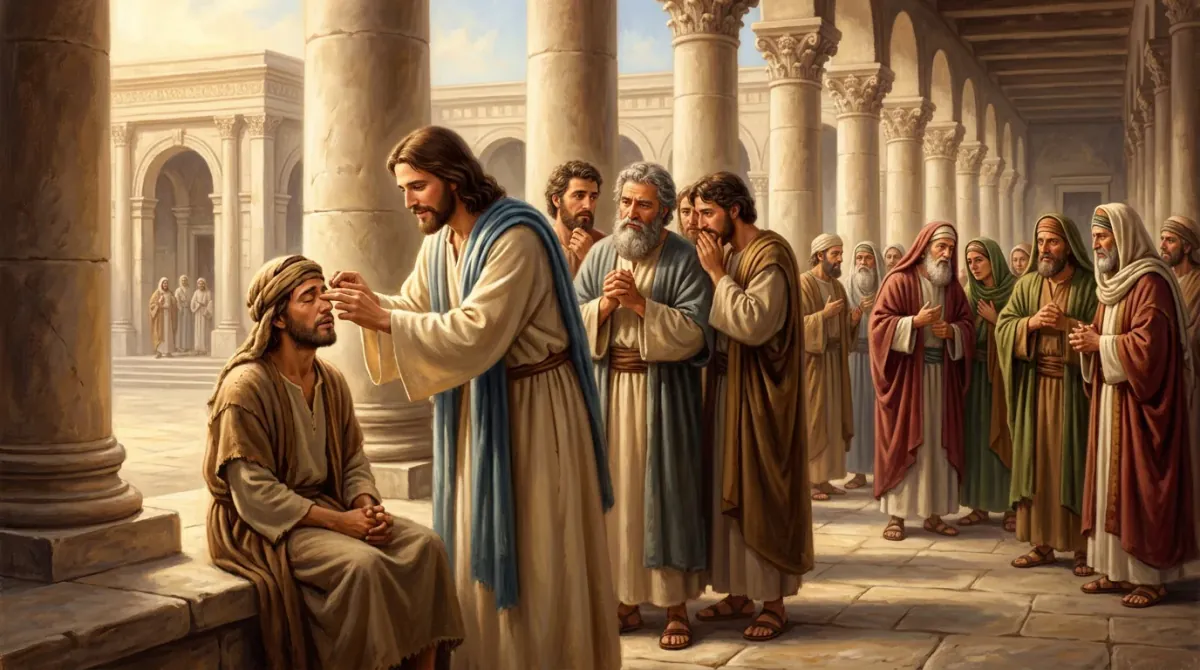 In the stone colonnade of the Jerusalem Temple, Jesus compassionately applies moistened clay to the eyes of the man born blind.
Observing Christ halt His stride, the disciples clustered around the seated beggar and posed a theological question steeped in traditional Jewish speculation: "Rabbi, who sinned, this man or his parents, that he was born blind?" (John 9:2). In the prevailing worldview of the first century, severe congenital suffering was invariably viewed as a divine penalty for specific moral guilt. Some scribes posited that an infant could commit spiritual rebellion within the maternal womb, while others cited Exodus 20:5 to argue that parental iniquities were visited upon innocent offspring.
With majestic clarity, Jesus demolished this fatalistic framework: "Neither this man nor his parents sinned, but that the works of God should be revealed in him" (John 9:3). Christ did not imply that the man and his parents were sinless human beings; rather, He refuted the cruel notion that this specific disability was a calibrated retribution for specific sins. Suffering, in the hands of the Sovereign God, is not a prison house of karma; it is an arena destined for the manifestation of redemptive grace and divine power.
Adding an urgent eschatological reminder, Jesus proclaimed: "I must work the works of Him who sent Me while it is day; the night is coming when no one can work. As long as I am in the world, I am the light of the world" (John 9:4–5). Before the approaching darkness of Golgotha, Christ would banish physical and spiritual blindness with the radiance of His divine presence.
2. The Clay, the Spittle, and the Command to Wash
Having spoken these words, Jesus performed a physical action that startled the watching crowd. Spitting upon the dusty pavement, He kneaded the moisture with the soil between His fingers, fashioning a small portion of soft clay. He then leaned forward and gently anointed the sightless, sunken eyes of the blind beggar with the mud.
Why did the Lord employ such an unconventional method? Scripture reveals a profound theological parallel: just as the Lord God had gathered the dust of the ground in Eden to form Adam (Genesis 2:7), so the incarnate Creator now took earthly dust, mixed it with His own moisture, and applied it to missing ocular faculties. Furthermore, by kneading clay on the Sabbath day, Jesus intentionally confronted the suffocating oral traditions of the Pharisees, which prohibited thirty-nine categories of labor, including the mixing of mud.
Then Christ gave a singular, testing imperative: "Go, wash in the pool of Siloam" (which is translated, Sent—John 9:7). The beggar was not promised instant sight; he was commanded to walk through the crowded, uneven stone streets of lower Jerusalem, blinded by mud, down the steep slopes to the southern pool. The beggar asked no questions, demanded no guarantees, and offered no excuses. He stood up on his trembling feet, tapped his walking stick along the flagstones, and made his way down to the waters of Siloam.
3. The Miraculous Dawn at Siloam
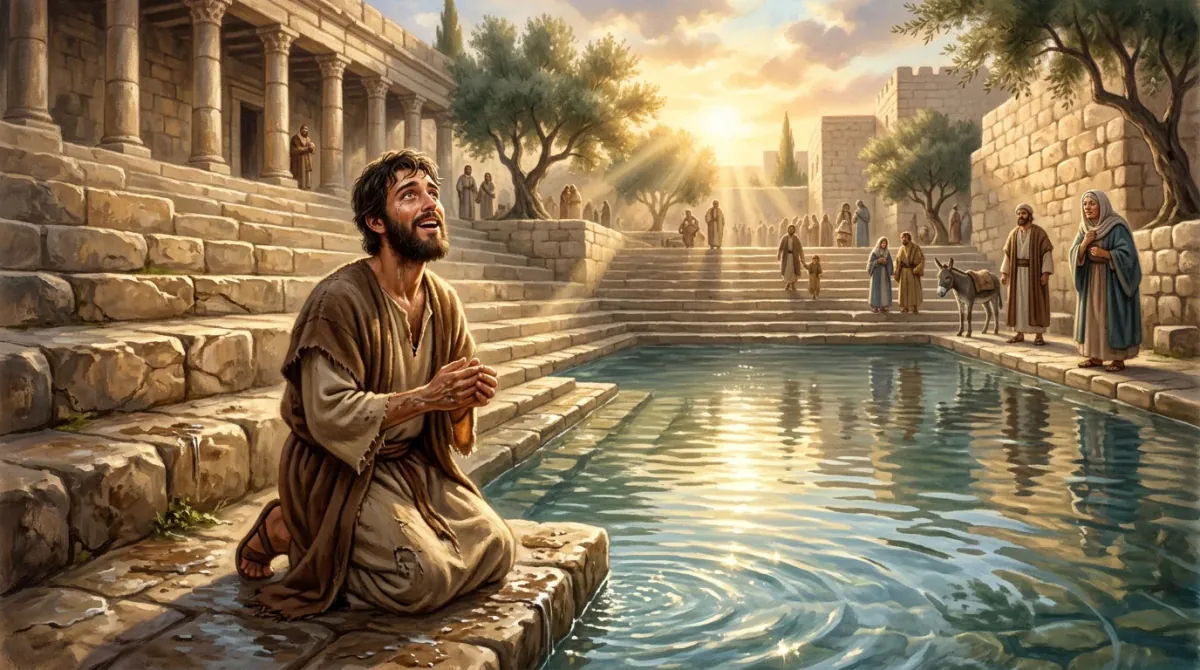
Descending the monumental limestone steps of the Pool of Siloam—the massive reservoir fed by the subterranean Gihon Spring built by King Hezekiah—the blind man knelt beside the cool, rippling waters. Cupping the living water in his hands, he splashed it repeatedly over his brow, washing away the encrusted clay.
As the muddy residue cleared, an indescribable sensation surged through his optic nerves. The perpetual midnight that had imprisoned him for decades shattered in a split second! Light—dazzling, golden, prismatic light—flooded his brain. He saw the shimmering reflections on the water’s surface, the ancient masonry of the stone steps, the leafy branches of olive trees swaying against the azure sky, and the amazed faces of pilgrims staring at him. He went away blind, but he came back seeing! (John 9:7).
Joy turned his steps into a sprint as he returned to his neighborhood. But when his neighbors and former acquaintances saw him walking upright with clear, shining eyes, confusion erupted. Some said, "Is this not he who sat and begged?" Others argued, "He is like him." But the man himself shouted repeatedly: "I am he!" (John 9:9). When pressed on how his eyes were opened, he gave an unvarnished account: "A Man called Jesus made clay and anointed my eyes and said to me, 'Go to the pool of Siloam and wash.' So I went and washed, and I received sight."
4. The Inquisition of the Pharisees
Unable to process the miracle, the neighbors marched the healed man directly to the ruling religious council of the Pharisees. The atmosphere inside the judgment hall turned instantly hostile when the rulers realized the healing had taken place on the Sabbath. A fierce division broke out among the council. Some declared dogmatically: "This Man is not from God, because He does not keep the Sabbath!" But others whispered in perplexity: "How can a man who is a sinner do such signs?" (John 9:16).
Turning to the healed beggar, they demanded: "What do you say about Him, since He opened your eyes?" The beggar answered without hesitation: "He is a prophet!"
Refusing to accept the evidence, the suspicious council summoned the man’s elderly parents to verify his identity. Terrified of the supreme religious penalty—excommunication from the synagogue (aposynagōgos), which meant complete social ostracization, commercial boycott, and familial shame—the parents gave guarded, evasive answers: "We know that this is our son, and that he was born blind; but by what means he now sees we do not know, or who opened his eyes we do not know. He is of age; ask him. He will speak for himself" (John 9:20–21).
5. 'One Thing I Know: I Was Blind, Now I See!'
Summoning the healed man for a second, intimidating cross-examination, the Pharisees attempted to coerce him into condemning his benefactor: "Give God the glory! We know that this Man is a sinner."
The former beggar’s response stands as one of the most brilliant, unassailable apologetics in Christian history:
"Whether He is a sinner or not I do not know. One thing I know: that though I was blind, now I see!" (John 9:25)
Furious at their inability to break his testimony, the scribes sneered: "What did He do to you? How did He open your eyes?" With courageous irony, the beggar retorted: "I told you already, and you did not listen. Why do you want to hear it again? Do you also want to become His disciples?"
Enraged, the proud council hurled insults at him, shouting: "You are His disciple, but we are Moses' disciples! We know that God spoke to Moses; as for this Fellow, we do not know where He is from." The beggar delivered the fatal theological blow: "Why, this is a marvelous thing, that you do not know where He is from; yet He has opened my eyes! Since the world began it has been unheard of that anyone opened the eyes of one who was born blind. If this Man were not from God, He could do nothing!" (John 9:30–33). Incensed by his wisdom, the council snarled, "You were completely born in sins, and are you teaching us?" And they violently cast him out of the synagogue.
6. True Sight: Worshiping the Son of God
Jesus heard that the religious authorities had excommunicated the faithful beggar. When religion discards a soul, the Shepherd of Israel draws near! Seeking him out in the crowded streets, Christ found the isolated outcast and asked him the definitive question of eternity:
"Do you believe in the Son of God?" (John 9:35)
The man answered with earnest longing: "Who is He, Lord, that I may believe in Him?" Jesus said to him with breathtaking intimacy: "You have both seen Him, and it is He who is talking with you." The first human being this man had ever laid eyes on in full spiritual and physical illumination was his Creator and Redeemer!
Falling prostrate in the dust before Christ, the man cried aloud: "Lord, I believe!" And he worshiped Him (prosekynēsen—John 9:38). Turning to the watching Pharisees, Jesus delivered the ultimate spiritual verdict: "For judgment I have come into this world, that those who do not see may see, and that those who see may be made blind." The beggar gained both physical sight and everlasting salvation, while the self-righteous leaders remained forever trapped in their self-inflicted spiritual blindness.
Ancient Near Eastern & Archaeological Context
During the autumn Feast of Tabernacles (Sukkot), Jerusalem was flooded with tens of thousands of pilgrims celebrating the wilderness journey and praying for rain. Each morning of the festival, the priests led a jubilant liturgical procession from the Temple Mount down the Tyropoeon Valley to the Pool of Siloam. With golden pitchers, the High Priest drew living water from Siloam, carried it back up to the Temple through the Water Gate, and poured it out at the base of the Brazen Altar amid the blasting of silver trumpets and the chanting of the Great Hallel (Psalms 113–118).
It was against this electrifying backdrop that Jesus declared: "If anyone thirsts, let him come to Me and drink!" (John 7:37) and "I am the light of the world!" (John 8:12). Immediately following these claims, Jesus encountered a man blind from birth sitting outside the Temple colonnades begging for alms. In ancient Jewish culture, congenital blindness was regarded as a tragic life sentence. Without government assistance, the blind had no economic recourse other than begging beside religious shrines.
By spitting on the dust to make clay, Jesus deliberately challenged the rigid scribal 'fences' around the Sabbath law. Rabbinic tradition cataloged thirty-nine categories of forbidden Sabbath work (*Melachot*), specifically prohibiting 'kneading' (*Lash*) and the application of saliva to heal eyes on the Sabbath. By commanding the man to walk blind through the city streets to Siloam, Christ turned the beggar's obedience into a public sign: the living water of Siloam could not wash away blindness, but the One who sent him was the true Light of the world.
Practical Discipleship & Spiritual Application
- Shattering Karmic Guilt: Stop viewing trials, illness, or setbacks as divine vengeance for past sins. In Christ, your hardest circumstances are not a prison of punishment, but a platform for the sovereign grace and glory of God to be revealed.
- Simple, Unhesitating Obedience: The blind man did not debate the physics of clay or question the logic of washing in Siloam; he simply went and washed. Supernatural transformation often hinges on uncalculating obedience to Christ's spoken Word.
- Courageous Witness Under Fire: When interrogated by powerful religious authorities, the healed beggar stood firm on his personal testimony: 'One thing I know: that though I was blind, now I see!' You do not need a theology degree to witness for Jesus; you only need to speak honestly of what He has done in your life.
- From Blind Beggar to True Worshiper: When religion cast the healed man out, Jesus sought him out. If the world rejects you for your faith in Christ, take heart: the Son of God meets you in your rejection and invites you into eternal, face-to-face worship.
Support Independent Biblical Research
Did this study bless you? Help support our independent bilingual research and interactive visual Bible tools.
⚡ Fast Facts
- Unprecedented Miracle: The healed man testified that since the beginning of the world, it had never been heard of that anyone opened the eyes of a man born congenitally blind (John 9:32)
- The Meaning of Siloam: The Hebrew name 'Shiloah' / Greek 'Silōam' literally means 'Sent', prophetically signifying Christ as the Father's Sent One who bestows life-giving living water
- Archaeological Discovery: In 2004, sewer excavation in the City of David uncovered the authentic monumental stepped limestone Pool of Siloam built by King Hezekiah, confirming John's topographical accuracy
- Cost of Discipleship: The healed beggar was officially 'cast out of the synagogue' (aposynagōgos), facing total social ostracization and economic boycott for confessing Christ
❓ Frequently Asked Questions (FAQs)
Why did the disciples ask whether the man or his parents sinned?
First-century Jewish theology was heavily influenced by rigid retributive justice: physical affliction was automatically presumed to be direct punishment for specific sin. Some rabbis even debated whether an infant could commit sin inside the womb, or whether ancestral sins directly afflicted offspring (citing Exodus 20:5). Jesus completely dismantled this karmic mindset, revealing that human suffering is not a ledger of personal guilt, but a fallen condition through which God's redemptive power and grace can be manifested.
Why did Jesus use mud and spittle to heal the blind man?
Jesus utilized clay and saliva for multiple theological reasons: First, it deliberately echoed Genesis 2:7, where God formed Adam from the dust of the ground—Christ was demonstrating His role as the divine Creator fashioning missing optic faculties. Second, by mixing clay on the Sabbath, Jesus deliberately violated Pharisaic oral traditions regarding forbidden Sabbath labor ('kneading clay'), exposing the dead legalism of the religious leaders. Third, sending him to wash in Siloam demanded active, step-by-step faith from the blind beggar.
What is the spiritual climax of John 9?
The climax occurs not when the physical eyes open, but when the spiritual eyes are illuminated. While the physically seeing Pharisees became increasingly blind through willful prejudice, the formerly blind beggar grew in progressive revelation: first seeing Jesus as 'a Man called Jesus,' then 'a prophet,' then 'a man from God,' and finally falling prostrate before Him as the 'Lord and Son of Man.' True sight is recognizing and worshiping Jesus Christ.