The sun was dipping beneath the jagged peaks of the Judean wilderness, casting long, bruised shadows across the sunken depression of the Jordan Rift Valley. Five miles east of the fortified perimeter of Jericho, the swollen waters of the Jordan River surged in violent torrents, overflowing all its banks in the springtime floods of the barley harvest. Across the churning river, on the acacia-covered terraces of Shittim, the armies of Israel stood poised for the conquest of Canaan. Their legendary prophet Moses was dead, but his spirit of wisdom rested upon Joshua the son of Nun. Joshua knew that before the nation could advance, the formidable border stronghold of Jericho had to be reckoned with. In secret, without alerting the excitable multitudes, Joshua summoned two seasoned, trustworthy young warriors and issued a quiet command: "Go, view the land, especially Jericho" (Joshua 2:1).
Slipping under cover of dusk across the treacherous river, the two scouts made their way across the alluvial plain. Jericho rose out of the desert oasis like a colossal stone monster. Ancient, wealthy, and strategically situated beside the sweet, bubbling waters of Ain es-Sultan, the city was guarded by an intimidating double-rampart defensive system. A lower retaining wall of cyclopean stones rose twelve to fifteen feet high, upon which sat a massive mudbrick parapet six feet thick. Behind this, a steep, plastered embankment rose thirty-five degrees toward a second, inner circuit of towering battlements. Entering through the massive wooden gates before the evening curfew, the spies sought lodging where foreign travelers and caravan traders routinely mingled without exciting suspicion: the inn and dwelling of a woman named Rahab.
Rahab was a *zonah*—a woman whose life was marked by the tragic compromises of pagan society. In the hyper-sexualized, idol-saturated culture of Canaan, she had operated an establishment built directly against the outer defensive wall of the city. Yet despite her dishonorable trade, Rahab possessed something entirely absent in the royal palace of Jericho: ears attuned to the invisible footsteps of the living God. For forty years, stories had drifted across the desert trade routes—tales of the Red Sea drying up before fleeing Hebrew slaves, stories of the supernatural slaughter of the Amorite giants Sihon and Og on the eastern tablelands. While the King of Jericho fortified his gates and offered desperate incantations to Baal and Ashtoreth, Rahab's heart had been seized by holy terror and divine revelation.
The arrival of the two strangers, however, had not escaped the watchful eyes of Jericho's counter-intelligence network. Within hours, armed soldiers banged violently upon Rahab's door with a royal warrant: "Bring out the men who have come to you, who have entered your house, for they have come to search out all the country!" (Joshua 2:3). In that terrifying heartbeat, Rahab stood at the ultimate crossroads of eternity. To surrender the spies meant royal favor, civic approval, and preservation of her earthly business. To hide them was high treason, punishable by horrific torture and execution. Without hesitating, Rahab chose treason against the doomed city of man in order to pledge allegiance to the eternal City of God.
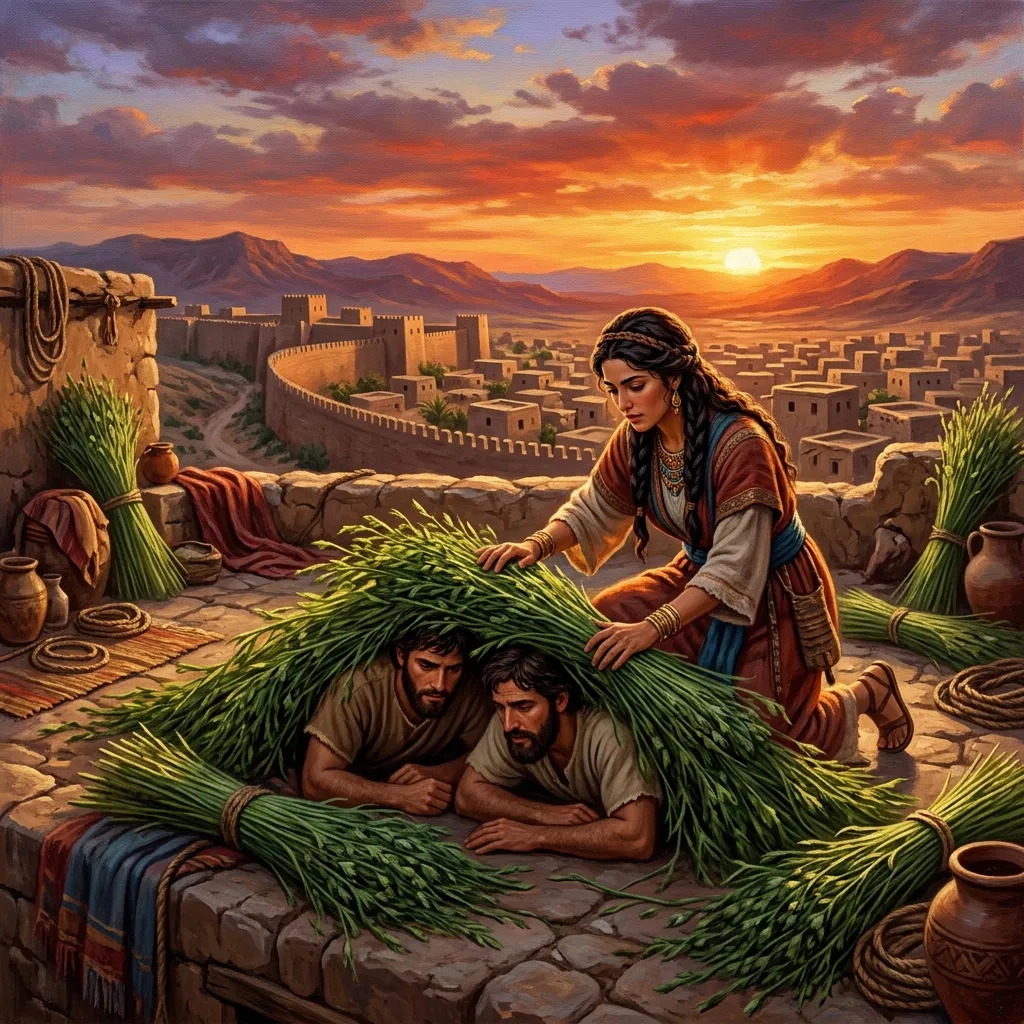
Earlier that evening, sensing the impending danger, Rahab had rushed the two men up the ladder to the flat mudbrick roof of her house. It was the spring harvest, and long, thick stalks of flax (*pishteh*) were spread across the terrace to dry in the Mediterranean breeze before being spun into linen. Rahab concealed the two Hebrews beneath the bundles of flax, burying them out of sight. When the king's interrogators burst into her courtyard, she answered with calm, deceptive poise: "True, the men came to me, but I did not know where they were from. And it happened as the gate was being shut, when it was dark, that the men went out. Where the men went I do not know; pursue them quickly, for you may overtake them!" (Joshua 2:4–5). Deceived by her urgency, the royal guards bolted out of the city gates, thundering toward the Jordan fords in a futile pursuit.
As soon as the city gates clanged shut and the sounds of pursuit faded into the night, Rahab ascended to the roof. Peeling back the fragrant stalks of flax, she looked down into the eyes of the two trembling scouts. There, under the canopy of the desert stars, this pagan prostitute delivered one of the most magnificent, doctrinally pure confessions of faith in the entire Old Testament: "I know that Yahweh has given you the land, that the terror of you has fallen on us, and that all the inhabitants of the land are fainthearted because of you... For Yahweh your God, He is God in heaven above and on earth beneath!" (Joshua 2:9, 11).
Rahab did not merely acknowledge Israel's military might; she recognized the absolute, cosmic supremacy of Yahweh. She knew that the gods of Canaan were dead wood and stone, powerless before the Maker of heaven and earth. Then, leaning upon the covenant mercy of the God she had just acknowledged, Rahab made her passionate petition: "Now therefore, I beg you, swear to me by Yahweh, since I have shown you covenant lovingkindness (chesed), that you also will show chesed to my father's house, and give me a true token, and spare my father, my mother, my brothers, my sisters, and all that they have, and deliver our lives from death!" (Joshua 2:12–13).
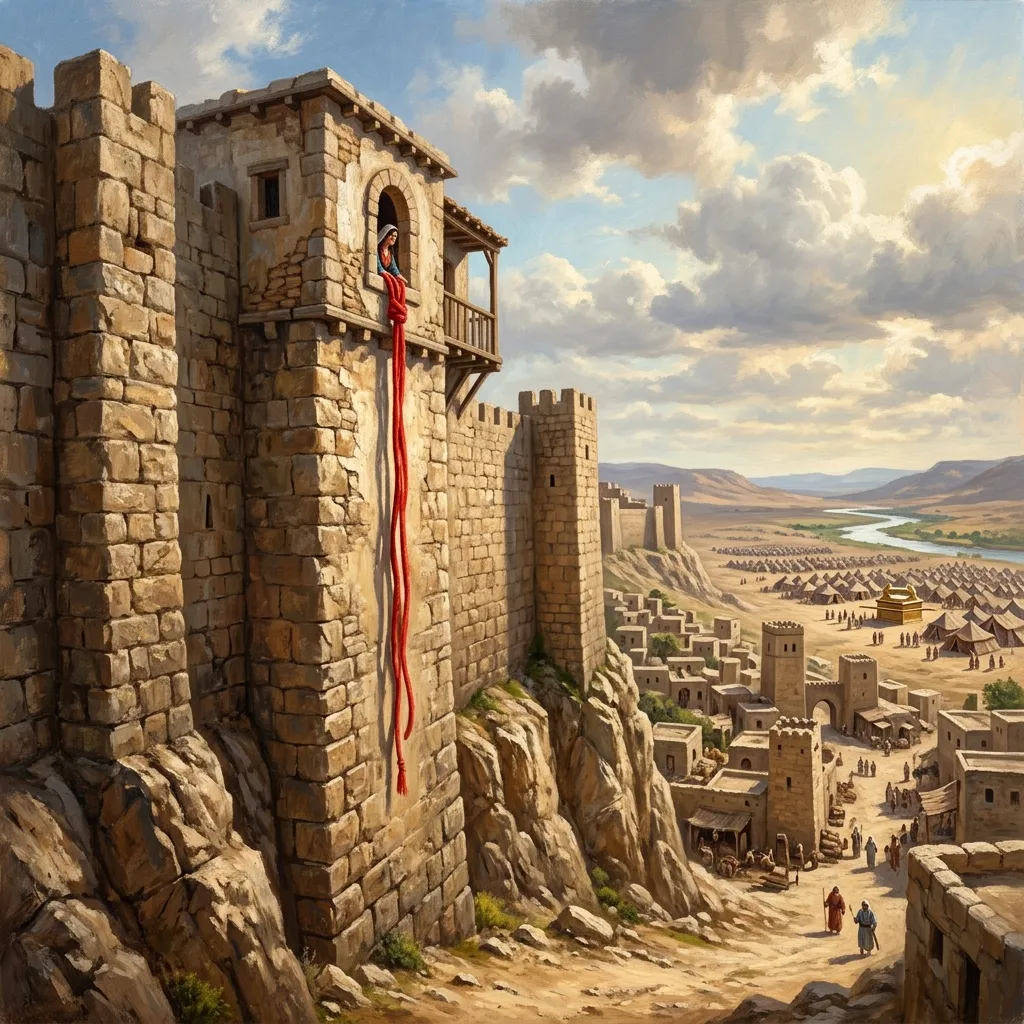
The spies responded with solemn reciprocity: "Our lives for yours, if none of you tell this business of ours!" (Joshua 2:14). Because her house was built directly into the exterior defensive wall, Rahab produced a strong rope and let the two men down through her window to the foot of the rampart outside the city. Before they vanished into the limestone ravines of the mountains to evade the search parties for three days, the spies gave her their binding instructions: "Behold, when we come into the land, you shall bind this line of scarlet cord (tiqvat chut hashani) in the window through which you let us down, and you shall bring your father, your mother, your brothers, and all your father's household into your house... Whoever goes outside the doors of your house into the street, his blood shall be on his own head, and we will be guiltless. And whoever is with you in the house, his blood shall be on our head if a hand is laid on him!" (Joshua 2:18–19).
The Hebrew text contains a breathtaking double entendre: the word for cord is *tiqvah*, which is also the biblical word for 'hope.' Rahab tied her entire hope upon a thread of crimson! As soon as the men disappeared into the darkness, Rahab immediately fastened the scarlet cord into the lattice of her window. Days later, when the armies of Israel marched around Jericho, and the priests blew the ram's horns, and the great shout of faith caused the colossal ramparts of the city to violently collapse into the ground, one solitary section of the northern wall remained standing like an invincible fortress—the house marked by the scarlet cord!
Joshua honored the oath. Joshua 6:23 records that the two young spies entered the ruins, brought out Rahab, her parents, her siblings, and all her kindred, and set them safely outside the camp of Israel. But grace did not leave Rahab outside the camp. She was cleansed, grafted into the covenant commonwealth of Israel, and married Salmon, a prince of the royal tribe of Judah. She bore a son named Boaz—the noble kinsman-redeemer who married Ruth. Through that lineage came King David, and through David came Jesus Christ, the Son of God! Etched forever into the genealogy of Matthew 1:5 and celebrated in the Hall of Faith (Hebrews 11:31), Rahab stands as an eternal monument that no sinner is too defiled for the blood of Calvary to redeem, transform, and crown with royal glory!
Biblical Keywords & Theological Roots
A cord, line, or thread twisted together; simultaneously the root for 'hope' and 'eager expectation.' The crimson cord in Rahab's window bound physical cordage to messianic hope.
A woman who commits fornication, a harlot, or keeper of an inn/brothel; designating Rahab's marginalized, unholy social status prior to sovereign covenant redemption.
Covenant loyalty, unfailing lovingkindness, steadfast mercy; the reciprocal covenant grace requested by Rahab and sworn by the Hebrew spies under divine oath.
To know experientially, perceive with certainty; Rahab's opening words ('I know that Yahweh has given you the land') demonstrating divine revelation surpassing pagan ignorance.
To deliver, snatch away, preserve alive, pluck from the jaws of death; the covenant promise to rescue Rahab's household from the total annihilation of Jericho.
Ancient Near Eastern & Archaeological Context
Ancient Jericho (Tell es-Sultan) was one of the oldest continuously fortified settlements in the ancient world, strategically controlling the spring of Ain es-Sultan and guarding the primary ascent from the Jordan Rift Valley into the Judean highlands. Archaeological excavations conducted by Ernst Sellin, Carl Watzinger, John Garstang, Kathleen Kenyon, and more recently analyzed by Bryant Wood, reveal that Bronze Age Jericho possessed a sophisticated double-rampart defensive system. The lower defense consisted of a massive cyclopean stone retaining wall (12–15 feet high), surmounted by an outer mudbrick wall (6–8 feet thick and roughly 20 feet high), followed by an inward-sloping rampart (a plaster revetment scarp) leading up to an inner, upper city wall. Poor domestic dwellings were routinely constructed between the outer and inner walls, utilizing timber beams spanning the ramparts, so that the back exterior wall of the house formed the literal defensive rampart of the city—directly corroborating Joshua 2:15 ('for her house was on the city wall; she dwelt on the wall'). In the spring harvest season (March/April, when flax and barley were reaped), the roofs of these flat-topped mudbrick homes were covered with long stalks of flax (*pishteh*) laid out to dry in the sun before being combed into linen threads, providing the precise physical concealment described in the biblical narrative. In Canaanite society, Rahab's designation as a *zonah* indicated an innkeeper, tavern operator, or secular harlot whose roadside establishment accommodated traveling caravans, foreign merchants, and mercenary scouts without arousing immediate municipal suspicion.
Practical Discipleship & Spiritual Application
- Sovereign Grace Reaches the Most Marginalized: Rahab was a Canaanite, a pagan, and a prostitute living under the shadow of divine condemnation. Yet God's sovereign grace pierced through the fortified walls of Jericho to rescue her. No human being is too far gone, too deeply entrenched in sin, or too socially disgraced for the redeeming mercy of God to transform into a trophy of grace.
- Genuine Faith Always Produces Courageous Action: James 2:25 asks, 'Was not Rahab the harlot also justified by works when she received the messengers and sent them out another way?' True biblical faith is never a passive theological opinion; it is an active allegiance that risks life, reputation, and worldly security to align with God's covenant people.
- The Scarlet Cord of Calvary: Just as the blood of the Passover lamb painted upon Israel's doorposts in Egypt shielded them from the destroying angel (Exodus 12), the scarlet cord suspended in Rahab's window marked her house as an inviolable sanctuary of mercy. Amidst the collapsing walls of Jericho, everyone inside that house was completely preserved by the covenant thread of blood.
- Radical Grafting into the Lineage of the Messiah: Rahab was not merely spared from physical slaughter; she was embraced into the community of Israel, married Prince Salmon of the tribe of Judah, and became the mother of Boaz and the great-great-grandmother of King David! Her name is etched forever into Matthew 1:5 in the royal genealogy of Jesus Christ, proving that God turns redeemed sinners into pillars of His kingdom.
⚡ Fast Facts
- Rahab hid the two scouts beneath stalks of flax (*pishteh*) laid out to dry on her roof, a detail confirming the springtime barley and flax harvest season (Joshua 2:6).
- Jericho was situated approximately 5 miles west of the Jordan River, directly opposite the Hebrew encampment at Shittim (Abel-Shittim).
- The scarlet cord (*tiqvat chut hashani*) had to remain visibly suspended outside her wall window, and all her family members had to remain inside her domicile to be saved (Joshua 2:18–19).
- Rahab is one of only four women specifically mentioned by name in Matthew's genealogy of Jesus Christ (Matthew 1:5), alongside Tamar, Ruth, and Bathsheba.
❓ Frequently Asked Questions (FAQs)
Rahab's deception in Joshua 2:4–5 ('Yes, the men came to me, but I did not know where they were from. And it happened as the gate was being shut... the men went out') has generated centuries of ethical and theological discussion. Scripture nowhere praises Rahab for lying; rather, the New Testament explicitly praises her *faith* (Hebrews 11:31) and her *courageous works* of hospitality and treason against an evil, idolatrous kingdom (James 2:25). Rahab was a newborn believer raised in a debased pagan culture where lying, human sacrifice, and sexual depravity were everyday norms; she did not possess the Ten Commandments or a refined biblical ethic. Yet, with the light she had, she correctly discerned that Yahweh was the true Sovereign of heaven and earth, and that the Canaanite kingdom of Jericho was under divine judgment. In wartime resistance against a wicked regime bent on slaughtering God's covenant servants, her tactical deception was the only weapon she had to preserve innocent life. God met Rahab in her imperfect spiritual infancy, honored her faith-fueled rescue of His people, and subsequently sanctified her life as she was incorporated into the holy nation of Israel.
The archaeological discoveries at Tell es-Sultan (ancient Jericho) provide some of the most striking physical synchronisms with the biblical text. In the 1930s and 1950s, excavations led by John Garstang and Dame Kathleen Kenyon revealed that Late Bronze Age Jericho was surrounded by a massive mudbrick wall built on top of a cyclopean stone retaining wall. German excavators Ernst Sellin and Carl Watzinger, and later Garstang, discovered that along the northern stretch of the lower city wall, sections of the mudbrick wall had not collapsed outward like the rest of the city walls, and domestic houses were actually preserved directly attached to the retaining wall! Furthermore, the city had been destroyed by an intense conflagration, with thick layers of ash, burnt timbers, and dozens of large ceramic storage jars filled with charred, uneaten grain—confirming that the siege took place in springtime just after harvest (when flax was drying on roofs), was exceptionally brief (leaving grain stores unconsumed), and that the city was not looted by the conquerors (fulfilling Joshua 6:24, where everything was devoted to destruction). Rahab's home, perched on the surviving northern wall, stands vindicated by archaeological stratigraphy.
The scarlet cord suspended from Rahab's window is one of the most vivid christological and redemptive types in Old Testament typology. First, the Hebrew phrase *tiqvat chut hashani* contains the word *tiqvah*, which simultaneously means a physical cord and the spiritual reality of 'hope' or 'expectation.' Rahab hung her physical hope upon a cord of crimson. Second, the scarlet color intentionally mirrors the sacrificial blood of the Passover lamb (Exodus 12). Just as the Hebrew slaves smeared blood upon their lintels and doorposts to be spared from the wrath of the destroying angel, Rahab's household was commanded to remain behind the boundary of that scarlet cord: 'Whoever goes outside the doors of your house into the street, his blood shall be on his own head... but whoever is with you in the house, his blood shall be on our head if a hand is laid on him' (Joshua 2:19). When the walls of Jericho violently collapsed under the blast of the rams' horns and the shout of faith, that single section of wall bearing the crimson thread remained standing as an island of life in a sea of judgment. It proclaims the eternal truth that there is only one sanctuary from the coming wrath of God: being sheltered under the crimson blood of Jesus Christ, our true Passover Lamb.