The eastern sky above the mountains of Moab was tinged with the first faint blushes of dawn. At the encampment of Shittim, the silver trumpets sounded, echoing across the acacia groves. Joshua the son of Nun, the commander of Israel, was awake and active early in the morning. After four decades of circular wandering in the howling wilderness, the destiny of the nation was about to be realized. Joshua commanded the officers to pass through the camp with a momentous directive: Israel was to strike their tents and march three days toward the banks of the Jordan River. Arriving at the river's eastern terrace, they camped along the flood line, looking across the water toward the emerald oasis of Jericho.
Yet as the two million men, women, and children stood upon the muddy embankment, human logic whispered that crossing was an absolute physical impossibility. It was the month of Nisan—the time of the barley harvest in the spring. Across the northern horizons, the torrential rains of the late season and the heavy melting snows of Mount Hermon poured down into the Sea of Galilee and gushed into the Jordan River. Scripture records with solemn emphasis: "For the Jordan overflows all its banks during the whole time of harvest" (Joshua 3:15). The river was not a peaceful, sluggish brook; it was a swollen, chocolate-brown monster, hundreds of yards wide, churning with violent whirlpools and uprooted trees across the dense jungle of the lower river basin (*Zor*). Without bridges, without pontoons, and without boats, any human attempt to cross with families, flocks, and heavy baggage would result in catastrophic drowning.
Joshua, however, looked not at the surging waves, but at the God of the covenant. He proclaimed to the congregation the divine mandate for spiritual victory: "Sanctify yourselves, for tomorrow Yahweh will do wonders among you!" (Joshua 3:5). Biblical miracles do not occur in an atmosphere of spiritual carelessness; genuine divine intervention requires a consecrated people who have cleansed their hearts, renounced their sins, and positioned themselves in reverent obedience before the living God.
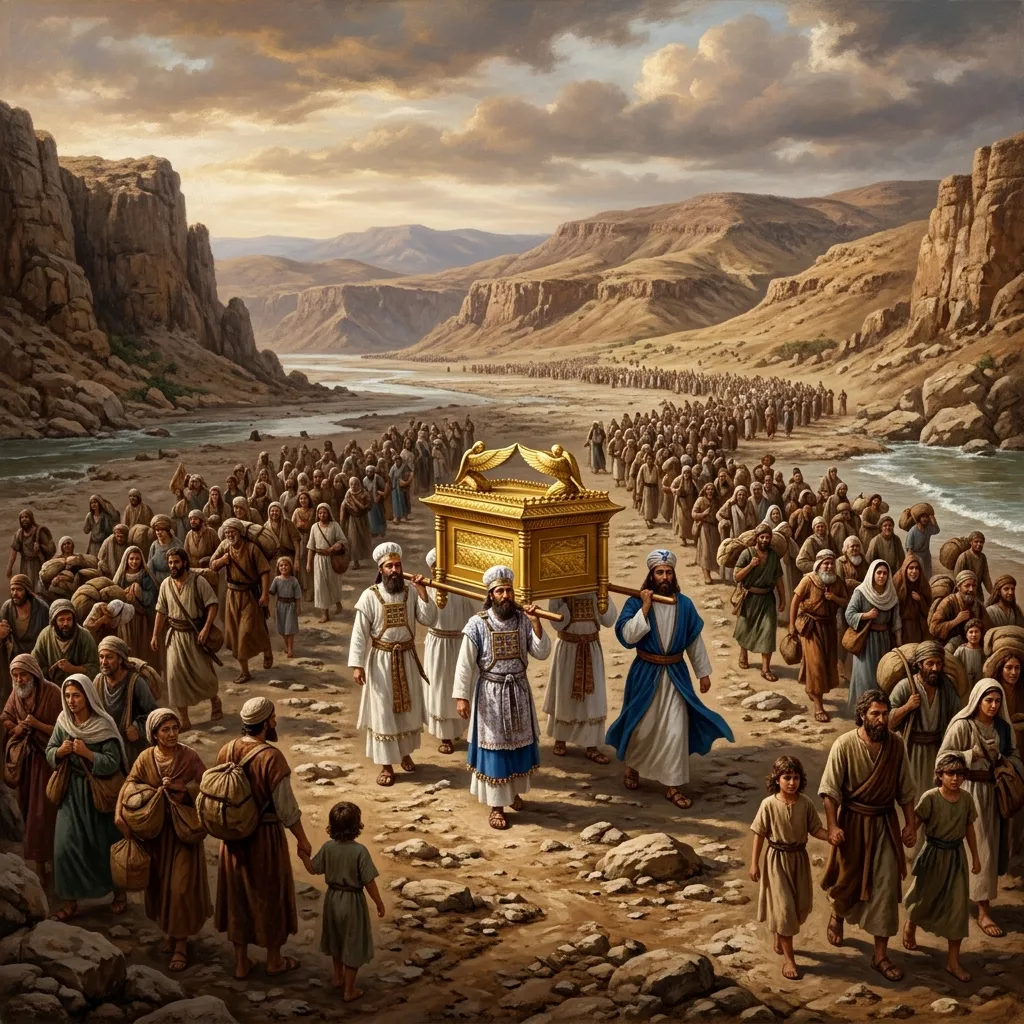
The following morning, Joshua unveiled the divine battle order. In worldly warfare, heavily armed vanguard infantry and cavalry lead the front lines to absorb the initial assault. But in the army of Yahweh, the front line was occupied by the priests of the tribe of Levi, bearing upon their shoulders the gold-plated Ark of the Covenant (*Aron ha-Berith*). Inside that sacred chest lay the two stone tablets of the Ten Commandments, the golden pot of manna, and Aaron's rod that budded; upon its lid rested the solid gold Mercy Seat shadowed by the wings of the cherubim, the earthly footstool of the Shekinah glory of Almighty God. The command was issued to the people: "When you see the ark of the covenant of Yahweh your God, and the priests, the Levites, bearing it, then you shall set out from your place and go after it. Yet there shall be a space between you and it, about two thousand cubits by measure. Do not come near it, that you may know the way by which you must go, for you have not passed this way before!" (Joshua 3:3–4).
A reverent distance of nearly three-quarters of a mile was kept between the people and the Ark. Every eye in the vast multitude could see the sacred gold chest moving forward alone across the plain. God was demonstrating that He is the vanguard of His people; He does not ask His sheep to go where the Shepherd has not already stepped.
Then came the ultimate test of active faith. Joshua instructed the priests: "When you have come to the edge of the water of the Jordan, you shall stand in the Jordan" (Joshua 3:8). The river did not divide while the priests stood comfortably upon the dry grass. There was no parting of the waters from afar. The Levites had to lift the poles of the Ark, march down the slippery, mud-caked riverbank, and physically plant the soles of their feet into the freezing, rushing current! Faith is never a passive mental agreement; biblical faith is active obedience that wades directly into the impossible at the command of God.
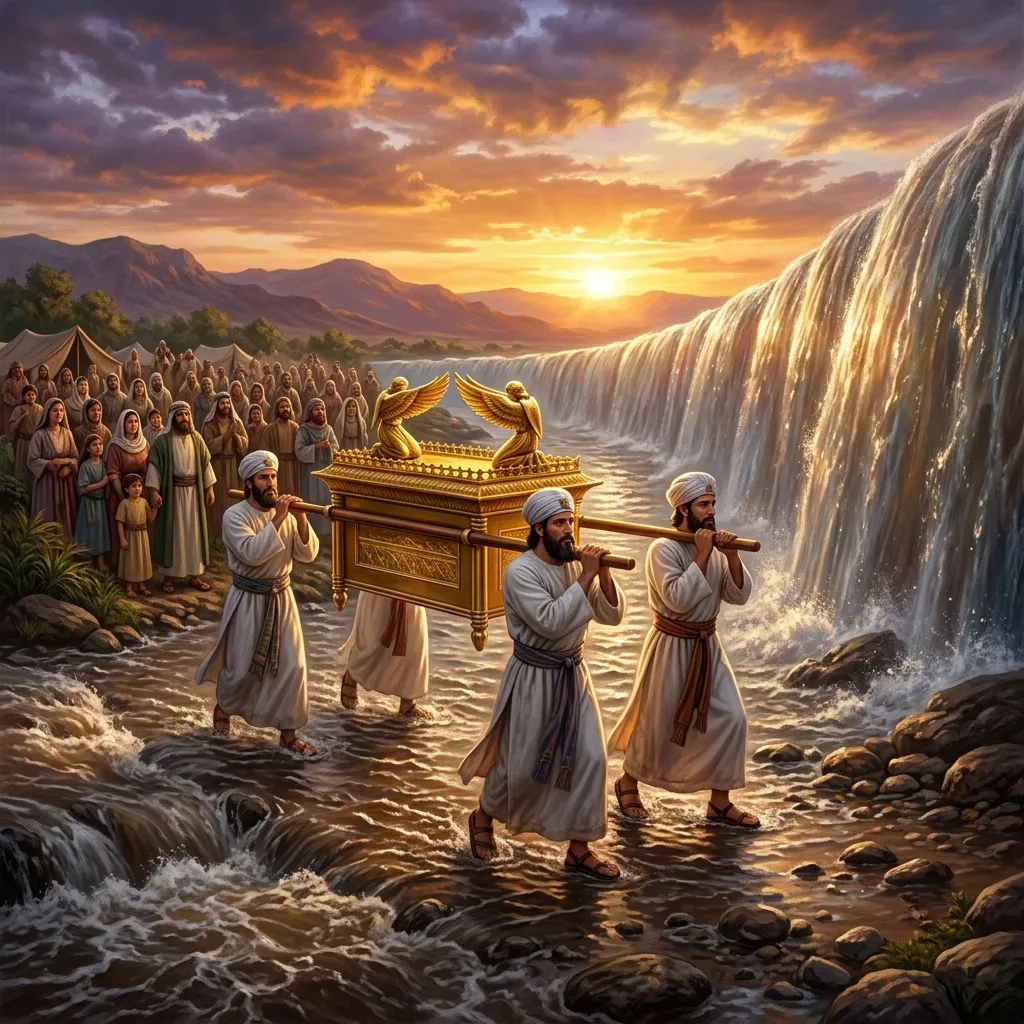
The microsecond the soles of the priests' feet touched the brim of the water, heaven intervened! Scripture records the astonishing mechanics of the miracle: "The waters which came down from upstream stood still, and rose in a heap (ned) very far away at the city of Adam, that is beside Zaretan; and those that went down into the Sea of the Arabah, the Salt Sea, failed, and were cut off; and the people crossed over opposite Jericho" (Joshua 3:16). Sixteen to eighteen miles north, near the confluence of the Jabbok at Tell ed-Damiya, the downward rush of the Jordan was supernaturally arrested. The surging waters piled up like a transparent vertical dam, held back by the invisible hand of the Almighty! Downstream, the remaining water rushed southward into the Dead Sea, leaving the riverbed completely exposed.
Yet God did not merely remove the water; He performed a dual miracle upon the terrain. A riverbed submerged under rushing water for centuries is naturally a treacherous morass of deep mud, sticky silt, and slippery stones. Had Israel attempted to march across such ground, wagons would have sunk to their axles, children would have been trapped, and livestock would have broken their legs. But Scripture declares that the priests stood on charavah—completely dry, baked, solid ground! The moisture was instantly desiccated by divine power. The priests bearing the Ark marched into the very center of the dry river channel and planted their feet firmly upon the bedrock. There they remained, holding the presence of God stationary in the midst of danger, while two million Hebrews—men, women, children, flocks, and cattle—marched swiftly and safely across the riverbed into Canaan!
Once the entire nation had safely crossed, Yahweh commanded Joshua to execute an act of permanent memorialization. One representative from each of the twelve tribes was ordered to take up a massive stone from the dry riverbed, directly from the spot where the priests' feet were standing, hoist it onto his shoulder, and carry it across to their first encampment on Canaanite soil. There, on the rolling plains of Gilgal, Joshua erected those twelve river stones into a towering monument (*zikkaron*). Simultaneously, Joshua personally erected a second monument of twelve stones directly in the midst of the riverbed itself, where the priests stood with the Ark (Joshua 4:9).
The spiritual typology of these two stone cairns is breathtaking. The twelve stones buried in the riverbed represent the old, unbelieving generation of the wilderness—and our old fallen nature—crucified and buried forever beneath the waters of death and judgment (Romans 6:4). When the priests finally stepped out of the river onto the western shore and the restrained waters crashed back down, completely submerging those twelve stones, the old life was sealed away forever. Conversely, the twelve stones lifted out of the riverbed and standing tall at Gilgal represent the resurrected people of God, brought out of death into victorious, triumphant life in the Promised Land!
Joshua looked upon the stones at Gilgal and delivered a prophetic charge that resonates to every generation: "When your children ask their fathers in time to come, saying, 'What are these stones?' then you shall let your children know, saying, 'Israel crossed over this Jordan on dry land'; for Yahweh your God dried up the waters of the Jordan before you until you had crossed over, as Yahweh your God did to the Red Sea, which He dried up before us until we had crossed over, that all the peoples of the earth may know the hand of Yahweh, that it is mighty, that you may fear Yahweh your God forever!" (Joshua 4:21–24).
Biblical Keywords & Theological Roots
The Descender; derived from *yarad* (to descend or fall down), signifying the rapid, tumbling drop of the Jordan River from Mount Hermon to the Dead Sea.
The Ark of the Covenant; the physical throne of the Shekinah presence of Yahweh, leading the nation into the impossible barrier.
A heap, wall, or mound; specifically used of fluid waters miraculously arrested and standing upright in defiance of gravity.
Dry land, parched ground; miraculous desiccation of the muddy, silt-laden riverbed, ensuring swift and unhindered passage for millions.
A memorial, reminder, or commemorative sign; permanent physical monuments erected so future generations would remember Yahweh's covenant acts.
Ancient Near Eastern & Archaeological Context
The crossing of the Jordan took place in the Hebrew month of Nisan (March/April), coinciding with the spring barley harvest. During this season, melting snowpacks from Mount Hermon combined with late seasonal rains in the Galilean highlands swell the Jordan River to overflowing flood stage (*male al-kol-gedotav*). Topographically, the Jordan Valley features two terraces: the upper terrace (*Ghor*) and the lower, sunken floodplain (*Zor*), a dense, impassable jungle of tamarisk, willows, and reeds typically 200 yards to a mile wide. In flood season, the river surged across the entire Zor in a muddy, lethal torrent with treacherous undercurrents, rendering human fording impossible. Scripture records that the waters were cut off at 'Adam, the city that is beside Zaretan' (Joshua 3:16), identified with modern Tell ed-Damiya, approximately 16 to 18 miles north of the Jericho ford. The Jordan Rift Valley is a seismically active tectonic plate boundary; historical records from AD 1267, 1834, 1906, and 1927 document that major earthquakes and seismic shocks frequently triggered massive collapses of unstable marl and clay bluffs at Damieh, choking the river channel for hours or days. God's miraculous intervention synchronized divine sovereign timing with the exact microsecond the priests' feet touched the river's edge, cutting off the waters upstream and supernaturally desiccating the muddy riverbed into hard, dry ground (*charavah*) to allow an estimated two million people, livestock, and wagons to cross safely.
Practical Discipleship & Spiritual Application
- Faith Steps into the Water Before the River Parts: The waters of the Jordan did not divide while the priests stood comfortably on the dry riverbank. God commanded them to step directly into the roaring floodwaters. Supernatural deliverance often awaits the courageous step of active obedience; God parts the waters only when the soles of our feet touch the brim of our impossibilities.
- Follow the Presence of God into Uncharted Territory: Israel was instructed to keep a distance of two thousand cubits behind the Ark, 'for you have not passed this way before' (Joshua 3:4). When entering unknown seasons of transition, crisis, or new callings, we must not rely on human ingenuity or past experience. We must keep our eyes riveted upon the presence of God and let Him lead the vanguard.
- Spiritual Leaders Must Stand Firm in the Midst of the Riverbed: The priests carrying the Ark remained standing motionless on dry ground in the very center of the riverbed until every last Israelite had safely crossed over (Joshua 3:17). Pastors and spiritual leaders are called to stand steadfast in the place of intercession and vulnerability, anchoring the flock through seasons of trial until everyone reaches safety.
- Erecting Memorials of Deliverance for the Next Generation: The twelve stones gathered from the Jordan and erected at Gilgal served a vital educational purpose: 'When your children ask in time to come, What do these stones mean? Then you shall tell them...' (Joshua 4:21–22). We must intentionally cultivate spiritual testimonies in our homes, reminding our children of the mighty interventions of God so their faith never falters.
⚡ Fast Facts
- Israel was commanded to maintain a reverent distance of approximately 2,000 cubits (about 3,000 feet, or over half a mile) behind the Ark of the Covenant (Joshua 3:4).
- The raging waters of the Jordan were arrested approximately 16 to 18 miles upstream at the city of Adam, near Zaretan (Joshua 3:16).
- Two distinct sets of twelve stones were erected: one set taken from the riverbed and erected at the camp in Gilgal, and a second set erected by Joshua directly in the midst of the river where the priests stood (Joshua 4:9, 20).
- The miraculous crossing occurred on the tenth day of the first month (Nisan), the exact day when the Passover lamb was selected according to Exodus 12:3 (Joshua 4:19).
❓ Frequently Asked Questions (FAQs)
While both crossings involved the miraculous division of waters, they represent two distinctly different stages in the believer's spiritual journey. The crossing of the Red Sea (Exodus 14) symbolizes salvation and regeneration: the redeemed people are delivered out of Egyptian bondage, the blood of the Passover lamb has been applied, and Pharaoh's pursuing armies are drowned in judgment. The Red Sea represents baptism into Moses (1 Corinthians 10:1–2), delivering believers *out of* the kingdom of darkness. However, the wilderness wanderings that followed proved that while Egypt was taken out of Israel, Israel had not fully taken Egypt out of their hearts. The crossing of the Jordan River (Joshua 3–4), by contrast, represents entering into the fullness of the Spirit-filled life—the land of spiritual inheritance, victory, and overcoming rest in Christ (Hebrews 3–4). At the Red Sea, the waters parted in response to Moses' outstretched rod; at the Jordan, the priests had to physically step into the flooded waters in active faith, following the Ark of the Covenant (Christ). The Red Sea delivered from judgment; the Jordan introduced into warfare and conquest. Typologically, the Jordan represents the believer's co-crucifixion and co-resurrection with Jesus Christ (Galatians 2:20; Romans 6:3–4), where the old wilderness self is buried in the riverbed, and the believer steps into the heavenly places to overcome principalities and powers.
Joshua 3:16 provides an extraordinarily precise topographical marker: 'The waters which came down from upstream stood still, and rose in a heap very far away at the city of Adam, that is beside Zaretan; and those that went down into the Sea of the Arabah, the Salt Sea, failed, and were cut off.' The city of Adam is identified with modern Tell ed-Damiya, located approximately sixteen to eighteen miles north of the Jericho crossing point, near the confluence of the Jabbok River and the Jordan. At this point, the Jordan flows through towering, unstable bluffs composed of marl, soft silt, and clay. The Jordan Rift is a major tectonic plate boundary notorious for intense seismic activity. Historical and modern geological records document numerous occasions where earthquakes triggered massive landslides of these marl cliffs into the river gorge, completely damming the Jordan for extended periods—most notably in December 1267 (blocked for 16 hours), 1834, 1906, and July 11, 1927, when a 6.2 magnitude earthquake caused the cliffs at Damieh to collapse, blocking the river for twenty-one and a half hours! God, the Creator of the earth, may well have utilized an earthquake or natural geological cliff-collapse to dam the river at Adam. However, the supreme miracle was divine synchronization: the water was arrested the exact microsecond the priests' feet touched the floodwaters, the muddy silt riverbed was instantly transformed into hard, dry ground (*charavah*), and the waters resumed flowing the exact moment the priests stepped onto the western bank (Joshua 4:18).
Scripture explicitly records that two separate monuments of twelve stones were erected during this event. First, Joshua 4:1–8 describes how one man from each of the twelve tribes gathered a large stone from the dry riverbed where the priests stood, carried it on his shoulder across the river, and erected a memorial cairn at their first encampment in Gilgal. Second, Joshua 4:9 reveals: 'Then Joshua set up twelve stones in the midst of the Jordan, in the place where the feet of the priests who bore the ark of the covenant stood; and they are there to this day.' These two monuments embody a profound, two-fold spiritual truth corresponding to the death and resurrection of the believer with Christ. The twelve stones buried in the riverbed represent the old, rebellious wilderness generation—and our old fallen nature—being buried forever beneath the waters of death and judgment. When the waters rushed back over them, those stones were hidden from sight, signifying that our old life is dead and buried with Christ (Romans 6:4). Conversely, the twelve stones lifted out of the riverbed and erected at Gilgal represent the new, resurrected covenant nation emerging into victorious life on the other side of death. Gilgal became the place where the reproach of Egypt was rolled away (*galal* means to roll), where the nation was circumcised in heart, and where they partook of the Passover in the Promised Land. The stones at Gilgal stood as an eternal, visible monument to future generations that Yahweh is living and faithful to His covenant promises.