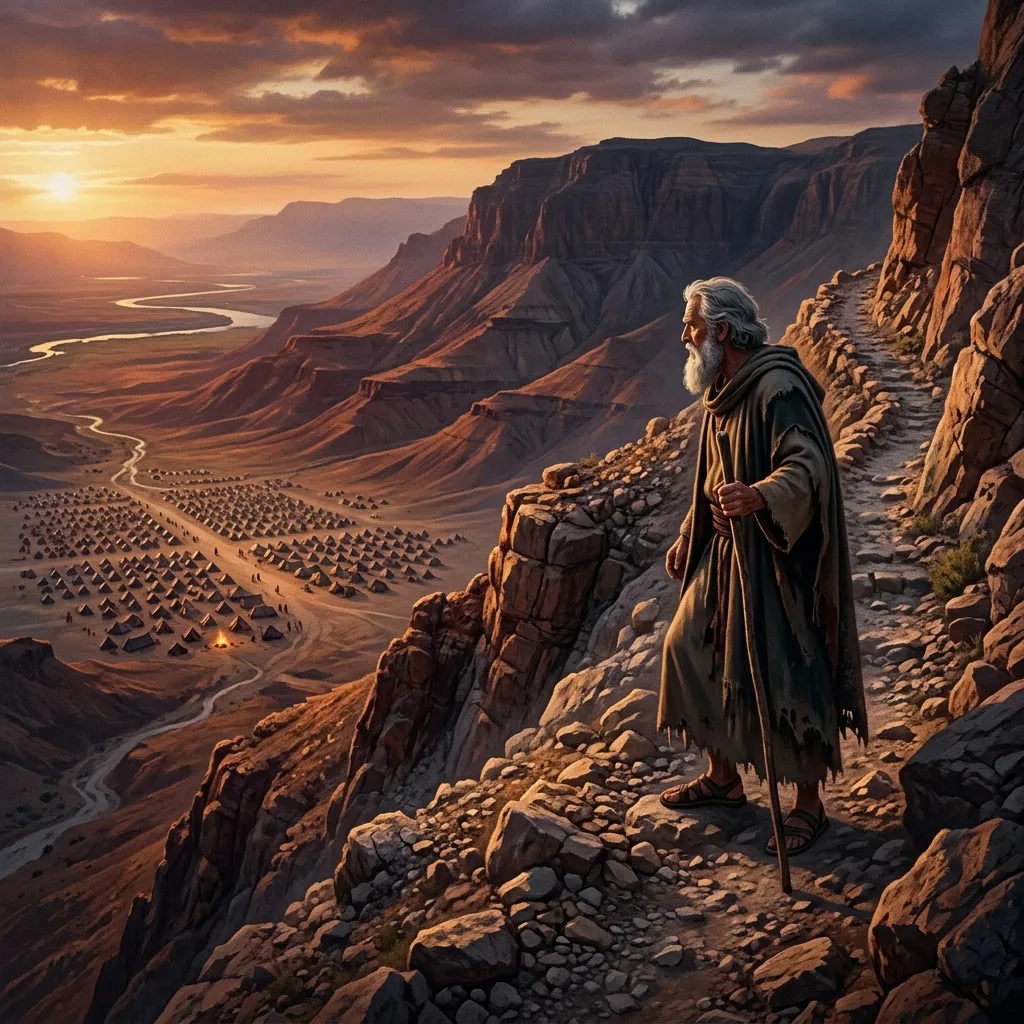
The scorching sun of the biblical east beat down upon the dry, limestone crags of the Abarim mountain range. From the dusty encampment at Shittim on the plains of Moab, where the white tents of the twelve tribes of Israel stretched across the acacia-dotted plains like a peaceful sea, a solitary, cloaked figure began his final ascent. It was Moses, the prince of Egypt, the shepherd of Midian, the deliverer of Israel, and the friend of God. He walked without an escort, without an armor-bearer, and without a physician. At one hundred and twenty years of age, his stride was firm, his spine unbent, and his step measured with solemn dignity. Behind him lay an entire lifetime of titanic redemptive dramas: the burning bush of Horeb, the ten plagues of Egypt, the roaring waters of the divided Red Sea, the blazing fire atop Mount Sinai, and forty long, agonizing years of shepherding a stiff-necked nation through the howling wasteland.
Now, at the summons of Yahweh, Moses ascended the rocky trail toward Mount Nebo, to the highest peak of the ridge known as Pisgah. Just hours earlier, he had gathered the elders, the priests, and the gathered congregation of Israel to pronounce his prophetic blessings upon the twelve tribes—words immortalized in the majestic poetry of Deuteronomy 33. He had laid his hands upon Joshua, publically investing him with authority before the High Priest Eleazar, ensuring that the flock would not be left without a shepherd. Then, turning his back upon the congregation he had loved and interceded for across four decades, Moses walked upward alone into the embrace of God.
Reaching the windswept summit of Pisgah, elevated nearly three thousand feet above the rift valley below, Moses stood upon the precipice. The desert wind whipped around his mantle as he looked out across the horizon. Suddenly, the hand of Yahweh came upon him, quickening his senses with supernatural clarity. Scripture records the breathtaking miracle of that moment: "Then Moses went up from the plains of Moab to Mount Nebo, to the top of Pisgah, which is across from Jericho. And Yahweh showed him all the land: Gilead as far as Dan, all Naphtali and the land of Ephraim and Manasseh, all the land of Judah as far as the Western Sea, the South, and the plain of the Valley of Jericho, the city of palm trees, as far as Zoar" (Deuteronomy 34:1–3).
Under ordinary physical conditions, the human eye cannot pierce the haze of distance to perceive Dan in the far north and the sparkling waters of the Mediterranean Sea in the west from a single vantage point. But this was no ordinary sight; it was a divine vision (*re'eh*), where God supernaturally expanded Moses' physical vision to behold the full geographical sweep of the covenant inheritance. Moses saw the emerald valleys of Galilee, the rolling hills of Samaria, the rugged mountains of Judea, the ancient terraces of Jerusalem, the fertile plains of the Shephelah, and the oasis of Jericho with its swaying date palms. Every square cubit of the land promised to his forefather Abraham centuries earlier was spread out before him like a royal tapestry of divine faithfulness.
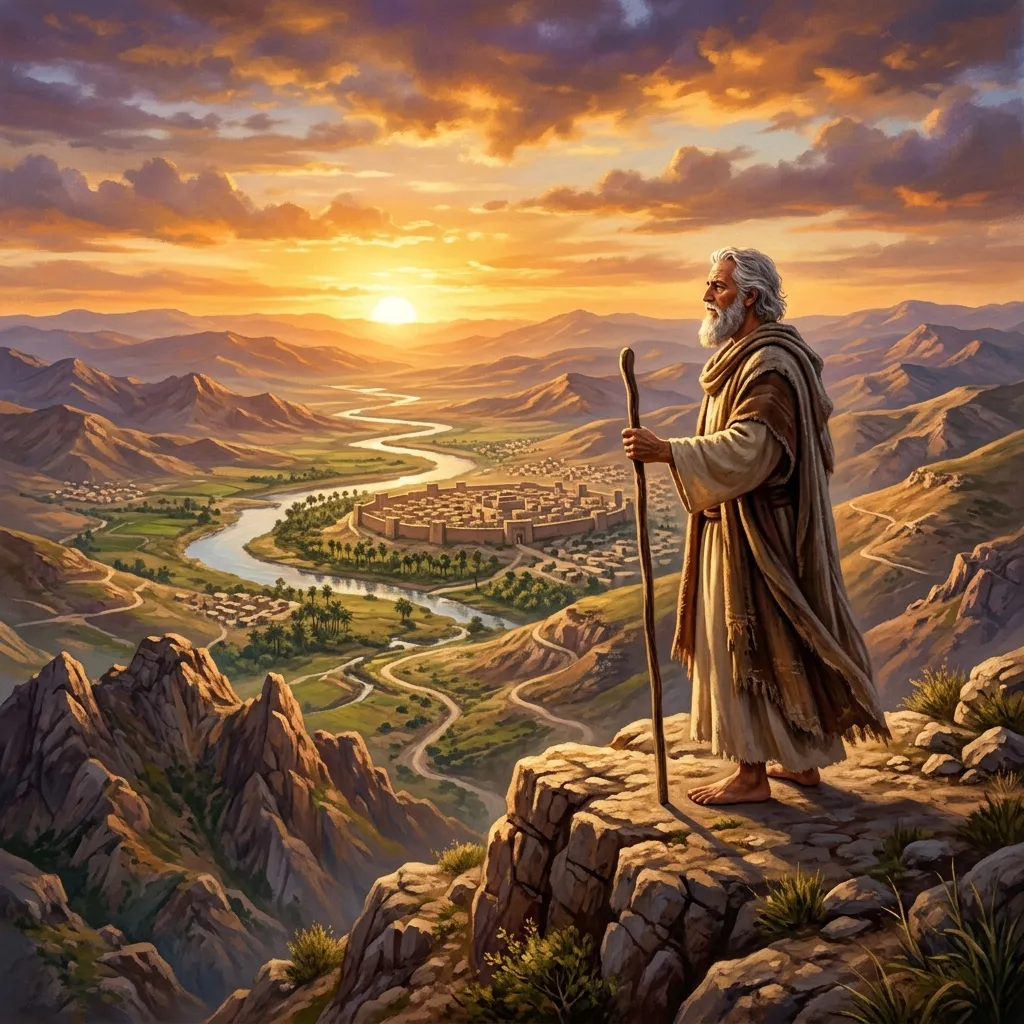
As Moses drank in the glorious vista, the voice of Yahweh broke the silence of the mountain, tender yet filled with unbending sovereignty: "This is the land of which I swore to give to Abraham, Isaac, and Jacob, saying, 'I will give it to your descendants.' I have caused you to see it with your eyes, but you shall not cross over there" (Deuteronomy 34:4). There was no bitterness in Moses' soul, no despair or recrimination. Forty years earlier at Kadesh, Moses had struck the rock in anger rather than speaking to it in quiet faith, misrepresenting God's holy character before the congregation. The decree that he would not enter the land was the righteous judgment of God upon spiritual leadership; but the privilege of beholding the land from Pisgah was the tender grace of a loving Father to His most faithful companion.
Moses was satisfied. He had seen the fulfillment of God's promise with his own eyes. His work was finished. The Law had completed its pedagogical mission. Upon that lonely mountain summit, with the golden light of the setting sun casting long purple shadows across the Jordan Valley, Moses breathed his last. Deuteronomy 34:5 records with sublime brevity: "So Moses the servant of Yahweh died there in the land of Moab, according to the word of Yahweh." Ancient Jewish rabbinic tradition translates the phrase 'according to the word of Yahweh' (*al-pi Yahweh*) quite literally as 'by the mouth of Yahweh'—saying that God gently drew Moses' soul out of his earthly frame with a divine kiss of peace.
Then occurred one of the most astonishing acts of divine intimacy in the history of the world: "And He buried him in a valley in the land of Moab, opposite Beth-peor; but no one knows his grave to this day" (Deuteronomy 34:6). The Almighty God Himself was the sole undertaker, the sole pallbearer, and the sole mourner at the funeral of Moses! No human hands carried his body down the rugged crags; no earthly mason chipped out a tombstone; no sculptor carved his likeness. God laid the tired frame of His servant into the secret earth of Moab, concealing his sepulcher forever from the eyes of men.
This secret burial was a masterstroke of divine wisdom. In the Ancient Near East, the tombs of great kings, patriarchs, and heroic deliverers were invariably transformed into shrines of pagan necromancy and relic worship. Had the Israelites known the location of Moses' grave, they would have inevitably built a colossal monument over his bones, offering sacrifices to his memory, seeking oracles from his spirit, and turning the Lawgiver into an idolatrous substitute for Yahweh. Centuries later, the Israelites actually burned incense to the bronze serpent Moses had forged in the wilderness, forcing King Hezekiah to smash it to dust as an abomination (2 Kings 18:4). By concealing Moses' body, God protected Israel from catastrophic apostasy and preserved the supreme truth that worship belongs exclusively to the living God.
Furthermore, as the Apostle Jude reveals, this concealment involved an invisible, cosmic struggle: "Yet Michael the archangel, in contending with the devil, when he disputed about the body of Moses, dared not bring against him a reviling accusation, but said, 'The Lord rebuke you!'" (Jude 1:9). Satan sought to seize the physical remains of Moses to exploit them for idolatry, or to accuse Moses of his past sin of murder in Egypt; but the archangel Michael, acting under divine commission, shattered the devil's claims and sealed Moses into the safety of God's secret sepulcher.
When the sun rose the following morning and Moses did not return, the children of Israel realized that their spiritual father was gone. In the plains of Moab, a deep, collective wail of grief echoed across the valley. For thirty full days, the nation wept, mourned, and fasted for Moses (Deuteronomy 34:8). They remembered his patience, his thunderous courage against Pharaoh, his prevailing intercession that had repeatedly saved them from divine wrath, and the glorious radiance that had shone from his face when he descended from Sinai.
Scripture concludes the Pentateuch with an immortal, unmatched epitaph: "Moses was one hundred and twenty years old when he died. His eyes were not dim nor his natural vigor abated... But since then there has not arisen in Israel a prophet like Moses, whom Yahweh knew face to face, in all the signs and wonders which Yahweh sent him to do in the land of Egypt, before Pharaoh, before all his servants, and in all his land, and by all that mighty power and all the great terror which Moses performed in the sight of all Israel" (Deuteronomy 34:7, 10–12).
Yet the story of Moses did not end in the dusty ravine of Moab. Fourteen centuries later, upon a high, snow-draped mountain in the Promised Land—the Mount of Transfiguration (Luke 9:28–36)—the heavens opened. There, standing beside Elijah within the dazzling, uncreated light of the Shekinah glory, stood Moses! The Lawgiver had finally crossed the Jordan River! He was not an outsider looking in from a distant peak; he was standing inside the Promised Land, conversing intimately with the Lord Jesus Christ about the ultimate *exodus* He was about to accomplish at the cross of Calvary. What the Law could never achieve because of human weakness, the Son of God accomplished through His glorious grace, ensuring that all who die in faith will one day stand in the eternal Promised Land of God's kingdom!
Biblical Keywords & Theological Roots
Nebo signifies a height or elevated lookout; Pisgah denotes a cleft, ridge, or isolated precipice commanding sweeping strategic vision.
To see, perceive, behold with spiritual illumination; used of Yahweh supernaturally enabling Moses to inspect the complete geographic boundaries of the covenant inheritance.
Servant of Yahweh; the consummate biblical title of supreme covenant loyalty, intimacy, and consecrated ministry conferred posthumously upon Moses.
Freshness, moisture, green vitality, natural vigor; denoting that Moses did not die of biological decrepitude, senility, or disease, but at the divine decree.
To bury, entomb, inter; uniquely used in Deuteronomy 34:6 where the subject is Yahweh Himself directly laying His departed servant into the hidden earth.
Ancient Near Eastern & Archaeological Context
The death of Moses occurred upon the highest ridges of the Abarim mountain range in modern Jordan—specifically Mount Nebo (identified with Jebel Niba, approximately 800 meters above sea level) and its northwestern promontory, Ras Siyagha (traditionally identified with the biblical Pisgah). Topographically, Pisgah offers an astonishing panoramic vantage over the Jordan Rift Valley, the Dead Sea (over 1,200 meters below), the Jericho oasis, and the central Judean hill country. Under ordinary atmospheric conditions, human eyesight cannot survey Dan in the extreme north or the Mediterranean coast simultaneously; Scripture emphasizes a divinely augmented visionary experience wherein Yahweh caused Moses to behold the full geographical sweep of covenant topography. In Ancient Near Eastern royal culture, kings, pharaohs, and heroic chieftains were entombed in massive monumental sepulchers (such as the pyramids of Giza, royal mastabas, or rock-cut hypogea in the Valley of the Kings) which inevitably evolved into centers of idolatrous ancestor worship (*cult of the dead* or *marzeah* festivals). By burying Moses directly and concealing his sepulcher in an unmarked ravine opposite Beth-peor, Yahweh decisively prevented Israel from descending into necromancy or venerating Moses' relics. Jude 1:9 further indicates a cosmic dispute between the archangel Michael and Satan over the body of Moses, underscoring the spiritual warfare surrounding the physical remains of God's covenant mediator.
Practical Discipleship & Spiritual Application
- Grace in Denied Ambitions: Even the Greatest Saints Face Earthly Boundaries: Moses pleaded with God to cross the Jordan (Deuteronomy 3:23–26), yet God gently said, 'Enough of that! Speak no more to Me of this matter.' God often denies our temporal dreams not out of malice, but to keep our eyes fixed on the greater eternal homeland. Even when an earthly reward is withheld due to past mistakes, God's personal fellowship and eternal glory remain intact.
- The Supreme Epitaph is Faithfulness, Not Monuments: When Moses died, no marble mausoleum, bronze statue, or elaborate tomb was erected. His sole epitaph was inscribed by the Holy Spirit: 'Moses the servant of Yahweh' (Deuteronomy 34:5). Earthly trophies, academic titles, and architectural empires will turn to dust; the only commendation that endures into eternity is being recognized by God as His faithful servant.
- Sustained by Divine Vitality to the Very End: Deuteronomy 34:7 records that at 120 years of age, Moses' eye was not dim nor his natural vigor abated (*leach*). When we walk in intimate obedience and daily communion with God, He provides the physical, mental, and spiritual resilience needed to complete our full race. We do not die by random chance or satanic whim; the believer's final breath is orchestrated by the sovereign appointment of God.
- The Consolation of the Mount of Transfiguration: Moses was forbidden from setting foot in Canaan under the economy of the Law. Yet approximately 1,400 years later, on a high mountain in the heart of the Promised Land (Luke 9:28–36), Moses appeared in blazing glory alongside Elijah to commune with the transfigured Jesus concerning His impending departure (*exodos*) at Jerusalem. What the Law could never achieve, the grace of Jesus Christ abundantly fulfilled!
⚡ Fast Facts
- Moses' 120-year lifespan is divided symmetrically into three distinct 40-year epochs: 40 years as a prince learning Egyptian wisdom, 40 years as a humble shepherd in Midian unlearning self-reliance, and 40 years as the deliverer leading Israel through the wilderness.
- According to Deuteronomy 34:7, Moses was 120 years old when he died, yet 'his eyes were not dim nor his natural vigor abated'—a supernatural preservation of bodily vitality.
- The children of Israel wept and mourned for Moses in the plains of Moab for thirty full days before Joshua commanded the march toward the Jordan (Deuteronomy 34:8).
- Deuteronomy concludes with the ultimate inspired tribute: 'Since then there has not arisen in Israel a prophet like Moses, whom Yahweh knew face to face' (Deuteronomy 34:10).
❓ Frequently Asked Questions (FAQs)
Moses' exclusion from Canaan is one of the most sobering demonstrations of God's unyielding holiness in Scripture. At Kadesh in the Wilderness of Zin, when the people grumbled for water, God explicitly commanded Moses: 'Speak to the rock before their eyes, and it will yield its water' (Numbers 20:8). Instead of speaking in gentle faith, Moses erupted in exasperated rage, shouting: 'Hear now, you rebels! Must we bring water for you out of this rock?' and struck the rock twice with his rod. While water miraculously gushed forth to quench the nation's thirst, God delivered an immediate, devastating verdict: 'Because you did not believe Me, to hallow Me in the eyes of the children of Israel, therefore you shall not bring this assembly into the land which I have given them' (Numbers 20:12). Leaders who represent God bear a terrifyingly higher standard of accountability. Moses misrepresented God's character before the nation by projecting anger when God was demonstrating grace, and by striking the rock twice, he ruptured a profound prophetic type: the Rock (Christ, 1 Corinthians 10:4) was to be struck once for sins at Calvary; thereafter, water of life is received simply by asking in faith. Striking the rock twice symbolically crucified Christ anew. Furthermore, in the divine drama of redemption, Moses represents the Law. The Law can convict of sin, lead through the desert, and bring humanity to the threshold of the inheritance, but the Law can never bring believers into the Promised Land of rest—only Joshua (Jesus) can do that.
Deuteronomy 34:6 contains one of the most tender, majestic statements in the entire Bible: 'And He [Yahweh] buried him in a valley in the land of Moab, opposite Beth-peor; but no one knows his grave to this day.' God Himself was the sole undertaker and mourner at Moses' private funeral! The Lord deliberately kept the location of the tomb an absolute secret for a profound theological and practical reason: human fallen nature has an incurable propensity toward idolatry, relic worship, and necromancy. Throughout the Ancient Near East, royal and heroic tombs became shrines where devotees offered sacrifices to ancestral spirits, sought oracles from the dead, and built superstitious religious cults. Had the children of Israel known the location of Moses' sepulcher, they would have inevitably built a monumental shrine over it, turning the mortal remains of the Lawgiver into an idol. Centuries later, Israel actually turned the bronze serpent Moses made in the wilderness into an idol called Nehushtan, burning incense to it until King Hezekiah smashed it to pieces (2 Kings 18:4). By concealing Moses' grave, God protected the nation from spiritual apostasy and preserved the truth that worship belongs solely to the living God, not to departed saints or sacred dirt.
In the New Testament Epistle of Jude, verse 9 records a fascinating cosmic encounter: 'Yet Michael the archangel, in contending with the devil, when he disputed about the body of Moses, dared not bring against him a reviling accusation, but said, "The Lord rebuke you!"' This revelation, also echoed in intertestamental Jewish traditions such as the *Assumption of Moses*, unveils the intense demonic warfare that raged over Moses' mortal remains. Satan sought to take possession of Moses' corpse for sinister purposes: primarily to display the body to the Israelites and entice them into idolatrous relic worship and necromancy, thereby corrupting the entire nation before they ever crossed the Jordan. Additionally, Satan may have sought to claim legal ownership of Moses' body on the grounds that Moses had committed murder in Egypt (Exodus 2:12) and had fallen under divine judgment at Meribah. God dispatched Michael, the great archangelic guardian of Israel (Daniel 10:13, 21; 12:1), to defeat Satan's machinations, retrieve the body, and execute God's secret burial in the secluded Moabite valley. Michael's refusal to bring a slanderous judgment against Satan, relying entirely on 'The Lord rebuke you,' models the ultimate posture of spiritual warfare: total dependence upon the supreme authority and rebuking power of God alone.