The Sovereign Detour from Samaria's Revival
The city of Samaria was shaking under the incandescent power of the Holy Spirit. Evangelist Philip—one of the seven deacons chosen alongside the martyred Stephen—had descended into this historic northern stronghold of Simon Magus's occult sorcery. Miracles of extraordinary magnitude were unfolding daily: shrieking unclean spirits were violently expelled; paralytics and the lame were leaping in the streets; crowds of former sorcerers were plunging into baptismal waters with immense joy (Acts 8:5–8). The Apostles Peter and John had arrived from Jerusalem, laying hands on converts as the Holy Spirit fell in sovereign glory. By every human metric, Philip was at the apex of an unstoppable urban revival.
Then, without warning, heaven intervened to disrupt Philip's ministerial momentum. An angel of the Lord materialized before the evangelist with a bizarre, counterintuitive geographic command: 'Arise and go toward the south along the road which goes down from Jerusalem to Gaza. This is desert' (Acts 8:26).
To natural human reason, the command was absurd. Why extract a victorious evangelist from a packed city where thousands were hanging on his every word, and send him fifty miles southwest into a sun-baked, trackless wasteland? Gaza had been demolished a century earlier, and the inland southern caravan track—descending from the Judean highlands toward the Sinai desert—was notorious for blistering heat, predatory bandits, and howling silence. Yet Philip belonged to that rare breed of servants who do not debate heaven. He did not ask for a strategic committee; he did not demand a sign. The text records his instantaneous response in a single, magnificent sentence: 'So he arose and went' (Acts 8:27).
Acts 8:26–27: 'Now an angel of the Lord spoke to Philip, saying, “Arise and go toward the south along the road which goes down from Jerusalem to Gaza.” This is desert. So he arose and went.'
The Royal Chariot on the Saffron Sands
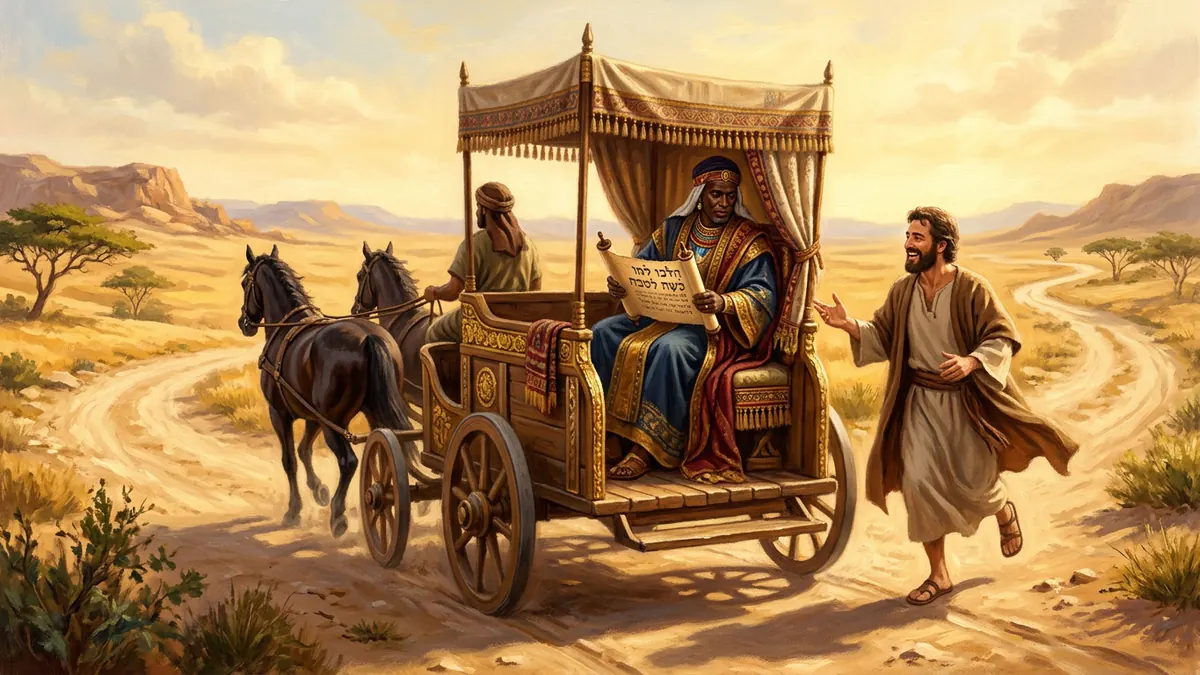
Hours of solitary trekking through the shimmering desert mirages brought Philip onto the parched coastal plain. Dust devils swirled across the limestone ridges. In the distance, against the stark saffron horizon, the quiet of the wilderness was broken by the rhythmic clatter of iron-rimmed wheels, the thud of hoofbeats, and the flapping of linen awnings. A high-status diplomatic caravan was advancing southward toward Egypt.
At the center of the entourage rolled an elaborate wooden chariot, constructed of imported cedar and bronze, shielded from the brutal sun by embroidered canopies. Seated comfortably upon dyed leather cushions was a man of commanding presence, dark-skinned, clothed in the opulent, flowing silk robes of the Nubian royal court. He was an Ethiopian court dignitary of immense global stature—the chief treasurer (dynastēs) over all the royal gazas (treasuries) of Candace, the queen of the Ethiopians.
This high minister was returning home from a grueling three-thousand-mile round-trip pilgrimage to the Jerusalem Temple. Drawn to the holy monotheism of Yahweh, he had traveled across the cataracts of the Nile to worship. Yet because he was a castrated eunuch, ancient Mosaic regulations had forbidden him from ever passing beyond the Court of the Gentiles (Deuteronomy 23:1). He had traveled thousands of miles only to be turned away at the inner gates. Yet his spiritual hunger was unquenched. As his chariot bumped along the rutted desert road, the dignitary held an immense, hand-copied parchment scroll upon his knees, unrolling its columns under the desert glare, reading aloud according to ancient Semitic custom.
'Go Near and Overtake This Chariot!'
As Philip stood by the roadside watching the magnificent carriage pass, the Holy Spirit spoke with urgent, unmistakable kinetic force inside his soul: 'Go near and overtake this chariot!'
The Greek verb kollēthēti literally commanded him to 'glue himself' alongside the moving vehicle. Philip did not stroll casually; he sprinted through the swirling sand with the athletic agility of an Olympic runner! Drawing abreast of the chariot wheels, matching the trot of the Nubian horses, Philip listened intently over the creak of the leather harnesses.
The words floating out from the chariot were unmistakable Greek: the official was chanting the ancient prophetic canticle of the Suffering Servant from the Septuagint scroll of Isaiah. Philip seized the sovereign conversational bridge. Leaning toward the window, the barefoot evangelist shouted above the wind: 'Do you understand what you are reading?'
The Ethiopian did not summon his armed royal bodyguards to strike down the audacious pedestrian. Instead, looking out with aristocratic grace and disarming transparency, the dignitary uttered words that resonate across centuries of theological education: 'How can I, unless someone guides me?'
Without an ounce of intellectual arrogance, this chancellor over a kingdom’s wealth ordered the reins pulled tight. The chariot ground to a halt in the desert dust. Extending his hand, the Ethiopian invited the sweat-drenched evangelist to climb up into the chariot and sit beside him.
The Lamb Led to the Slaughter: Isaiah 53 Unveiled
The royal scroll lay open to the fifty-third chapter of Isaiah. The eunuch pointed his finger to the exact passage that had arrested his soul, reading it aloud with trembling emotion:
Acts 8:32–33: 'The place in the Scripture which he read was this: “He was led as a sheep to the slaughter; and as a lamb before its shearer is silent, so He opened not His mouth. In His humiliation His justice was taken away, and who will declare His generation? For His life is taken from the earth.”'
Turning to Philip with genuine bewilderment, the treasurer asked the pivotal hermeneutical question that had divided rabbinic schools for centuries: 'I ask you, of whom does the prophet say this, of himself or of some other man?'
Luke records one of the most sublime statements in the entire New Testament: 'Then Philip opened his mouth, and beginning at this Scripture, preached Jesus to him' (Acts 8:35).
Starting right where the man was reading, Philip drew back the prophetic veil. He explained that seven hundred years before the Roman legions marched, the Holy Spirit had painted an exact portrait of Jesus of Nazareth. Philip explained the horror of Gethsemane, the illegal trials before Caiaphas, the brutal scourging of Pilate's praetorium, and how the sinless Son of God stood silent before His tormentors like a lamb before its shearer. He expounded the bloody substitution of Calvary: 'He was wounded for our transgressions, He was bruised for our iniquities; the chastisement for our peace was upon Him, and by His stripes we are healed' (Isaiah 53:5).
Furthermore, Philip undoubtedly carried the scroll forward just three chapters to Isaiah 56:3–5—the staggering prophetic promise directed explicitly to marginalized outcasts: 'Do not let the eunuch say, “Here I am, a dry tree.” For thus says the Lord: To the eunuchs who keep My Sabbaths, and choose what pleases Me, and hold fast My covenant, even to them I will give in My house and within My walls a place and a name better than that of sons and daughters; I will give them an everlasting name that shall not be cut off!'
The eyes of the Ethiopian filled with tears. The Temple in Jerusalem had excluded him because of his bodily mutilation; but the crucified and risen Christ was welcoming him into an eternal spiritual family with full sonship!
'See, Here Is Water!' — The Desert Baptism
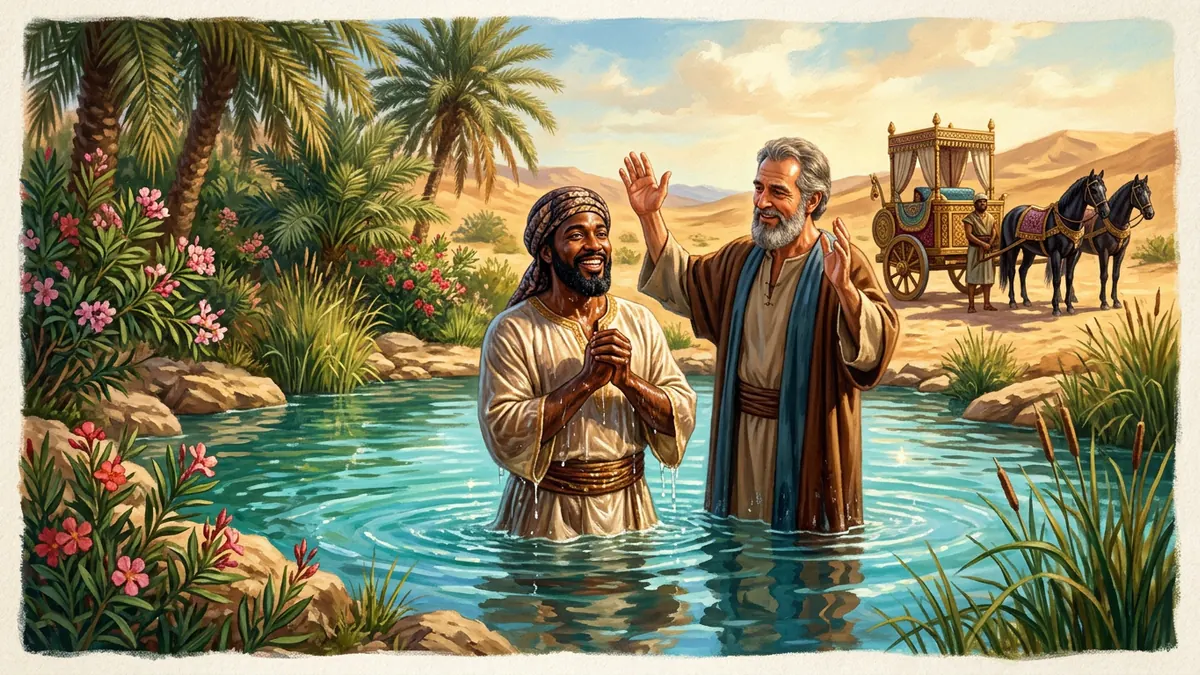
As the chariot rolled deeper into the wadi, the heat radiated off the chalk cliffs. Suddenly, around a rocky bend, an unexpected desert spring or rainwater catchment pool (such as the traditional Wadi el-Hesi) shimmered in the turquoise midday sun, framed by wild date palms and green reeds.
The Ethiopian’s heart leapt with radical, childlike faith. Grasping Philip’s arm, pointing eagerly to the pool, the royal treasurer cried: 'See, here is water! What hinders me from being baptized?'
The dignitary commanded the royal chariot to stop. Stripping off his ornate court tunics, the high minister of Queen Candace walked barefoot into the sand alongside the Galilean evangelist. Together they descended into the cool, clear water. There, in the desolate solitude of the Judean wilderness, Philip immersed the African dignitary in the name of the Father, the Son, and the Holy Spirit, sealing his burial and resurrection in Christ.
The Supernatural Rapture to Azotus
As they emerged dripping wet from the baptismal waters onto the pebbled bank, a terrifying and glorious supernatural manifestation took place. Luke records: 'Now when they came up out of the water, the Spirit of the Lord caught Philip away (hērpasan), so that the eunuch saw him no more' (Acts 8:39).
The Greek verb harpazō denotes sudden, kinetic abduction—the evangelist was physically snatched through the air by the Holy Spirit! When the Ethiopian wiped the water from his eyes, the sandy bank was empty. Philip had vanished into thin air.
Did the Ethiopian panic? Did he search the desert cliffs in distress? Not for a single moment. Scripture records that he 'went on his way rejoicing' (poreueto gar tēn hodon autou chairōn). The human messenger was gone, but the living Christ remained within his heart! Climbing back into his royal chariot, the treasurer continued his three-thousand-mile journey south through Nubia, carrying the blazing torch of the Gospel into the royal court of Meroë, birthing the ancient Christian heritage of Northeast Africa centuries before Europe would evangelize the nations.
Meanwhile, Philip found himself twenty miles to the north at Azotus (ancient Ashdod). Undaunted by his supernatural relocation, the tireless evangelist dusted off his tunic and traversed the entire Mediterranean coast, preaching the Gospel in every town until he arrived at Caesarea Maritima, where he established his lifelong missionary home.
Ancient Near Eastern & Archaeological Context
The Kingdom of Kush (Nubia), situated south of Egypt along the Upper Nile in modern-day Sudan, was an ancient, wealthy civilization renowned for its gold mines, iron production, and formidable military prowess. For centuries, Kush was ruled by royal queens known by the dynastic title 'Kandake' (Candace), who maintained luxurious palaces at Meroë. The treasurer mentioned in Acts 8 was the 'Gaza-phylax'—the imperial chancellor managing the national treasury of gold and ivory. His willingness to travel over 1,500 miles across the cataracts of the Nile, Egyptian deserts, and Judean wilderness demonstrates extraordinary religious devotion as a 'God-fearer' drawn to monotheistic worship. The Gaza road itself was an ancient military caravan highway leading from Jerusalem toward Egypt. After the destruction of Old Gaza by Alexander Jannaeus in 96 BC, a new coastal city had been founded, leaving the inland southern desert route abandoned to nomadic Bedouins and occasional high-status military entourages.
Practical Discipleship & Spiritual Application
- Philip’s desert encounter reveals the anatomy of Holy Spirit-led evangelism. Notice the progression: Divine sensitivity (hearing God in the middle of a revival), unconditional obedience (walking down an empty desert road without asking 'Why?'), tactical observation (seeing the chariot and hearing the scroll), respectful inquiry ('Do you understand?'), and Christ-centered exegesis (pointing everything straight to Jesus). Are we willing to leave our comfortable sanctuaries to meet an isolated soul in the parched deserts of life? Notice also the eunuch’s sublime humility: though a royal diplomat controlling a kingdom’s wealth, he was unashamed to say, 'How can I, unless someone guides me?' God honors the humble seeker. Wherever there is a thirsting heart and an obedient witness, living water will burst forth in the wasteland.
Support Independent Biblical Research
Did this study bless you? Help support our independent bilingual research and interactive visual Bible tools.
⚡ Fast Facts
- The Royal Title 'Candace' (Kandake): Candace was not a personal proper name, but the hereditary royal dynastic title of the warrior queen-mothers who ruled the ancient Kingdom of Kush (Meroë, modern Sudan/Nubia), while the kings were revered as children of the sun
- The Geographic Desolation: Luke specifically notes that the road descending southwest from Jerusalem toward Gaza was 'erēmos' (desert/wilderness), traversing dry wadis and parched chalk hills where human encounters were exceedingly rare
- The Imperial Scroll of Isaiah: A complete Hebrew or Septuagint parchment scroll of Isaiah was an exceedingly costly treasure in antiquity, hand-copied on animal skins, indicating the treasurer's immense wealth, royal status, and profound spiritual hunger
- The Sudden Teleportation (Harpazō): The Greek verb in Acts 8:39 for the Spirit snatching Philip away is 'hērpasan' (from harpazō), the identical supernatural term used by Paul for the rapture of the Church in 1 Thessalonians 4:17
❓ Frequently Asked Questions (FAQs)
Why did God pull Philip away from a thriving city-wide revival in Samaria to a deserted wilderness road?
This sovereign divine detour illustrates the infinite value God places on a single seeking individual. While human ministry often obsesses over crowds and statistics, the Holy Spirit directs His servants with laser precision to ready hearts. The Ethiopian eunuch was a high-ranking Gentile adherent to Judaism who possessed immense political influence across East Africa. By reaching this solitary dignitary on an empty desert highway, God opened an unstoppable gospel gateway into the royal courts of Africa centuries before formal western missionary movements, fulfilling Psalm 68:31: 'Ethiopia will stretch out her hands to God.'
What specific passage of Isaiah 53 was the Ethiopian eunuch reading, and why was it perplexing to him?
The official was reading Isaiah 53:7–8 from the Greek Septuagint: 'He was led as a sheep to the slaughter; and as a lamb before its shearer is silent, so He opened not His mouth. In His humiliation His justice was taken away, and who will declare His generation? For His life is taken from the earth.' In ancient rabbinic tradition, the identity of the 'Suffering Servant' was vigorously disputed—some scribes viewed the servant as Isaiah himself, others as the nation of Israel undergoing collective suffering, while others anticipated a suffering Messiah. Hence, the eunuch asked: 'Of whom does the prophet say this, of himself or of some other man?' Philip revealed that Jesus of Nazareth is the singular, spotless Lamb of God who died substitutionally for human sin.
What was the significance of the eunuch's physical condition under Mosaic Law, and how did the Gospel liberate him?
Under the Mosaic covenant in Deuteronomy 23:1, any man who had been castrated or was a eunuch was permanently excluded from the assembly of the Lord and could never enter the inner courts of the Temple. Consequently, though the Ethiopian had traveled over fifteen hundred miles to worship in Jerusalem, he was relegated to the outermost Court of the Gentiles, an excluded outsider. Yet through Isaiah 56:3–5, God had prophetically promised that eunuchs who lay hold of His covenant would receive an everlasting name better than sons and daughters. When Philip preached Jesus, the Ethiopian realized that the Cross shattered all ceremonial barriers, granting him direct sonship and full inheritance in the kingdom of God.