The Breathing of Threats and the Damascus Expedition
The streets of Jerusalem were thick with terror. Following the stoning of Stephen outside the eastern city gate, a systemic pogrom had swept through the holy city like a wildfire. Leading the assault with volcanic ferocity was a brilliant young Pharisee from Cilicia named Saul of Tarsus. Scripture paints an alarming portrait of his psychological obsession using a rare medical Greek participle: empneōn—he was literally 'breathing in threats and murder' (Acts 9:1). Persecuting the followers of the Nazarene was not merely an official duty for Saul; it was the very oxygen his lungs inhaled, the fuel that drove his every waking hour.
He broke down the doors of private homes; he dragged weeping mothers and devout fathers into subterranean holding cells; he entered the synagogues of Jerusalem, compelling believers under brutal flagellation to blaspheme the name of Jesus (Acts 26:11). Yet crushing the disciples in Jerusalem was insufficient for his insatiable zeal. Reports reached the Sanhedrin that Hellenistic believers who had fled the Jerusalem persecution had reached Damascus, the ancient Syrian oasis city 135 miles to the northeast, where they were establishing house churches within the city's vast Jewish community.
Approaching High Priest Caiaphas, Saul secured official extraditing warrants under the imperial authority of the Sanhedrin. Armed with legal mandates granting him the power to arrest any man or woman belonging to 'the Way' and march them bound in iron chains back to Jerusalem for capital trial, Saul mounted his stallion. Flanked by an armed temple cohort, his heart burning with righteous fury, Saul spurred his company north through the Jordan Valley toward Damascus.
Acts 9:1–3: 'Then Saul, still breathing threats and murder against the disciples of the Lord, went to the high priest and asked letters from him to the synagogues of Damascus, so that if he found any who were of the Way, whether men or women, he might bring them bound to Jerusalem. As he journeyed he came near Damascus, and suddenly a light shone around him from heaven.'
The Blinding Noon and the Voice from the Flame
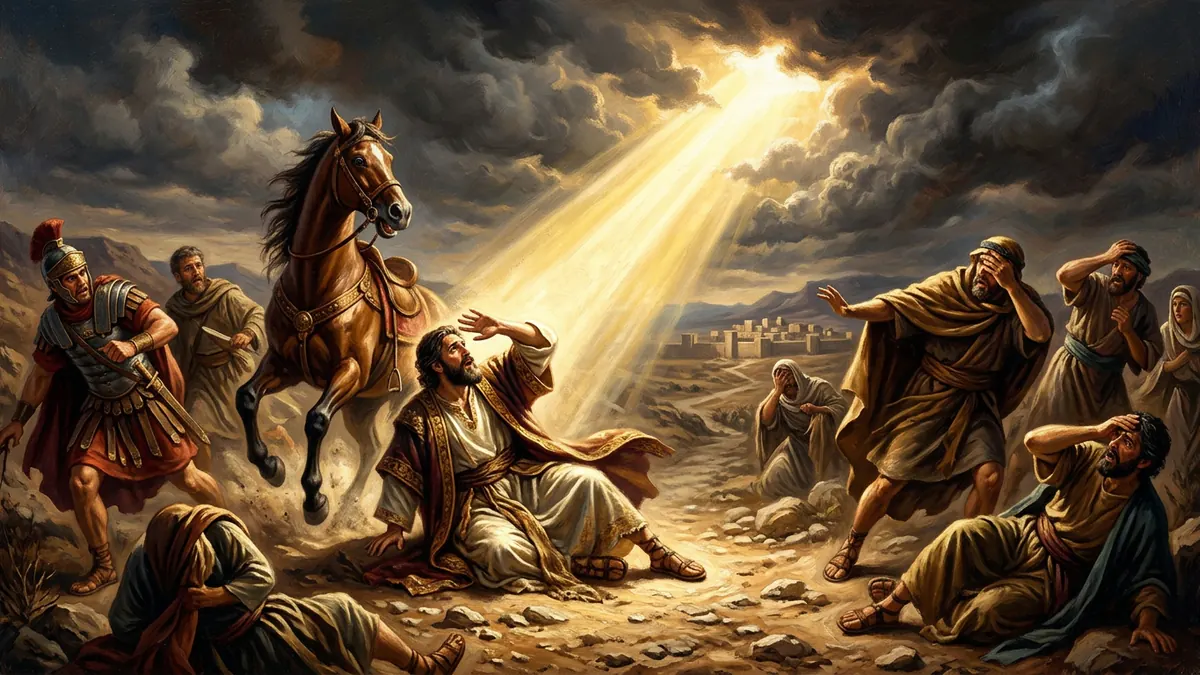
After a grueling week-long march through the basalt ravines of the Decapolis, the expedition mounted the final desert ridge overlooking the Damascus oasis. It was high noon. The Mediterranean sun hung at its absolute zenith, scorching the Syrian sands with blistering, white-hot intensity. Far below, the lush green orchards of Damascus, nourished by the crystalline waters of the Barada and Awaj rivers, glittered like an emerald set in gold. Saul could already visualize his triumph: raiding the synagogues, chaining the heretics, and purging the holy covenant of Israel.
Suddenly, without warning, the sky tore open. A celestial light erupted from the heavens with a brilliance that made the blazing Syrian midday sun look like a dying candle! Luke specifies that it flashed around him like a lightning vortex. Struck violently from his mount, Saul was hurled face-down into the burning limestone dust. His military cohort froze in terrifying paralysis, falling to the ground beside him, blinded and disoriented.
Out of the blinding radiant vortex, a voice resonated in the ancient Hebrew tongue, vibrating through the bedrock of the earth directly into Saul's marrow: 'Sha'ul, Sha'ul, why are you persecuting Me?'
'Who Are You, Lord?' — The Cosmic Identification
Trembling violently in the dust, every particle of his legalistic certainty shattered into dust, the great scholar of Gamaliel gasped out the only question his paralyzed soul could formulate: 'Who are You, Lord?'
He expected the voice of Yahweh Sabaoth to declare: 'I am the God of Abraham, vindicating your zeal!' Instead, the answer that descended from the glory struck Saul like a cosmic thunderbolt, collapsing his entire theological universe:
'I am Jesus, whom you are persecuting. It is hard for you to kick against the goads.'
The Nazarene was not dead! The tomb was empty! The crucified Carpenter whom Saul had branded an accursed criminal under the curse of Deuteronomy (Deuteronomy 21:23) was alive, reigning in the uncreated Shekinah light of the Father! And in that single question—'Why are you persecuting Me?'—the mystery of the Church exploded into Saul's consciousness. When he had cast his vote to stone Stephen, he had struck Jesus; when he had dragged Christian mothers to prison, he had bound the Son of God. The Church was not an organization; it was the living, breathing physical Body of Christ!
Furthermore, Jesus exposed Saul's inner turmoil: 'It is hard for you to kick against the goads' (Acts 26:14). Like a rebellious young ox kicking backward against the iron-tipped prick of the farmer's plow, only to drive the spike deeper into its own bleeding flesh, Saul had been inwardly wrestling against the conviction of Stephen’s angelic face and the supernatural peace of the martyrs he had tormented.
Acts 9:5–6: 'And he said, “Who are You, Lord?” Then the Lord said, “I am Jesus, whom you are persecuting. It is hard for you to kick against the goads.” So he, trembling and astonished, said, “Lord, what do You want me to do?”'
The Three Days of Blindness on Straight Street
The sovereign Lord instructed the trembling Pharisee: 'Arise and go into the city, and you will be told what you must do.' The soldiers who journeyed with him stood speechless, hearing a sound like rumbling thunder, but seeing no man. When Saul opened his eyelids and pushed himself up from the dust, the emerald city of Damascus had vanished into absolute, pitch-black darkness. His physical retinas had been scorched blind by the uncreated glory of the risen Christ.
The proud Grand Inquisitor of the Sanhedrin, who had planned to enter Damascus in triumph at the head of a mounted military brigade, was reduced to a helpless, stumbling invalid. Taking him by the hand like a little child, his guards led him through the eastern Roman gate of Damascus, down the grand colonnaded thoroughfare known as the Street Called Straight (the Via Recta), and deposited him into the private lodging of a man named Judas.
For three grueling days and three nights, Saul sat in total, suffocating darkness. He refused food; he refused water. His mind was enduring a violent spiritual earthquake. All his rabbinic pedigree, his phylacteries, his boasting in the Law were reduced to ashes. Day and night, in the dark chamber, Saul wept, fast, and poured out his crushed heart to the God he had unknowingly opposed. In heaven, the Lord Jesus looked down and observed: 'Behold, he is praying' (Acts 9:11).
The Hesitant Servant: Ananias of Damascus
Across the city of Damascus lived a devout Christian disciple named Ananias. The Lord appeared to him in a vision, calling: 'Ananias!'
The faithful servant answered: 'Here I am, Lord.'
The Lord gave him hyper-specific geographic instructions: 'Arise and go to the street called Straight, and inquire at the house of Judas for one called Saul of Tarsus, for behold, he is praying. And in a vision he has seen a man named Ananias coming in and putting his hand on him, so that he might receive his sight.'
Ananias’s breath caught in his throat. Saul of Tarsus was the most feared name in the Roman Near East! Trembling, the disciple reasoned with the Lord: 'Lord, I have heard from many about this man, how much harm he has done to Your saints in Jerusalem. And here he has authority from the chief priests to bind all who call on Your name!'
The Lord answered with sovereign majesty: 'Go, for he is a chosen vessel of Mine (skeuos eklogēs) to bear My name before Gentiles, kings, and the children of Israel. For I will show him how many things he must suffer for My name’s sake!'
'Brother Saul!' — The Radical Grace of Christ
Submitting his terror to the sovereign word of Christ, Ananias walked through the bazaars of Damascus, entered the house of Judas on Straight Street, and stepped into the dark room where the broken Pharisee knelt prostrate on the floor. Ananias did not draw a weapon; he did not speak words of condemnation or bitter retribution.
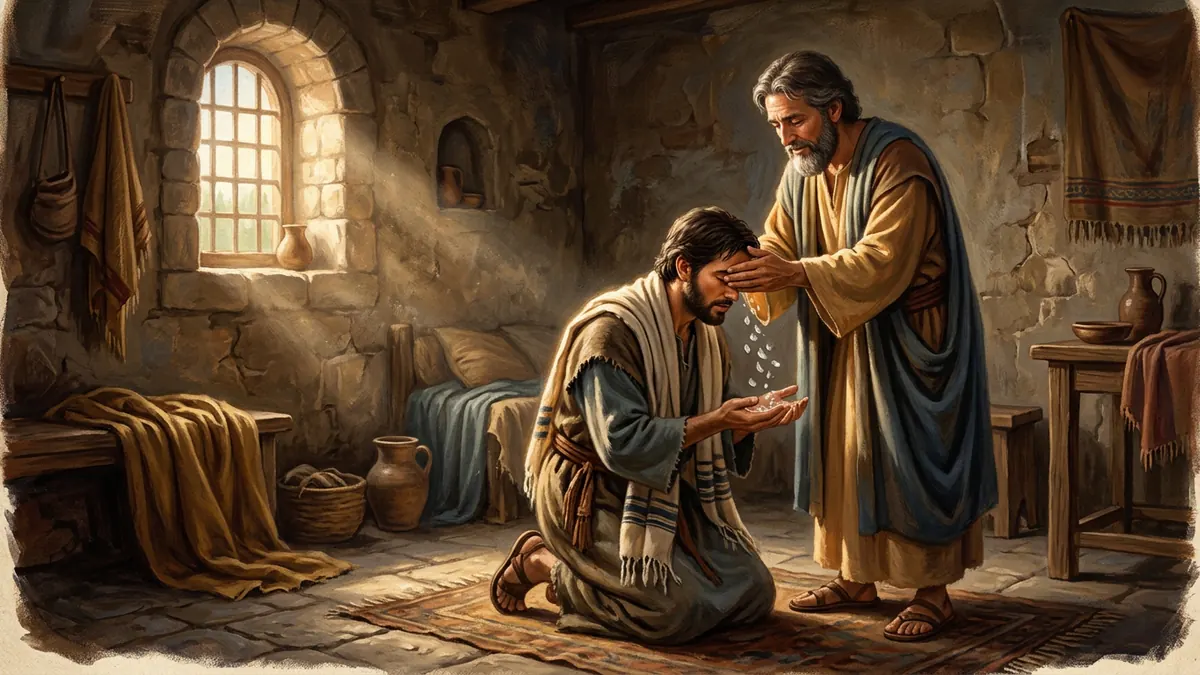
Stepping forward, Ananias gently laid his hands upon the sightless eyes of his persecutor. The first words that broke from the disciple's lips were an immortal anthem of radical Christian reconciliation: 'Brother Saul!'
'Brother Saul, the Lord Jesus, who appeared to you on the road as you came, has sent me that you may receive your sight and be filled with the Holy Spirit!'
Instantly, a physical and spiritual miracle occurred. Luke records with physician’s precision: 'Immediately there fell from his eyes something like scales (lepides), and he received his sight at once' (Acts 9:18). Thick, translucent flakes peeled away from Saul’s corneas. He blinked against the streaming morning light. Looking up, the first human face Saul saw with his restored vision was the loving, tear-stained face of a Christian brother whom he had come to slaughter.
Baptism and the Fire of the Apostle
Saul did not waste a single hour. Arising from his knees, he was immediately led to water and baptized, washing away his sins and publicly declaring allegiance to Jesus of Nazareth as his Lord, King, and Savior. Breaking his three-day fast with bread, his physical strength returned.
Saul did not retire into private convalescence. Within days, the former champion of the Sanhedrin strode boldly into the very synagogues of Damascus where he had planned to arrest believers. Unrolling the sacred scrolls, Saul detonated an intellectual and spiritual earthquake across Syria: 'He immediately preached the Christ in the synagogues, that He is the Son of God!' (Acts 9:20).
The Jewish community sat in paralyzed shock: 'Is this not he who destroyed those who called on this name in Jerusalem, and has come here for that purpose, so that he might bring them bound to the chief priests?' Yet Scripture records that Saul increased all the more in strength, and confounded the Jews who dwelt in Damascus, proving that this Jesus is the Christ. The greatest persecutor of the Early Church had been sovereignly transformed into its greatest missionary, theologian, and martyr—the Apostle Paul, whose letters and life would rewrite the history of the world.
Ancient Near Eastern & Archaeological Context
Saul was born in Tarsus of Cilicia, a prominent Greco-Roman university city renowned for Stoic philosophy. Uniquely possessing inherited Roman citizenship (civitas Romana)—a rare aristocratic privilege—he was also a Hebrew of Hebrews, sent in his youth to Jerusalem to sit at the feet of Rabban Gamaliel the Elder, the most revered Pharisaic scholar of the era. The High Priest Caiaphas and the Sanhedrin possessed imperial Roman authorization to extradite fugitive Jewish offenders from surrounding provinces back to Jerusalem for capital trial under Mosaic law. Damascus, an ancient desert oasis situated 135 miles northeast of Jerusalem in the Roman province of Syria, was home to an estimated 30,000 Jewish residents worshipping across dozens of synagogues. Messianic believers who fled the persecution in Jerusalem had established thriving house churches in Damascus, prompting Saul to mount a mounted military expedition to extinguish the nascent movement before it infected the Syrian diaspora.
Practical Discipleship & Spiritual Application
- The conversion of Saul is God’s eternal proof that no human being is beyond the reach of sovereign grace. Saul was not seeking Jesus; he was hunting Jesus' followers with murderous rage. Yet Christ intercepted him in his tracks. Notice that when Christ spoke, He did not destroy Saul with holy lightning—He revealed Himself in blinding glory and disarmed him with a question of wounded love. In three days of darkness, God dismantled a lifetime of religious arrogance to forge the greatest missionary the world has ever seen. Are there people in your life who seem utterly hopeless, hostile to the Gospel, and hardened in pride? Never write off anyone whom Christ can redeem. When the Lord strikes off our self-righteous scales and calls us 'Brother', He turns our fiery hatred into passionate devotion for His eternal kingdom.
Support Independent Biblical Research
Did this study bless you? Help support our independent bilingual research and interactive visual Bible tools.
⚡ Fast Facts
- The Radiance Beyond the Syrian Sun: Acts 26:13 specifies that the heavenly light flashed at midday ('at midday, O king, along the road I saw a light from heaven, brighter than the sun'), proving that this was no natural desert lightning or sunstroke, but the uncreated Shekinah glory of the resurrected Lord
- The Hebrew Dialect of Jesus: In Acts 26:14, Paul recounts that the voice spoke specifically 'in the Hebrew language' (tē Hebraïdi dialektō)—specifically the Aramaic/Hebrew dialect—using his intimate covenant name repeated twice: 'Sha'ul, Sha'ul, why are you persecuting Me?'
- The Metaphor of the Goads (Kentra): 'It is hard for you to kick against the goads' (Acts 26:14) refers to a sharp pointed wooden ox-goad used by plowmen; when an unruly ox kicked backward against the spiked stick, it only drove the iron tip deeper into its own flesh, describing Saul's futile internal wrestling against conviction following Stephen's stoning
- The Ancient Street Called Straight: The 'Via Recta' (Darb al-Mustaqim) in Damascus is an authentic Roman colonnaded thoroughfare spanning over a mile from east to west through the ancient city, preserved to this day, where the house of Judas was situated
❓ Frequently Asked Questions (FAQs)
Why did Jesus ask 'Why are you persecuting Me?' when Saul had never physically met or attacked Jesus?
This profound question unveils the organic, mystical union between Jesus Christ and His Church. Saul believed he was merely rounding up heretical human sectarians; but Christ revealed that every blow struck against a believer is a direct assault upon the Lord Himself. The Church is not a mere human organization; it is the living Body of Christ, with Jesus as the exalted Head. When Stephen was stoned, when believers were scourged in synagogues, Christ felt the pain. This profound revelation of Christological union became the theological bedrock of Paul's later epistles, in which he repeatedly articulates the doctrine of the Church as the Body of Christ (1 Corinthians 12; Ephesians 1:22–23).
Why did God command Ananias to minister to Saul instead of healing Saul directly on the road?
God deliberately utilized a humble, ordinary disciple in Damascus to humble the intellectual giant of Tarsus and integrate him into the local church. Saul was a celebrated rabbinic scholar who carried official warrants from the High Priest; yet his healing and baptism came not through the famous Apostles in Jerusalem, but through an ordinary disciple named Ananias. When Ananias laid trembling hands upon Saul and spoke the words 'Brother Saul', he extended the radical grace and unconditional fellowship of the Christian community to the very man who had come to bind them in chains, modeling the supernatural reconciliation of the Gospel.
What is the historical significance of the three days of blindness and fasting before Saul's restoration?
The three days of total darkness, fasting, and blindness directly symbolized a spiritual death, burial, and resurrection, echoing the three days Jonah spent in the belly of the great fish and the three days Christ lay in the tomb. In that pitch-black darkness, all of Saul's pride, legalistic self-righteousness, and rabbinic credentials were completely shattered. Stripped of physical sight, his spiritual eyes were opened to behold the truth of the Old Testament scriptures fulfilled in the Crucified Messiah. God told Ananias: 'Behold, he is praying' (Acts 9:11)—the haughty Pharisee who had recited formulaic prayers for decades was finally weeping in true, brokenhearted communion with God.