The Crisis of Growth and the Seven Servants
In the wake of Pentecost, the infant Church in Jerusalem was exploding with dynamic vitality. Thousands of souls were abandoning ancestral traditions to plunge into apostolic teaching, fellowship, and the breaking of bread. Yet explosive numerical growth brought inevitable organizational friction. Jerusalem was an ancient melting pot: resident within its limestone walls were conservative 'Hebrews'—Aramaic-speaking native Judeans who traced their ancestry without interruption—and 'Hellenists'—Greek-speaking diaspora Jews who had returned from Alexandria, Antioch, Rome, and Cyrene, carrying foreign cultural accents and customs.
A simmering murmur arose among the Hellenists: their vulnerable, impoverished widows were being inadvertently neglected in the daily communal distribution of bread (the diakonia). The Apostles recognized the acute danger of cultural factionalism fracturing the body of Christ. Convening the entire multitude of disciples, the Twelve proposed a revolutionary solution: 'It is not desirable that we should leave the word of God and serve tables. Therefore, brethren, seek out from among you seven men of good reputation, full of the Holy Spirit and wisdom, whom we may appoint over this business; but we will give ourselves continually to prayer and to the ministry of the word' (Acts 6:2–4).
The multitude rejoiced, and the congregation selected seven men, every single one bearing a Greek name to ensure absolute transparency and comfort for the marginalized Hellenists. Preeminent among them was Stephen—a man described by Scripture as uniquely 'full of faith and the Holy Spirit' and 'full of grace and power' (Acts 6:5, 8). Though commissioned to balance food ledgers and supervise bread lines, the supernatural fire within Stephen could not be confined to domestic logistics.
Acts 6:8–10: 'And Stephen, full of faith and power, did great wonders and signs among the people. Then there arose some from what is called the Synagogue of the Freedmen (Cyrenians, Alexandrians, and those from Cilicia and Asia), disputing with Stephen. And they were not able to resist the wisdom and the Spirit by which he spoke.'
The Clashing Synagogues and the Conspiracy of Perjury
Stephen stepped into the public squares of Jerusalem, performing jaw-dropping signs and wonders that shook the city. His most fierce opposition erupted from the 'Synagogue of the Freedmen' (Libertinoi)—a prominent congregation composed of Jewish ex-slaves emancipated from Roman captivity, allied with brilliant intellectual scholars from Cyrene, Alexandria, and the province of Cilicia. Among the Cilician contingent sat an ambitious, fiery young Pharisee named Saul of Tarsus, trained under the legendary master Gamaliel.
Debating Stephen on the marble porticos, these seasoned rabbinic apologists expected an easy victory over a deacon. Instead, they collided with a theological hurricane. Stephen’s encyclopedic mastery of the Septuagint scriptures, combined with the razor-sharp illumination of the Holy Spirit, dismantled every rabbinic argument. The text states with striking finality: 'They were not able to resist the wisdom and the Spirit by which he spoke.'
Humiliated in public debate, defeated in logical disputation, the opponents resorted to the timeless weapon of religious tyranny: slander, suborned perjury, and mob violence. They secretly bribed false witnesses to circulate toxic rumors through the bazaars: 'We have heard him speak blasphemous words against Moses and God!' Stiring up the volatile populace, the temple elders, and the scribes, they ambushed Stephen, seized him, and dragged him before the supreme judicial body of the nation: the Sanhedrin.
The Face of an Angel in the Council of Shadows
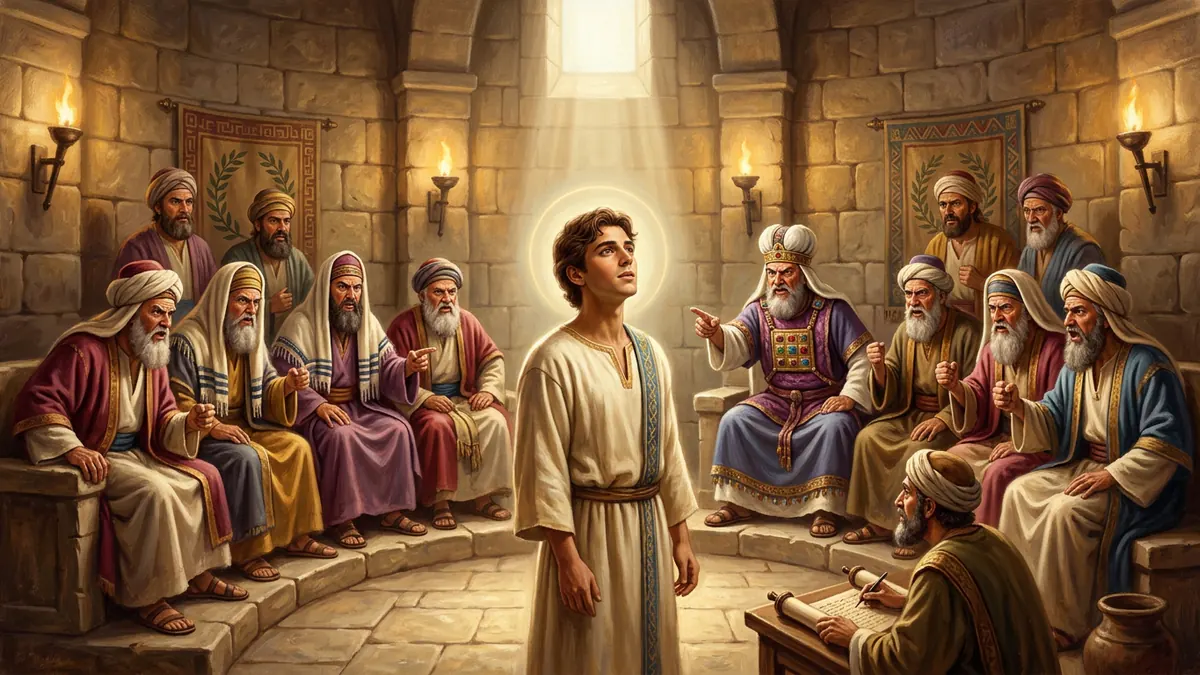
Inside the semicircular Hall of Hewn Stones (the Lishkat ha-Gazith), seventy-one elite aristocrats, high priests, and Pharisees sat elevated upon tiered stone benches. In the center stood the suborned accusers, leveling their venomous charge: 'This man does not cease to speak blasphemous words against this holy place and the law; for we have heard him say that this Jesus of Nazareth will destroy this place and change the customs which Moses delivered to us!' (Acts 6:13–14).
Every eye in the council shifted from the witnesses to the accused prisoner. What they saw paralyzed the chamber with supernatural dread. Stephen did not sweat; he did not cower; his jaw did not tremble. Luke records an awe-inspiring visual reality: 'And all who sat in the council, looking steadfastly at him, saw his face as the face of an angel' (Acts 6:15).
Just as Moses had descended the crags of Mount Sinai with the uncreated glory of God illuminating his skin so brilliantly that Aaron and the elders shrank back in terror (Exodus 34:29–30), so the Holy Spirit transfigured Stephen's face with celestial radiance. God was placing His visible, heavenly seal upon His servant right in the presence of his accusers, demonstrating that Stephen was not the enemy of Moses, but the true inheritor of Moses' prophetic spirit!
The Grand Historical Sweep: God Beyond Stone Walls
Breaking the stunned silence, High Priest Caiaphas demanded with cold hostility: 'Are these things so?'
Stephen did not present a sniveling defense of his life. Instead, he launched into history's most magnificent, sweeping theological survey of the Old Testament, traversing two millennia of redemptive history in a single breath. Beginning with the sovereign call of Abraham in pagan Mesopotamia, Stephen systematically dismantled the council’s idolatrous premise that the Living God could be monopolized by a stone temple in Jerusalem or an exclusive religious caste.
Notice the breathtaking geography of his argument:
- God appeared to Abraham in Mesopotamia, before he ever set foot in Canaan (Acts 7:2).
- God was with Joseph when he was betrayed and sold as a slave into Egypt (Acts 7:9).
- God spoke to Moses not in the Jerusalem temple, but in the desolate sands of Midian, turning a common desert thornbush into holy ground (Acts 7:30–33).
- God dwelt among Israel in the portable Tabernacle of Witness in the wilderness, long before Solomon constructed a permanent house of cedar and stone (Acts 7:44–47).
Then Stephen delivered the theological thunderbolt that struck at the very heart of the council's religious security: 'However, the Most High does not dwell in temples made with hands, as the prophet says: Heaven is My throne, and earth is My footstool. What house will you build for Me? says the Lord, or what is the place of My rest? Has My hand not made all these things?' (Acts 7:48–50, citing Isaiah 66:1–2).
The Indictment of the Stiff-Necked Council
Throughout his historical recitation, Stephen demonstrated a tragic, recurring crimson thread: whenever God raised up a deliverer, the rebellious leaders of Israel rejected him. Joseph was rejected and sold by his brothers; Moses was rejected by his brethren with the bitter sneer: 'Who made you a ruler and a judge over us?' (Acts 7:27, 35). Yet God sovereignly vindicated those very rejected deliverers!
Suddenly, the Holy Spirit shifted Stephen’s tone from historical exposition to prophetic indictment. Turning his glowing face directly toward Caiaphas, Annas, and the assembled Sanhedrin, Stephen unleashed words that cut like double-edged bronze:
'You stiff-necked and uncircumcised in heart and ears! You always resist the Holy Spirit; as your fathers did, so do you. Which of the prophets did your fathers not persecute? And they killed those who foretold the coming of the Just One, of whom you now have become the betrayers and murderers, who have received the law by the direction of angels and have not kept it!'
The Gnashing of Teeth and the Opened Heavens
Stephen’s words detonated like a seismic shockwave inside the council chamber. The text uses an intense medical Greek term: dieprionto tais kardiais autōn—their hearts were violently sawn in two! Convicted by truth, yet refusing to repent, their wounded pride erupted in uncontrolled, animalistic fury. Dignified elders and wealthy Sadducean aristocrats lost all composure, leaping to their feet and audibly gnashing their teeth at the solitary prisoner.
Stephen did not look at their contorted, hateful faces. He did not hear their snarling curses. Filled overflowing with the Holy Spirit, he tilted his head backward and gazed steadfastly into the infinite expanse of the heavens above.
In that incandescent instant, physical reality peeled away like a scroll. Stephen saw the uncreated Shekinah glory of God blazing in blinding majesty—and standing at the right hand of God was the Lord Jesus Christ!
Unable to contain the ecstasy of the vision, Stephen cried aloud: 'Look! I see the heavens opened and the Son of Man standing at the right hand of God!'
Acts 7:55–56: 'But he, being full of the Holy Spirit, gazed into heaven and saw the glory of God, and Jesus standing at the right hand of God, and said, “Look! I see the heavens opened and the Son of Man standing at the right hand of God!”'
The Extralegal Lynch Mob outside the City Gate
The title 'Son of Man' was Jesus’ supreme self-designation, derived from Daniel’s cosmic vision of the eternal King (Daniel 7:13–14). Hearing this young Hellenist declare that the crucified Nazarene was standing at the right hand of Yahweh’s throne, the council erupted in hysterical pandemonium. Covering their ears with their hands to block out what they deemed intolerable blasphemy, they drowned out his voice with a unified shriek.
Rushing upon him as a raging mob, they dragged Stephen by his tunics out of the council chamber, through the crowded streets of the city, and out through one of the ancient eastern city gates into the rocky crags of the Kidron Valley. Jewish law mandated that blasphemers be stoned to death outside the camp (Leviticus 24:14), and that the primary witnesses must cast the first heavy stones.
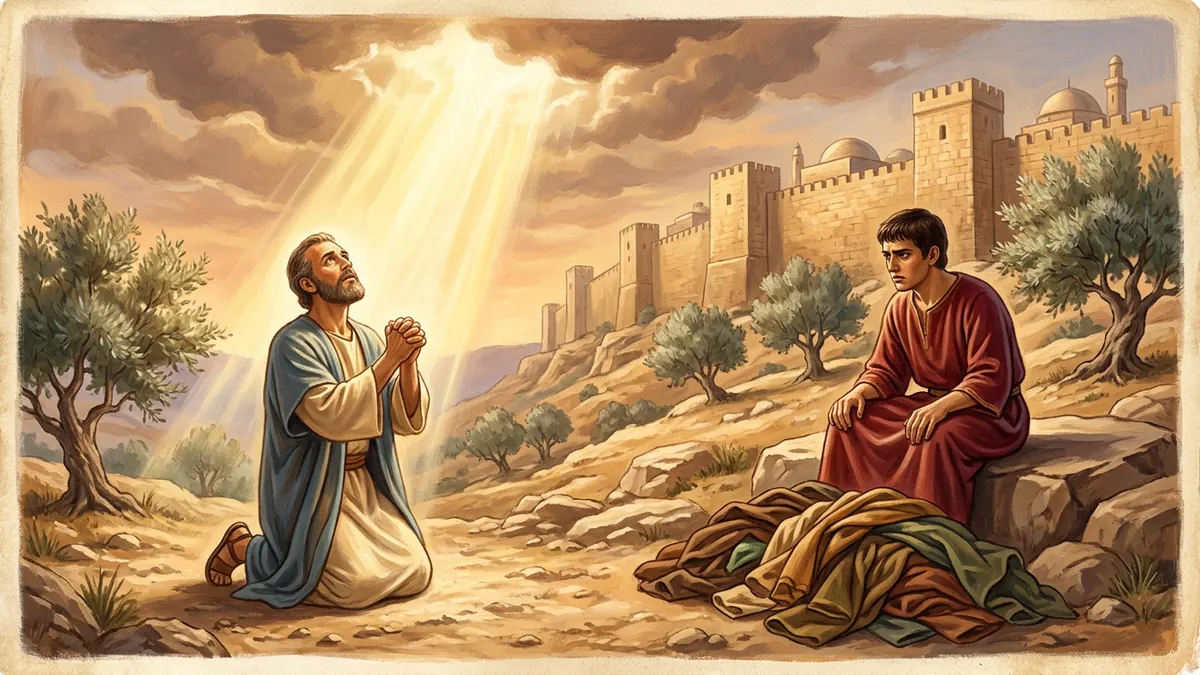
Stripping off their heavy, flowing outer garments to free their arms for violent throwing, the executioners deposited their folded robes at the feet of a young, intense Pharisee who supervised the execution with ruthless satisfaction: Saul of Tarsus.
The Prayers of the Dying Witness
Heavy, jagged limestone rocks began to rain down upon Stephen’s body. Flesh tore; bones fractured; blood poured down his serene brow onto the parched Judean soil. Yet there was no scream of rage, no cursing of his tormentors, no desperate plea for earthly rescue.
Lifting his voice above the dull thud of the stones, Stephen cried aloud his first dying petition: 'Lord Jesus, receive my spirit!'
Then, battered and broken, his physical strength failing, Stephen sank to his knees upon the blood-stained earth. Gathering his final breath, echoing the transcendent grace of his Master on Golgotha, he shouted with a loud voice that reverberated off the stone ramparts: 'Lord, do not charge them with this sin!'
And when he had uttered these words of radical, unmerited forgiveness, Scripture records with breathtaking pastoral tenderness: 'He fell asleep' (ekoimēthē). His battered earthly body lay still beneath the heap of stones, but his immortal soul was swept instantly into the welcoming embrace of the Son of Man who had stood to receive him.
The Blood of the Martyr and the Seed of the Church
Godly men carried Stephen to his burial and made great lamentation over him, carving out a memorial of honor for the first man in history to shed his blood for the name of Jesus Christ. That very day, a ferocious wave of systemic persecution erupted against the Church in Jerusalem. Saul of Tarsus, obsessed with exterminating this messianic movement, went from house to house, dragging off men and women and committing them to prison.
Yet Satan’s strategy backfired completely. The scattering of the disciples did not extinguish the fire of the Gospel; it acted like a cosmic wind blowing glowing embers across the globe! Disciples fled to Judea, Samaria, Phoenicia, Cyprus, and Antioch, preaching the Word wherever they went. And deep inside the soul of young Saul of Tarsus, the vision of Stephen’s angelic face and his dying prayer of forgiveness remained an unshakeable divine thorn, relentlessly preparing the soil for his own historic encounter on the road to Damascus. As the early church father Tertullian immortalized: 'The blood of the martyrs is the seed of the Church!'
Ancient Near Eastern & Archaeological Context
The early Christian community in Jerusalem expanded so rapidly that logistical and linguistic friction arose between the Hebrew-speaking native Jewish believers and the Hellenistic (Greek-speaking diaspora) Jewish converts. Hellenistic widows were being overlooked in the daily distribution of food (Acts 6:1). Rather than distracting the Apostles from prayer and the ministry of the Word, the church selected seven Spirit-filled Hellenistic men of sterling reputation to oversee this relief ministry—prominent among them was Stephen. Jerusalem during this period was home to over four hundred synagogues catering to diverse linguistic and geographic diaspora groups. The 'Synagogue of the Freedmen' (Libertinoi) comprised descendants of Jews taken captive to Rome by Pompey in 63 BC and later emancipated, returning with Roman citizenship. When Stephen engaged their leading scholars in theological disputation, his irresistible mastery of the Greek Old Testament (Septuagint) humiliated their scribes, provoking an extralegal lynch mob coordinated through the corrupt high-priestly house of Annas.
Practical Discipleship & Spiritual Application
- Stephen’s life and death teach us that spiritual greatness in the kingdom of God is never measured by length of earthly days, but by depth of surrender to Christ. He was appointed to wait on dining tables and distribute loaves of bread, yet he carried the burning presence of God so intensely that his face shone like an angel and his witness shook an empire. When the stones flew and human hatred reached its zenith, Stephen did not look at his executioners, nor did he look at the jagged rocks cutting his flesh—he fixed his eyes on the opened heavens and beheld Jesus. Bitterness cannot survive in a heart focused on the glory of Christ. When we face slander, betrayal, or severe persecution for the truth, we must remember Stephen’s posture: kneeling in grace, forgiving our persecutors, and committing our spirits into the hands of the Savior who rises to stand for us.
Support Independent Biblical Research
Did this study bless you? Help support our independent bilingual research and interactive visual Bible tools.
⚡ Fast Facts
- The Transfigured Face of Stephen: Acts 6:15 records that all who sat in the council saw his face 'like the face of an angel' (prosōpon angelou), a deliberate thematic parallel to Moses descending Mount Sinai with radiant skin (Exodus 34:29–35), vindicating Stephen against false charges of blaspheming Moses
- The Christological Stance — Jesus Standing: While Scripture consistently portrays Christ seated at the right hand of the Father (Psalm 110:1; Hebrews 1:3) signifying His finished redemption, Stephen uniquely sees Jesus standing (hestōta, Acts 7:55–56), risen as divine Advocate, Judge, and welcoming Sovereign to receive His first martyr
- The Synagogue of the Freedmen (Libertinoi): Acts 6:9 identifies Stephen's opponents as Jewish freedmen (former Roman prisoners of war emancipated from Rome) and scholars from Cilicia; this Cilician contingent undoubtedly included brilliant young Saul of Tarsus
- Echoing the Cross of Calvary: Stephen’s final two prayers—commending his spirit to Jesus ('Kyrie Iēsou, dexai to pneuma mou') and pleading mercy for his executioners ('Lord, do not hold this sin against them')—precisely mirror Christ’s dying words on the cross (Luke 23:34, 46)
❓ Frequently Asked Questions (FAQs)
Why was Stephen accused of speaking blasphemy against the Temple and the Law of Moses?
Stephen grasped the revolutionary theological reality of the New Covenant earlier than many of his contemporaries. He understood that Christ’s bodily resurrection, the rending of the temple veil, and the outpouring of the Holy Spirit meant that the animal sacrificial system, the Aaronic priesthood, and the physical Herodian Temple were temporary shadows fulfilled in Jesus Christ. His opponents from the Hellenistic synagogues distorted his preaching regarding Jesus 'destroying this place and changing the customs of Moses' (Acts 6:14), weaponizing it as treasonous blasphemy. In ancient Judaism, attacking the sanctity of the Temple or the Law was considered capital high treason punishable by death.
What was the central theological argument of Stephen's speech before the Sanhedrin in Acts 7?
Stephen’s monumental defense was not an apology for himself, but an inspired historical indictment of religious apostasy. He proved three foundational points: First, God’s presence has never been confined to a geographic shrine or stone building; God met Abraham in Mesopotamia, Joseph in Egypt, Moses in Midian at a burning bush on holy desert ground, and Israel in the wilderness Tabernacle. Second, throughout redemptive history, Israel consistently rejected God’s chosen deliverers at first (Joseph was sold by his brothers; Moses was rejected with 'Who made you a ruler and judge?'). Third, just as their fathers persecuted the prophets who foretold the Coming One, the present council had betrayed and murdered the Righteous Messiah Himself, perpetuating their historic rebellion against the Holy Spirit.
How did Stephen’s martyrdom directly prepare the ground for the conversion of Saul of Tarsus?
Saul of Tarsus was present as an active participant, guarding the cloaks of the witnesses and formally voting for Stephen's execution. Yet Stephen’s supernatural composure, his angelic radiance, his celestial vision of Christ, and above all, his dying prayer of forgiveness for his murderers ('Lord, do not charge them with this sin') became an indelible spiritual goad driven into Saul's conscience. Though Saul initially responded with frantic, violent persecution of the Church, Christ later confronted him on the Damascus road saying, 'It is hard for you to kick against the goads' (Acts 26:14). St. Augustine famously declared: 'If Stephen had not prayed, the Church would not have had Paul.'