The Tyrant's Sword and the Gathering Storm
The dark storm clouds of imperial persecution gathered rapidly over the infant Church in Jerusalem. King Herod Agrippa I—the cunning, Rome-educated grandson of Herod the Great—had consolidated royal dominion over Judea. Desperate to curry favor with the aristocratic Sadducees and the nationalist Pharisees who viewed the blossoming Christian community with venomous hatred, Agrippa struck at the very core of the apostolic inner circle. He arrested James, the son of Zebedee, and without trial, executed him with the Roman broadsword (Acts 12:1–2). James became the first of the Twelve Apostles to seal his testimony with his life's blood.
When Agrippa saw that this bloody execution generated rapturous applause from the temple elite, he decided to deliver the ultimate death blow to the messianic movement. During the sacred Feast of Unleavened Bread, royal guards seized Simon Peter, the chief spokesman of the Church. Yet because Mosaic law strictly forbade formal trials or public executions during the holy Passover week, Agrippa remanded Peter to the deepest, most secure subterranean dungeon in the city: the formidable Fortress Antonia, overlooking the northwest corner of the Temple Mount.
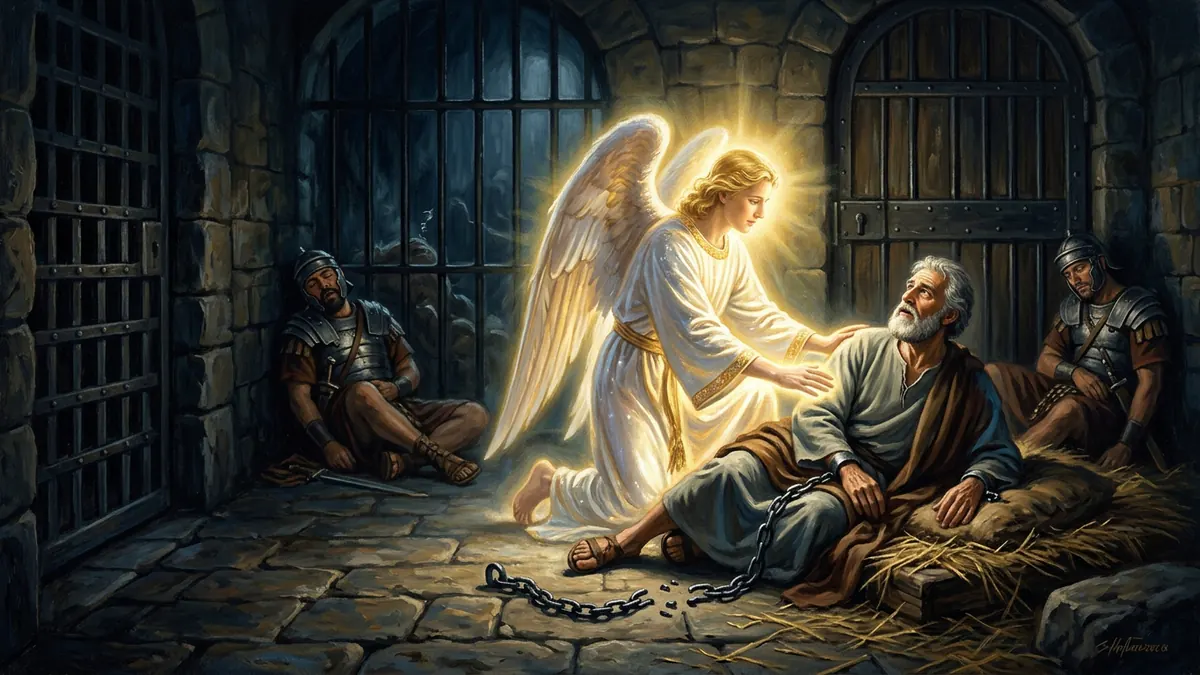
Determined that no rescue or escape could occur, Agrippa delivered Peter into the custody of four quaternions of soldiers—sixteen battle-hardened Roman legionaries. They operated in rotating shifts across the four watches of the night. Inside the damp limestone cell, Peter was subjected to maximum-security confinement: stripped of his outer cloak, his wrists were bound with heavy, forged iron chains fastened directly to two armed Roman guards sleeping on either side of him, while two additional sentries stood sword-in-hand outside the barred iron door.
Acts 12:4–5: 'So when he had arrested him, he put him in prison, and delivered him to four quaternions of soldiers to keep him, intending to bring him before the people after Passover. Peter was therefore kept in prison, but constant prayer was offered to God for him by the church.'
The Sleeping Apostle and the Midnight Intercession
It was the final night of the Passover feast. In just a few hours, dawn would break over the Mount of Olives. Herod Agrippa had already arranged the public tribunal in the grand forum; the executioner’s block was prepared; the bloodthirsty crowds were eager for the morning spectacle. Death was staring Simon Peter directly in the face.
Yet inside that subterranean stone vault, illuminated only by the faint, sputtering glow of a smoky oil lamp, something utterly astonishing was taking place: Simon Peter was fast asleep. He was not merely dozing; he was in a slumber so profound that even the clinking of iron chains against cold stone could not stir him. Slumped between his two captors, his rhythmic breathing echoed off the damp limestone walls.
How could a condemned man sleep so serenely on the eve of his decapitation? Peter possessed an anchor that no Roman emperor could shake. Years earlier, by the Sea of Galilee, the risen Christ had looked into Peter’s eyes and prophesied: 'When you are old, you will stretch out your hands, and another will gird you and carry you where you do not wish' (John 21:18). Peter was still a vigorous, middle-aged man. He knew with unshakeable certainty that if Jesus said he would die in old age, King Herod Agrippa I could not execute him tomorrow morning! Grounded in the immutable promises of God, Peter slept like a child in the Father's arms.
Meanwhile, across the city in the quiet residential alleys, a very different scene was unfolding. In the spacious home of Mary, the mother of John Mark, dozens of believers were crammed into the courtyard and upper chambers. Scripture records that constant, unceasing prayer (proseuchē ektenēs) was being poured out to God for Peter. It was the same intense, soul-straining Greek word used to describe Christ’s agony in Gethsemane. Weeping, fasting, and pacing the stone floors, the saints wrestled in intercession throughout the dark watches of the night.
The Midnight Burst of Shekinah Light
Suddenly, in the dead silence of the fourth watch—between 3:00 and 6:00 AM—the pitch-black darkness of Peter’s dungeon cell was obliterated! A blinding, supernatural radiance filled the subterranean room like liquid lightning. Standing in the center of the cell was an Angel of the Lord, robed in dazzling celestial glory.
The sleeping guards on either side remained locked in a supernatural stupor. But Peter was sleeping so deeply that even the blinding celestial glare did not wake him! Stepping forward, the angel bent down and struck Peter firmly on his side (pataxas tēn pleuran), shaking him awake with a crisp, urgent command: 'Arise quickly!'
In that electrifying instant, the heavy iron cuffs encasing Peter's wrists snapped like rotten twine. Soundlessly, without a clink, the iron chains slid off his hands and dropped onto the stone floor! The angel gave swift, practical instructions: 'Gird yourself and tie on your sandals... Put on your garment and follow me.'
Still groggy with sleep, Peter mechanically fastened his leather belt, slipped his feet into his wooden sandals, threw his wool mantle over his shoulders, and stepped out behind the glowing celestial guide. Peter’s mind was in a daze; he assumed he was experiencing an ecstatic night vision, unable to comprehend that physical reality was being rewritten before his eyes.
Acts 12:7–9: 'Now behold, an angel of the Lord stood by him, and a light shone in the prison; and he struck Peter on the side and raised him up, saying, “Arise quickly!” And his chains fell off his hands. Then the angel said to him, “Gird yourself and tie on your sandals”; and so he did. And he said to him, “Put on your garment and follow me.” So he went out and followed him, and did not know that what was done by the angel was real, but thought he was seeing a vision.'
The Iron Gate that Opened of Its Own Accord
Walking silently behind the luminous angel, Peter traversed the dark labyrinth of the fortress. They passed the first guard post—two Roman legionaries stood motionless, frozen in supernatural slumber. They moved down the stone staircase and passed the second guard post without a sound. No alarm was sounded; no sword was drawn; no dog barked.
Finally, they arrived at the formidable outer perimeter of the fortress: the colossal iron gate that opened into the sleeping city of Jerusalem. Forged from thick bands of black iron and secured with massive sliding bronze bolts, it was an impenetrable barrier designed to withstand a battering ram.
As the angel and the apostle approached, Luke records a breathtaking miracle using the singular Greek word automatē: 'The iron gate that leads to the city opened to them of its own accord!'
Without a key, without a human touch, without the creak of rusty hinges, the massive iron bolts slid back soundlessly, and the colossal gates swung wide into the cool night air! Peter and the angel stepped out into the cobblestone street. They walked together down one quiet alleyway, and suddenly, as abruptly as he had appeared, the angel vanished into the darkness.
'Now I Know of a Certainty!'
The cold Mediterranean night wind whipped against Peter's face, instantly banishing the fog of slumber. Standing alone under the glittering stars on an open Jerusalem street, looking back at the closed iron ramparts of the Antonia, total cognitive clarity flooded Peter’s soul.
Slapping his hands against his chest, feeling the crisp night air in his lungs, Peter exclaimed aloud in holy awe: 'Now I know for certain that the Lord has sent His angel, and has delivered me from the hand of Herod and from all the expectation of the Jewish people!' (Acts 12:11).
The death sentence was broken! The executioner’s axe was cheated! The living God had made a mockery of Rome's maximum-security prison.
Pandemonium at Mary's House: Rhoda and the Disbelieving Saints
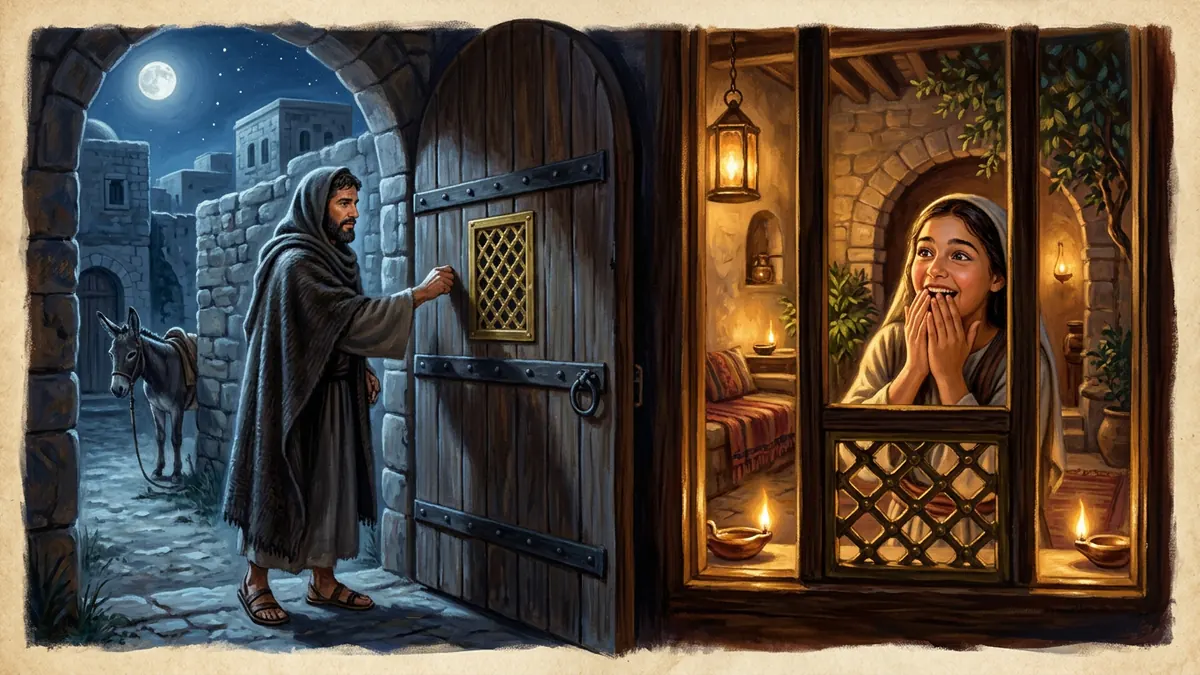
Considering his next move, Peter hurried through the shadows toward the familiar home of Mary, the mother of John Mark. He knew this was the spiritual heartbeat of the Jerusalem assembly. Arriving at the outer courtyard gate, Peter began knocking on the heavy wooden door with urgent persistence: Knock! Knock! Knock!
Inside, the prayer meeting was still in full, desperate swing. A young servant girl named Rhoda (meaning 'Rose') hurried across the stone courtyard to the gate to see who was disturbing the household in the dead of night. Listening through the decorative lattice, she heard a voice whisper: 'It is Peter! Let me in!'
Rhoda knew that deep, Galilean baritone instantly. It was the Apostle! But Luke records a scene of pure, delightful human humor: overcome with ecstatic joy, she forgot to unlock the door! Leaving the most wanted fugitive in the Roman Empire standing outside on the dark street, Rhoda spun around and sprinted into the house, screaming at the top of her lungs: 'Peter is standing at the gate! Peter is standing at the gate!'
The praying saints stopped their intercession and stared at the girl in disgust. 'You are out of your mind!' they scolded her. But Rhoda insisted with tears of certainty that it was truly Peter. Rationalizing their unbelief, the sophisticated adults concluded: 'It must be his guardian angel!'
Meanwhile, out in the street, the knocking grew louder and more frantic: KNOCK! KNOCK! KNOCK!
Finally, the entire congregation rushed across the courtyard and flung open the wooden gate. There, standing in the moonlight, smiling warmly, whole, unharmed, and completely free, was Simon Peter! The saints gasped, shrieking in disbelieving astonishment. Peter motioned with his hands for silence lest the neighborhood be awakened, stepped into the house, and recounted how the Lord had led him out of the prison. Instructing them to inform James the Lord's brother and the elders, Peter slipped away into the night to safety.
The Tyrant Eaten by Worms
At daybreak, all hell broke loose inside the Fortress Antonia. There was no small stir among the sixteen soldiers as to what had become of Peter! Chained guards woke up staring at empty iron cuffs; corridor sentries looked upon locked inner doors and an open iron gate. Enraged at the humiliating breach, Herod Agrippa interrogated the guards and ordered them summarily executed.
Shortly thereafter, Agrippa traveled to Caesarea Maritima for a lavish festival in honor of Emperor Claudius. Dressed in magnificent royal robes woven entirely of silver thread, the king entered the outdoor amphitheater at sunrise. As the morning light hit the silver fabric, it reflected with blinding brilliance. Flattering sycophants from Tyre and Sidon began shouting: 'The voice of a god and not of a man!'
Agrippa basked in the blasphemous adoration, refusing to deflect glory to the Living God. Immediately, an Angel of the Lord struck him down! Scripture records that the proud monarch was eaten alive by parasitic worms (skōlēkobrōtos), dying five days later in agonizing torment. Luke concludes the drama with the triumphant epitaph of the Early Church: 'But the word of God grew and multiplied' (Acts 12:24). Tyrants fall, empires crumble, but the Church of the Living God marches on victorious!
Ancient Near Eastern & Archaeological Context
King Herod Agrippa I (grandson of Herod the Great and Mariamne the Hasmonean princess) was an astute political chameleon educated in the imperial palace of Rome alongside Claudius and Caligula. Awarded royal rule over Judea, Samaria, and Galilee, Agrippa was keenly sensitive to orthodox Jewish sentiment. To solidify his popularity among the Pharisaic and Sadducean ruling elite, he launched an aggressive persecution against the leadership of the Way, executing James son of Zebedee with the broadsword (Acts 12:2). Seeing that this assassination delighted the populace, he arrested Simon Peter during the seven-day Feast of Unleavened Bread. Jewish law forbade public executions during holy feast days; consequently, Agrippa imprisoned Peter within the subterranean fortress Antonia adjacent to the Temple mount, intending to execute him publicly the morning after the Passover week concluded. The four quaternions of guards (sixteen men) ensured that escape was physically impossible under Roman military code, which mandated that guards who lost a prisoner suffered the prisoner's death penalty (Acts 12:19).
Practical Discipleship & Spiritual Application
- Peter’s midnight deliverance demonstrates that the fervent, unceasing prayer of the Church is infinitely more powerful than the iron bars, chains, and imperial legions of earthly empires. Notice the contrast: Herod deployed sixteen trained legionaries, two iron chains, three locked gates, and the full authority of Rome; the Church deployed only the name of Jesus in a humble prayer meeting at midnight. And prayer won! When the world locks its heaviest iron gates against your calling, remember that heaven has an angel with a key. When you are surrounded by impossible circumstances, do not pace the floor in anxiety; lie down and sleep in the promise of God like Peter. God rarely moves early, but He is never a second too late. Before Herod can execute his plot at sunrise, the midnight angel will touch your chains, the iron gates will open of their own accord, and your weeping will turn into disbelieving joy.
Support Independent Biblical Research
Did this study bless you? Help support our independent bilingual research and interactive visual Bible tools.
⚡ Fast Facts
- The Roman Quaternions of Security: Acts 12:4 specifies that Peter was delivered to 'four quaternions of soldiers' (tessarsin tetradiois stratiōtōn)—sixteen elite Roman guards rotating across the four night watches, with two soldiers handcuffed directly to Peter and two guarding the iron corridor doors
- The Power of Unceasing Prayer (Ektenōs): The Greek adverb describing the Church’s prayer in Acts 12:5 is 'ektenōs' (stretched out, strained, fervent), the exact anatomical term used in Luke 22:44 to describe Jesus sweating drops of blood in Gethsemane
- The Sovereign Self-Opening Gate (Automatē): In Acts 12:10, Luke uses the rare word 'automatē' (from autos and maomai, meaning 'of its own accord' or automatically) to describe the massive city iron gate swinging open without human hand, the origin of our English word 'automatic'
- The Royal Fate of Herod Agrippa I: Immediately following this prison escape in Acts 12:20–23, Herod Agrippa I accepted blasphemous adulation from the citizens of Tyre and Sidon ('The voice of a god and not of a man!'); struck down by an angel of the Lord, he was eaten by worms and died in agony, proving that earthly tyrants perish while the Word of God multiplies
❓ Frequently Asked Questions (FAQs)
Why did God allow James the brother of John to be executed, but supernaturally rescued Peter?
This profound disparity highlights the mysterious sovereignty of God in suffering and ministry. James and John were the 'Sons of Thunder' who had once asked to sit on Christ's right and left hand, to which Jesus replied that they would indeed drink His cup (Matthew 20:23). James became the very first Apostle to drink that cup of martyrdom, receiving his eternal crown immediately. Peter, conversely, still had apostolic milestones to accomplish—writing his epistles, shepherding the flock through Nero’s persecution, and sealing his own martyrdom decades later in Rome (John 21:18–19). God's grace is equally present in the martyr who dies for His glory and the apostle who is miraculously spared; both glorify God according to His sovereign timeline.
Why was Peter able to sleep so soundly on the eve of his scheduled execution?
Peter's deep, undisturbed slumber between two Roman legionaries while bound in iron chains is one of the most astonishing portraits of peace in Scripture. His tranquility flowed from unshakeable faith in the prophetic promise of Jesus. In John 21:18, Jesus had explicitly prophesied that Peter would live to be an old man ('When you are old, you will stretch out your hands'). Because Peter was not yet an old man, he knew with absolute certainty that Herod Agrippa I could not execute him the following morning! Resting on the promises of God extinguishes all fear of earthly death, allowing a believer to sleep peacefully even in the shadow of the executioner's sword.
What is the humor and theological irony in Rhoda and the praying church's reaction in Acts 12?
Luke injects delightful human realism and sanctified humor into the narrative. While the church had gathered to pray earnestly throughout the night for Peter’s deliverance, when God actually answered their prayers in full, they refused to believe it! When the young servant girl Rhoda recognized Peter's voice at the gate and announced he was standing outside, the praying saints dismissed her as crazy ('You are out of your mind!'), and then suggested it was merely 'his guardian angel.' Rhoda stood her ground, and when they finally unlatched the door, they were stunned. It poignantly reminds us that God in His boundless mercy often answers our prayers according to His sovereign faithfulness, rather than the perfection of our fragile faith.