The Devout Soldier in Caesarea Maritima
Along the sunlit Mediterranean coastline of Judea lay Caesarea Maritima, the opulent Roman administrative capital rebuilt by Herod the Great with colonnaded palaces, an amphitheater, and the colossal deepwater port named Sebastos. While Jerusalem remained the ecclesiastical epicenter of orthodox Judaism, Caesarea was the fortified seat of Roman imperial dominance. Stationed within this pagan metropolis was a Roman military officer named Cornelius, a centurion commanding the prestigious Italian Cohort (Cohors II Italica civium Romanorum). Centurions were the backbone of the Roman legions—hardened veterans renowned for unyielding discipline, tactical courage, and strict adherence to imperial oaths.
Yet Luke presents Cornelius with an astonishing theological portrait: "a devout man and one who feared God with all his household, who gave alms generously to the people, and prayed to God always" (Acts 10:2). In the first-century Roman world, many thoughtful Gentiles had grown weary of the moral decadence, frivolous myths, and hollow rituals of Greco-Roman polytheism. Drawn to the sublime monotheism, ethical purity, and ancient Scriptures of the Jewish synagogue, these individuals were known across the empire as "God-fearers" (phoboumenoi ton Theon). They worshiped Yahweh and observed moral commands, yet remained uncircumcised outsiders who could not enter the inner courts of the Temple or recline at table with strict Jews.
At approximately three o'clock in the afternoon—the traditional ninth hour of prayer when the evening incense ascended in the Jerusalem Temple seventy miles to the south—Cornelius was in deep supplication. Suddenly, the shadows in his chamber fractured. A celestial messenger in dazzling white apparel stood before him. Terror gripped the hardened centurion, but the angel spoke with reassuring majesty: "Cornelius! Your prayers and your alms have come up for a memorial before God. Now send men to Joppa, and send for Simon whose surname is Peter. He is lodging with Simon, a tanner, whose house is by the sea" (Acts 10:4–6). Without hesitation, the centurion dispatched two faithful household servants and a devout soldier under his command to make the thirty-mile journey south down the coastal plain.
The Seaside Rooftop and the Cosmic Trance at Joppa
Thirty miles south, nestled against the rugged reefs of the ancient Mediterranean harbor where Jonah had once fled the call of God, lay the port of Joppa. In this dusty maritime town, Apostle Simon Peter was lodging in the humble home of a fellow tradesman named Simon the Tanner. By Jewish rabbinic halakhah, tanning was an occupation held in ceremonial revulsion. Tanners constantly handled the rotting skins, fats, and carcasses of dead animals, rendering their workshops ceremonially defiled and ostracized outside municipal limits. Peter's willingness to lodge with an outcast tanner demonstrated that the traditional social prejudices of legalistic Judaism were already beginning to unravel under the radical gospel of Jesus Christ.
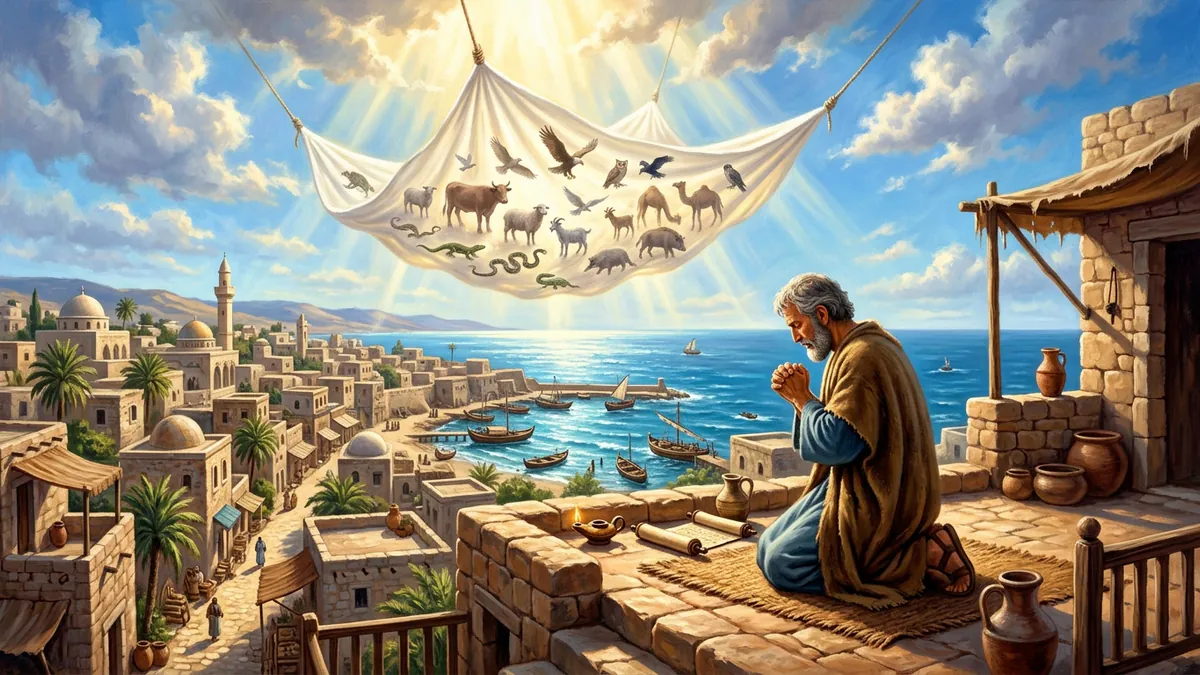
The following day at noon—the sixth hour—the sun beat relentlessly upon the flat terracotta roof of the tanner's dwelling. Peter had climbed the exterior stairs to seek solitude with Yahweh while the midday meal was being prepared below. The rhythmic crash of ocean waves against the rocks echoed beneath him. Parched and ravenously hungry, the apostle knelt in prayer. Suddenly, an intense prophetic ecstasy (ekstasis) overwhelmed his physical senses. The physical coastline vanished; the heavens parted like an unfurled scroll, and Peter beheld a supernatural vessel descending toward him.
The descending object resembled a colossal linen sail or sheet (othonē megalē), held suspended by its four corners, encompassing the vast expanse between heaven and earth. As it settled before the astonished fisherman, Peter peered inside and beheld a chaotic menagerie of biological creation: four-footed beasts of the earth, wild carnivorous beasts, creeping reptiles, and predatory birds of the air. Mingled promiscuously together were creatures declared clean by the Torah alongside camels, swine, vultures, and lizards—animals strictly forbidden under the dietary legislation of Leviticus 11.
From the celestial radiance came an authoritative, sovereign command:
"Rise, Peter; kill and eat." (Acts 10:13)
Peter recoiled in visceral horror. His entire life from childhood had been calibrated by strict Mosaic observance. Never had an unkosher morsel touched his lips. With characteristic Galilean bluntness, the apostle protested: "Not so, Lord! For I have never eaten anything common or unclean" (Acts 10:14). It was an astonishing paradox: addressing the Almighty as "Lord" while simultaneously refusing His explicit command! Yet the heavenly voice answered with thunderous finality, exposing the shallow legalism of human tradition:
"What God has cleansed you must not call common." (Acts 10:15)
Three consecutive times the heavenly drama was enacted—three commands to kill and eat, three apostolic refusals, and three divine rebukes. Just as Peter had denied his Master three times by the charcoal fire in Caiaphas's courtyard, and three times been restored by the lakeside of Tiberias, so now three divine blows battered against his ancient ethnocentric walls. Then, as suddenly as it had descended, the great sheet was drawn up again into heaven, leaving Peter breathless, bewildered, and deeply troubled in spirit.
The Knock at the Gate and the Journey to Caesarea
While Peter paced the rooftop wrestling with the theological meaning of this bizarre riddle, three dust-covered men halted outside the courtyard gate below: the two servants and the soldier sent by Cornelius. In the ancient Near East, strict Jews considered stepping under the roof of a Gentile, sharing their hospitality, or eating from their vessels to cause severe ritual defilement. Before Peter could retreat into rabbinic caution, the Holy Spirit spoke with unmistakable clarity to his inward ear: "Behold, three men are seeking you. Arise therefore, go down and go with them, doubting nothing; for I have sent them" (Acts 10:19–20).
Descending the exterior staircase, Peter greeted the foreign emissaries. When they narrated the angel's appearance to the pious centurion Cornelius, Peter crossed his first momentous boundary: he invited the Gentile travelers inside the house and lodged them overnight as his honored guests. On the following morning, Peter set out for Caesarea, accompanied not only by the Roman envoys but also by six Jewish Christian brothers from Joppa (Acts 11:12)—prudent witnesses whom providence ordained to authenticate the unfolding miracle before the watchful eyes of the Jerusalem council.
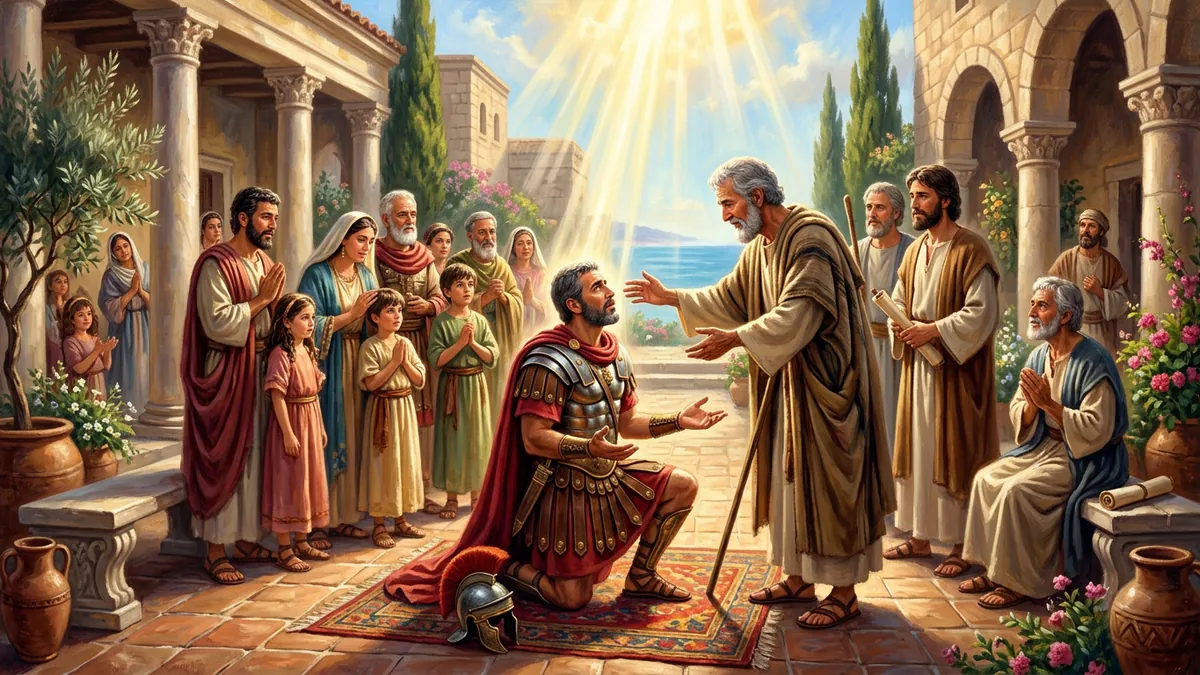
The thirty-mile journey across the Sharon Plain consumed two days of brisk walking. Meanwhile, in Caesarea, Cornelius had gathered a packed assembly. Anticipating the arrival of the apostolic messenger with intense expectation, the centurion had filled his spacious villa with his kinsmen, fellow officers, and intimate friends. When Peter crossed the threshold into the Roman residence, Cornelius rushed forward, casting himself facedown on the stone mosaic floor in acts of obeisance customary before Roman emperors and eastern sovereigns.
Peter immediately took the centurion by the hand and hoisted him upward, declaring the fundamental equality of all humanity before the Creator: "Stand up; I myself am also a man" (Acts 10:26). Entering the crowded banquet hall and beholding the expectant faces of uncircumcised Gentiles, the profound mystery of the rooftop vision finally detonated in Peter's consciousness with blinding clarity. Turning to the assembly, the apostle declared:
"You know how unlawful it is for a Jewish man to keep company with or go to one of another nation. But God has shown me that I should not call any man common or unclean." (Acts 10:28)
The Sermon of Sovereign Impartiality
Cornelius recounted his angelic visitation with trembling reverence, concluding with a magnificent posture of spiritual receptivity: "Now therefore, we are all present before God, to hear all the things commanded you by God" (Acts 10:33). Gazing into their earnest eyes, Peter opened his mouth and uttered one of the most revolutionary theological declarations in human history:
"In truth I perceive that God shows no partiality. But in every nation whoever fears Him and works righteousness is accepted by Him." (Acts 10:34–35)
The Greek word used by Luke is prosōpolēmptēs—a compound term meaning "one who accepts the face or external appearance." For centuries, Jewish thought had harbored the comfortable assumption that biological descent from Abraham conferred an exclusive monopoly upon divine favor, while the uncircumcised nations of the earth were merely kindling for judgment. Peter now recognized that the Creator looks not at ethnic ancestry, ceremonial phylacteries, or dietary customs, but at the broken heart and reverent faith of the seeker.
With cinematic power, Peter proclaimed the gospel of Jesus Christ. He recounted Jesus of Nazareth anointed with the Holy Spirit and with power, going about doing good and healing all who were oppressed by the devil, for God was with Him. He testified to Christ's public crucifixion upon the Roman cross at Calvary, His bodily resurrection on the third day, and His appearances to chosen eyewitnesses who ate and drank with Him after He arose. Finally, Peter unveiled the universal promise that shattered the ancient gates of exclusivity:
"To Him all the prophets witness that, through His name, whoever believes in Him will receive remission of sins." (Acts 10:43)
The Gentile Pentecost: Tongues of Holy Fire in Caesarea
While the word was still on Peter's lips—before the apostle could conclude his sermon, issue an altar call, or propose water baptism—heaven interrupted earth. The sovereign God who had sent the rushing mighty wind upon the 120 Jewish disciples in the Upper Room on the Day of Pentecost now enacted an identical sovereign epiphany in the living room of a Roman legionary.
The Holy Spirit fell bodily upon all who heard the word! The Greek verb is epepesen—the Spirit fell upon them with overwhelming, crushing weight and divine reality. Instantly, the Roman centurion, his household, and his pagan friends began speaking with unknown tongues (lalein glōssais) and magnifying the majesty of God! The six circumcised Jewish believers who had accompanied Peter from Joppa stood paralyzed in breathless astonishment. Their entire theological paradigm dissolved before their eyes: the uncircumcised Gentiles, without observing a single Mosaic ritual or submitting to the surgical knife of circumcision, were filled with the very same Holy Spirit that had ignited the apostles!
Recognizing the undeniable seal of Almighty God, Peter looked at his stunned companions and issued a triumphant rhetorical challenge:
"Can anyone forbid water, that these should not be baptized who have received the Holy Spirit just as we have?" (Acts 10:47)
No voice could object. Peter commanded Cornelius, his family, and his companions to be baptized immediately in the name of the Lord Jesus Christ into the waters of the Mediterranean. For several days, the chief apostle of the circumcision remained in Caesarea, reclining at table, breaking bread, and enjoying sweet fellowship in the home of Roman Gentiles, fully liberated from the yoke of ethnic segregation.
The Vindication in Jerusalem and the Global Harvest
Word of Peter's unprecedented fellowship with Gentiles raced across the hills of Judea like wild fire. When Peter returned to Jerusalem, the ultraconservative Jewish faction—those "of the circumcision"—confronted him with fierce indignation: "You went into the house of uncircumcised men and ate with them!" (Acts 11:3). For these devout believers, table fellowship was a sacred covenant boundary; violating it threatened the very identity of Israel.
Peter did not respond with apostolic anger or authoritarian decrees. Instead, he systematically recounted the entire providential narrative step-by-step: the rooftop vision of the descending sheet, the divine rebuke regarding what God has cleansed, the synchronized arrival of Cornelius's messengers, the promptings of the Spirit, and the testimony of the six accompanying brethren who stood beside him as witnesses. Peter brought his defense to a climactic, unanswerable theological zenith:
"If therefore God gave them the same gift as He gave us when we believed on the Lord Jesus Christ, who was I that I could withstand God?" (Acts 11:17)
When the assembly of apostles and elders heard these words, the contentious accusations dissolved into reverent silence. Then, a roar of ecstatic thanksgiving erupted through the Jerusalem church: "Then God has also granted to the Gentiles repentance to life!" (Acts 11:18).
The rooftop trance at Joppa and the outpouring at Caesarea altered the trajectory of human history. The middle wall of separation had been permanently pulverized by the cross of Calvary. From that sacred afternoon forward, the Gospel of Jesus Christ was no longer an ethnic sect confined to Judea, but a glorious cosmic flood overflowing every tribal boundary, welcoming Jew and Gentile, slave and free, barbarian and Roman into one unified, redeemed family of God.
Support Independent Biblical Research
Did this study bless you? Help support our independent bilingual research and interactive visual Bible tools.
⚡ Fast Facts
- The Italian Cohort (Cohors II Italica civium Romanorum) was an elite Roman auxiliary infantry unit composed entirely of Roman citizens stationed in Judea.
- Simon the Tanner's house by the Mediterranean Sea was already on the margins of Jewish ceremonial society, as handling animal carcasses made tanners perpetually ritually unclean under strict rabbinic tradition.
- The sheet tied at four corners represented the four cardinal compass points of the earth (north, south, east, west), symbolizing the global redemption of all nations.
- Cornelius was a 'God-fearer' (phoboumenos ton Theon)—a Gentile who worshiped Yahweh, observed the moral Torah, and gave alms to the synagogues, yet had not undergone circumcision.
❓ Frequently Asked Questions (FAQs)
Was the vision of the great sheet primarily about dietary laws or human beings?
While the visual metaphor employed kosher and non-kosher animals (Leviticus 11), God's direct target was racial and covenantal partiality. Peter himself interpreted the revelation in Acts 10:28: 'God has shown me that I should not call any man common or unclean.' The ceremonial food laws served as a social barrier that segregated Jews from Gentiles; by cleansing all foods, Christ abolished the ethnic barrier separating humanity from grace.
Why did the Holy Spirit fall upon Cornelius' household before they were water baptized?
In the normative apostolic pattern (e.g., Acts 2:38; 8:12–17), water baptism preceded or accompanied the baptism of the Holy Spirit. However, at Caesarea, God sovereignly inverted the order. Had circumcision or water baptism been demanded first by Peter's six Jewish companions, the legalists in Jerusalem would have claimed Gentiles must conform to Mosaic ritual before receiving salvation. By pouring out the Spirit sovereignly upon uncircumcised Gentiles simply through faith in Peter's preaching, God proved beyond dispute that justification is by grace through faith alone.
What theological impact did the conversion of Cornelius have on the early Church?
The conversion of Cornelius was the pivotal watershed of the Book of Acts. It broke the ethnocentric boundaries of Jewish Christianity, established that God shows no partiality (prosōpolēmptēs), and set the authoritative legal precedent later ratified at the Jerusalem Council in Acts 15, permanently freeing Gentile believers from the burden of Mosaic legalism and circumcision.