The Ascent to Mount Moriah at the Hour of Incense
The afternoon heat over the Judean hills was beginning to soften into the amber glow of late day. It was the ninth hour—three o'clock in the afternoon—the sacred moment when the silver trumpets of the sons of Aaron sounded across the limestone terraces of Jerusalem to signal the evening Tamid sacrifice. From every bustling quarter of the Upper and Lower City, devout Jews, Galilean pilgrims, and Greek-speaking proselytes ascended the broad southern monumental staircases, their sandaled feet sweeping rhythmically across the white pavers toward the temple gates.
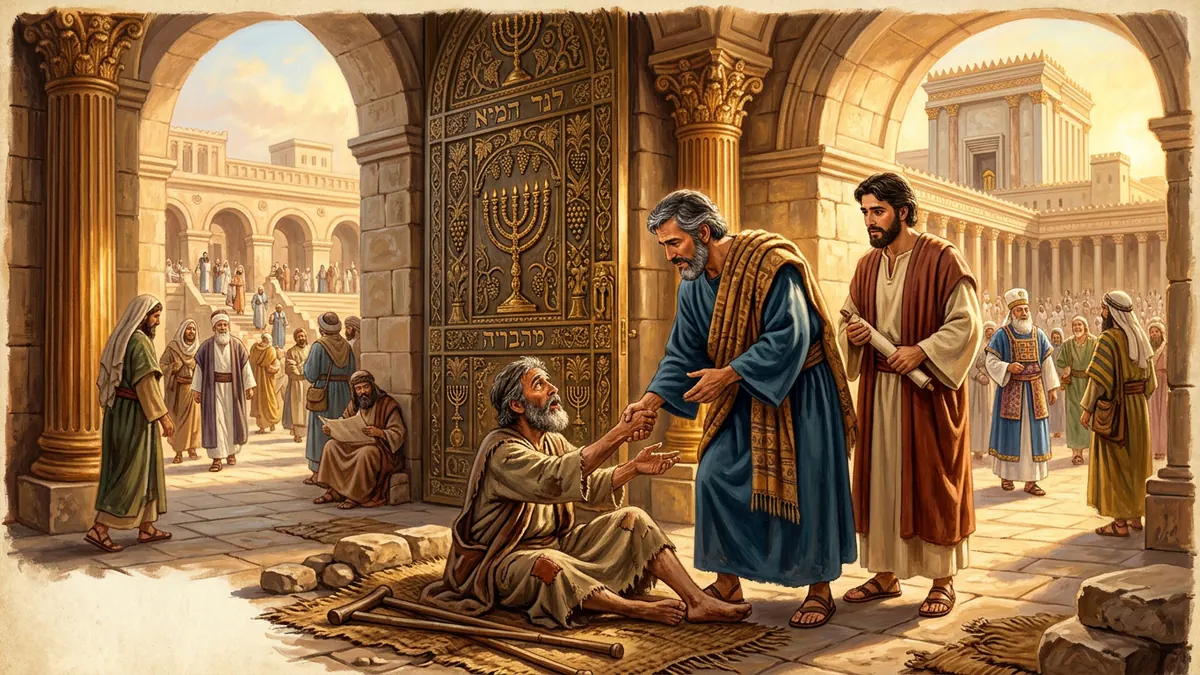
Moving quietly among the surging pilgrim throng were Simon Peter and John, the son of Zebedee. Only weeks earlier, these two fishermen had cowered behind barred doors in terror of the Sanhedrin. But the rushing wind and celestial fire of Pentecost had permanently obliterated their fear. They walked now as heralds of the New Covenant, carrying within their hearts the indwelling fire of the Holy Spirit. They were ascending to the Court of the Women through the most magnificent portal in the ancient world: the Nicanor Gate, celebrated among all nations as the Beautiful Gate.
Flavius Josephus, the Jewish chronicler who walked these colonnades, wrote that while nine other temple gates were heavily overlaid with beaten sheets of gold and silver, this monumental eastern gateway was cast from solid Corinthian bronze. It stood seventy-five feet high, flanked by colossal sculpted lintels, and its polished metal gleamed with a deep, radiant amber luster that outshone pure gold under the scorching Levantine sun. Yet beneath the breathtaking splendor of this bronze colossus sat the raw, weeping tragedy of human brokenness.
Acts 3:1–3: 'Now Peter and John went up together to the temple at the hour of prayer, the ninth hour. And a certain man lame from his mother’s womb was carried, whom they laid daily at the gate of the temple which is called Beautiful, to ask alms from those who entered the temple; who, seeing Peter and John about to go into the temple, asked for alms.'
The Beggar at the Threshold of Glory
He was a man over forty years of age, and from the very moment he drew his first breath in his mother's arms, his legs had hung lifeless and withered. In ancient Mediterranean antiquity, a congenital deformity of this severity was an absolute economic and social death sentence. He could not sow grain in the terraced hills of Judea; he could not push a carpenter’s adze; he could not cast a linen net into the waves of Galilee. Even worse, Mosaic ceremonial regulations strictly excluded him from the inner courts where the presence of God dwelt (Leviticus 21:18). He was perpetually stranded at the threshold: close enough to inhale the sweet fragrance of frankincense and hear the antiphonal Psalms of the Levitical choir, yet barred by his physical affliction from ever taking a single step inside.
Every morning, compassionate relatives or neighbors lifted his emaciated body, carried him through the labyrinthine alleys of Jerusalem, and set him down upon a coarse woolen mat against the bronze threshold of the Beautiful Gate. There, amidst the swirl of aristocratic tunics and phylacteries, he extended his leather cupped palm, chanting the customary beggar's refrain: 'Tzedakah! Tzedakah! Bestow mercy, that the Lord may remember you in the day of trial!'
As the shadows lengthened, the beggar’s tired eyes scanned the approaching sea of sandals. Two men dressed in the simple wool garments of northern Galileans were mounting the marble steps toward the portal. Lifting his hollow face, without even looking into their eyes, the lame man rattled his wooden bowl and pleaded for a meager copper lepton.
'Look at Us!' — The Sovereign Pause
Peter and John did not hurry past. In a city where thousands of self-righteous Pharisees deliberately averted their gaze from beggars to maintain ceremonial detachment, the two apostles halted in their tracks. Peter did not glance casually downward; Luke records that he 'fastened his eyes' (atenisas) upon the crippled man, peering through the dirt, shame, and despair directly into his wounded soul.
'Look at us!' Peter commanded, his voice ringing with quiet, undeniable authority.
The beggar turned his gaze upward, his heart quickening with momentary anticipation. He expected a clinking silver drachma or at least a handful of bronze coins from generous provincial pilgrims. But what Peter spoke next shattered every human expectation and completely redefined the economics of heaven.
'Silver and gold I do not have,' Peter declared firmly, 'but what I do have I give you: In the name of Jesus Christ of Nazareth, rise up and walk!'
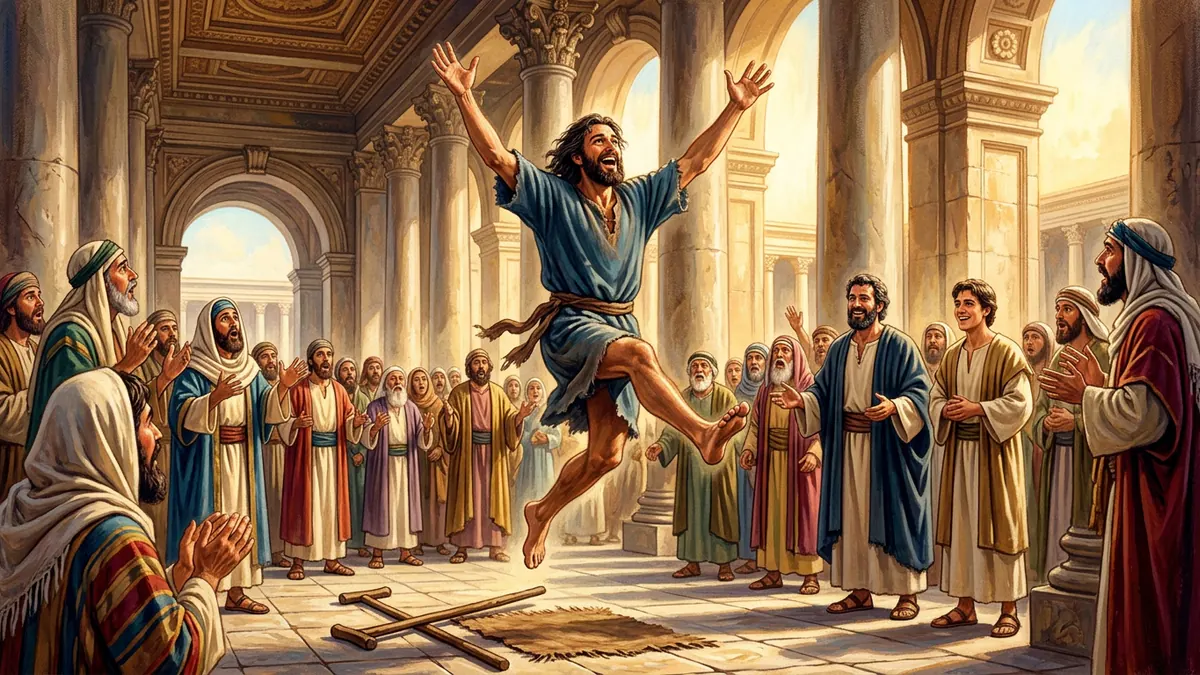
The Anatomical Miracle: Bones and Sinews Reknit
Before the beggar’s bewildered mind could process the impossibility of the command, Peter reached down his calloused right hand and seized the man's trembling wrist. In that instant of tactile contact, the physical realm collided with the omnipotence of the resurrected Christ.
Luke, the physician, carefully records the anatomical sequence using technical medical vocabulary: 'Immediately his feet and ankle bones received strength' (Acts 3:7). The Greek words basis (the articulating structural soles) and sphydra (the ankle bones) describe a supernatural, instantaneous remodeling. Tendons that had been atrophied for forty years thickened in a split second; flaccid nerves fired with electric vitality; calcified joints unlocked; new cartilage, muscle tissue, and arterial pathways surged with warm, oxygen-rich blood.
Peter pulled upward, and the man did not merely stagger to his knees—he sprang violently to his feet! The Greek participle exallomenos paints a vivid kinetic portrait: he leapt upward like a released spring! For the first time in forty long years, his soles stood flat upon the cold limestone bedrock. He tested his weight; his ankles held firm. He took one step, then another, then broke into an uncontrolled gallop of pure, ecstatic joy!
Acts 3:8–9: 'So he, leaping up, stood and walked and entered the temple with them—walking, leaping, and praising God. And all the people saw him walking and praising God.'
The Uproar in Solomon's Colonnade
He did not stay outside at the bronze gate. Clinging with tears of gratitude to Peter's woolen mantle and grasping John’s arm, the former beggar surged through the Nicanor portal straight into the Court of the Women, and from there into the massive, shaded colonnade known as Solomon’s Porch. He ran in wild circles, leaping over the stone balustrades, weeping aloud, shouting praises to the God of Abraham, Isaac, and Jacob. The ancient prophecy of Isaiah had materialized in the temple courts before their very eyes: 'Then the lame shall leap like a deer, and the tongue of the dumb sing!' (Isaiah 35:6).
The sound of his shouting tore through the dignified liturgical murmurs of the afternoon prayer. Worshippers dropped their prayer shawls; Levite singers paused their cymbals; priests turned from the smoking altar. Thousands of people came running from every quarter of the sacred precinct, converging upon Solomon’s Porch. When they pushed through the crowd and recognized the beggar who had sat at the Beautiful Gate day after day, year after year, Scripture records that they were seized with 'wonder and amazement' (thambous kai ekstaseōs)—an overwhelming, paralyzing holy dread.
Peter's Fearless Sermon to the Multitude
Standing beneath the towering double rows of cedar-roofed Corinthian pillars, Simon Peter saw the sea of astonished faces gazing at him as though he were a magician or a demigod. Raising his hand, the apostle deflected every ounce of glory away from himself and directed it straight to the crucified and risen Lord.
'Men of Israel, why do you marvel at this?' Peter proclaimed, his voice echoing across the courtyard. 'Or why look so intently at us, as though by our own power or godliness we had made this man walk? The God of Abraham, Isaac, and Jacob, the God of our fathers, glorified His Servant Jesus, whom you delivered up and denied in the presence of Pilate, when he was determined to let Him go. But you denied the Holy One and the Just, and asked for a murderer to be granted to you, and killed the Prince of Life, whom God raised from the dead, of which we are witnesses!'
Then Peter unveiled the theological heart of the miracle: 'And His name, through faith in His name, has made this man strong, whom you see and know. Yes, the faith which comes through Him has given him this perfect soundness in the presence of you all.'
Peter did not leave the crowd crushed beneath their guilt. In soaring words of grace, he invited the nation to immediate spiritual restoration: 'Repent therefore and be converted, that your sins may be blotted out, so that times of refreshing may come from the presence of the Lord, and that He may send Jesus Christ, who was preached to you before!'
The Clash with the Temple Elite
While Peter was still speaking to the mesmerized thousands, the heavy tramp of Roman-shod boots broke through the perimeter. The Captain of the Temple guard (the Sagan), flanked by temple police and aristocratic Sadducean priests, pushed through the multitude. The Sadducees were incandescent with rage—first, because these unauthorized Galilean commoners were teaching the masses in the temple courts, and second, because they were preaching the bodily resurrection of the dead in the person of Jesus, a doctrine the Sadducees vehemently denied.
Rough hands seized Peter and John. They were bound in iron chains and marched down the stone steps into the dark holding cells beneath the temple, to be kept overnight until the full Sanhedrin could convene at daybreak. Yet the religious aristocracy had struck too late: the Word of God had already exploded. Scripture records that many who heard the word believed, and the number of disciples in Jerusalem surged to over five thousand men, not counting women and children!
The Morning Trial Before the Sanhedrin
At sunrise, the seventy-one members of the supreme judicial council of Israel assembled in their chamber of cut stone. In the center sat Annas, the elderly high-priestly patriarch, Caiaphas, John, Alexander, and all the high-priestly lineage. Guards brought Peter, John, and the formerly lame man—who refused to leave the apostles' side—and placed them in the midst of the intimidating circle.
The High Priest leveled his finger and demanded: 'By what power or by what name have you done this?'
Then Simon Peter, filled freshly with the Holy Spirit, delivered an indictment that reverberates through the ages: 'Rulers of the people and elders of Israel: If we this day are judged for a good deed done to a helpless man, by what means he has been made well, let it be known to you all, and to all the people of Israel, that by the name of Jesus Christ of Nazareth, whom you crucified, whom God raised from the dead, by Him this man stands here before you whole! This is the stone which was rejected by you builders, which has become the chief cornerstone. Nor is there salvation in any other, for there is no other name under heaven given among men by which we must be saved!'
The council sat in stunned silence. They looked upon the bold, articulate demeanor of Peter and John; they knew these men were unlettered provincials (agrammatoi kai idiōtai), lacking formal rabbinic training. Yet they could not deny the living evidence standing beside them: the forty-year-old beggar, radiating health, whole and strong. Scripture records their speechless dilemma: 'And seeing the man who had been healed standing with them, they could say nothing against it.'
Though the council threatened them with severe punishments and strictly commanded them never to speak or teach in the name of Jesus, Peter and John answered with immovable resolve: 'Whether it is right in the sight of God to listen to you more than to God, you judge. For we cannot but speak the things which we have seen and heard.' Released back into the fellowship of the saints, the Church erupted in united prayer, the room shook with supernatural power, and the kingdom of God advanced across Jerusalem with unstoppable glory.
Ancient Near Eastern & Archaeological Context
The Temple of Herod the Great in first-century Jerusalem was one of the architectural wonders of the Roman world. Surrounding the sacred inner courts was the vast Court of the Gentiles, paved with multicolored polished stones and framed by massive porticos. Between the Court of the Gentiles and the Court of the Women stood the Nicanor Gate, celebrated in ancient rabbinic literature (Mishnah Middot 2:3) as the most sumptuous entrance on Mount Moriah, cast in radiant Corinthian bronze whose gleam mimicked solid gold under the Mediterranean sun. Jewish law strictly prohibited anyone with chronic physical deformities, blindness, or lameness from entering the inner sacred courts or approaching the altar (Leviticus 21:16–24). Consequently, public almsgiving (Tzedakah) clustered along the outer gates where festive pilgrim streams converged. The lame man had been deposited at this threshold year after year, reduced to an invisible fixture of temple scenery until the explosive power of the Holy Spirit rewrote his destiny.
Practical Discipleship & Spiritual Application
- How often do we approach God begging for mere copper pennies when His sovereign purpose is to restore our entire walking life? The lame man asked for temporary alms to survive another grueling day on the stone pavement; Christ offered him absolute divine restoration so he could walk, leap, and enter the sanctuary of God in praise. Notice that Peter did not merely pray from a safe distance; he fastened his eyes upon the outcast, touched his trembling hand, and lifted him into resurrection life. We live in a broken culture that throws financial bandages over spiritual wounds. The Church of Jesus Christ does not exist to compete with worldly financial empires; our incomparable inheritance is the unshakeable authority of the Living Christ. When we surrender our material insufficiency to His omnipotence, the Name of Jesus breaks generational paralysis and turns our roadside weeping into a testimony of praise.
Support Independent Biblical Research
Did this study bless you? Help support our independent bilingual research and interactive visual Bible tools.
⚡ Fast Facts
- The Architectural Marvel of the Beautiful Gate: Flavius Josephus (Jewish Wars 5.5.3) records that the Nicanor Gate was forged from Corinthian bronze, standing fifty cubits high (approx. 75 feet) and requiring twenty men to swing shut each evening, far outshining gates plated in gold or silver
- The Congenital Duration of the Infirmity: Acts 4:22 specifies that the man was over forty years old; since he had been carried daily to the gate, Jesus Himself had likely walked past him during His earthly ministry, reserving this miracle to validate apostolic authority after Pentecost
- The Ninth Hour of Jewish Liturgy: The ninth hour (approx. 3:00 PM) was the sacred hour of the Tamid evening sacrifice (Minchah), when the blood of the spotless lamb was poured out at the altar and temple trumpets sounded for national intercession
- The Medical Specificity of Luke's Vocabulary: Luke, the beloved physician, utilizes specialized anatomical Greek terms found nowhere else in the New Testament: 'basis' (the anatomical soles of the feet) and 'sphydra' (the articulating ankle bones), describing immediate structural stabilization
❓ Frequently Asked Questions (FAQs)
Why did Peter specify 'Silver and gold I do not have' when the Early Church held all things in common?
In Acts 2:44–45, the believers pooled their financial resources to ensure no member suffered poverty, and these communal funds were stewarded for the poor, not personal apostolic enrichment. Peter had no secular currency on his person for casual street begging, nor did he possess worldly wealth. By explicitly declaring his lack of material silver, Peter directed the beggar's expectation away from transient financial relief toward the eternal, supernatural power residing in the Name of Jesus Christ. Earthly coins could at best buy a day's bread, leaving the man crippled on the pavement; the living Christ granted total bodily restoration and eternal salvation, proving that the spiritual treasury of the Church transcends all earthly wealth.
What is the biblical and legal significance of performing the miracle 'In the Name of Jesus Christ of Nazareth'?
In ancient Semitic and Greco-Roman jurisprudence, invoking someone's 'name' (onoma) was not a superstitious magical incantation; it signified acting as a legally authorized ambassador carrying the full sovereign authority, character, and power of the person named. The Sanhedrin had publicly crucified Jesus of Nazareth as a convicted criminal just weeks earlier, assuming His movement was crushed. By invoking the full geographic and messianic title—'Jesus Christ of Nazareth'—Peter legally declared that the Crucified One was alive, vindicated by God, exalted to the cosmic throne, and actively exerting supreme restorative power over human physical brokenness right in the Temple precincts.
How did the healing of the lame man catalyze the first persecution of the Church in Acts 4?
The sudden, undeniable miracle within Solomon's Porch drew thousands of temple pilgrims, giving Peter the public platform to proclaim Christ's resurrection. This deeply disturbed the Sadducees—the aristocratic high-priestly faction who controlled temple security and vehemently rejected the doctrine of bodily resurrection. Alarmed by the explosive growth of the Church (which surged to over five thousand men), the temple captain and priests arrested Peter and John, holding them overnight. When interrogated the next day by the Sanhedrin, Peter boldly declared that salvation exists in no other name under heaven, forcing the astonished council to recognize that these uneducated Galilean fishermen had been with Jesus.